Practical RIS Gain without the Pain via Randomization and Opportunistic Scheduling in 5G NR Wireless Systems: Theory and Experiments
Pith reviewed 2026-05-21 07:23 UTC · model grok-4.3
The pith
Random RIS phase switching lets 5G NR's proportional fair scheduler capture performance gains with no coordination or CSI overhead.
A machine-rendered reading of the paper's core claim, the machinery that carries it, and where it could break.
Core claim
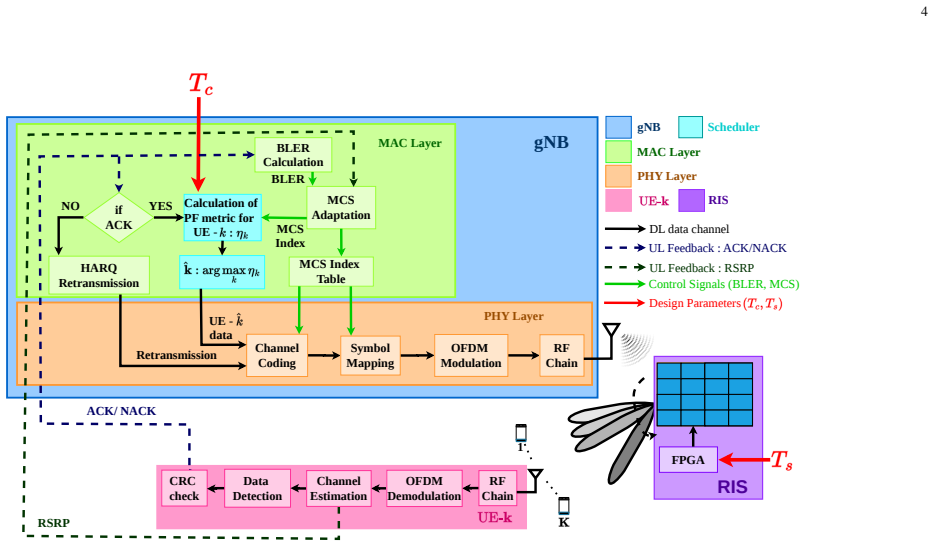
Randomly configured RIS operation with appropriately chosen system parameters can achieve performance comparable to optimized RIS designs, with no additional overhead compared to a conventional 5G NR system and requiring no coordination between the RIS and the 5G NR system. The authors develop a theoretical framework that characterizes the interaction between RIS switching dynamics and PF scheduling, then use it to give design guidelines for the RIS switching time Ts and the PF throughput averaging window Tc that maximize system throughput.
What carries the argument
Random RIS phase switching that induces artificial channel fluctuations opportunistically exploited by the proportional fair scheduler, governed by the relation between switching interval Ts and averaging window Tc.
Load-bearing premise
The proportional fair scheduler will reliably exploit the artificial channel fluctuations created by random RIS switching before they are averaged out by the throughput averaging window Tc.
What would settle it
Measure average user throughput while sweeping the ratio of RIS switching time Ts to scheduler averaging window Tc; the throughput should peak near the ratio predicted by the theoretical model if the central claim holds.
Figures


read the original abstract
In this paper, we theoretically analyze and experimentally demonstrate the performance gains achievable by integrating an in-house built reconfigurable intelligent surface (RIS) with a 5G new radio (NR) system implemented using the OpenAirInterface (OAI) software stack. Unlike conventional RIS-assisted systems that rely on explicit channel state information (CSI) estimation followed by RIS phase configuration optimization, we adopt a low-complexity approach in which the RIS phase states are randomly switched among predefined configurations. The resulting channel fluctuations are opportunistically exploited by the inherent proportional fair (PF) scheduling mechanism of 5G NR. We develop a theoretical framework that characterizes the interaction between RIS switching dynamics and PF scheduling. Based on this framework and the associated analysis, we provide design guidelines for selecting the RIS switching time $T_s$ and the PF throughput averaging window $T_c$ that maximize the system throughput. Experimental evaluations on the 5G NR testbed demonstrate improvements in key performance metrics, including reference signal received power (RSRP), block error rate (BLER), modulation and coding scheme (MCS) index, and throughput. Our key takeaway is that randomly configured RIS operation with appropriately chosen system parameters can achieve performance comparable to optimized RIS designs, with no additional overhead compared to a conventional 5G NR system. More importantly, it requires no coordination between the RIS and the 5G NR system.
Editorial analysis
A structured set of objections, weighed in public.
Referee Report
Summary. The manuscript claims that randomly switching the phase states of a reconfigurable intelligent surface (RIS) in a 5G NR system, combined with appropriate choices of switching interval Ts and proportional fair averaging window Tc, can yield performance gains comparable to optimized RIS configurations. This is achieved without CSI estimation, phase optimization, or coordination with the 5G system, as the PF scheduler opportunistically exploits the induced channel fluctuations. The authors develop a theoretical framework for the Ts-Tc interaction and validate the approach through experiments on an OpenAirInterface-based 5G NR testbed, reporting improvements in RSRP, BLER, MCS, and throughput.
Significance. If the central claims hold, this work provides a practical pathway for RIS integration into existing 5G infrastructure with minimal modifications and no additional overhead. The emphasis on randomization and opportunistic scheduling addresses key deployment barriers like complexity and coordination. The inclusion of both theoretical analysis and real-world experimental results on hardware strengthens the significance, particularly the demonstration of gains without explicit RIS-5G coordination.
major comments (2)
- Experimental Results section: The design guidelines for Ts and Tc are derived from the theoretical interaction model, yet the reported experiments use only a small number of hand-picked (Ts, Tc) pairs. No sweep of the Ts/Tc ratio is presented, nor is there a direct comparison of observed throughput curves against the closed-form predictions. This leaves the claim that the framework supplies actionable, empirically anchored guidelines only partially verified and is load-bearing for the paper's positioning of the theory as justification for near-optimal performance without coordination.
- §4 (Theoretical Framework), the derivation relating Ts and Tc: The analysis assumes the PF scheduler will reliably exploit RIS-induced fluctuations before averaging over Tc. The manuscript does not report sensitivity checks or full error-bar details on how post-hoc parameter choices affect the measured gains, consistent with the soundness assessment that full derivations and statistical details are needed to confirm independence from fitted parameters.
Simulated Author's Rebuttal
We thank the referee for the constructive feedback on our manuscript. We address each major comment below, indicating where revisions will be made to strengthen the empirical validation of the Ts-Tc guidelines and the robustness of the theoretical analysis.
read point-by-point responses
-
Referee: Experimental Results section: The design guidelines for Ts and Tc are derived from the theoretical interaction model, yet the reported experiments use only a small number of hand-picked (Ts, Tc) pairs. No sweep of the Ts/Tc ratio is presented, nor is there a direct comparison of observed throughput curves against the closed-form predictions. This leaves the claim that the framework supplies actionable, empirically anchored guidelines only partially verified and is load-bearing for the paper's positioning of the theory as justification for near-optimal performance without coordination.
Authors: We acknowledge that the current experimental section presents results for a limited but representative set of (Ts, Tc) pairs chosen to illustrate the key regimes predicted by the theory. In the revised manuscript we will expand this section with additional experimental data covering a broader sweep of the Ts/Tc ratio. We will also add a figure that overlays the measured throughput values against the closed-form theoretical predictions to provide a more direct empirical check of the design guidelines. revision: yes
-
Referee: §4 (Theoretical Framework), the derivation relating Ts and Tc: The analysis assumes the PF scheduler will reliably exploit RIS-induced fluctuations before averaging over Tc. The manuscript does not report sensitivity checks or full error-bar details on how post-hoc parameter choices affect the measured gains, consistent with the soundness assessment that full derivations and statistical details are needed to confirm independence from fitted parameters.
Authors: The derivation in §4 establishes the necessary separation between the RIS switching interval Ts and the PF averaging window Tc to allow opportunistic exploitation of the induced fluctuations. To strengthen the presentation, the revised manuscript will include sensitivity plots showing throughput variation under small perturbations of Ts and Tc around the operating points used in the experiments. We will also report error bars on all experimental metrics (throughput, RSRP, BLER, MCS) computed over multiple independent trials to quantify statistical variability and demonstrate that the observed gains are robust to the precise parameter selections. revision: yes
Circularity Check
No significant circularity; theory derives guidelines independently and experiments provide external validation.
full rationale
The paper develops a theoretical framework analyzing the interaction between random RIS phase switching (parameterized by Ts) and the proportional fair scheduler's throughput averaging window (Tc), then derives design guidelines for their ratio to maximize exploitation of induced fluctuations. These guidelines are positioned as outputs of the analysis rather than inputs. The central performance claims are anchored in independent hardware experiments on the 5G NR OpenAirInterface testbed, which report measured improvements in RSRP, BLER, MCS index, and throughput for chosen (Ts, Tc) pairs. No equations or steps reduce a claimed prediction to a fitted parameter or self-citation by construction; the experimental results serve as external benchmarks outside the model's fitted values. This is the most common honest outcome for a theory-plus-hardware paper.
Axiom & Free-Parameter Ledger
free parameters (2)
- RIS switching interval Ts
- PF averaging window Tc
axioms (2)
- domain assumption The wireless channel remains constant over the RIS switching interval Ts but varies across intervals.
- standard math Proportional fair scheduling selects the user with the highest instantaneous-to-average rate ratio.
Lean theorems connected to this paper
-
IndisputableMonolith/Foundation/ArithmeticFromLogic.leanreality_from_one_distinction unclear?
unclearRelation between the paper passage and the cited Recognition theorem.
We develop a theoretical framework that characterizes the interaction between RIS switching dynamics and PF scheduling... design guidelines for selecting the RIS switching time Ts and the PF throughput averaging window Tc
-
IndisputableMonolith/Cost/FunctionalEquation.leanwashburn_uniqueness_aczel unclear?
unclearRelation between the paper passage and the cited Recognition theorem.
randomly configured RIS operation with appropriately chosen system parameters can achieve performance comparable to optimized RIS designs, with no additional overhead
What do these tags mean?
- matches
- The paper's claim is directly supported by a theorem in the formal canon.
- supports
- The theorem supports part of the paper's argument, but the paper may add assumptions or extra steps.
- extends
- The paper goes beyond the formal theorem; the theorem is a base layer rather than the whole result.
- uses
- The paper appears to rely on the theorem as machinery.
- contradicts
- The paper's claim conflicts with a theorem or certificate in the canon.
- unclear
- Pith found a possible connection, but the passage is too broad, indirect, or ambiguous to say the theorem truly supports the claim.
Reference graph
Works this paper leans on
-
[1]
Practical RIS gain without the pain: Randomization and opportunistic scheduling in 5G NR,
L. Yashvanthet al., “Practical RIS gain without the pain: Randomization and opportunistic scheduling in 5G NR,” inProc. IEEE Int. Conf. on Commun., Accepted, 2026. [Online]. Available: arXiv:2602.12437
-
[2]
Wireless communications through reconfigurable intel- ligent surfaces,
E. Basaret al., “Wireless communications through reconfigurable intel- ligent surfaces,”IEEE Access, vol. 7, pp. 116 753–116 773, 2019
work page 2019
-
[3]
M. Di Renzo,et al., “Smart radio environments empowered by recon- figurable AI meta-surfaces: An idea whose time has come,”EURASIP J. Wireless Commun. Netw ., vol. 2019, no. 1, pp. 1–20, 2019
work page 2019
-
[4]
Reconfigurable intelligent surfaces: A signal processing perspective with wireless applications,
E. Bj ¨ornsonet al., “Reconfigurable intelligent surfaces: A signal processing perspective with wireless applications,”arXiv preprint arXiv:2102.00742, 2021
-
[5]
Q. Wu and R. Zhang, “Intelligent reflecting surface enhanced wireless network: Joint active and passive beamforming design,” inProc. IEEE Global Commun. Conf., 2018, pp. 1–6
work page 2018
-
[6]
D. Mishra and H. Johansson, “Channel estimation and low-complexity beamforming design for passive intelligent surface assisted MISO wire- less energy transfer,” inProc. IEEE Int. Conf. Acoust. Speech Signal Process., 2019, pp. 4659–4663
work page 2019
-
[7]
Q.-U.-A. Nadeemet al., “Intelligent reflecting surface-assisted multi- user MISO communication: Channel estimation and beamforming de- sign,”IEEE Open J. Commun. Soc., vol. 1, pp. 661–680, 2020
work page 2020
-
[8]
IRS-assisted multicell multiband systems: Practical reflection model and joint beamforming design,
W. Caiet al., “IRS-assisted multicell multiband systems: Practical reflection model and joint beamforming design,”IEEE Trans. Commun., vol. 70, no. 6, pp. 3897–3911, Jun. 2022
work page 2022
-
[9]
Towards smart and reconfigurable environment: Intelligent reflecting surface aided wireless network,
Q. Wu and R. Zhang, “Towards smart and reconfigurable environment: Intelligent reflecting surface aided wireless network,”IEEE Commun. Mag., vol. 58, no. 1, pp. 106–112, 2020
work page 2020
-
[10]
Opportunistic beamforming using dumb antennas,
P. Viswanathet al., “Opportunistic beamforming using dumb antennas,” IEEE Trans. Inf. Theory, vol. 48, no. 6, pp. 1277–1294, 2002
work page 2002
-
[11]
Opportunistic beam- forming using an intelligent reflecting surface without instantaneous CSI,
Q.-U.-A. Nadeem, A. Chaaban, and M. Debbah, “Opportunistic beam- forming using an intelligent reflecting surface without instantaneous CSI,”IEEE Wireless Commun. Lett., vol. 10, no. 1, pp. 146–150, 2021
work page 2021
-
[12]
Performance analysis of intelligent reflecting surface assisted opportunistic communications,
L. Yashvanth and C. R. Murthy, “Performance analysis of intelligent reflecting surface assisted opportunistic communications,”IEEE Trans. Signal Process., vol. 71, pp. 2056–2070, 2023
work page 2056
-
[13]
Exploiting beam-split effect in IRS-aided systems via oppor- tunistic OFDMA: Design and analysis,
——, “Exploiting beam-split effect in IRS-aided systems via oppor- tunistic OFDMA: Design and analysis,”IEEE Trans. Signal Process., pp. 1–17, 2026
work page 2026
-
[14]
W. Tanget al., “MIMO transmission through reconfigurable intelligent surface: System design, analysis, and implementation,”IEEE J. Sel. Areas Commun., vol. 38, no. 11, pp. 2683–2699, Nov. 2020
work page 2020
-
[15]
L. Daiet al., “Reconfigurable intelligent surface-based wireless commu- nications: Antenna design, prototyping, and experimental results,”IEEE Access, vol. 8, pp. 45 913–45 923, 2020
work page 2020
-
[16]
L. Caoet al., “RIS with insufficient phase shifting capability: Modeling, beamforming, and experimental validations,”IEEE Trans. Commun., vol. 72, no. 9, pp. 5911–5923, Sep. 2024
work page 2024
-
[17]
Y . Renet al., “On deployment position of RIS in wireless commu- nication systems: Analysis and experimental results,”IEEE Wireless Commun. Lett., vol. 12, no. 10, pp. 1756–1760, Oct. 2023
work page 2023
-
[18]
X. Peiet al., “RIS-aided wireless communications: Prototyping, adaptive beamforming, and indoor/outdoor field trials,”IEEE Trans. Commun., vol. 69, no. 12, pp. 8627–8640, Dec. 2021
work page 2021
-
[19]
W. Tanget al., “Wireless communications with reconfigurable intelligent surface: Path loss modeling and experimental measurement,”IEEE Trans. Wireless Commun., vol. 20, no. 1, pp. 421–439, Jan. 2021
work page 2021
-
[20]
Experimental evaluation of multi-operator RIS-assisted links in indoor environment,
M. Lodroet al., “Experimental evaluation of multi-operator RIS-assisted links in indoor environment,”arXiv preprint arXiv:2206.07788, 2022
-
[21]
S. Kayraklıket al., “Indoor coverage enhancement for RIS-assisted communication systems: Practical measurements and efficient grouping,” inProc. IEEE Int. Conf. Commun. (ICC), May 2023, pp. 485–490
work page 2023
-
[22]
Active RIS vs. passive RIS: Which will prevail in 6G?
Z. Zhanget al., “Active RIS vs. passive RIS: Which will prevail in 6G?” IEEE Trans. Commun., vol. 71, no. 3, pp. 1707–1725, Mar. 2023
work page 2023
-
[23]
M. Arun Muthu Ramet al., “Dual-polarized, angularly stable, self-biased and single layered substrate based 4-bit ris aided communication system for wireless sensor networks,”IEEE Internet Things J., pp. 1–1, 2025
work page 2025
-
[24]
Virtualized 5G testbed using openairinterface: Tutorial and benchmarking tests,
D ´oriaet al., “Virtualized 5G testbed using openairinterface: Tutorial and benchmarking tests,”Journal of Internet Services and Applications, vol. 15, no. 1, p. 523–535, Oct. 2024
work page 2024
-
[25]
An open source 5G experimentation testbed,
P. Matzakoset al., “An open source 5G experimentation testbed,” in IEEE International Mediterranean Conference on Communications and Networking, MeditCom 2021, Greece, Sep. 2021. IEEE, 2021, pp. 1–2
work page 2021
-
[26]
RIS meets O-RAN: A practical demonstration of multi-user RIS optimization through RIC,
A. F. Sahinet al., “RIS meets O-RAN: A practical demonstration of multi-user RIS optimization through RIC,”arXiv:2501.18917, 2025
-
[27]
A digitally coded intelligent reflecting surface for 6G wireless communication,
R. Malleboina and D. Sarkar, “A digitally coded intelligent reflecting surface for 6G wireless communication,” in2025 19th European Con- ference on Antennas and Propagation (EuCAP), 2025, pp. 1–5
work page 2025
-
[28]
Design of anomalous reflectors by phase gradient unit cell-based digitally coded metasurface,
R. Malleboinaet al., “Design of anomalous reflectors by phase gradient unit cell-based digitally coded metasurface,”IEEE Antennas Wireless Propag. Lett., vol. 22, no. 9, pp. 2305–2309, Sep. 2023
work page 2023
-
[29]
OpenAirInterface: A flexible platform for 5G re- search,
N. Nikaeinet al., “OpenAirInterface: A flexible platform for 5G re- search,”SIGCOMM Comput. Commun. Rev., vol. 44, no. 5, p. 33–38, Oct. 2014
work page 2014
-
[30]
3GPP TS 38.214, 5G NR: Physical layer procedures for data, v 15.2.0 rel 15
“3GPP TS 38.214, 5G NR: Physical layer procedures for data, v 15.2.0 rel 15.”
-
[31]
New radio physical layer abstraction for system-level simulations of 5G networks,
S. Lagenet al., “New radio physical layer abstraction for system-level simulations of 5G networks,” inProc. IEEE Int. Conf. Commun. (ICC), Jun. 2020, pp. 1–7
work page 2020
-
[32]
Spatial correlation-aware opportunistic beamforming in IRS-aided multi-user systems,
L. Yashvanth, C. R. Murthy, and B. D. Rao, “Spatial correlation-aware opportunistic beamforming in IRS-aided multi-user systems,”IEEE Wireless Commun. Lett., vol. 14, no. 10, pp. 3174–3178, Oct. 2025
work page 2025
-
[33]
Comparative study of IRS assisted opportunistic communications over i.i.d. and LoS channels,
L. Yashvanth and C. R. Murthy, “Comparative study of IRS assisted opportunistic communications over i.i.d. and LoS channels,” inProc. IEEE Int. Conf. Acoust. Speech Signal Process., Jun. 2023, pp. 1–5
work page 2023
-
[34]
3GPP Rep. TR 38.901 V16.1.0: Study on channel model for frequencies from 0.5 to 100 GHz,
“3GPP Rep. TR 38.901 V16.1.0: Study on channel model for frequencies from 0.5 to 100 GHz,”3GPP , Sophia Antipolis, France, Dec. 2019
work page 2019
-
[35]
Charging and rate control for elastic traffic,
F. Kelly, “Charging and rate control for elastic traffic,”European Transactions on Telecommunications, vol. 8, 02 1997
work page 1997
-
[36]
Asymptotic analysis of proportional fair algorithm,
J. Holtzman, “Asymptotic analysis of proportional fair algorithm,” in 12th IEEE International Symposium on Personal, Indoor and Mobile Radio Communications. PIMRC 2001., vol. 2, 2001
work page 2001
-
[37]
Hard fairness versus proportional fairness in wireless communications: The single-cell case,
Caireet al., “Hard fairness versus proportional fairness in wireless communications: The single-cell case,”IEEE Trans. Inf. Theory, vol. 53, no. 4, pp. 1366–1385, 2007
work page 2007
-
[38]
Probability inequalities for sums of bounded random variables,
W. Hoeffding, “Probability inequalities for sums of bounded random variables,”J. Amer. Statist. Assoc., vol. 58, no. 301, pp. 13–30, 1963
work page 1963
discussion (0)
Sign in with ORCID, Apple, or X to comment. Anyone can read and Pith papers without signing in.