Ground-state Entropy of the Ising model on a Frustrated lattice
Pith reviewed 2026-05-20 02:11 UTC · model grok-4.3
The pith
The 2D Ising model on the Shastry-Sutherland lattice has a non-zero ground-state entropy due to frustration.
A machine-rendered reading of the paper's core claim, the machinery that carries it, and where it could break.
Core claim
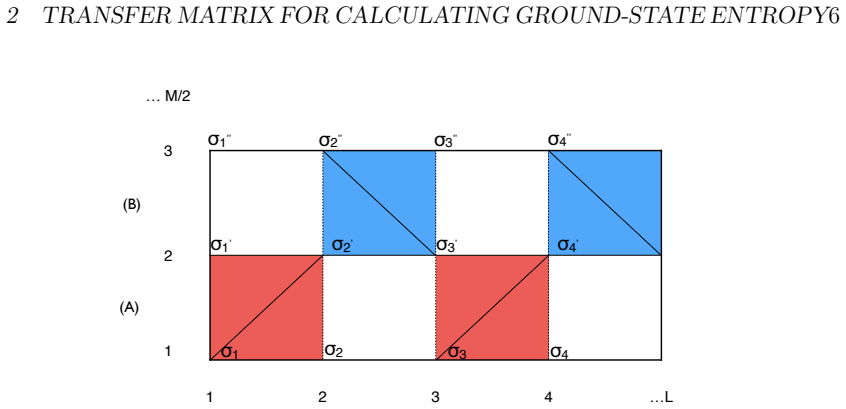
We report the ground-state entropy of a 2-d Ising model on the Shastry-Sutherland lattice. We also study a generalization of this model, where a constraint on the zero temperature allowed configurations is removed continuously.
What carries the argument
The Shastry-Sutherland lattice with Ising spins subject to a specific pattern of frustrated interactions, whose degenerate ground-state manifold is counted via enumeration or transfer-matrix methods.
If this is right
- The ground states remain degenerate even at absolute zero, producing a finite residual entropy per spin.
- Relaxing the constraint continuously produces a family of models whose entropy varies smoothly with the relaxation parameter.
- The degeneracy is a direct geometric consequence of the lattice and interaction pattern rather than an artifact of finite size.
- Similar counting methods apply to other lattices that share the same local frustration motif.
Where Pith is reading between the lines
- If the entropy is extensive, the number of ground states grows exponentially with system size, a signature of strong frustration.
- Adding weak quantum fluctuations would likely lift the degeneracy and select a unique ground state or produce a quantum spin liquid.
- The continuous generalization offers a tunable knob that could be realized in artificial spin-ice arrays or optical-lattice simulators.
- Comparison with series expansions or tensor-network methods on the same lattice would provide an independent check on the entropy value.
Load-bearing premise
The Shastry-Sutherland lattice geometry and the Ising interaction pattern are taken as given, and the ground-state manifold is assumed to be correctly identified by the enumeration or transfer-matrix method used in the calculation.
What would settle it
An exact count of ground states on a larger finite patch of the lattice, or a Monte Carlo sampling at extremely low temperature, that yields an entropy per site different from the reported value would falsify the result.
Figures




read the original abstract
We report the ground-state entropy of a 2-d Ising model on the Shastry-Sutherland lattice. We also study a generalization of this model, where a constraint on the zero temperature allowed configurations is removed continuously.
Editorial analysis
A structured set of objections, weighed in public.
Referee Report
Summary. The manuscript reports the ground-state entropy of the 2D Ising model on the Shastry-Sutherland lattice, obtained as (1/N) log W where W is the number of minimizing configurations in the ground-state manifold. It also examines a continuous generalization in which a constraint on the zero-temperature allowed configurations is removed.
Significance. If the reported entropy value is accurate and the manifold is correctly enumerated, the result supplies a concrete benchmark for residual entropy in a frustrated 2D Ising system on the Shastry-Sutherland lattice, which is realized in materials such as SrCu2(BO3)2. The continuous generalization provides a controlled way to study the lifting of degeneracy and the evolution of the entropy, which could connect to broader questions of constrained systems and their thermodynamics.
major comments (2)
- [Enumeration / transfer-matrix section] The identification of the ground-state manifold (central to the entropy claim) rests on an enumeration or transfer-matrix procedure whose completeness is not cross-checked by independent brute-force enumeration on small clusters. Any systematic under- or over-counting of W propagates directly into the reported residual entropy per site.
- [Results] No error analysis, finite-size scaling, or convergence checks for the entropy value are supplied, which is required to substantiate the numerical result given that the central claim is the specific value of (1/N) log W.
minor comments (1)
- [Abstract] The abstract states the result without indicating the numerical value, method, or any supporting detail, which is atypical and reduces immediate accessibility.
Simulated Author's Rebuttal
We thank the referee for the careful reading of our manuscript and the constructive comments. We address the two major comments point by point below and describe the changes we will implement.
read point-by-point responses
-
Referee: [Enumeration / transfer-matrix section] The identification of the ground-state manifold (central to the entropy claim) rests on an enumeration or transfer-matrix procedure whose completeness is not cross-checked by independent brute-force enumeration on small clusters. Any systematic under- or over-counting of W propagates directly into the reported residual entropy per site.
Authors: We agree that an independent cross-check on small clusters would increase confidence in the completeness of the ground-state manifold. In the revised manuscript we will add a dedicated subsection presenting brute-force enumeration results for small finite clusters (compatible with periodic boundary conditions on the Shastry-Sutherland lattice) and direct comparison of the counted W with the transfer-matrix output for the same sizes. This verification will be shown explicitly for several small system sizes. revision: yes
-
Referee: [Results] No error analysis, finite-size scaling, or convergence checks for the entropy value are supplied, which is required to substantiate the numerical result given that the central claim is the specific value of (1/N) log W.
Authors: We acknowledge the absence of these analyses in the original submission. The revised manuscript will include a new figure and accompanying text that reports the entropy per site for a sequence of increasing system sizes, together with a finite-size scaling extrapolation to the thermodynamic limit and a discussion of numerical uncertainties arising from the enumeration procedure. revision: yes
Circularity Check
No circularity detected; derivation is a direct count of minimizing configurations
full rationale
The paper reports the ground-state entropy via enumeration or transfer-matrix counting of configurations that minimize all local bond energies on the given Shastry-Sutherland lattice geometry with the stated antiferromagnetic couplings. The abstract and description contain no equations, no fitted parameters renamed as predictions, and no self-citation chains that bear the central claim. The residual entropy is obtained directly as (1/N) log W where W is the counted degeneracy; this is independent of the inputs once the lattice and Hamiltonian are fixed. The method is a standard, externally verifiable computational procedure for frustrated Ising models and does not reduce to its own assumptions by construction.
Axiom & Free-Parameter Ledger
Lean theorems connected to this paper
-
IndisputableMonolith/Cost/FunctionalEquation.leanwashburn_uniqueness_aczel unclear?
unclearRelation between the paper passage and the cited Recognition theorem.
We report the ground-state entropy of a 2-d Ising model on the Shastry-Sutherland lattice... transfer matrix T_L ... CTMRG results at α=1 Σ=0.45877772
-
IndisputableMonolith/Foundation/RealityFromDistinction.leanreality_from_one_distinction unclear?
unclearRelation between the paper passage and the cited Recognition theorem.
At r=0 ... Σ=½ log 2 ... superstability of the transfer-matrix
What do these tags mean?
- matches
- The paper's claim is directly supported by a theorem in the formal canon.
- supports
- The theorem supports part of the paper's argument, but the paper may add assumptions or extra steps.
- extends
- The paper goes beyond the formal theorem; the theorem is a base layer rather than the whole result.
- uses
- The paper appears to rely on the theorem as machinery.
- contradicts
- The paper's claim conflicts with a theorem or certificate in the canon.
- unclear
- Pith found a possible connection, but the passage is too broad, indirect, or ambiguous to say the theorem truly supports the claim.
Reference graph
Works this paper leans on
-
[1]
B. S. Shastry and B. Sutherland, Exact Ground State of a Quantum- Mechanical Antiferromagnet, Physica108B, 1069 (1981)
work page 1981
-
[2]
M. Albrecht and F. Mila, First-order transition between magnetic order and valence bond order in a 2D frustrated Heisenberg model, Europhys. Lett. 34 , 145 (1996)
work page 1996
-
[3]
R. W. Smith and D. A. Keszler, Synthesis, structure, and properties of the orthoborateSrCu 2(BO3)2, J. Solid State Chem.93, 430 (1991)
work page 1991
-
[4]
H. Kageyama, K. Yoshimura, N. V. Mushnikov, K. Onizuka, M. Kato, K. Kosuge, C. P. Slichter, T. Goto, and Y. Ueda, Exact Dimer Ground State and Quantized Magnetization Plateaus in the Two-Dimensional Spin SystemSrCu 2(BO3)2, Phys. Rev. Letts.82, 3168 (1999)
work page 1999
-
[5]
S. Miyahara and K. Ueda, Exact Dimer Ground State of the Two Di- mensional Heisenberg Spin SystemSrCu 2(BO3)2 , Phys. Rev. Letts. 82, 3701 (1999)
work page 1999
-
[6]
A. Koga and N. Kawakami,Quantum Phase Transitions in the Shastry- Sutherland Model forSrCu 2(BO3)2 , Phys. Rev. Lett. 84, 4461, (2000)
work page 2000
- [7]
-
[8]
J. Streˇ cka, Exact solution of the spin-1/2 Ising model on the Shastry- Sutherland (orthogonal-dimer) lattice, Phys. Letts.349, 505 (2006)
work page 2006
-
[9]
I. Rousochatzakis, A. M. L´ auchli, and R. Moessner, Quantum mag- netism on the Cairo pentagonal lattice, Phys. Rev. B85, 104415 (2012)
work page 2012
-
[10]
Johannes Kepler,Harmonice Mundi, Linz (Austria): Johann Planck, (1619)
-
[11]
Branko Gr¨ unbaum and G. C. Shephard,Tilings and Patterns, Dover Publications, 2016. (ISBN-13978-0486469812)
work page 2016
-
[12]
M. Barma and B. S. Shastry, Classical equivalents of one-dimensional quantum-mechanical systems, Phys. Rev. B18, 3351 (1978), see Fig. 1
work page 1978
-
[13]
Baxter, R. J., Corner transfer matrices. Physica A Statistical Mechanics and its Applications 106, 18–27 (1981)
work page 1981
-
[14]
and Okunishi, K., Corner Transfer Matrix Renormalization Group Method
Nishino, T. and Okunishi, K., Corner Transfer Matrix Renormalization Group Method. J. Phys. Soc. Jpn. 65, 891–894 (1996)
work page 1996
-
[15]
Vanhecke, B., Colbois, J., Vanderstraeten, L., Verstraete, F. and Mila, F. Solving frustrated Ising models using tensor networks. Phys. Rev. Research 3, 013041 (2021)
work page 2021
-
[16]
In a finite T study of the Ising model, the factorrin the weight factor Wcan be (somewhat artificially) generated by adding energy−logr×T for configurations with parallel spins on a diagonal
-
[17]
A line connecting two tensors stands for a contracted index
In the Tensor Network diagrammatic notation, tensors are represented as squares or circles, while their indices are represented as lines. A line connecting two tensors stands for a contracted index
-
[18]
John G. Wright and B. S. Shastry, ”DiracQ: A Quantum Many- Body Physics Package”, arXiv:1301.4494[cond-mat.str-el] (2013), Journal of Open Research Software, 3(1) e13 (2015); DOI: https://doi.org/10.5334/jors.cb. REFERENCES18
-
[19]
B. Sutherland and B. S. Shastry, ‘Exact Solution of a Large Class of Quantum Systems Exhibiting Ground State Singularities, J. Stat. Phys. 33, 477 (1983)
work page 1983
discussion (0)
Sign in with ORCID, Apple, or X to comment. Anyone can read and Pith papers without signing in.