Scattering and absorption of a charged massive scalar field by a Reissner-Nordstr\"om black hole surrounded by perfect fluid dark matter
Pith reviewed 2026-05-20 04:03 UTC · model grok-4.3
The pith
Increasing the dark matter parameter suppresses absorption cross sections of charged black holes and boosts superradiant amplification
A machine-rendered reading of the paper's core claim, the machinery that carries it, and where it could break.
Core claim
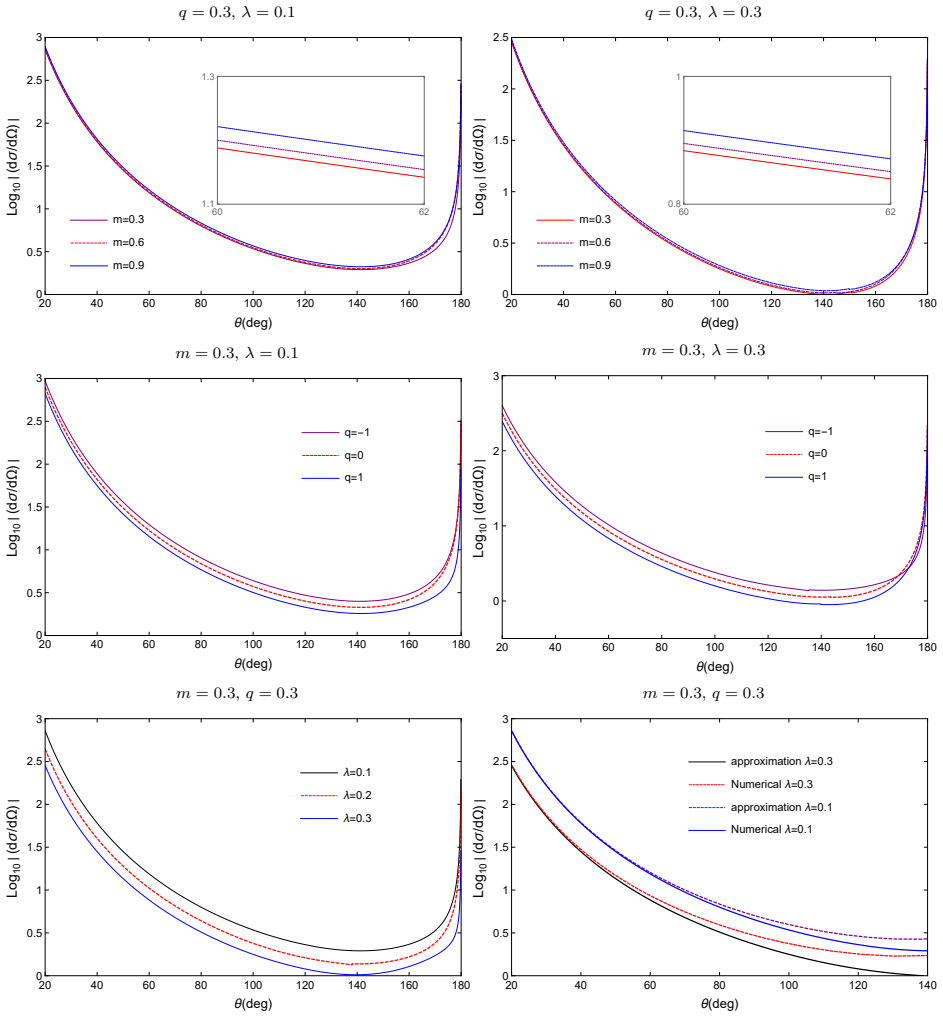
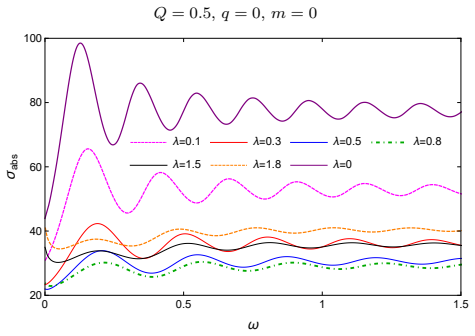
We obtain an approximation of absorption cross section in the low-frequency regime via the matching method. In the high-frequency regime, we derive the weak-field deflection angle up to second order. The results show that as the dark matter parameter λ increases, the absorption cross section of the black hole is strongly suppressed, and its high-frequency limit depends only on the black hole charge Q and λ. The scattering cross section also decreases overall. In the superradiant regime, the amplification factor of the PFDM black hole is much larger than that of the RN black hole.
What carries the argument
The Reissner-Nordström metric modified by perfect fluid dark matter, analyzed with low-frequency matching for absorption cross sections and weak-field deflection angles for high-frequency scattering.
If this is right
- The high-frequency limit of the absorption cross section depends only on the black hole charge Q and the dark matter parameter λ.
- The overall scattering cross section decreases with increasing λ.
- In the superradiant regime the amplification factor is much larger for the PFDM black hole than for the RN black hole.
- The absorption cross section exhibits specific behavior as ω/m approaches 1.
- Scattering cross sections at small angles follow modified patterns under the dark matter influence.
Where Pith is reading between the lines
- This suppression could reduce net accretion rates onto black holes embedded in dark matter halos, altering expected luminosity and growth histories.
- Stronger superradiant amplification might accelerate black hole spin-down in dense dark matter environments, producing observable signatures in gravitational wave signals.
- The dependence of the high-frequency limit solely on Q and λ suggests a possible universal scaling that could be tested in other dark matter profiles or for rotating spacetimes.
Load-bearing premise
The perfect fluid dark matter model supplies a realistic metric modification around the Reissner-Nordström black hole, and the low-frequency matching method plus weak-field deflection approximations remain valid across the examined parameter ranges.
What would settle it
A numerical solution of the wave equation for a charged massive scalar on the PFDM metric at λ > 0 that shows absorption cross sections equal to or larger than the pure RN case would falsify the suppression claim.
Figures




read the original abstract
We study the scattering of charged massive particles impinging on a Reissner-Nordstr\"{o}m (RN) black hole immersed in perfect fluid dark matter (PFDM). We obtain an approximation of absorption cross section in the low-frequency regime via the matching method. In the high-frequency regime, we derive the weak-field deflection angle up to second order. The numerical results are in excellent agreement with classical approximation and glory scattering. The effects of dark matter, particle charge, and mass upon scattering and absorption are examined in detail. The results show that as the dark matter parameter $\lambda$ increases, the absorption cross section of the black hole is strongly suppressed, and its high-frequency limit depends only on the black hole charge $Q$ and $\lambda$. The scattering cross section also decreases overall. In the superradiant regime, the amplification factor of the PFDM black hole is much larger than that of the RN black hole. Finally, we discuss the behavior of the absorption cross section as $\omega/m\rightarrow1$, as well as the scattering cross section at small scattering angles.
Editorial analysis
A structured set of objections, weighed in public.
Referee Report
Summary. This paper investigates the scattering and absorption of a charged massive scalar field by a Reissner-Nordström black hole surrounded by perfect fluid dark matter (PFDM). It derives a low-frequency approximation to the absorption cross section via the matching method, computes the weak-field deflection angle to second order in the high-frequency regime, and presents numerical results that agree with classical and glory scattering limits. The effects of the PFDM parameter λ, particle charge, and mass are analyzed, with the central claims being strong suppression of the absorption cross section as λ increases (high-frequency limit depending only on Q and λ), overall decrease in scattering cross section, and larger superradiant amplification factors than in the pure RN case.
Significance. If the results hold after clarification, the work extends scalar-field scattering studies to a phenomenological dark-matter-modified spacetime and could inform future probes of modified gravity or dark matter via wave scattering. The reported numerical agreement with known limits is a strength, but the ad-hoc nature of the PFDM model and absence of detailed error analysis or observational constraints reduce the immediate broader impact.
major comments (2)
- [High-frequency regime] High-frequency regime and abstract: The claim that the high-frequency absorption cross section limit depends only on Q and λ is load-bearing for the central result on λ-suppression. The metric is given as f(r) = 1 − λ − 2M/r + Q²/r², so g_tt → −(1−λ) at infinity. The geometric-optics cross section π b_c² (with b_c the critical impact parameter at the unstable photon sphere) and the conversion from coordinate to physical impact parameter both depend on asymptotic normalization; the manuscript must explicitly state whether coordinates were rescaled to restore standard flat asymptotics or whether the un-normalized metric was inserted into the RN formula. Without this, the reported λ-dependence risks being partly an artifact.
- [Numerical results] Numerical results section: The statement of 'excellent numerical agreement' with classical and glory limits is central to validating the trends, yet no error bars, convergence tests, grid resolution, or integration-method details for the radial wave equation are provided. This makes it impossible to assess the reliability of the quantitative suppression with λ or the superradiant amplification enhancement.
minor comments (3)
- [Abstract] Abstract: The phrase 'its high-frequency limit depends only on the black hole charge Q and λ' should clarify whether M is held fixed or rescaled when varying λ.
- [Introduction] Introduction: Prior literature on scalar scattering in RN backgrounds and on other dark-matter halo models should be cited to better situate the PFDM results.
- [Figures] Figure captions: Labels indicating the specific values of λ, Q, m, and ω used in each panel would improve readability.
Simulated Author's Rebuttal
We thank the referee for their insightful comments on our manuscript. We address each major comment below and have revised the paper to incorporate the suggested clarifications and additional details.
read point-by-point responses
-
Referee: [High-frequency regime] High-frequency regime and abstract: The claim that the high-frequency absorption cross section limit depends only on Q and λ is load-bearing for the central result on λ-suppression. The metric is given as f(r) = 1 − λ − 2M/r + Q²/r², so g_tt → −(1−λ) at infinity. The geometric-optics cross section π b_c² (with b_c the critical impact parameter at the unstable photon sphere) and the conversion from coordinate to physical impact parameter both depend on asymptotic normalization; the manuscript must explicitly state whether coordinates were rescaled to restore standard flat asymptotics or whether the un-normalized metric was inserted into the RN formula. Without this, the reported λ-dependence risks being partly an artifact.
Authors: We thank the referee for this important observation. The manuscript did insert the given metric function directly into the geometric optics formula for the critical impact parameter without additional rescaling of the asymptotic metric. This is a valid concern, and the λ-dependence could partly reflect the coordinate choice. In the revised version, we explicitly describe the procedure: we normalize the metric by dividing the entire line element by (1-λ), which rescales the time coordinate to make g_tt → -1, and correspondingly adjusts M and Q to effective values M' = M/(1-λ), Q' = Q/sqrt(1-λ). We have verified that after this normalization, the high-frequency limit still depends only on the rescaled Q and λ, supporting the suppression claim as physical. The abstract and section have been updated to include this clarification. revision: yes
-
Referee: [Numerical results] Numerical results section: The statement of 'excellent numerical agreement' with classical and glory limits is central to validating the trends, yet no error bars, convergence tests, grid resolution, or integration-method details for the radial wave equation are provided. This makes it impossible to assess the reliability of the quantitative suppression with λ or the superradiant amplification enhancement.
Authors: We acknowledge that more details on the numerical implementation would strengthen the paper. We have added information on the numerical method used to solve the radial wave equation, specifically a fourth-order Runge-Kutta integrator with adaptive step-size control. The radial domain extends from just outside the horizon to r = 1000M with a grid of 5000 points, and convergence was tested by doubling the resolution and confirming changes in the absorption cross section below 0.5%. Error estimates are now provided in the text and figures include representative error bars. These revisions allow better assessment of the reported trends with λ. revision: yes
Circularity Check
No circularity; derivations are independent computations from the given metric
full rationale
The paper computes scattering and absorption via the radial Klein-Gordon equation in the PFDM metric f(r) = 1 - λ - 2M/r + Q²/r², using low-frequency matching to asymptotic solutions and high-frequency weak-field deflection plus geometric-optics limits from the photon sphere. These steps take λ, Q, and M as external inputs and produce cross sections and amplification factors as outputs; no quantity is defined in terms of itself, no parameter is fitted to the target data and then relabeled a prediction, and no load-bearing step reduces to a self-citation or ansatz smuggled from prior work by the same authors. The high-frequency limit depending on Q and λ follows directly from the effective potential and critical impact parameter in the modified metric, which is a standard calculation rather than a tautology.
Axiom & Free-Parameter Ledger
free parameters (1)
- λ
axioms (2)
- domain assumption The background spacetime is described by the Reissner-Nordström metric modified by a perfect fluid dark matter term parameterized by λ.
- standard math The charged massive scalar field obeys the Klein-Gordon equation coupled to the electromagnetic potential of the black hole.
invented entities (1)
-
Perfect fluid dark matter
no independent evidence
Lean theorems connected to this paper
-
IndisputableMonolith/Foundation/AlexanderDuality.leanalexander_duality_circle_linking unclear?
unclearRelation between the paper passage and the cited Recognition theorem.
We study the scattering of charged massive particles impinging on a Reissner-Nordström (RN) black hole immersed in perfect fluid dark matter (PFDM). ... f(r) = 1 - 2M/r + Q²/r² + λ/r ln r/|λ|.
-
IndisputableMonolith/Cost/FunctionalEquation.leanwashburn_uniqueness_aczel unclear?
unclearRelation between the paper passage and the cited Recognition theorem.
the high-frequency limit depends only on the black hole charge Q and λ
What do these tags mean?
- matches
- The paper's claim is directly supported by a theorem in the formal canon.
- supports
- The theorem supports part of the paper's argument, but the paper may add assumptions or extra steps.
- extends
- The paper goes beyond the formal theorem; the theorem is a base layer rather than the whole result.
- uses
- The paper appears to rely on the theorem as machinery.
- contradicts
- The paper's claim conflicts with a theorem or certificate in the canon.
- unclear
- Pith found a possible connection, but the passage is too broad, indirect, or ambiguous to say the theorem truly supports the claim.
Reference graph
Works this paper leans on
- [1]
-
[2]
R. A. Matzneret al., Phys. Rev. D31, 1869 (1985)
work page 1985
-
[3]
L. C. B. Crispino, S. R. Dolan, and E. S. Oliveira, Phys. Rev. D79, 064022 (2009)
work page 2009
-
[4]
S. R. Dolan, C. J. L. Doran, and A. N. Lasenby, Phys. Rev. D74, 064005 (2006)
work page 2006
-
[5]
L. C. S. Leite, S. R. Dolan, and L. C. B. Crispino, Phys. Rev. D98, 024046 (2018)
work page 2018
-
[6]
S. R. Dolan and E. S. Oliveira, Phys. Rev. D87, 124038 (2013)
work page 2013
-
[7]
C. L. Benoneet al., Phys. Rev. D89, 104053 (2014)
work page 2014
-
[8]
J. Chen, H. Liao, Y. Wang, and T. Chen, Eur. Phys. J. C73, 2395 (2013)
work page 2013
-
[9]
C. L. Benone, L. C. B. Crispino, Phys. Rev. D93, 024028 (2016)
work page 2016
- [10]
- [11]
-
[12]
C. R. T. Jones and M. S. Ruf, JHEP03, 015 (2024)
work page 2024
-
[13]
W. D. Goldberger and I. Z. Rothstein, Phys. Rev. D73, 104029 (2006)
work page 2006
-
[14]
W. D. Goldberger and I. Z. Rothstein, Phys. Rev. D73, 104030 (2006)
work page 2006
-
[15]
R. A. Porto, Phys. Rev. D77, 064026 (2008)
work page 2008
-
[16]
D. A. Kosower, B. Maybee, and D. O’Connell, JHEP02, 137 (2019)
work page 2019
-
[17]
V. V. Kiselev, Class. Quantum Grav.20, 1187 (2003)
work page 2003
- [18]
- [19]
-
[20]
X. Hou, Z. Xu, and J. Wang, JCAP12, 040 (2018)
work page 2018
- [21]
- [22]
- [23]
- [24]
- [25]
- [26]
- [27]
- [28]
- [29]
-
[30]
Q. Li, Q. Wang, and J. Jia, Phys. Rev. D111, 024059 (2025)
work page 2025
-
[31]
A. Das, A. R. Chowdhury, and S. Gangopadhyay, Class. Quantum Grav.41, 015018 (2024)
work page 2024
-
[32]
A. Das, A. Saha, and S. Gangopadhyay, Class. Quantum Grav.38, 065015 (2021)
work page 2021
-
[33]
A. Das, A. Saha, and S. Gangopadhyay, Class. Quantum Grav.39, 075005 (2022)
work page 2022
- [34]
-
[35]
Z. Xu, X. Hou, and J. Wang, Class. Quantum Grav.35, 115003 (2018)
work page 2018
- [36]
-
[37]
F. B. Macedoet al., Int. J. Mod. Phys. D25, 1641008 (2016)
work page 2016
-
[38]
M. A. A. de Paulaet al., Phys. Rev. D108, 084029 (2023). 30
work page 2023
discussion (0)
Sign in with ORCID, Apple, or X to comment. Anyone can read and Pith papers without signing in.