ADOPT: Analytical Demodulation of Periodic Textures for In-Plane Wave Tracking
Pith reviewed 2026-05-20 03:57 UTC · model grok-4.3
The pith
ADOPT demodulates periodic textures with an oriented analytic signal to track in-plane wave displacements.
A machine-rendered reading of the paper's core claim, the machinery that carries it, and where it could break.
Core claim
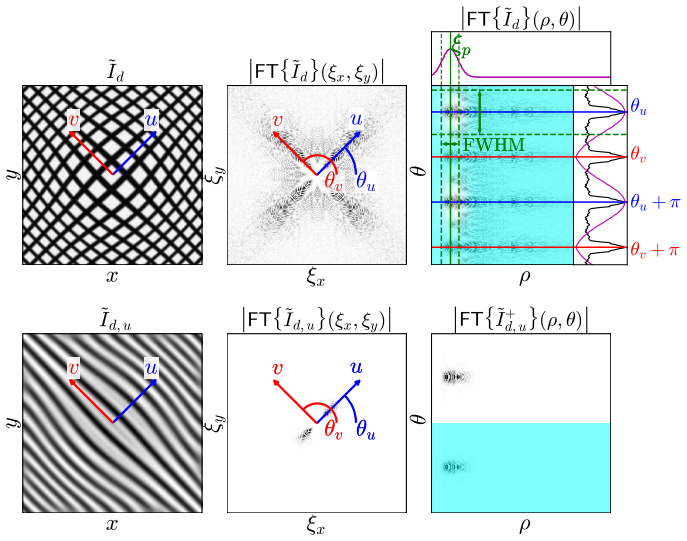
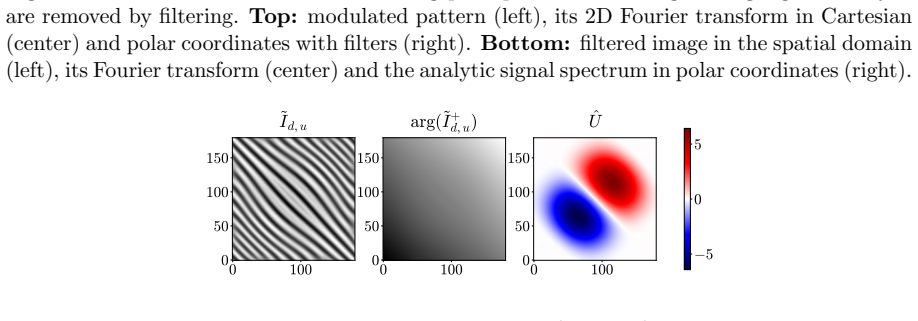
Wave-induced in-plane deformation is modeled as a spatial phase modulation of a periodic carrier; ADOPT recovers the displacement field by constructing an oriented two-dimensional analytic signal, performing orientation-selective filtering, and extracting the local phase that directly encodes the displacement vector.
What carries the argument
oriented two-dimensional analytic signal that isolates spectral components via orientation-selective filtering before phase extraction
Load-bearing premise
Wave-induced deformation can be accurately modeled as a spatial phase modulation of a periodic carrier, with orientation-selective filtering successfully isolating the relevant spectral components without significant interference from other effects.
What would settle it
Independent laser-vibrometer measurements of surface displacement on the same membrane specimen under identical impulsive excitation, compared directly against ADOPT phase estimates.
Figures






read the original abstract
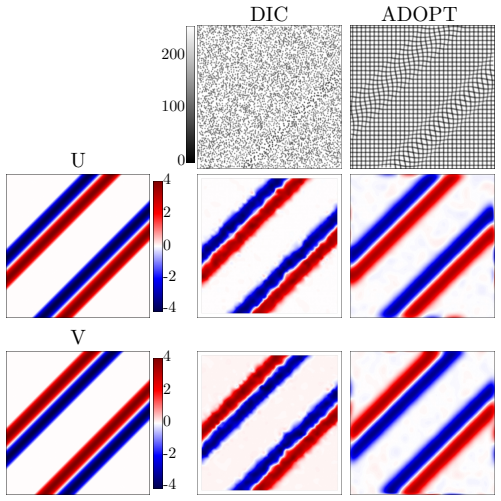
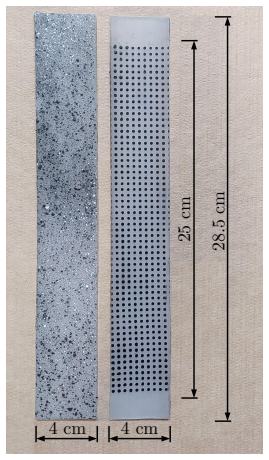
This paper addresses the problem of tracking in-plane waves from image sequences using periodic surface patterns. Wave-induced deformation is modeled as a spatial phase modulation of a periodic carrier. We propose ADOPT (Analytical Demodulation of Periodic Texture), a method based on an oriented two-dimensional analytic signal to estimate displacement phase and orientation. The approach relies on a physical model describing longitudinal and transverse in-plane waves. Orientation-selective filtering isolates relevant spectral components, and phase extraction provides a stable reconstruction of the displacement field. A theoretical analysis using the Cramer--Rao bound evaluates performance limits of ADOPT. Simulations show that the proposed method outperforms state-of-the-art Digital Image Correlation (DIC) at high signal-to-noise ratios, especially for small displacements where DIC becomes limited. Moreover, ADOPT is more computationally efficient. Experiments on silicone membranes with periodic patterns confirm accurate estimation of wave fields and dispersion curves under impulsive excitation. Overall, the proposed framework provides a robust and efficient solution for wave-induced displacement estimation.
Editorial analysis
A structured set of objections, weighed in public.
Referee Report
Summary. The paper proposes ADOPT, a method for estimating in-plane wave displacements from image sequences of periodic textures. Wave deformation is modeled as spatial phase modulation of a known carrier; an oriented 2-D analytic signal (after orientation-selective filtering) extracts the displacement via the argument of the demodulated signal. A Cramér-Rao bound analysis is presented, simulations claim outperformance over DIC especially at high SNR and small displacements, and silicone-membrane experiments under impulsive excitation are used to recover wave fields and dispersion curves.
Significance. If the central modeling assumptions hold, ADOPT offers a computationally lighter, phase-based alternative to DIC for high-precision tracking of small-amplitude waves on periodic surfaces. The combination of a physical model, analytic-signal demodulation, and CRB-derived performance limits is a clear strength; the experimental validation on real membranes further supports practical utility in wave-propagation studies.
major comments (2)
- [§2] §2 (physical model) and abstract: the derivation of the oriented analytic signal (Eqs. 4–6) and the subsequent CRB analysis rest on the assumption that displacement appears strictly as a spatial phase shift of a constant-amplitude periodic carrier. No analysis or simulation is provided for cases with spatially varying amplitude (e.g., local thickness or illumination changes) or overlapping sidebands from longitudinal/transverse components; under those conditions the quadrature component is no longer pure phase and the extracted displacement contains systematic bias not bounded by the reported CRB.
- [Simulations and experiments] Simulations and experiments section: all reported simulations use ideal sinusoidal carriers with a single dominant orientation; the silicone-membrane experiments likewise employ a single dominant pattern orientation. Consequently the interference/cross-talk case raised by the phase-modulation model is not stress-tested, leaving the claim of robust outperformance over DIC at high SNR dependent on unverified assumptions.
minor comments (2)
- Notation for the 2-D analytic signal and orientation filter could be clarified with an explicit block diagram or pseudocode to aid reproducibility.
- Figure captions should explicitly state the SNR values, displacement amplitudes, and number of Monte-Carlo trials used in the DIC comparison plots.
Simulated Author's Rebuttal
We thank the referee for the constructive and detailed comments on the modeling assumptions and validation aspects of our work. We address each major comment point by point below, proposing revisions to strengthen the manuscript where the concerns are valid.
read point-by-point responses
-
Referee: [§2] §2 (physical model) and abstract: the derivation of the oriented analytic signal (Eqs. 4–6) and the subsequent CRB analysis rest on the assumption that displacement appears strictly as a spatial phase shift of a constant-amplitude periodic carrier. No analysis or simulation is provided for cases with spatially varying amplitude (e.g., local thickness or illumination changes) or overlapping sidebands from longitudinal/transverse components; under those conditions the quadrature component is no longer pure phase and the extracted displacement contains systematic bias not bounded by the reported CRB.
Authors: We agree that the core derivation and CRB analysis in §2 are developed under the phase-modulation model with constant-amplitude carrier, which enables the oriented analytic signal to extract displacement via the argument. This is a deliberate modeling choice aligned with the high-contrast periodic textures used in our target applications. We acknowledge that the manuscript does not explicitly quantify bias under spatially varying amplitude or overlapping sidebands. In the revised version we will add an explicit statement of these modeling assumptions in §2 and the abstract, together with a short robustness analysis (including a targeted simulation with mild amplitude modulation) to bound the resulting phase error relative to the ideal CRB. revision: yes
-
Referee: [Simulations and experiments] Simulations and experiments section: all reported simulations use ideal sinusoidal carriers with a single dominant orientation; the silicone-membrane experiments likewise employ a single dominant pattern orientation. Consequently the interference/cross-talk case raised by the phase-modulation model is not stress-tested, leaving the claim of robust outperformance over DIC at high SNR dependent on unverified assumptions.
Authors: The simulations were intentionally restricted to ideal single-orientation carriers to isolate the performance gain of ADOPT over DIC under the exact conditions for which the CRB was derived, thereby providing a controlled benchmark. The silicone-membrane experiments similarly reflect typical laboratory patterns with one dominant orientation. We recognize that the current results do not directly stress-test cross-talk from multiple orientations or longitudinal/transverse sideband overlap. We will therefore augment the revised manuscript with additional simulation cases that superimpose weak secondary orientations and wave components, reporting the resulting displacement error and comparison with DIC to substantiate the robustness claim. revision: yes
Circularity Check
No significant circularity in derivation chain
full rationale
The paper states a physical model (wave displacement as spatial phase modulation of a known periodic carrier) as an input assumption in the abstract and §2, then applies standard oriented 2-D analytic signal processing (Eq. 4–6) to extract phase. The Cramér–Rao bound is derived under those explicit model assumptions rather than fitted to data. Simulations and experiments serve as external validation rather than re-deriving the inputs. No self-citation chains, fitted parameters renamed as predictions, or ansatz smuggled via prior work appear in the provided sections; the derivation remains self-contained against the stated model and established signal-processing results.
Axiom & Free-Parameter Ledger
axioms (2)
- domain assumption Wave-induced deformation is modeled as a spatial phase modulation of a periodic carrier
- domain assumption Orientation-selective filtering isolates relevant spectral components for phase extraction
Reference graph
Works this paper leans on
-
[1]
Springer Science & Business Media, 2003
Pramod K Rastogi.Photomechanics, volume 77. Springer Science & Business Media, 2003
work page 2003
-
[2]
Michel Gr´ ediac and Fran¸ cois Hild.Full-field measurements and identification in solid me- chanics. John Wiley & Sons, 2012
work page 2012
-
[3]
Characterization of necking phenomena in high-speed experiments by using a single camera
Gilles Besnard, Jean-Michel Lagrange, Fran¸ cois Hild, St´ ephane Roux, and Christophe Voltz. Characterization of necking phenomena in high-speed experiments by using a single camera. EURASIP Journal on Image and Video Processing, 2010(1):215956, 2010
work page 2010
-
[4]
Ioannis Chasiotis and Wolfgang G Knauss. A new microtensile tester for the study of mems materials with the aid of atomic force microscopy.Experimental Mechanics, 42(1):51–57, 2002. 19
work page 2002
-
[5]
Maxime Lanoy, Fabrice Lemoult, Antonin Eddi, and Claire Prada. Dirac cones and chiral selection of elastic waves in a soft strip.Proceedings of the National Academy of Sciences, 117(48):30186–30190, 2020
work page 2020
-
[6]
Sbastien Leprince, Sylvain Barbot, Franois Ayoub, and Jean-Philippe Avouac. Automatic and precise orthorectification, coregistration, and subpixel correlation of satellite images, application to ground deformation measurements.IEEE Transactions on Geoscience and Remote Sensing, 45(6):1529–1558, 2007
work page 2007
-
[7]
Pol Grasland-Mongrain, Ali Zorgani, Shoma Nakagawa, Simon Bernard, Lia Gomes Paim, Greg Fitzharris, Stefan Catheline, and Guy Cloutier. Ultrafast imaging of cell elasticity with optical microelastography.Proceedings of the National Academy of Sciences, 115(5):861– 866, 2018
work page 2018
-
[8]
MA Sutton, X Ke, SM Lessner, M Goldbach, M Yost, F Zhao, and HW Schreier. Strain field measurements on mouse carotid arteries using microscopic three-dimensional digital image correlation.Journal of Biomedical Materials Research Part A: An Official Journal of The Society for Biomaterials, The Japanese Society for Biomaterials, and The Australian Society f...
work page 2008
-
[9]
Jiayuan Zhu, Fran¸ cois Legrand, Sibylle Gr´ egoire, Jorge Torres, Stefan Catheline, and Bruno Giammarinaro. Young’s modulus estimation of a soft viscoelastic rod using optical elastog- raphy.The Journal of the Acoustical Society of America, 158(4):3203–3209, 2025
work page 2025
-
[10]
Andrea Alfarano, Luca Maiano, Lorenzo Papa, and Irene Amerini. Estimating optical flow: A comprehensive review of the state of the art.Computer vision and image understanding, 249:104160, 2024
work page 2024
-
[11]
Sander Wildeman. Real-time quantitative schlieren imaging by fast fourier demodulation of a checkered backdrop.Experiments in Fluids, 59(6):97, 2018
work page 2018
-
[12]
Faraday wave lattice as an elastic metamaterial.Physical Review E, 93(5):050202, 2016
L Domino, M Tarpin, Sylvain Patinet, and A Eddi. Faraday wave lattice as an elastic metamaterial.Physical Review E, 93(5):050202, 2016
work page 2016
-
[13]
Dover Publications, Inc., New York, 1966
Phil Brodatz.Textures: a photographic album for artists and designers. Dover Publications, Inc., New York, 1966
work page 1966
-
[14]
Karl F Graff.Wave motion in elastic solids. Courier Corporation, 2012
work page 2012
-
[15]
American Mathematical Soc., 2008
Mark A Pinsky.Introduction to Fourier analysis and wavelets, volume 102. American Mathematical Soc., 2008
work page 2008
-
[16]
Notes on the theory of modulation.Proceedings of the institute of radio engineers, 10(1):57–64, 2006
John R Carson. Notes on the theory of modulation.Proceedings of the institute of radio engineers, 10(1):57–64, 2006
work page 2006
-
[17]
PhD thesis, ´Ecole normale sup´ erieure de Cachan-ENS Cachan, 2013
Mauricio Delbracio.Two Problems of Digital Image Formation: Recovering the Camera Point Spread Function and Boosting Stochastic Renderers by Auto-similarity Filtering. PhD thesis, ´Ecole normale sup´ erieure de Cachan-ENS Cachan, 2013
work page 2013
-
[18]
PhD thesis, Kiel University, 1999
Thomas B¨ ulow.Hypercomplex spectral signal representations for the processing and analysis of images. PhD thesis, Kiel University, 1999
work page 1999
-
[19]
Miguel Arevallilo Herr´ aez, David R Burton, Michael J Lalor, and Munther A Gdeisat. Fast two-dimensional phase-unwrapping algorithm based on sorting by reliability following a noncontinuous path.Applied optics, 41(35):7437–7444, 2002. 20
work page 2002
-
[20]
PhD thesis, Kiel University, 2002
Michael Felsberg.Low-level image processing with the structure multivector. PhD thesis, Kiel University, 2002
work page 2002
-
[21]
Di Zang and Gerald Sommer. Signal modeling for two-dimensional image structures.Jour- nal of Visual Communication and Image Representation, 18(1):81–99, 2007
work page 2007
-
[22]
Kay.Fundamentals of statistical signal processing: estimation theory
Steven M. Kay.Fundamentals of statistical signal processing: estimation theory. Prentice- Hall, Inc., USA, 1993
work page 1993
-
[23]
Paul Luizard, Lucie Bailly, Hamid Yousefi-Mashouf, Rapha¨ el Girault, Laurent Org´ eas, and Nathalie Henrich Bernardoni. Flow-induced oscillations of vocal-fold replicas with tuned extensibility and material properties.Scientific reports, 13(1):22658, 2023
work page 2023
-
[24]
Alexandre Delory, Daniel A Kiefer, Maxime Lanoy, Antonin Eddi, Claire Prada, and Fabrice Lemoult. Viscoelastic dynamics of a soft strip subject to a large deformation.Soft Matter, 20(9):1983–1995, 2024. 21
work page 1983
discussion (0)
Sign in with ORCID, Apple, or X to comment. Anyone can read and Pith papers without signing in.