Mesoscale Domain Evolution Mechanism during Alternating Current (AC) Poling of Relaxor Ferroelectrics
Pith reviewed 2026-05-20 03:57 UTC · model grok-4.3
The pith
The spacing ratio between 71° and 109° domain walls decides which 71° walls get irreversibly eliminated during AC poling.
A machine-rendered reading of the paper's core claim, the machinery that carries it, and where it could break.
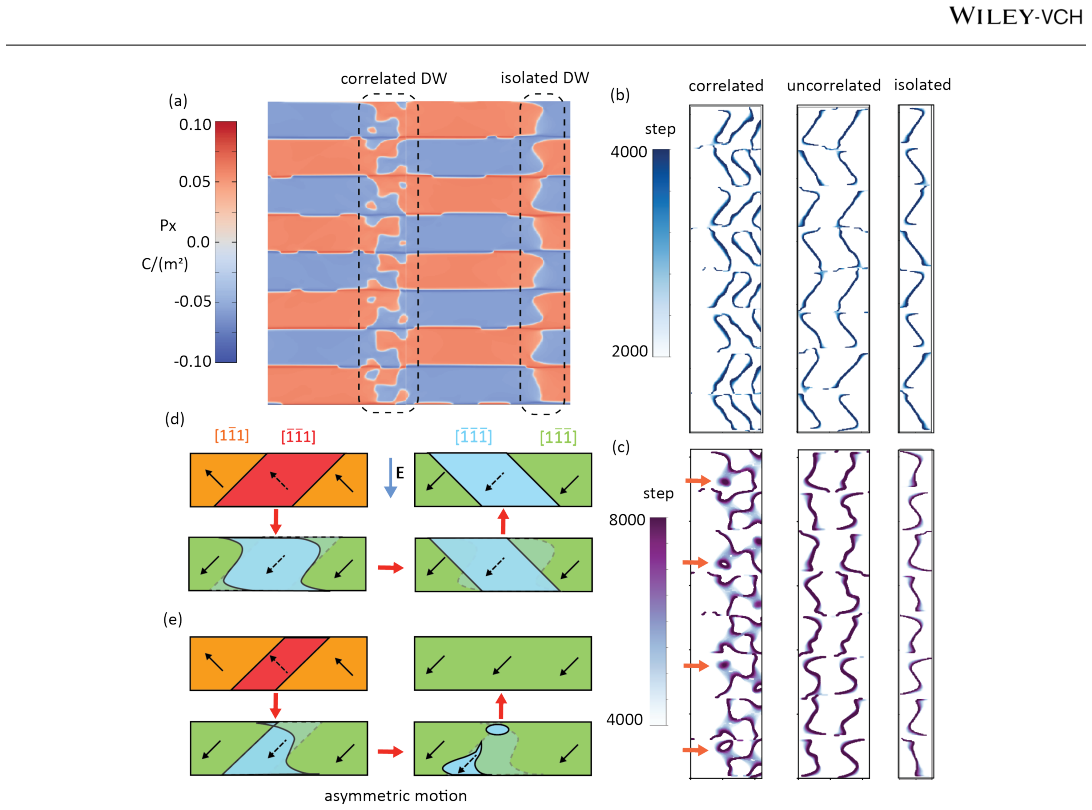
Core claim
In quasi-two-dimensional laminated geometries of rhombohedral Pb(Mg1/3Nb2/3)O3–PbTiO3 single crystals, the domain-wall behavior during polarization reversal under AC poling depends on the spacing ratio between the 71° and 109° domain walls. Closely spaced 71° domain walls undergo irreversible elimination due to unsynchronized motion arising from long-range elastic interactions, whereas more widely separated walls are preserved, and the 109° domain walls remain intact. A threshold ratio for elimination is identified that depends on mechanical boundary conditions.
What carries the argument
The spacing ratio between 71° and 109° domain walls, which controls the strength of long-range elastic coupling and produces collective unsynchronized wall motion during switching.
If this is right
- Domain engineering can use controlled initial wall densities to achieve selective elimination of 71° walls while preserving 109° walls.
- Adjusting mechanical boundary conditions changes the critical spacing ratio that triggers irreversible wall removal.
- Collective elastic-driven wall motion provides a mesoscale route to break symmetry between equivalent variants during cyclic poling.
- Phase-field models that include long-range strain coupling can predict which walls survive repeated polarization reversal.
Where Pith is reading between the lines
- The same spacing-dependent elimination could appear in other ferroelectric systems that contain multiple domain-wall angles under cyclic electric fields.
- Preparing crystals with deliberately varied initial domain-wall densities and measuring survival rates after AC poling would test the predicted threshold.
- The mechanism may help explain differences in piezoelectric response between samples poled under different mechanical constraints.
Load-bearing premise
The quasi-two-dimensional laminated geometry together with the chosen mechanical boundary conditions accurately captures the long-range strain coupling that drives unsynchronized motion between neighboring 71° walls.
What would settle it
In-situ imaging of domain wall trajectories during AC poling that shows synchronized motion of 71° walls even when their spacing ratio falls below the simulated threshold would falsify the dependence on spacing.
Figures



read the original abstract
Ferroelectric domain variants that are energetically equivalent are expected to remain preserved during polarization reversal under a symmetry-preserving electric field. However, recent experiments on relaxor-ferroelectric crystals have revealed irreversible elimination of inclined domain walls during AC poling, while the underlying mesoscale mechanism remains unclear. Here, we investigate the domain-wall motion during AC poling of rhombohedral Pb(Mg$_{1/3}$Nb$_{2/3}$)O$_3$--PbTiO$_3$ single crystals containing both 71$^\circ$ and 109$^\circ$ domain walls within a quasi-two-dimensional laminated geometry using phase-field simulations. The simulations reveal that the domain-wall behavior during polarization reversal depends on the spacing ratio between the 71$^\circ$ and 109$^\circ$ domain walls. Closely spaced 71$^\circ$ domain walls undergo irreversible elimination, whereas more widely separated walls are preserved, while the 109$^\circ$ domain walls remain intact. A threshold ratio for domain-wall elimination is identified and found to depend on the mechanical boundary conditions. By tracking the domain-wall trajectories during the switching process, we attribute this behavior to unsynchronized motion of neighboring 71$^\circ$ domain walls arising from long-range elastic interactions when the walls become strongly coupled. This collective motion breaks the symmetry between energetically equivalent domain variants and leads to irreversible domain-wall elimination during polarization reversal. These findings provide mechanistic insight into collective domain-wall evolution during polarization reversal and suggest that proximity-driven symmetry breaking may provide a mesoscale mechanism for domain engineering in ferroelectric materials with high domain-wall densities.
Editorial analysis
A structured set of objections, weighed in public.
Referee Report
Summary. The paper uses phase-field simulations based on the time-dependent Ginzburg-Landau equations with long-range elastic interactions to study AC poling in a quasi-two-dimensional laminated model of rhombohedral PMN-PT. It claims that 71° domain walls undergo irreversible elimination during polarization reversal when their spacing ratio to intact 109° walls falls below a threshold (dependent on mechanical boundary conditions), while more widely spaced 71° walls are preserved; this is attributed to unsynchronized collective motion arising from elastic coupling when walls are strongly interacting.
Significance. If the reported spacing-ratio dependence and trajectory-based attribution hold, the work supplies a concrete mesoscale mechanism for the irreversible domain-wall elimination observed in AC-poling experiments on relaxor ferroelectrics. A clear strength is the forward simulation approach: the threshold ratio and elimination outcome emerge directly from the standard equations without fitted parameters, self-referential thresholds, or circular definitions, and the collective-motion explanation is tied to explicit wall-trajectory tracking.
major comments (1)
- Model setup and boundary-condition statements: the central claim that a well-defined spacing-ratio threshold governs irreversible 71° wall elimination rests on the quasi-two-dimensional laminated geometry together with the two specific mechanical boundary conditions (clamped or stress-free). In three dimensions, out-of-plane strain components and additional curvature degrees of freedom can redistribute elastic energy and modify the effective range of long-range coupling between neighboring 71° walls, which could shift or remove the reported threshold. A short 3D test case or scaling argument quantifying this effect is needed to establish whether the mechanism is robust beyond the quasi-2D approximation.
minor comments (2)
- An explicit sensitivity analysis with respect to the gradient energy coefficients (the only free parameters listed) should be added to confirm that the identified threshold ratio remains stable under reasonable variations.
- The precise operational definition of the spacing ratio (e.g., how distances are measured between wall mid-planes) should be stated clearly in the results section to allow direct reproduction.
Simulated Author's Rebuttal
We thank the referee for the positive assessment of our work and the recommendation for minor revision. We address the major comment point by point below.
read point-by-point responses
-
Referee: Model setup and boundary-condition statements: the central claim that a well-defined spacing-ratio threshold governs irreversible 71° wall elimination rests on the quasi-two-dimensional laminated geometry together with the two specific mechanical boundary conditions (clamped or stress-free). In three dimensions, out-of-plane strain components and additional curvature degrees of freedom can redistribute elastic energy and modify the effective range of long-range coupling between neighboring 71° walls, which could shift or remove the reported threshold. A short 3D test case or scaling argument quantifying this effect is needed to establish whether the mechanism is robust beyond the quasi-2D approximation.
Authors: We thank the referee for this insightful comment on the model dimensionality. Our quasi-two-dimensional laminated geometry is deliberately chosen to represent the experimentally observed laminated domain structures in rhombohedral PMN-PT, in which domains extend uniformly along the out-of-plane direction; this setup allows us to isolate the in-plane spacing-ratio dependence while incorporating long-range elastic interactions via the Khachaturyan approach. We acknowledge that a full three-dimensional treatment would introduce out-of-plane strain components and additional curvature modes that could, in principle, alter the absolute elastic energy. However, because the elastic coupling between neighboring 71° walls is dominated by the in-plane compatibility constraints in the laminated configuration, the relative synchronization (or lack thereof) that produces the spacing-ratio threshold should remain qualitatively unchanged; out-of-plane contributions would shift the overall energy scale similarly for all walls without modifying the critical ratio at which collective unsynchronized motion sets in. To address the referee’s concern, we will add a concise paragraph in the revised manuscript that (i) justifies the quasi-2D approximation on the basis of experimental domain morphology and (ii) provides the scaling argument outlined above. We believe this clarification is sufficient to support the reported mechanism within the scope of a minor revision; performing new three-dimensional simulations lies beyond the present study. revision: partial
Circularity Check
Phase-field simulation of domain evolution is self-contained forward modeling
full rationale
The paper performs forward numerical integration of the standard time-dependent Ginzburg-Landau equations with long-range elastic interactions inside a quasi-2D laminated geometry. The reported threshold spacing ratio and irreversible 71° wall elimination emerge directly as simulation outcomes under the stated clamped or stress-free boundary conditions; no parameters are fitted to the target result, no self-citation supplies a uniqueness theorem or ansatz, and the central claim is not redefined in terms of itself. The derivation chain therefore remains independent of its own outputs.
Axiom & Free-Parameter Ledger
free parameters (1)
- gradient energy coefficients
axioms (2)
- standard math Time-dependent Ginzburg-Landau equation governs polarization evolution under applied AC field and long-range elastic interactions
- domain assumption Quasi-two-dimensional laminated geometry with periodic or clamped mechanical boundaries accurately captures mesoscale strain coupling
Lean theorems connected to this paper
-
IndisputableMonolith/Foundation/AlexanderDuality.leanalexander_duality_circle_linking unclear?
unclearRelation between the paper passage and the cited Recognition theorem.
domain-wall behavior during polarization reversal depends on the spacing ratio between the 71° and 109° domain walls... threshold ratio for domain-wall elimination is identified and found to depend on the mechanical boundary conditions
What do these tags mean?
- matches
- The paper's claim is directly supported by a theorem in the formal canon.
- supports
- The theorem supports part of the paper's argument, but the paper may add assumptions or extra steps.
- extends
- The paper goes beyond the formal theorem; the theorem is a base layer rather than the whole result.
- uses
- The paper appears to rely on the theorem as machinery.
- contradicts
- The paper's claim conflicts with a theorem or certificate in the canon.
- unclear
- Pith found a possible connection, but the passage is too broad, indirect, or ambiguous to say the theorem truly supports the claim.
Reference graph
Works this paper leans on
-
[1]
N. M. Brichta, L. Tegg, L. W. Giles, J. E. Daniels, J. M. Cairney,Journal of the American Ceramic Society2025,108, 5 e20346
-
[2]
AD. Ushakov, Q. Hu, X. Liu, Z. Xu, X. Wei, V. Y. Shur,Applied Physics Letters2021,118, 23
-
[3]
F. Yang, L. Chen,arXiv preprint arXiv:2412.043082024
work page internal anchor Pith review Pith/arXiv arXiv
-
[4]
F. Yang, X. Li, D. Talbayev, L. Chen,Physical review letters2025,135, 5 056901
-
[5]
H. Wan, C. Luo, C. Liu, W.-Y. Chang, Y. Yamashita, X. Jiang,Acta Materialia2021,208116759
- [6]
-
[7]
M. J. Krogstad, P. M. Gehring, S. Rosenkranz, R. Osborn, F. Ye, Y. Liu, J. P. C. Ruff, W. Chen, J. M. Wozniak, H. Luo, O. Chmaissem, Z.-G. Ye, D. Phelan,Nature Materials2018,17718
-
[8]
M. Eremenko, V. Krayzman, A. Bosak, H. Y. Playford, K. W. Chapman, J. C. Woicik, B. Ravel, I. Levin,Nature Communications2019,102728
- [9]
-
[10]
A. A. Bokov, H. Guo, M. Bari, Z.-G. Ye,Acta Materialia2026,309122095
-
[11]
R. P´ erez-Moyet, W. A. Kaminsky, Y. Cardona-Quintero, W. A. Visser, A. A. Heitmann, H. C. Robinson,Journal of the American Ceramic Society2026,109, 3 e70643
- [12]
- [13]
- [14]
-
[15]
J. Schultheiß, G. Picht, J. Wang, Y. Genenko, L. Chen, J. Daniels, J. Koruza,Progress in Materials Science2023,136101101
-
[16]
E. Sun, W. Cao,Progress in Materials Science2014,65124
-
[17]
M. L. Jablonski, S. Liu, C. R. Winkler, A. R. Damodaran, I. Grinberg, L. W. Martin, A. M. Rappe, M. L. Taheri,ACS Applied Materials & Interfaces2016,8, 5 2935
- [18]
-
[19]
M. W. Mervosh, C. A. Randall,Acta Materialia2026,302121627
-
[20]
M. W. Mervosh, J.-H. Lee, C. A. Randall,Nano Convergence2025,12, 1 62
-
[21]
Chen,Journal of the American Ceramic Society2008,91, 6 1835
L.-Q. Chen,Journal of the American Ceramic Society2008,91, 6 1835
-
[22]
J.-J. Wang, B. Wang, L.-Q. Chen,Annual Review of Materials Research2019,49, 1 127
-
[23]
N. Khakpash, H. Khassaf, G. Rossetti, S. Alpay,Applied Physics Letters2015,106, 8
-
[24]
Hlinka,Ferroelectrics2007,349, 1 49
J. Hlinka,Ferroelectrics2007,349, 1 49. 13 Supporting Information Yuan-Jie Sun, Bo Wang, ∗ and Long-Qing Chen † Department of Materials Science and Engineering and Materials Research Institute, The Pennsylvania State University, University Park, PA 16802, USA I. ENERGY COMP ARISON TABLE I. Energy density differences (unit: J/(m 3)) between the final relax...
work page 2000
-
[25]
subsequently drives domain-wall elimination and produces the eliminated-wall configuration. 2 III. SIMULA TIONS OF SLAB SAMPLE 0 0.5 1.0 1.5 2.0 2.5 3.0 3.2 0 0.5 1.0 1.5 2.0 2.5 3.0 3.2 initial w/h final ratio w/h slab ‹σ›=0 w/h=1.29 w/h=0.93 w/h=2.05 FIG. S3. Domain size analysis of a single slab similar to Fig. 4 with mechanical boundary condition ⟨σ⟩= ...
discussion (0)
Sign in with ORCID, Apple, or X to comment. Anyone can read and Pith papers without signing in.