Two-point enstrophy dynamics in homogeneous isotropic turbulence
Pith reviewed 2026-05-20 03:38 UTC · model grok-4.3
The pith
Vortex stretching sets the enstrophy budget at large scales in turbulence while diffusion dominates smaller ones.
A machine-rendered reading of the paper's core claim, the machinery that carries it, and where it could break.
Core claim
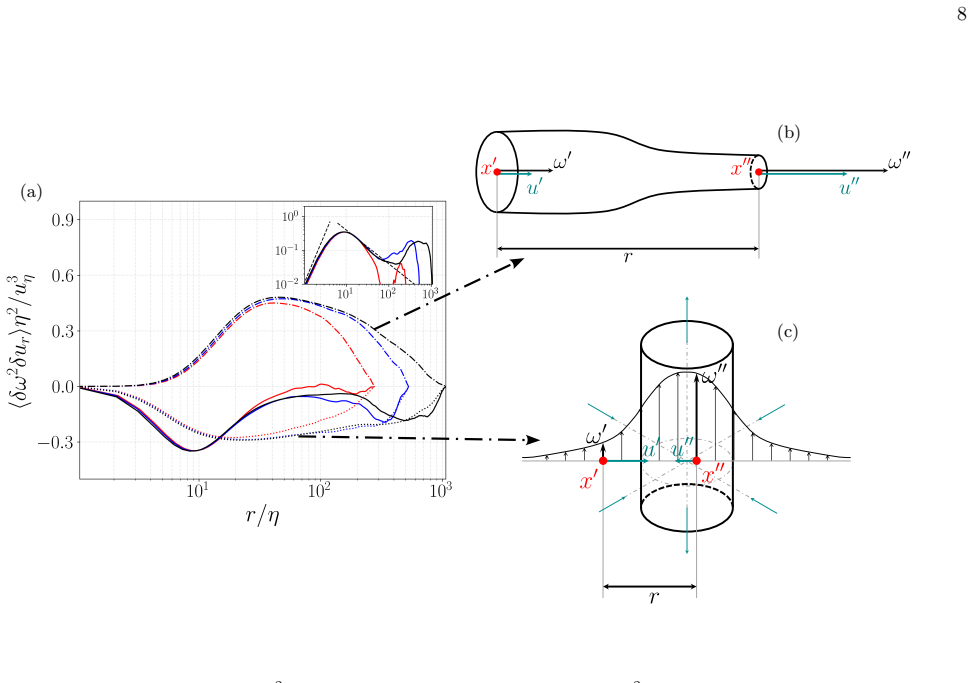
The paper establishes that the two-point enstrophy budget at scales r greater than 10 η is entirely determined by production via vortex stretching balancing enstrophy destruction, while diffusive transport dominates at smaller scales thereby preventing an inertial transport dominated range. Furthermore the inertial enstrophy flux has a dual direct and reverse character that arises directly from the vortex stretching mechanism acting differently on longitudinal and transverse vorticity components.
What carries the argument
The two-point enstrophy budget equation obtained via the Kármán-Howarth-Monin-Hill approach, including its decomposition into longitudinal and transverse parts.
If this is right
- The enstrophy dynamics do not exhibit a classical inertial range at the examined Reynolds numbers.
- The dual transfer nature is a direct consequence of how vortex stretching amplifies and reorients vorticity.
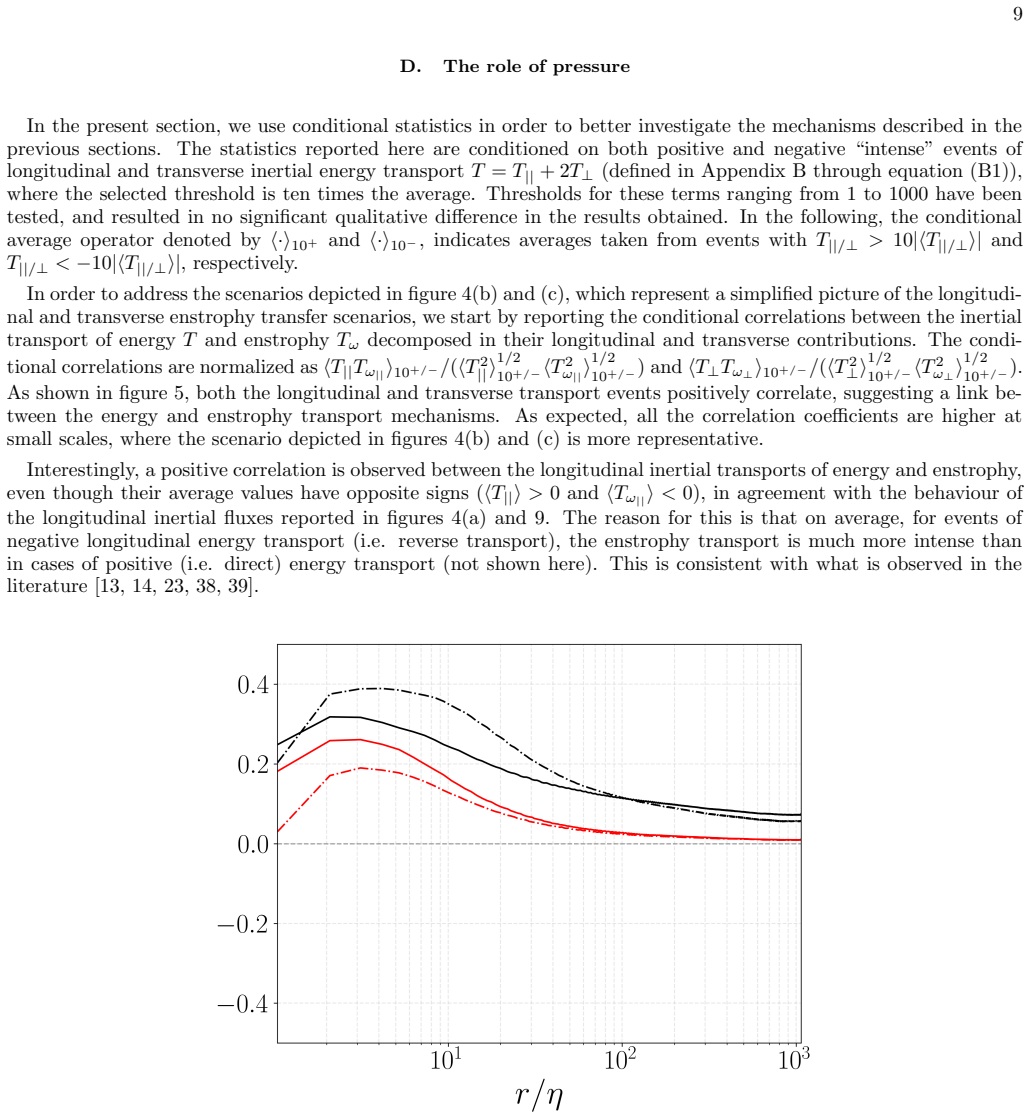
- Pressure transport terms can proxy for inertial energy and enstrophy transport events.
- Inertial compression plays a key role in longitudinal energy transport.
- Transverse energy transport correlates with radial contraction of vortical elements.
Where Pith is reading between the lines
- This suggests that turbulence models may need separate treatment for enstrophy production and transport rather than assuming a uniform cascade process.
- Similar two-point analyses could be applied to other invariants like helicity to check for comparable scale dependencies.
- Extending the Reynolds number range might show whether an inertial enstrophy range appears only at much higher values.
Load-bearing premise
The direct numerical simulations sufficiently resolve all relevant scales at the studied Reynolds numbers to allow accurate evaluation of all terms in the two-point enstrophy budget, especially the transport terms at small separations.
What would settle it
Observing a clear range of scales where the inertial transport term dominates the enstrophy budget in a higher-resolution simulation or laboratory experiment would contradict the reported findings.
Figures





read the original abstract
In the present work we investigate the multiscale dynamics of enstrophy in homogeneous isotropic turbulence by exploiting the two-point formalism provided by the K\'arm\'an-Howarth-Monin-Hill approach. The study is conducted on direct numerical simulations with a Taylor-based Reynolds number in the range of $140 \lesssim Re_{\lambda} \lesssim 400$. The two-point enstrophy budget at scales $r > 10 \eta$ appears to be entirely determined by production via vortex stretching, which balances enstrophy destruction, and to be dominated by the diffusive transport at smaller scales, thus preventing the emergence of a range dominated by the inertial transport of enstrophy. The decomposition in longitudinal and transverse contributions also highlights a dual nature of the inertial enstrophy flux. In particular, enstrophy appears to be transferred across scales through a non-trivial combination of direct and reverse interscale transfer. It is shown that the dual nature of this transfer is strictly related to the vortex stretching mechanism, which, in addition to producing enstrophy through vorticity amplification, also transfers longitudinal vorticity towards larger scales (by stretching the vortical elements) and transverse vorticity towards smaller scales (by contracting these vortical elements in the radial direction). The sum of these two contributions results in an overall transfer of enstrophy from large towards small scales. We propose the use of the pressure transport term as a proxy to obtain some information on the dynamics of relevant events of inertial energy and enstrophy transport. The new findings highlight the relevance of inertial compression events in longitudinal energy transport. At the same time, a good correlation between transverse energy transport events and the radial contraction of vortical elements due to vortex stretching mechanisms is also found.
Editorial analysis
A structured set of objections, weighed in public.
Referee Report
Summary. The manuscript analyzes the two-point enstrophy dynamics in homogeneous isotropic turbulence using the Kármán-Howarth-Monin-Hill two-point formalism applied to DNS at Taylor Reynolds numbers 140 ≲ Re_λ ≲ 400. It reports that at scales r > 10η the enstrophy budget is determined by the balance between production via vortex stretching and enstrophy destruction, while diffusive transport dominates at smaller scales and prevents emergence of an inertial-transport-dominated range. The inertial enstrophy flux is shown to exhibit a dual direct/reverse nature strictly linked to the vortex stretching mechanism, with pressure transport proposed as a proxy for inertial energy and enstrophy transport events.
Significance. If the term balances hold under adequate resolution, the work supplies concrete evidence on the multiscale enstrophy cascade, clarifying how vortex stretching simultaneously produces enstrophy and drives opposing longitudinal/transverse transfers that net to a forward cascade. The absence of an inertial enstrophy range and the suggested pressure-transport proxy are potentially useful for theoretical closures and subgrid modeling in turbulence.
major comments (2)
- [DNS resolution and small-scale budget analysis] The central claim that diffusive transport dominates at r ≲ 10η (preventing any inertial enstrophy range) and that the inertial flux has a dual nature rests on accurate evaluation of the diffusive (second-derivative) and inertial (triple-correlation) terms at separations comparable to η. At Re_λ = 400, η is typically only a few grid spacings; no resolution study, grid-convergence test, or truncation-error estimate for these terms is provided, which directly affects the reported dominance ordering.
- [Longitudinal/transverse flux decomposition] The decomposition into longitudinal and transverse contributions to the inertial enstrophy flux (and the attribution of direct/reverse transfer to vortex stretching) assumes that the underlying velocity/vorticity fields are sufficiently resolved to capture radial contraction and stretching effects at r ~ η without numerical bias. This assumption is load-bearing for the mechanistic interpretation but lacks supporting checks.
minor comments (2)
- [Numerical setup] The abstract states the Re_λ range but the main text would benefit from an explicit table listing grid resolution, η/Δx, and time-step criteria for each simulated case.
- [Budget equation presentation] Notation for the two-point enstrophy budget terms (production, destruction, diffusive transport, inertial transport) could be collected in a single equation or table for easier cross-reference.
Simulated Author's Rebuttal
We thank the referee for their careful reading of the manuscript and for the constructive comments, which help clarify the robustness of our two-point enstrophy analysis. We address each major comment below and outline the revisions planned for the next version of the paper.
read point-by-point responses
-
Referee: [DNS resolution and small-scale budget analysis] The central claim that diffusive transport dominates at r ≲ 10η (preventing any inertial enstrophy range) and that the inertial flux has a dual nature rests on accurate evaluation of the diffusive (second-derivative) and inertial (triple-correlation) terms at separations comparable to η. At Re_λ = 400, η is typically only a few grid spacings; no resolution study, grid-convergence test, or truncation-error estimate for these terms is provided, which directly affects the reported dominance ordering.
Authors: We agree that explicit checks on numerical accuracy for the small-scale budget terms are important to support the claimed dominance of diffusion below 10η. The underlying DNS datasets satisfy standard resolution requirements for HIT (Δx/η ≲ 2 at Re_λ = 400) and have been validated in prior work, with derivatives evaluated via high-order spectral or finite-difference schemes whose truncation errors are small relative to the physical terms. Nevertheless, to directly address the concern we will add an appendix to the revised manuscript containing a grid-convergence study and truncation-error estimates for the diffusive and inertial contributions at r ∼ η. This will confirm that the observed balance ordering is not sensitive to the grid spacing. revision: yes
-
Referee: [Longitudinal/transverse flux decomposition] The decomposition into longitudinal and transverse contributions to the inertial enstrophy flux (and the attribution of direct/reverse transfer to vortex stretching) assumes that the underlying velocity/vorticity fields are sufficiently resolved to capture radial contraction and stretching effects at r ~ η without numerical bias. This assumption is load-bearing for the mechanistic interpretation but lacks supporting checks.
Authors: We concur that the mechanistic link between vortex stretching and the dual direct/reverse inertial flux requires verification that radial stretching/contraction is faithfully captured at the smallest separations. The decomposition is obtained from the exact two-point KHMH equations evaluated on the DNS fields. In the revision we will supplement the manuscript with additional supporting material, including sensitivity tests to the differentiation scheme and comparisons of the longitudinal/transverse fluxes computed on the native grid versus mildly filtered fields, to demonstrate that the reported dual transfer and its attribution to stretching remain unchanged. revision: yes
Circularity Check
No significant circularity; direct term-by-term DNS evaluation of two-point budget
full rationale
The paper derives the two-point enstrophy budget from the Kármán-Howarth-Monin-Hill formalism and evaluates each term (production via vortex stretching, destruction, diffusive and inertial transport) directly from DNS velocity/vorticity fields at Re_λ = 140–400. No quantities are defined in terms of other outputs, no parameters are fitted to data subsets and then relabeled as predictions, and no load-bearing steps rely on self-citations whose validity is presupposed. The central observations (diffusive dominance at r ≲ 10η, dual direct/reverse inertial flux tied to stretching) are statistical results of the computed fields rather than algebraic identities or renamings. The derivation chain is therefore self-contained against external benchmarks.
Axiom & Free-Parameter Ledger
free parameters (1)
- Scale threshold r > 10 η
axioms (1)
- domain assumption The simulated flow satisfies the assumptions of homogeneous isotropic incompressible turbulence required by the Kármán-Howarth-Monin-Hill two-point formalism.
Reference graph
Works this paper leans on
-
[1]
To study the scale-dependent properties of enstrophy we introduce the second-order structure function of vorticity (i.e. two-point enstrophy), defined asδω 2 =δω iδωi, whereδω i =ω i(x′′ j , t)−ω i(x′ j, t), and the distance between the two points defines the space of scalesr=x ′ −x ′′. For statistically steady homogeneous isotropic conditions, the exact ...
work page 2022
-
[2]
A. N. Kolmogorov, The local structure of turbulence in incompressible viscous fluid for very large reynolds numbers, Dokl. Akad. Nauk SSSR30, 301 (1941)
work page 1941
-
[3]
A. N. Kolmogorov, Dissipation of energy in the locally isotropic turbulence, Dokl. Akad. Nauk SSSR32, 19 (1941)
work page 1941
-
[4]
A. N. Kolmogorov, On the degeneration of isotropic turbulence, Dokl. Akad. Nauk SSSR31, 538 (1941)
work page 1941
-
[5]
Frisch,Turbulence: The Legacy of A
U. Frisch,Turbulence: The Legacy of A. N. Kolmogorov(Cambridge University Press, Cambridge, 1995)
work page 1995
-
[6]
Dubrulle, Beyond kolmogorov cascades, Journal of Fluid Mechanics867, P1 (2019)
B. Dubrulle, Beyond kolmogorov cascades, Journal of Fluid Mechanics867, P1 (2019)
work page 2019
-
[7]
A. Alexakis and L. Biferale, Cascades and transitions in turbulent flows, Physics Reports767, 1 (2018)
work page 2018
-
[8]
G. I. Taylor, Production and dissipation of vorticity in a turbulent fluid, Proc. R. Soc. Lond. A164, 15 (1938)
work page 1938
-
[9]
Onsager, Statistical hydrodynamics, Il Nuovo Cimento (1943-1954)6, 279 (1949)
L. Onsager, Statistical hydrodynamics, Il Nuovo Cimento (1943-1954)6, 279 (1949)
work page 1943
-
[10]
H. Tennekes and J. L. Lumley,A First Course in Turbulence(MIT Press, Cambridge, MA, 1972)
work page 1972
-
[11]
R. Betchov, An inequality concerning the production of vorticity in isotropic turbulence, Journal of Fluid Mechanics1, 497–504 (1956)
work page 1956
-
[12]
P. Constantin and G. Iyer, A stochastic lagrangian representation of the three-dimensional incompressible navier-stokes equations, Communications on Pure and Applied Mathematics:61, 330 (2008)
work page 2008
-
[13]
S. Chen, G. L. Eyink, M. Wan, and Z. Xiao, Is the kelvin theorem valid for high reynolds number turbulence?, Physical review letters97, 144505 (2006)
work page 2006
-
[14]
A. Tsinober, E. Kit, and T. Dracos, Experimental investigation of the field of velocity gradients in turbulent flows, Journal of Fluid Mechanics242, 169–192 (1992)
work page 1992
-
[15]
Tsinober,An informal conceptual introduction to turbulence(Springer, 2009)
A. Tsinober,An informal conceptual introduction to turbulence(Springer, 2009)
work page 2009
-
[16]
M. Carbone and A. D. Bragg, Is vortex stretching the main cause of the turbulent energy cascade?, Journal of Fluid Mechanics883, R2 (2020)
work page 2020
-
[17]
P. L. Johnson, On the role of vorticity stretching and strain self-amplification in the turbulence energy cascade, Journal of Fluid Mechanics922, A3 (2021)
work page 2021
-
[18]
R. M. Kerr, Higher-order derivative correlations and the alignment of small-scale structures in isotropic numerical turbu- lence, J. Fluid Mech.153, 31 (1985)
work page 1985
- [19]
-
[20]
P. A. Davidson, K. Morishita, and Y. Kaneda, On the generation and flux of enstrophy in isotropic turbulence, Journal of Turbulence9, N42 (2008)
work page 2008
-
[21]
N. A. K. Doan, N. Swaminathan, P. A. Davidson, and M. Tanahashi, Scale locality of the energy cascade using real space quantities, Phys. Rev. Fluids3, 084601 (2018)
work page 2018
-
[22]
P. Baj, F. Alves Portela, and D. Carter, On the simultaneous cascades of energy, helicity, and enstrophy in incompressible homogeneous turbulence, Journal of Fluid Mechanics952, A20 (2022). 17
work page 2022
-
[23]
A. Chiarini, R. K. Singh, and M. E. Rosti, Energy, enstrophy and helicity transfers in polymeric turbulence, Journal of Fluid Mechanics1024, A21 (2025)
work page 2025
-
[24]
P. L. Johnson and M. Wilczek, Multiscale velocity gradients in turbulence, Annual Review of Fluid Mechanics56, 463 (2024)
work page 2024
-
[25]
H. Yao, M. Schnaubelt, A. S. Szalay, T. A. Zaki, and C. Meneveau, Comparing local energy cascade rates in isotropic turbulence using structure-function and filtering formulations, Journal of Fluid Mechanics980, A42 (2024)
work page 2024
-
[26]
R. J. Hill, Exact second-order structure-function relationships, Journal of Fluid Mechanics468, 317 (2002)
work page 2002
- [27]
-
[28]
L. Danaila, J. Krawczynski, F. Thiesset, and B. Renou, Yaglom-like equation in axisymmetric anisotropic turbulence, Physica D: Nonlinear Phenomena241, 216 (2012)
work page 2012
-
[29]
A. Cimarelli, G. Boga, A. Pavan, P. Costa, and E. Stalio, Spatially evolving cascades in wall turbulence with and without interface, Journal of Fluid Mechanics987, A4 (2024)
work page 2024
- [30]
-
[31]
J. C. R. Hunt, J. C. Vassilicos, J. C. R. Hunt, O. M. Phillips, and D. Williams, Kolmogorov’s contributions to the physical and geometrical understanding of small-scale turbulence and recent developments, Proceedings of the Royal Society of London. Series A: Mathematical and Physical Sciences434, 183 (1991)
work page 1991
-
[32]
P. L. Johnson, Energy transfer from large to small scales in turbulence by multiscale nonlinear strain and vorticity inter- actions, Phys. Rev. Lett.124, 104501 (2020)
work page 2020
-
[33]
G. Boga,Multiscale phenomena in turbulent boundary layers, Ph.D. thesis, Corso di Dottorato di Ricerca in Ingegneria Industriale e del Territorio “Enzo Ferrari” - XXXVII Ciclo (2025)
work page 2025
- [34]
-
[35]
F. Moisy and J. Jim´ enez, Geometry and clustering of intense structures in isotropic turbulence, Journal of fluid mechanics 513, 111 (2004)
work page 2004
-
[36]
G. K. Batchelor, Small-scale variation of convected quantities like temperature in turbulent fluid part 1. general discussion and the case of small conductivity, Journal of Fluid Mechanics5, 113–133 (1959)
work page 1959
-
[37]
M. Germano, The elementary energy transfer between the two-point velocity mean and difference, Physics of Fluids19, 085105 (2007)
work page 2007
-
[38]
Nelkin, Multifractal scaling of velocity derivatives in turbulence, Physical Review A42, 7226 (1990)
M. Nelkin, Multifractal scaling of velocity derivatives in turbulence, Physical Review A42, 7226 (1990)
work page 1990
-
[39]
W. T. Ashurst, A. R. Kerstein, R. M. Kerr, and C. H. Gibson, Alignment of vorticity and scalar gradient with strain rate in simulated navier–stokes turbulence, The Physics of Fluids30, 2343 (1987)
work page 1987
- [40]
-
[41]
D. Buaria and A. Pumir, Role of pressure in the dynamics of intense velocity gradients in turbulent flows, Journal of Fluid Mechanics973, A23 (2023)
work page 2023
-
[42]
C. Meneveau, Lagrangian dynamics and models of the velocity gradient tensor in turbulent flows, Annual Review of Fluid Mechanics43, 219 (2011)
work page 2011
-
[43]
A. A. Ghira, G. E. Elsinga, and C. B. da Silva, Characteristics of the intense vorticity structures in isotropic turbulence at high reynolds numbers, Phys. Rev. Fluids7, 104605 (2022)
work page 2022
-
[44]
K. Alvelius, Random forcing of three-dimensional homogeneous turbulence, Physics of Fluids11, 1880 (1999)
work page 1999
-
[45]
Kolmogorov, Dissipation of energy in the locally isotropic turbulence, Dokl
A. Kolmogorov, Dissipation of energy in the locally isotropic turbulence, Dokl. Akad. SSSR 32, 301 (1941); reprinted in Proc. R. Soc. Lond. A, 434, 15434, 15 (1991)
work page 1941
discussion (0)
Sign in with ORCID, Apple, or X to comment. Anyone can read and Pith papers without signing in.