Secondary Collective Excitations in Intermediate to Strong-Coupling Superconductors
Pith reviewed 2026-05-20 03:22 UTC · model grok-4.3
The pith
Energy-transfer-dependent interactions generate secondary collective excitations below the continuum in intermediate-to-strong-coupling superconductors.
A machine-rendered reading of the paper's core claim, the machinery that carries it, and where it could break.
Core claim
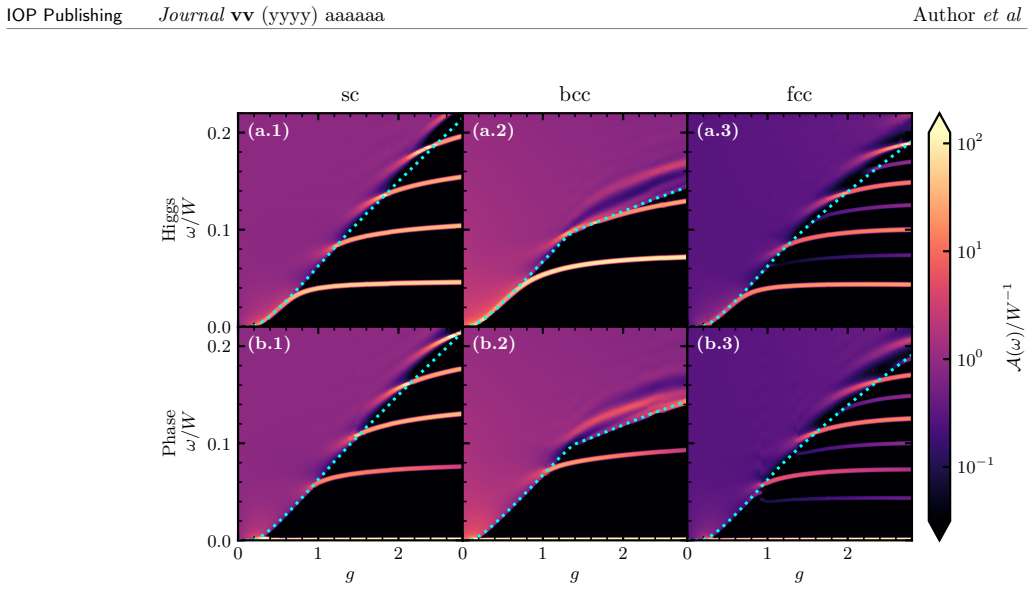
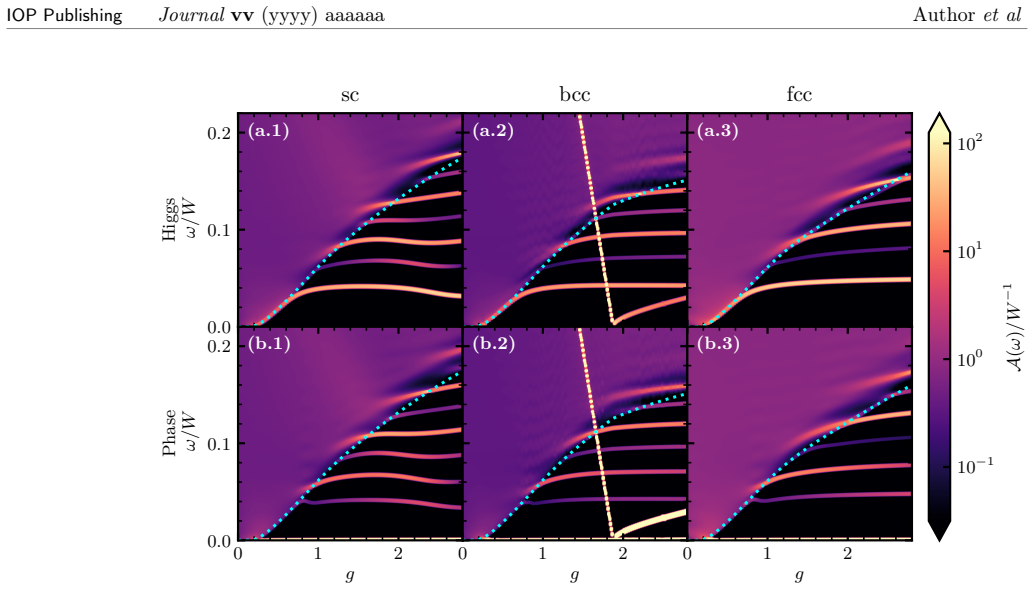
Considering systematically derived energy-transfer-dependent effective electron-electron interactions leads to the appearance of secondary phase and amplitude modes in isotropic superconductors in the intermediate-to-strong-coupling regime. We study the implications of such interactions on Bravais lattices by computing the corresponding response functions using the iterated equations of motion (iEoM) approach. In the weak-coupling regime, we find the conventional, primary amplitude and phase modes at ω=2Δ and ω=0, respectively. For intermediate coupling, the amplitude mode detaches from the quasiparticle continuum towards lower energies. Increasing the coupling further leads to additional,长期
What carries the argument
Iterated equations of motion (iEoM) response-function calculation that takes energy-transfer-dependent effective electron-electron interactions as input.
If this is right
- Additional long-lived secondary collective excitations appear below the quasiparticle continuum once coupling exceeds the intermediate regime.
- The secondary modes remain present and long-lived on any Bravais lattice and for any Fermi-level position.
- Amplitude and phase modes hybridize once particle-hole symmetry is broken.
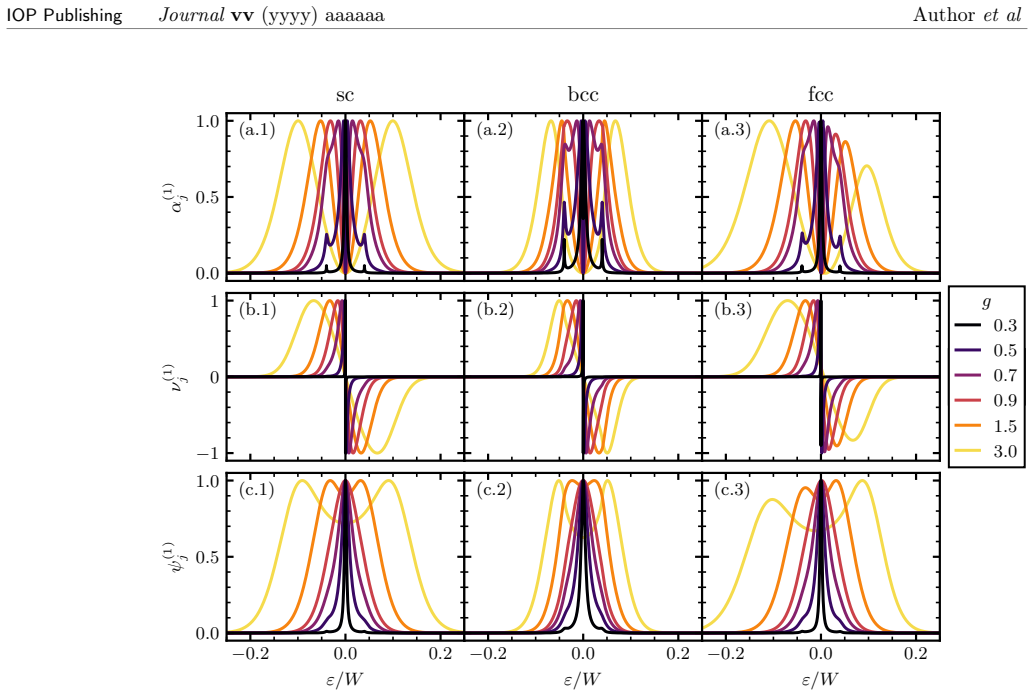
- Eigenoperators that excite each secondary mode individually exhibit nodal structures in their coefficients that resemble hydrogen wave functions.
Where Pith is reading between the lines
- Spectroscopic experiments on materials with intermediate-to-strong coupling could search for sharp features below the pair-breaking edge as a direct signature of energy-dependent interactions.
- The hydrogen-like nodal patterns in the eigenoperators suggest a possible bound-state analogy for the secondary modes that could be explored by mapping the problem onto an effective radial equation.
- The method could be applied to multi-orbital or anisotropic models to test whether even richer sets of secondary modes appear.
Load-bearing premise
The effective electron-electron interactions are taken to be systematically derived energy-transfer-dependent quantities whose specific functional form, when inserted into the iEoM calculation, is what produces the secondary modes.
What would settle it
A response-function calculation or spectroscopic measurement on an intermediate-to-strong-coupling superconductor that uses the same energy-dependent interactions yet shows no additional long-lived modes below the continuum, or that finds the modes strongly dependent on lattice details or Fermi-level position.
Figures


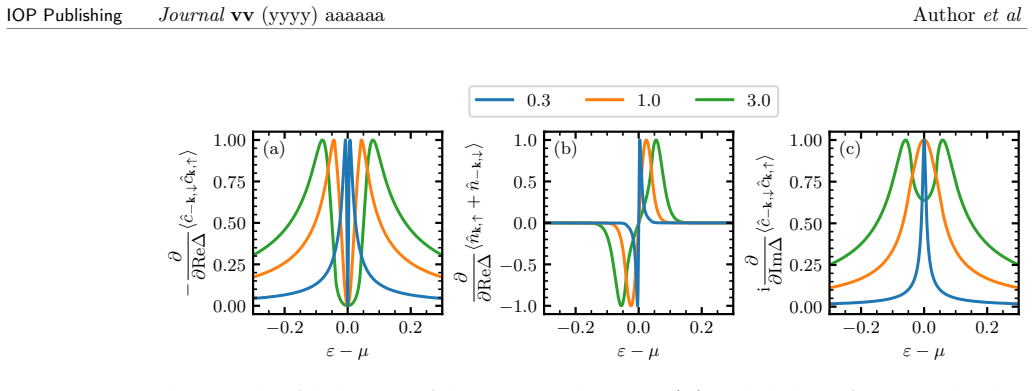


read the original abstract
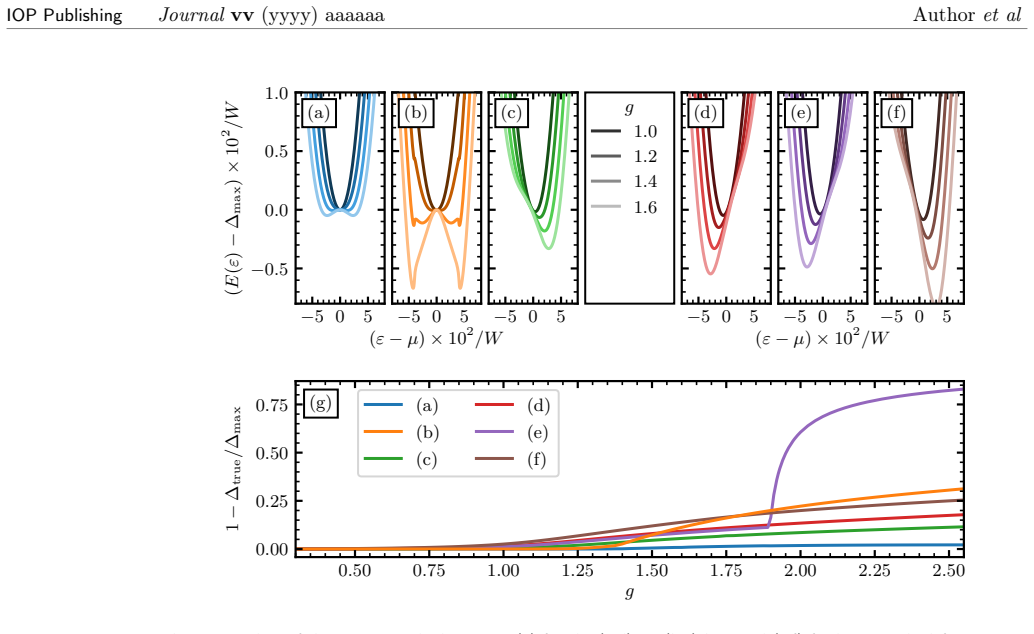
Considering systematically derived energy-transfer-dependent effective electron-electron interactions leads to the appearance of secondary phase and amplitude modes in isotropic superconductors in the intermediate-to-strong-coupling regime. We study the implications of such interactions on Bravais lattices by computing the corresponding response functions using the iterated equations of motion (iEoM) approach. In the weak-coupling regime, we find the conventional, primary amplitude and phase modes at $\omega=2\Delta$ and $\omega=0$, respectively. For intermediate coupling, the amplitude mode detaches from the quasiparticle continuum towards lower energies. Increasing the coupling further leads to additional, long-lived secondary collective excitations below the continuum. This phenomenon is largely independent of the underlying lattice and the specific Fermi level. The amplitude and phase modes couple if the system is not particle-hole symmetric. Additionally, we extend the method to compute eigenoperators, i.e., linear combinations of operators that excite each secondary mode specifically. We identify nodal structures in the coefficients for these eigenoperators reminiscent of wave functions in the Hydrogen problem.
Editorial analysis
A structured set of objections, weighed in public.
Referee Report
Summary. The manuscript claims that systematically derived energy-transfer-dependent effective electron-electron interactions, when inserted into the iterated equations of motion (iEoM) response-function calculation, produce secondary phase and amplitude collective excitations in isotropic superconductors on Bravais lattices in the intermediate-to-strong-coupling regime. In weak coupling the conventional primary modes appear at ω=2Δ (amplitude) and ω=0 (phase); at intermediate coupling the amplitude mode detaches from the continuum toward lower energies; further increase in coupling yields additional long-lived secondary modes below the continuum. These secondary excitations are asserted to be largely independent of lattice and Fermi level. Amplitude and phase modes couple when particle-hole symmetry is broken. The work extends iEoM to compute eigenoperators whose coefficients exhibit nodal structures reminiscent of hydrogen wave functions.
Significance. If the result holds, the identification of robust secondary collective modes below the continuum would constitute a notable addition to the theory of excitations in strong-coupling superconductors, with potential relevance to spectroscopic probes in materials where coupling is intermediate to strong. The claimed lattice and Fermi-level independence would enhance generality. Credit is given for the systematic derivation of energy-dependent interactions and for the explicit construction of eigenoperators that allow mode-specific excitation.
major comments (3)
- [Section deriving the effective interactions] The energy-transfer dependence of the effective interactions is the central modeling input that generates the secondary modes in the iEoM calculation. A direct comparison to constant-interaction or standard Eliashberg baselines is required to establish that the secondary excitations are not an artifact of this choice; without it the claim that they are a generic feature of strong-coupling superconductivity remains open.
- [Results on strong-coupling regime] The extension of iEoM to the strong-coupling regime reports long-lived secondary modes but provides no explicit error estimates, convergence tests, or truncation analysis for the iterated response functions. These checks are necessary to confirm the reported lifetimes and positions are not sensitive to the iteration cutoff.
- [Discussion of lattice and Fermi-level independence] The statement that the phenomenon is 'largely independent of the underlying lattice and the specific Fermi level' is load-bearing for generality. Quantitative evidence—e.g., tables or overlaid spectra showing mode frequencies and damping across at least two distinct Bravais lattices and several Fermi levels—must be supplied to support the claim.
minor comments (1)
- [Section on eigenoperators] The notation and explicit operator expressions for the eigenoperators could be expanded with one additional equation to make the nodal-structure analysis more transparent.
Simulated Author's Rebuttal
We thank the referee for their careful reading of the manuscript and for the constructive comments, which have helped us improve the presentation and strengthen the supporting evidence. We address each major comment in turn below.
read point-by-point responses
-
Referee: [Section deriving the effective interactions] The energy-transfer dependence of the effective interactions is the central modeling input that generates the secondary modes in the iEoM calculation. A direct comparison to constant-interaction or standard Eliashberg baselines is required to establish that the secondary excitations are not an artifact of this choice; without it the claim that they are a generic feature of strong-coupling superconductivity remains open.
Authors: We agree that an explicit comparison is necessary to demonstrate that the secondary modes arise specifically from the energy-transfer dependence rather than from other aspects of the iEoM framework. In the revised manuscript we have added a dedicated subsection and accompanying figure that recomputes the response functions using both a constant-interaction model and a standard Eliashberg baseline. These calculations recover only the conventional primary modes in the weak-coupling limit and show that the secondary modes appear exclusively when the energy-dependent interactions are retained in the intermediate-to-strong-coupling regime. revision: yes
-
Referee: [Results on strong-coupling regime] The extension of iEoM to the strong-coupling regime reports long-lived secondary modes but provides no explicit error estimates, convergence tests, or truncation analysis for the iterated response functions. These checks are necessary to confirm the reported lifetimes and positions are not sensitive to the iteration cutoff.
Authors: We acknowledge that the original manuscript lacked a systematic presentation of numerical convergence. We have performed additional runs varying the iteration cutoff and the number of retained eigenoperators. In the revised version we include a convergence table and error bars derived from these variations, showing that the reported frequencies and lifetimes of the secondary modes remain stable to within a few percent once the cutoff exceeds the values used in the main calculations. revision: yes
-
Referee: [Discussion of lattice and Fermi-level independence] The statement that the phenomenon is 'largely independent of the underlying lattice and the specific Fermi level' is load-bearing for generality. Quantitative evidence—e.g., tables or overlaid spectra showing mode frequencies and damping across at least two distinct Bravais lattices and several Fermi levels—must be supplied to support the claim.
Authors: We appreciate the request for quantitative support. The revised manuscript now contains an additional figure and a supplementary table that overlay the amplitude- and phase-mode spectra for the square and triangular Bravais lattices at three different Fermi-level positions within the band. The secondary-mode frequencies shift by less than 4 % and the damping rates remain comparable across all cases, thereby substantiating the claimed lattice and Fermi-level independence. revision: yes
Circularity Check
No significant circularity; derivation applies established iEoM to new interaction form
full rationale
The paper derives energy-transfer-dependent effective interactions systematically and feeds them into the iterated equations of motion (iEoM) response-function calculation. Secondary modes appear as an output of that computation in the intermediate-to-strong regime. No quoted equation or step reduces the reported excitations to a direct re-expression of the input parameters by construction, nor does the central claim rest on a load-bearing self-citation chain whose validity is presupposed. The approach remains self-contained, with the weak-coupling limit recovering the conventional primary modes as an independent check.
Axiom & Free-Parameter Ledger
free parameters (1)
- coupling strength
axioms (2)
- domain assumption Effective electron-electron interaction is energy-transfer dependent
- domain assumption Isotropic superconductor on Bravais lattice
Reference graph
Works this paper leans on
-
[1]
Collective Excitations in Competing Phases in Two and Three Dimensions , author =
-
[2]
Althüser, Joshua and Uhrig, Götz S. , date =. Collective Modes in Superconductors Including. doi:10.21468/SciPostPhys.19.3.067 , langid =
-
[3]
Althüser, Joshua and Eremin, Ilya M. and Uhrig, Götz S. , date =. Enhanced. doi:10.48550/arXiv.2512.11451 , langid =. 0704.1292 , eprinttype =
-
[4]
Anderson, P. W. , date =. Random-
-
[5]
Avella, Adolfo and Mancini, Ferdinando , editor =. The. Strongly. doi:10.1007/978-3-642-21831-6_4 , isbn =
-
[6]
Barankov, R. A. and Levitov, L. S. , date =. Excitation of the Dissipationless. doi:10.48550/arXiv.0704.1292 , pubstate =. 0704.1292 , eprinttype =
work page internal anchor Pith review Pith/arXiv arXiv doi:10.48550/arxiv.0704.1292
- [7]
- [8]
-
[9]
Barlas, Yafis and Varma, C. M. , date =. doi:10.1103/PhysRevB.87.054503 , title =
-
[10]
Böhm, T. and Kemper, A. F. and Moritz, B. and Kretzschmar, F. and Muschler, B. and Eiter, H.-M. and Hackl, R. and Devereaux, T. P. and Scalapino, D. J. and Wen, Hai-Hu , date =. doi:10.1103/PhysRevX.4.041046 , title =
-
[11]
doi:10.1140/epjb/s10051-020-00032-4 , langid =
Equation of Motion Truncation Scheme Based on Partial Orthogonalization , author =. doi:10.1140/epjb/s10051-020-00032-4 , langid =
- [12]
-
[13]
Cea, T. and Castellani, C. and Benfatto, L. , date =. Nonlinear Optical Effects and Third-Harmonic Generation in Superconductors:
-
[14]
and Keimer, Bernhard and Schnyder, Andreas P
Chu, Hao and Kim, Min-Jae and Katsumi, Kota and Kovalev, Sergey and Dawson, Robert David and Schwarz, Lukas and Yoshikawa, Naotaka and Kim, Gideok and Putzky, Daniel and Li, Zhi Zhong and Raffy, Hélène and Germanskiy, Semyon and Deinert, Jan-Christoph and Awari, Nilesh and Ilyakov, Igor and Green, Bertram and Chen, Min and Bawatna, Mohammed and Cristiani,...
-
[15]
Inelastic Light Scattering from Correlated Electrons , author =
-
[16]
Collisionless Dynamics of the Pairing Amplitude in Disordered Superconductors , author =
-
[17]
and Randeria, Mohit and Sá de Melo, C
Engelbrecht, Jan R. and Randeria, Mohit and Sá de Melo, C. A. R. , date =
-
[18]
Short-Distance Breakdown of the
Fischer, Sonja and Hecker, Matthias and Hoyer, Mareike and Schmalian, Jörg , date =. Short-Distance Breakdown of the
-
[19]
Glier, Tomke E. and Tian, Sida and Rerrer, Mika and Westphal, Lea and Lüllau, Garret and Feng, Liwen and Dolgner, Jakob and Haenel, Rafael and Zonno, Marta and Eisaki, Hiroshi and Greven, Martin and Damascelli, Andrea and Kaiser, Stefan and Manske, Dirk and Rübhausen, Michael , date =. Non-Equilibrium Anti-. doi:10.1038/s41467-025-62245-4 , langid =
-
[20]
Goldstone, J. , date =. Field Theories with «. doi:10.1007/BF02812722 , langid =
- [21]
-
[22]
Hamerla, Simone A. and Uhrig, Götz S. , date =. Dynamical Transition in Interaction Quenches of the One-Dimensional
-
[23]
Hamerla, Simone A. and Uhrig, Götz S. , date =. Interaction Quenches in the Two-Dimensional Fermionic
-
[24]
Hanaguri, T. and Niitaka, S. and Kuroki, K. and Takagi, H. , date =. Unconventional S-
-
[25]
and Müller-Hartmann, Erwin , date =
Hanisch, Thoralf and Uhrig, Götz S. and Müller-Hartmann, Erwin , date =. Lattice Dependence of Saturated Ferromagnetism in the
-
[26]
and Namaizawa, Hiroshi , date =
Hirashima, Dai S. and Namaizawa, Hiroshi , date =. Collective. doi:10.7567/JJAPS.26S3.167 , langid =
-
[27]
Joyce, G. S. , date =. Exact Evaluation of the Body Centred Cubic Lattice. doi:10.1088/0022-3719/4/12/008 , langid =
-
[28]
Joyce, G. S. , date =. On the. 52609 , eprinttype =
-
[29]
Joyce, G. S. and Delves, R. T. , date =. On the. doi:10.1007/s10955-011-0257-0 , langid =
-
[30]
and Matsunaga, Ryusuke and Schneeloch, John and Zhong, Ruidan D
Katsumi, Kota and Tsuji, Naoto and Hamada, Yuki I. and Matsunaga, Ryusuke and Schneeloch, John and Zhong, Ruidan D. and Gu, Genda D. and Aoki, Hideo and Gallais, Yann and Shimano, Ryo , date =. doi:10.1103/PhysRevLett.120.117001 , title =
-
[31]
doi:10.1103/PhysRevB.102.054510 , title =
Katsumi, Kota and Li, Zhi Zhong and Raffy, Hélène and Gallais, Yann and Shimano, Ryo , date =. doi:10.1103/PhysRevB.102.054510 , title =
-
[32]
Kehrein, Stefan , editor =. The. doi:10.1007/3-540-34068-8 , isbn =
-
[33]
Kos, Š. and Millis, A. J. and Larkin, A. I. , date =. Gaussian Fluctuation Corrections to the
-
[34]
Kostrzewa, Małgorzata and Szczęśniak, Radosław and Kalaga, Joanna K. and Wrona, Izabela A. , date =. Anomalously High Value of. doi:10.1038/s41598-018-30391-z , langid =
-
[35]
Enhanced Perturbative Continuous Unitary Transformations , author =
-
[36]
Krull, H. and Bittner, N. and Uhrig, G. S. and Manske, D. and Schnyder, A. P. , date =. Coupling of. doi:10.1038/ncomms11921 , langid =
-
[37]
Kulik, I. O. and Entin-Wohlman, Ora and Orbach, R. , date =. Pair Susceptibility and Mode Propagation in Superconductors:. doi:10.1007/BF00115617 , langid =
-
[38]
Significance of the Nonlocal Optical Response of Metal Nanoparticles in Describing the Operation of Plasmonic Lasers , author =
-
[39]
doi:10.1016/S0550-3213(96)00521-4 , keywords =
Flow Equations for Electron-Phonon Interactions , author =. doi:10.1016/S0550-3213(96)00521-4 , keywords =
-
[40]
Littlewood, P. B. and Varma, C. M. , date =. Gauge-
-
[41]
Amplitude Collective Modes in Superconductors and Their Coupling to Charge-Density Waves , author =
-
[42]
Lorenzana, José and Seibold, Götz , date =. Long-
-
[43]
Lorenzana, José and Seibold, Götz , date =. Undamped. doi:10.3390/condmat9040038 , langid =
- [44]
-
[45]
Light-Induced Collective Pseudospin Precession Resonating with
Matsunaga, Ryusuke and Tsuji, Naoto and Fujita, Hiroyuki and Sugioka, Arata and Makise, Kazumasa and Uzawa, Yoshinori and Terai, Hirotaka and Wang, Zhen and Aoki, Hideo and Shimano, Ryo , date =. Light-Induced Collective Pseudospin Precession Resonating with. doi:10.1126/science.1254697 , langid =
-
[46]
Méasson, M.-A. and Gallais, Y. and Cazayous, M. and Clair, B. and Rodière, P. and Cario, L. and Sacuto, A. , date =. doi:10.1103/PhysRevB.89.060503 , title =
-
[47]
Mielke, A. , date =. Calculating Critical Temperatures of Superconductivity from a Renormalized. doi:10.1209/epl/i1997-00445-5 , langid =
-
[48]
doi:10.1002/andp.19975090305 , langid =
Similarity Renormalization of the Electron-Phonon Coupling , author =. doi:10.1002/andp.19975090305 , langid =
-
[49]
Collective Modes in Pumped Unconventional Superconductors with Competing Ground States , author =
- [50]
-
[51]
Okazaki, K. and Ota, Y. and Kotani, Y. and Malaeb, W. and Ishida, Y. and Shimojima, T. and Kiss, T. and Watanabe, S. and Chen, C.-T. and Kihou, K. and Lee, C. H. and Iyo, A. and Eisaki, H. and Saito, T. and Fukazawa, H. and Kohori, Y. and Hashimoto, K. and Shibauchi, T. and Matsuda, Y. and Ikeda, H. and Miyahara, H. and Arita, R. and Chainani, A. and Shin...
-
[52]
Reinhoffer, C. and Pilch, P. and Reinold, A. and Derendorf, P. and Kovalev, S. and Deinert, J.-C. and Ilyakov, I. and Ponomaryov, A. and Chen, Min and Xu, Tie-Quan and Wang, Yue and Gan, Zi-Zhao and Wu, De-Sheng and Luo, Jian-Lin and Germanskiy, S. and Mashkovich, E. A. and family=Loosdrecht, given=P. H. M., prefix=van, useprefix=true and Eremin, I. M. an...
-
[53]
Roth, Laura M. , date =. doi:10.1103/PhysRev.184.451 , title =
-
[54]
Linearized Kinetic Equations and Relaxation Processes of a Superconductor near
Schmid, Albert and Schön, Gerd , date =. Linearized Kinetic Equations and Relaxation Processes of a Superconductor near. doi:10.1007/BF00115264 , langid =
-
[55]
Propagating Collective Modes in Superconductors , author =
-
[56]
Schwarz, L. and Fauseweh, B. and Tsuji, N. and Cheng, N. and Bittner, N. and Krull, H. and Berciu, M. and Uhrig, G. S. and Schnyder, A. P. and Kaiser, S. and Manske, D. , date =. Classification and Characterization of Nonequilibrium. doi:10.1038/s41467-019-13763-5 , langid =
-
[57]
Momentum-Resolved Analysis of Condensate Dynamic and
Schwarz, Lukas and Fauseweh, Benedikt and Manske, Dirk , date =. Momentum-Resolved Analysis of Condensate Dynamic and
- [58]
- [59]
- [60]
-
[61]
Angle-Resolved Photoemission Studies of Quantum Materials , author =
- [62]
- [63]
- [64]
-
[65]
Quantum fluctuations and the emergence of in-gap Higgs mode in superconductors
Tian, Sida and Tsuji, Naoto and Manske, Dirk , date =. Quantum Fluctuations and the Emergence of In-Gap. doi:10.48550/arXiv.2604.15120 , pubstate =. 2604.15120 , eprinttype =
work page internal anchor Pith review Pith/arXiv arXiv doi:10.48550/arxiv.2604.15120
-
[66]
family=Tserkovnikov, given=Yu. A., given-i=. A Method of Solving Infinite Systems of Equations for Two-Time Thermal. doi:10.1007/BF01028994 , langid =
- [67]
- [68]
- [69]
-
[70]
Varma, C. M. , date =. Higgs. doi:10.1023/A:1013890507658 , langid =
-
[71]
Collisionless Relaxation of the Energy Gap in Superconductors , author =
-
[72]
Unprecedentedly Large Gap in \
Wen, Chuanhao and Hou, Zhiyong and Akbari, Alireza and Chen, Kailun and Hong, Wenshan and Yang, Huan and Eremin, Ilya and Li, Yuan and Wen, Hai-Hu , date =. Unprecedentedly Large Gap in \. doi:10.1038/s41535-025-00735-w , langid =
-
[73]
and Tsyplyatyev, Oleksandr and Altshuler, Boris L
Yuzbashyan, Emil A. and Tsyplyatyev, Oleksandr and Altshuler, Boris L. , date =. Relaxation and
-
[74]
Yuzbashyan, Emil A. and Altshuler, Boris L. , date =. Breakdown of the
discussion (0)
Sign in with ORCID, Apple, or X to comment. Anyone can read and Pith papers without signing in.