A Three-Variable Benchmark for Post-GFC Covered Interest Parity Deviations
Pith reviewed 2026-05-22 09:04 UTC · model grok-4.3
The pith
Three lagged public variables form a daily benchmark for post-GFC covered interest parity deviations.
A machine-rendered reading of the paper's core claim, the machinery that carries it, and where it could break.
Core claim
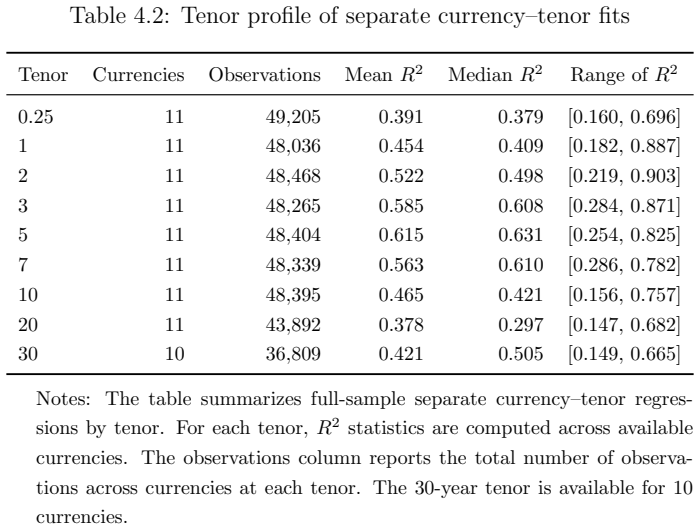
The paper establishes that a linear combination of three lagged public state variables—the National Financial Conditions Index, the nominal broad U.S. dollar index, and the Treasury 10-year minus 2-year slope—delivers strong in-sample and leave-one-year-out explanatory power for post-GFC government-bond CIP deviations in G10 plus KRW currency-tenor panels, while cointegration, quarter-end, and aggregation-difference diagnostics confirm that the benchmark isolates a persistent background component rather than short-maturity spikes or spurious correlations.
What carries the argument
A three-variable linear benchmark that uses lagged values of NFCI, the nominal broad U.S. dollar index, and the Treasury 10-year minus 2-year slope to predict CIP deviations at daily frequency.
If this is right
- Enables daily-frequency regressions on CIP deviations that are comparable to standard factor models in asset pricing.
- Distinguishes persistent background deviations from transient quarter-end effects.
- Supports leave-one-year-out validation as a check against overfitting.
- Applies uniformly across multiple tenors and G10 plus KRW currency pairs.
Where Pith is reading between the lines
- Researchers could test whether additional candidate drivers of CIP deviations retain incremental power once this benchmark is included.
- The same three variables might serve as controls when studying related phenomena such as cross-currency basis swaps or bank funding spreads.
- Extensions to real-time releases of the input series could allow monitoring of CIP conditions during future stress episodes.
Load-bearing premise
The three variables capture a genuine persistent economic component rather than statistical artifacts, omitted short-term patterns, or data-specific features.
What would settle it
Substantial deterioration in out-of-sample explanatory power or outright failure of cointegration tests when the same three variables are applied to data after 2022 or to additional currency panels.
Figures


read the original abstract
This paper proposes a public daily-frequency benchmark for post-GFC government-bond CIP deviations. Although CIP deviations are observed daily, the literature lacks a canonical benchmark for daily regressions comparable to standard factor models in asset pricing. Using G10 plus KRW currency-tenor panels, I show that three lagged public state variables-NFCI, the nominal broad U.S. dollar index, and the Treasury 10-year minus 2-year slope-deliver strong in-sample and leave-one-year-out performance. Cointegration, quarter-end, and aggregation-difference diagnostics suggest that the benchmark captures a persistent background component rather than short-maturity quarter-end spikes or spurious level correlation.
Editorial analysis
A structured set of objections, weighed in public.
Referee Report
Summary. This paper proposes a public daily-frequency benchmark for post-GFC government-bond CIP deviations. Using G10 plus KRW currency-tenor panels, three lagged public state variables—NFCI, the nominal broad U.S. dollar index, and the Treasury 10-year minus 2-year slope—deliver strong in-sample and leave-one-year-out performance. Cointegration, quarter-end, and aggregation-difference diagnostics suggest that the benchmark captures a persistent background component rather than short-maturity quarter-end spikes or spurious level correlation.
Significance. If the central claims hold, this would supply a simple, replicable public benchmark for daily CIP regressions analogous to standard factor models in asset pricing. The focus on lagged, publicly available variables and explicit out-of-sample plus diagnostic checks is a constructive contribution that could reduce data-mining concerns and support further work on post-GFC financial conditions.
major comments (2)
- [§4.2] §4.2 Cointegration Diagnostics: residual-based tests (Engle-Granger or Phillips-Ouliaris) applied to highly autocorrelated series such as NFCI and the broad USD index can exhibit low power and size distortions in moderate samples. The manuscript should report results under alternative lag selections, deterministic terms, and perhaps Johansen trace tests; if the no-cointegration null is not rejected for most currency-tenor pairs under these variations, the claim that the benchmark isolates a true persistent background factor rather than correlated I(1) processes is materially weakened.
- [Table 3] Table 3 (or equivalent regression-results table), leave-one-year-out panel: the reported R² and t-statistics for the three-variable specification must be shown alongside single-variable and random-walk benchmarks with the same lag structure; without these comparisons the incremental explanatory power of the three-variable benchmark cannot be assessed and the 'strong performance' claim remains unsubstantiated.
minor comments (2)
- [Abstract] Abstract: include one or two headline quantitative metrics (e.g., average in-sample R² or out-of-sample RMSE) so readers can gauge the magnitude of the claimed performance without immediately consulting the tables.
- [§2] §2 Data and variable construction: clarify the exact aggregation method used for the daily NFCI and slope series when aligning with currency-tenor CIP observations; any implicit smoothing or interpolation should be stated explicitly.
Simulated Author's Rebuttal
We thank the referee for the constructive comments, which help clarify the robustness of our proposed benchmark. We respond to each major comment below and indicate the revisions we will implement.
read point-by-point responses
-
Referee: [§4.2] §4.2 Cointegration Diagnostics: residual-based tests (Engle-Granger or Phillips-Ouliaris) applied to highly autocorrelated series such as NFCI and the broad USD index can exhibit low power and size distortions in moderate samples. The manuscript should report results under alternative lag selections, deterministic terms, and perhaps Johansen trace tests; if the no-cointegration null is not rejected for most currency-tenor pairs under these variations, the claim that the benchmark isolates a true persistent background factor rather than correlated I(1) processes is materially weakened.
Authors: We agree that residual-based tests can have limited power against alternatives involving highly persistent series. In the revision we will add Johansen trace-test results for the same panels, using alternative lag lengths selected by AIC/BIC and both constant-only and constant-plus-trend specifications. These supplementary tables will be placed alongside the existing Engle-Granger results so readers can judge whether the evidence for cointegration is robust across methods. revision: yes
-
Referee: [Table 3] Table 3 (or equivalent regression-results table), leave-one-year-out panel: the reported R² and t-statistics for the three-variable specification must be shown alongside single-variable and random-walk benchmarks with the same lag structure; without these comparisons the incremental explanatory power of the three-variable benchmark cannot be assessed and the 'strong performance' claim remains unsubstantiated.
Authors: We accept that incremental explanatory power is best demonstrated by direct comparison. The revised leave-one-year-out table will report R² and t-statistics for each of the three individual lagged regressors, for the three-variable specification, and for a simple random-walk benchmark, all estimated with identical lag structure and sample. This will make the contribution of the multivariate benchmark transparent. revision: yes
Circularity Check
No circularity: empirical benchmark uses external lagged public variables with out-of-sample validation
full rationale
The paper proposes a benchmark for CIP deviations based on three explicitly public and lagged state variables (NFCI, broad USD index, Treasury slope) and evaluates their performance via in-sample regressions and leave-one-year-out cross-validation, along with separate cointegration, quarter-end, and aggregation diagnostics. These elements constitute standard econometric reporting on observed data rather than any self-definitional loop, fitted parameter renamed as prediction, or load-bearing self-citation. The variables are external to the target series, the validation methods are independent of the fitted coefficients, and no ansatz or uniqueness theorem is invoked. The chain is therefore self-contained against external benchmarks.
Axiom & Free-Parameter Ledger
axioms (1)
- domain assumption The three public variables capture a persistent component of CIP deviations after appropriate diagnostics.
Lean theorems connected to this paper
-
IndisputableMonolith/Cost/FunctionalEquation.leanwashburn_uniqueness_aczel unclear?
unclearRelation between the paper passage and the cited Recognition theorem.
three lagged public state variables—NFCI, the nominal broad U.S. dollar index, and the Treasury 10-year minus 2-year slope—deliver strong in-sample and leave-one-year-out performance. Cointegration, quarter-end, and aggregation-difference diagnostics
-
IndisputableMonolith/Foundation/AbsoluteFloorClosure.leanabsolute_floor_iff_bare_distinguishability unclear?
unclearRelation between the paper passage and the cited Recognition theorem.
Engle–Granger residual-based tests as a diagnostic check against this possibility
What do these tags mean?
- matches
- The paper's claim is directly supported by a theorem in the formal canon.
- supports
- The theorem supports part of the paper's argument, but the paper may add assumptions or extra steps.
- extends
- The paper goes beyond the formal theorem; the theorem is a base layer rather than the whole result.
- uses
- The paper appears to rely on the theorem as machinery.
- contradicts
- The paper's claim conflicts with a theorem or certificate in the canon.
- unclear
- Pith found a possible connection, but the passage is too broad, indirect, or ambiguous to say the theorem truly supports the claim.
Reference graph
Works this paper leans on
-
[1]
Frenkel, J. A., & Levich, R. M. (1975). Covered interest arbitrage: Unexploited profits? Journal of Political Economy, 83(2), 325--338. https://www.jstor.org/stable/1830925
-
[2]
Frenkel, J. A., & Levich, R. M. (1977). Transaction costs and interest arbitrage: Tranquil versus turbulent periods. Journal of Political Economy, 85(6), 1209--1226. https://www.jstor.org/stable/1837423
- [3]
-
[4]
Taylor, M. P. (1987). Covered interest parity: A high-frequency, high-quality data study. Economica, 54(216), 429--438. https://doi.org/10.2307/2554178
- [5]
-
[6]
Akram, Q. F., Rime, D., & Sarno, L. (2008). Arbitrage in the foreign exchange market: Turning on the microscope. Journal of International Economics, 76(2), 237--253. https://doi.org/10.1016/j.jinteco.2008.07.004
-
[7]
Baba, N., Packer, F., & Nagano, T. (2008). The spillover of money market turbulence to FX swap and cross-currency swap markets. BIS Quarterly Review, March, 73--86
2008
-
[8]
Baba, N., & Packer, F. (2009a). From turmoil to crisis: Dislocations in the FX swap market before and after the failure of Lehman Brothers. Journal of International Money and Finance, 28(8), 1350--1374. https://doi.org/10.1016/j.jimonfin.2009.08.003
-
[9]
Baba, N., & Packer, F. (2009b). Interpreting deviations from covered interest parity during the financial market turmoil of 2007--08. Journal of Banking & Finance, 33(11), 1953--1962. https://doi.org/10.1016/j.jbankfin.2009.05.007
-
[10]
Brunnermeier, M. K., & Pedersen, L. H. (2009). Market liquidity and funding liquidity. The Review of Financial Studies, 22(6), 2201--2238. https://doi.org/10.1093/rfs/hhn098
-
[11]
G \^ a rleanu, N., & Pedersen, L. H. (2011). Margin-based asset pricing and deviations from the law of one price. The Review of Financial Studies, 24(6), 1980--2022. https://doi.org/10.1093/rfs/hhr027
-
[12]
McGuire, P., & von Peter, G. (2012). The dollar shortage in global banking and the international policy response. International Finance, 15(2), 155--178. https://doi.org/10.1111/j.1468-2362.2012.01300.x
-
[13]
He, Z., & Krishnamurthy, A. (2013). Intermediary asset pricing. American Economic Review, 103(2), 732--770. https://doi.org/10.1257/aer.103.2.732
-
[14]
Adrian, T., Etula, E., & Muir, T. (2014). Financial intermediaries and the cross-section of asset returns. The Journal of Finance, 69(6), 2557--2596. https://doi.org/10.1111/jofi.12189
-
[15]
N., McGuire, P., & Sushko, V
Borio, C., McCauley, R. N., McGuire, P., & Sushko, V. (2016). Covered interest parity lost: Understanding the cross-currency basis. BIS Quarterly Review, September
2016
-
[16]
Du, W., & Schreger, J. (2016). Local currency sovereign risk. The Journal of Finance, 71(3), 1027--1070. https://doi.org/10.1111/jofi.12389
-
[17]
Du, W., Tepper, A., & Verdelhan, A. (2018a). Deviations from covered interest rate parity. The Journal of Finance, 73(3), 915--957. https://doi.org/10.1111/jofi.12620
-
[18]
Du, W., Im, J., & Schreger, J. (2018b). The U.S. Treasury premium. Journal of International Economics, 112, 167--181. https://doi.org/10.1016/j.jinteco.2018.01.001
-
[19]
Avdjiev, S., Du, W., Koch, C., & Shin, H. S. (2019). The dollar, bank leverage, and deviations from covered interest parity. American Economic Review: Insights, 1(2), 193--208. https://doi.org/10.1257/aeri.20180322
-
[20]
Cerutti, E. M., Obstfeld, M., & Zhou, H. (2021). Covered interest parity deviations: Macrofinancial determinants. Journal of International Economics, 130, 103447. https://doi.org/10.1016/j.jinteco.2021.103447
-
[21]
Du, W., & Schreger, J. (2022). CIP deviations, the dollar, and frictions in international capital markets. In G. Gopinath, E. Helpman, & K. Rogoff (Eds.), Handbook of International Economics, Vol. 6, 147--197. Elsevier. https://doi.org/10.1016/bs.hesint.2022.03.001
-
[22]
Rime, D., Schrimpf, A., & Syrstad, O. (2022). Covered interest parity arbitrage. The Review of Financial Studies, 35(11), 5185--5227. https://doi.org/10.1093/rfs/hhac026
-
[23]
Ben Zeev, N., & Nathan, D. (2024). The widening of cross-currency basis: When increased FX swap demand meets limits of arbitrage. Journal of International Economics, 152, 103984. https://doi.org/10.1016/j.jinteco.2024.103984
-
[24]
Du, W., Keerati, R., & Schreger, J. (2025a). Decoupling dollar and Treasury privilege. Prepared for the 2025 IMF Annual Research Conference
2025
-
[25]
Du, W., Keerati, R., & Schreger, J. (2025b). Covered interest rate parity deviations between government bonds. Version 4, updated October 2025. Retrieved from Jesse Schreger's website, April 17, 2026. https://sites.google.com/view/jschreger/CIP
2025
-
[26]
Market yield on U.S
Board of Governors of the Federal Reserve System (US) (2026a). Market yield on U.S. Treasury securities at 2-year constant maturity, quoted on an investment basis [DGS2]. Retrieved from FRED, Federal Reserve Bank of St.\ Louis, April 3, 2026. https://fred.stlouisfed.org/series/DGS2
2026
-
[27]
Market Yield on U.S
Board of Governors of the Federal Reserve System (US) (2026b). Market Yield on U.S. Treasury Securities at 10-Year Constant Maturity, Quoted on an Investment Basis [DGS10] retrieved from FRED, Federal Reserve Bank of St.\ Louis, April 3, 2026. https://fred.stlouisfed.org/series/DGS10
2026
-
[28]
Federal Reserve Bank of Chicago (US). (2026). Chicago Fed National Financial Conditions Index [NFCI], retrieved from FRED, Federal Reserve Bank of St.\ Louis, April 3, 2026. https://fred.stlouisfed.org/series/NFCI
2026
-
[29]
Board of Governors of the Federal Reserve System (US), Nominal Broad U.S
Board of Governors of the Federal Reserve System (US) (2026d). Board of Governors of the Federal Reserve System (US), Nominal Broad U.S. Dollar Index [DTWEXBGS], retrieved from FRED, Federal Reserve Bank of St.\ Louis, April 3, 2026. https://fred.stlouisfed.org/series/DTWEXBGS
2026
discussion (0)
Sign in with ORCID, Apple, or X to comment. Anyone can read and Pith papers without signing in.