Towards a Matrix Product Ansatz in Two Dimensions
Pith reviewed 2026-05-20 03:04 UTC · model grok-4.3
The pith
A two-dimensional matrix product ansatz yields exact steady states for the non-conserved assisted exclusion model and maps it to the hard-square lattice gas.
A machine-rendered reading of the paper's core claim, the machinery that carries it, and where it could break.
Core claim
We introduce the MPA formalism for two dimensions. As a concrete application, we introduce and exactly solve a non-conserved assisted exclusion model (NAEM) in one and two dimensions with constrained hopping and local birth-death dynamics: a particle can hop to a neighbouring site only when exactly one of its neighbouring sites is vacant, while creation and annihilation occur exclusively at sites whose neighbours are all occupied. The MPA yields exact steady-state weights and provides a systematic method to compute observables such as density moments and particle currents. In the particle-conserving limit, the system undergoes an absorbing phase transition at the critical density rho_c=1/2,0
What carries the argument
The two-dimensional matrix product ansatz, in which the probability weight of each lattice configuration is expressed as a product of matrices whose arrangement follows the two-dimensional geometry and whose algebraic relations close under the local update rules.
If this is right
- Exact steady-state weights are obtained for the NAEM without further approximation.
- Density moments and particle currents follow systematically from the matrix algebra.
- The steady state maps exactly onto the hard-square lattice gas with nearest-neighbour exclusion.
- An absorbing phase transition occurs at density 1/2 with order-parameter exponent beta equal to 3 in the conserving limit.
- The mapping supplies a nonequilibrium dynamical route to equilibrium states of constrained lattice gases.
Where Pith is reading between the lines
- The same matrix-product closure might be tested on other local update rules in two dimensions to identify which models admit exact solutions.
- The equivalence suggests that certain equilibrium lattice gases can be realized as stationary states of driven stochastic dynamics.
- Correlation functions computed from the ansatz could be compared with Monte Carlo simulations of the NAEM to confirm the mapping beyond the density.
Load-bearing premise
That a matrix-product form for the steady-state weights, generalized from the one-dimensional case, can be constructed and closed under the two-dimensional update rules of the NAEM without additional approximations or constraints.
What would settle it
Direct verification on small lattices that the proposed matrix-product weights satisfy the global balance condition (net probability flow into each configuration equals zero) for the NAEM master equation, or that measured densities and correlations reproduce those of the hard-square gas.
Figures


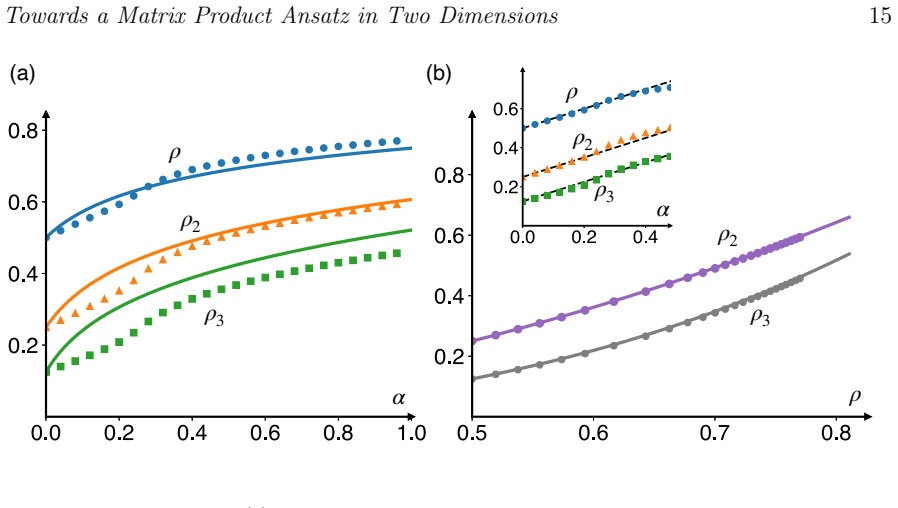
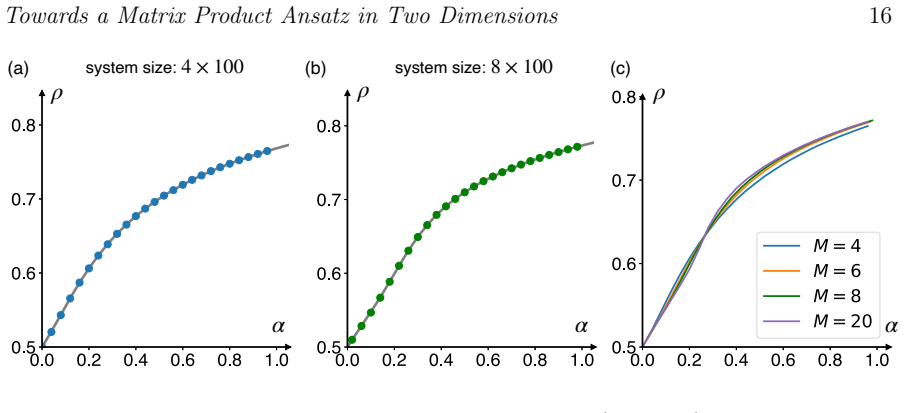

read the original abstract
Matrix product ansatz (MPA) is a powerful framework for constructing exact steady state weights of one dimensional non-equilibrium stochastic processes; but its generalization to higher dimensions is limited. Here, we introduce the MPA formalism for two dimensions (2D). As a concrete application, we introduce and exactly solve a non-conserved assisted exclusion model (NAEM) in one and two dimensions with constrained hopping and local birth-death dynamics: a particle can hop to a neighbouring site only when exactly one of its neighbouring sites is vacant, while creation and annihilation occur exclusively at sites whose neighbours are all occupied. The MPA yields exact steady-state weights and provides a systematic method to compute observables such as density moments and particle currents. In the particle-conserving limit, the system undergoes an absorbing phase transition at the critical density $\rho_c=\frac12$ with order-parameter exponent $\beta=3$. We further show that the steady state of the NAEM maps exactly onto the well-studied hard-square lattice gas with nearest-neighbour exclusion, thereby providing a nonequilibrium dynamical route to realizing equilibrium states of constrained lattice gases. Our work generalizes matrix-product methods beyond one dimension, establishing a systematic approach to exact solutions of interacting stochastic systems in 2D.
Editorial analysis
A structured set of objections, weighed in public.
Referee Report
Summary. The manuscript introduces a two-dimensional generalization of the matrix product ansatz (MPA) for constructing exact steady-state weights of non-equilibrium lattice models. It defines the non-conserved assisted exclusion model (NAEM) with constrained hopping and local birth-death dynamics, claims an exact MPA solution in both 1D and 2D, demonstrates that the NAEM steady state maps exactly onto the hard-square lattice gas with nearest-neighbor exclusion, and reports an absorbing phase transition at critical density ρ_c = 1/2 with exponent β = 3 in the particle-conserving limit.
Significance. If the 2D MPA closure holds, the work would be significant for extending exact-solution techniques beyond one dimension and for supplying a dynamical realization of equilibrium constrained lattice gases. The explicit mapping to the independently studied hard-square model supplies external grounding and allows cross-checks of observables such as density moments and currents. The parameter-free character of the mapping and the systematic computation of moments are strengths that would remain valuable even if the 2D construction requires further elaboration.
major comments (2)
- [§4] §4 (2D MPA construction and closure): The central claim that the generalized matrix-product state remains an exact eigenvector of the full 2D master operator after every local update (assisted hop, birth, death) rests on an unproven cancellation of tensor contractions over overlapping plaquettes. The algebraic relations inherited from the 1D quadratic algebra are stated but not shown to factorize identically for 2D neighborhoods; without this explicit verification the exactness assertion for the 2D NAEM is not secured.
- [§5.2] §5.2 (phase-transition analysis): The reported order-parameter exponent β = 3 and the location ρ_c = 1/2 are obtained from the mapping to the hard-square gas, yet the manuscript does not demonstrate that the MPA-derived steady-state weights reproduce the known equilibrium critical behavior of that model to the required precision; a direct comparison of the MPA density moments against the hard-square series expansion would be needed to confirm consistency.
minor comments (2)
- [Figure 2] Figure 2: the schematic of the 2D tensor network is helpful but the bond indices and contraction order are not labeled, making it difficult to verify the claimed factorization.
- [Abstract] The abstract states that observables are computed 'systematically' from the MPA; a short explicit example (e.g., the expression for the current in terms of the matrices) should be added in the main text for reproducibility.
Simulated Author's Rebuttal
We thank the referee for the careful reading of the manuscript and the constructive comments. We address each major comment in turn and indicate the changes that will be incorporated in the revised version.
read point-by-point responses
-
Referee: [§4] §4 (2D MPA construction and closure): The central claim that the generalized matrix-product state remains an exact eigenvector of the full 2D master operator after every local update (assisted hop, birth, death) rests on an unproven cancellation of tensor contractions over overlapping plaquettes. The algebraic relations inherited from the 1D quadratic algebra are stated but not shown to factorize identically for 2D neighborhoods; without this explicit verification the exactness assertion for the 2D NAEM is not secured.
Authors: We agree that the manuscript would be strengthened by an explicit demonstration of the tensor cancellations on overlapping plaquettes. The algebraic relations are constructed so that the 1D quadratic algebra extends consistently to 2D, but we will add a dedicated appendix (or expanded subsection) that performs the explicit contraction for representative 2D neighborhoods, including assisted hops, birth, and death processes. This calculation will verify that all overlapping contributions cancel identically, thereby securing the exactness claim for the 2D case. revision: yes
-
Referee: [§5.2] §5.2 (phase-transition analysis): The reported order-parameter exponent β = 3 and the location ρ_c = 1/2 are obtained from the mapping to the hard-square gas, yet the manuscript does not demonstrate that the MPA-derived steady-state weights reproduce the known equilibrium critical behavior of that model to the required precision; a direct comparison of the MPA density moments against the hard-square series expansion would be needed to confirm consistency.
Authors: Because the mapping between the NAEM steady-state weights and the hard-square lattice gas is exact and parameter-free, all moments and critical properties are identical by construction. Nevertheless, we accept that an explicit cross-check would be useful. In the revision we will add a short comparison of the first few density moments obtained from the MPA against the known low-density series expansions for the hard-square model, confirming numerical agreement up to the precision available from the series. revision: yes
Circularity Check
No significant circularity; derivation grounded by external mapping
full rationale
The paper generalizes the 1D matrix-product ansatz to 2D and applies it to the NAEM, claiming exact steady-state weights via algebraic closure under local updates. The key result is an exact mapping of the NAEM steady state onto the independently studied hard-square lattice gas with nearest-neighbour exclusion. This external equivalence supplies non-circular grounding. No quoted step reduces a prediction or uniqueness claim to a fitted parameter, self-definition, or load-bearing self-citation chain; the 2D closure is presented as a derived property rather than an input renamed as output. The construction remains self-contained against the external benchmark.
Axiom & Free-Parameter Ledger
axioms (1)
- domain assumption A steady state exists and satisfies the master equation for the continuous-time Markov process defined by the hopping, birth, and death rules.
Lean theorems connected to this paper
-
IndisputableMonolith/Cost/FunctionalEquation.leanwashburn_uniqueness_aczel unclear?
unclearRelation between the paper passage and the cited Recognition theorem.
the matrix-product ansatz for the two-dimensional system is then defined as follows: the steady-state weight P({n_ij}) ... Tr[ ... W1 ⊗ W2 ⊗ ... WL ... ] (Eq. 18); algebra E²=0; D²=αD; (ED)²=αED with α=p/q (Eq. 15)
-
IndisputableMonolith/Foundation/RealityFromDistinction.leanreality_from_one_distinction unclear?
unclearRelation between the paper passage and the cited Recognition theorem.
the steady state of the NAEM maps exactly onto the well-studied hard-square lattice gas with nearest-neighbour exclusion
What do these tags mean?
- matches
- The paper's claim is directly supported by a theorem in the formal canon.
- supports
- The theorem supports part of the paper's argument, but the paper may add assumptions or extra steps.
- extends
- The paper goes beyond the formal theorem; the theorem is a base layer rather than the whole result.
- uses
- The paper appears to rely on the theorem as machinery.
- contradicts
- The paper's claim conflicts with a theorem or certificate in the canon.
- unclear
- Pith found a possible connection, but the passage is too broad, indirect, or ambiguous to say the theorem truly supports the claim.
Reference graph
Works this paper leans on
-
[1]
Tolman R C 1938The Principles of Statistical Mechanics(London: Oxford University Press)
-
[2]
Boltzmann L 1964Lectures on Gas Theory(University of California Press)
-
[3]
Privman V 1997Nonequilibrium Statistical Mechanics in One Dimension(New York: Cambridge University Press)
-
[4]
Schmittmann B and Zia R K P 1995Statistical Mechanics of Driven Diffusive Systems(New York: Academic Press)
-
[5]
Bertini L, De Sole A, Gabrielli D, Jona-Lasinio G and Landim C 2015Reviews of Modern Physics 87593
-
[6]
Marro J and Dickman R 1999Nonequilibrium Phase Transitions in Lattice Models(New York: Cambridge University Press)
-
[7]
Domb C and Lebowitz J L 1972Phase Transitions and Critical Phenomena(New York: Academic Press)
-
[8]
Evans M R, Kafri Y, Koduvely H M and Mukamel D 1998Phys. Rev. Lett.80425
-
[9]
Evans M R 2000Braz. J. Phys.3042
-
[10]
Basu U and Mohanty P K 2010J. Stat. Mech.: Theory Exp.2010L03006
- [11]
-
[12]
Lazarescu A 2015J. Phys. A: Math. Theor.48503001
-
[13]
Chatterjee A K, Basu U and Mohanty P K 2018Phys. Rev. E97052137
-
[14]
Derrida B 2007J. Stat. Mech.: Theory Exp.2007P07023
-
[15]
Basu U and Mohanty P K 2010Phys. Rev. E82041117
-
[16]
Antal T and Sch¨ utz G M 2000Phys. Rev. E6283
- [17]
-
[18]
Hinsch H, Kouyos R and Frey EFrom Intracellular Traffic to a Novel Class of Driven Lattice Gas Models(Springer Berlin Heidelberg) p 205
-
[19]
Gaber M, Ribeiro R H and Kozicki J 2024Powder Technol.433119283
-
[20]
Golinelli O and Mallick K 2006J. Phys. A: Math. Gen.3912679
- [21]
- [22]
-
[23]
Baxter R J 1982Exactly Solved Models in Statistical Mechanics(London: Academic Press)
- [24]
-
[25]
Krug J 1991Phys. Rev. Lett.671882
-
[26]
Derrida B, Domany E and Mukamel D 1992J. Stat. Phys.69667
-
[27]
Derrida B, Evans M R, Hakim V and Pasquier V 1993J. Phys. A: Math. Gen.261493
-
[28]
Hilhorst H J and Appert-Rolland C 2012J. Stat. Mech.P06009
-
[29]
Pronina E and Kolomeisky A B 2004J. Phys. A: Math. Gen.379907
-
[30]
Frey E, Parmeggiani A and Franosch T 2004Genome Informatics1546
-
[31]
Helbing D 2001Rev. Mod. Phys.731067
- [32]
-
[33]
Appert-Rolland C, Chevoir F, Gondret P, Lassarre S, Lebacque J P and Schreckenberg M 2009 Traffic and Granular Flow(Berlin: Springer)
work page 2009
-
[34]
Chatterjee A, Pradhan P and Mohanty P K 2015Phys. Rev. E92032103
-
[35]
Aneva B L and Brankov J G 2016Phys. Rev. E94022138
-
[36]
Chatterjee A and Mohanty P K 2016Phys. Rev. E94062141
-
[37]
Gupta S, Barma M, Basu U and Mohanty P K 2011Phys. Rev. E84041102
-
[38]
Chatterjee A K, Daga B and Mohanty P K 2016Phys. Rev. E94012121
-
[39]
Basu U and Mohanty P K 2009Phys. Rev. E79041143
-
[40]
Chatterjee A and Mohanty P K 2017Phys. Rev. E96042120
-
[41]
Kumar Chatterjee A and Mohanty P K 2017J. Phys. A: Math. Theor.50495001
-
[42]
Evans M R 1997J. Phys. A: Math. Gen.305669 Towards a Matrix Product Ansatz in Two Dimensions24
-
[43]
Blythe R A and Evans M R 2007J. Phys. A: Math. Theor.40R333
- [44]
-
[45]
de Oliveira M J 2005Phys. Rev. E71016112
-
[46]
Gabel A, Krapivsky P L and Redner S 2010Phys. Rev. Lett.105210603
-
[47]
Fisher M E 1963J. Math. Phys.4278
-
[48]
Gaunt D S and Fisher M E 1965J. Chem. Phys.432840
-
[49]
Burley D M 1961 Statistical mechanics of lattice gases
work page 1961
-
[50]
Runnels L K 1967J. Math. Phys.82081
-
[51]
Temperley H N V 1962Proc. Phys. Soc. London80813
-
[52]
Runnels L K 1965Phys. Rev. Lett.15581
-
[53]
Baxter R J, Enting I G and Tsang S K 1980J. Stat. Phys.22465
-
[54]
R´ acz Z 1980Phys. Rev. B214012
-
[55]
Binder K and Landau D P 1980Phys. Rev. B211941
-
[56]
Fernandes H C M, Arenzon J J and Levin Y 2007J. Chem. Phys.126052101
-
[57]
Runnels L K 1972 Lattice-gas modelsPhase Transitions and Critical Phenomenavol 2 ed Domb C and Green M S (London: Academic Press) p 305
work page 1972
-
[58]
Lafuente L and Cuesta J A 2003Phys. Rev. E68066120
- [59]
- [60]
discussion (0)
Sign in with ORCID, Apple, or X to comment. Anyone can read and Pith papers without signing in.