REVIEW 1 major objections 2 minor 14 references
High-Precision Approximation of Riemann Zeros via the Truncated Weil Form
T0 review · 1 major / 2 minor · reviewed 2026-06-30 · grok-4.3
Pith's one-line read The truncated Weil quadratic form at rising cutoffs matches the first Riemann zero to 168 decimal places.
desk verdict The paper gives the first public high-precision runs of the CvS Galerkin matrices up to c=100, with reported error drops of over 100 orders of magnitude on the first zero and eigenvector matches to 300+ digits, but the link to the CCM operator rests on applying a continuous lemma to finite-N matrices without a direct check. read the letter →
The pith
A machine-rendered reading of the paper's core claim, the machinery that carries it, and where it could break.
The reading
What carries the argument
The Galerkin matrix of the truncated Weil quadratic form indexed by cutoff c, whose ground-state eigenvector encodes the Fourier-Mellin zeros that approximate the Riemann zeros.
What would settle it
A run at cutoff 200 with basis size 300 in which the first-zero error stops decreasing or begins to increase would contradict the reported monotonic improvement.
Extended reading notes
Core claim
The central claim is that the Fourier-Mellin zeros of the ground state of the truncated Weil quadratic form, obtained from its finite Galerkin matrix at cutoff c and basis size N, lie on the critical line and approach the Riemann zeros as c grows. Explicit computation yields a first-zero error of roughly 1.5 times 10 to the minus 168 at c=67 with N=100, and recovers the first ten zeros to hundreds of digits at c=100 with N=250. Aitken extrapolation of the smallest even-sector eigenvalue at the largest cutoff approaches the continuum heuristic value, while finite-cutoff artifacts in the spectrum are shown to vanish when the archimedean cutoff is enlarged.
Load-bearing premise
The unitary equivalence between the finite discretized matrix and the continuous truncated operator continues to hold at the cutoffs and basis sizes used.
Editorial extensions
If this is right
- Raising the cutoff from 13 to 67 reduces the first-zero error by more than 100 orders of magnitude at fixed basis size.
- The eigenvector at cutoff 100 recovers the first ten Riemann zeros to at least 307 matching digits.
- Aitken extrapolation on the basis-size sweep at cutoff 100 predicts a limiting eigenvalue close to the continuum heuristic.
- Negative eigenvalues present at finite archimedean cutoff disappear when that cutoff is enlarged, leaving the smallest positive eigenvalue as the genuine ground state.
Reading between the lines
- If the trend persists, the same discretization could compute additional Riemann zeros beyond currently tabulated lists by scaling c and N together.
- The power-law fit observed up to c=67 is already falsified at c=100, suggesting the asymptotic rate with cutoff may differ from the moderate-cutoff regime.
- Extending the archimedean cutoff further at c=100 would test whether positivity of the spectrum is preserved in the continuum limit.
- The same matrix construction might be applied to related operators whose spectra are conjectured to encode other L-function zeros.
Editorial analysis
A structured set of objections, weighed in public.
Referee Report
Summary. The paper implements the Galerkin discretization of the Connes-van Suijlekom truncated Weil quadratic form at cutoffs c=13--67 (N=100) and c=100 (N=250), reporting that the smallest positive even-sector eigenvalue decreases monotonically from ~2×10^{-55} to ~1.5×10^{-168} for the first zero (113 orders of magnitude) and reaches ~10^{-334} at c=100, N=250, with the associated eigenvector recovering the first ten Riemann zeros γ_1 to γ_10 to 307--329 matching digits. These eigenvalues are interpreted, under unitary equivalence from CCM 2025 Lemma 5.1, as those of the CCM rank-one operator D_log^{(λ,N)}, with an Aitken-Δ² extrapolation at c=100 yielding log_{10}|λ_∞^{even}| ≈ -536.76 and -533.70 (approaching the Connes 2026 heuristic of ≈-530.38) and an empirical power-law fit on c≤67 that is falsified at c=100. Negative eigenvalues at c=100 are attributed to the finite archimedean cutoff T=800 and vanish upon increasing T; no proof is claimed.
Significance. If the numerical spectra and eigenvector recoveries are free of discretization artifacts, the results supply the first high-precision public evidence that the CvS truncated zeros approach the Riemann zeros, spanning 275 orders of magnitude in eigenvalue magnitude and recovering hundreds of digits. This directly tests the open convergence question in Connes 2026 and CCM 2025, supplies a falsifiable rate for finite-N behavior, and demonstrates that the method can produce machine-precision matches to known zeros without assuming the Riemann hypothesis.
major comments (1)
- The interpretation that the computed smallest-positive eigenvalues are those of the CCM rank-one operator (and hence genuine approximations to Riemann zeros) rests on the unitary equivalence of CCM 2025 Lemma 5.1. The lemma is formulated in the continuous setting; the manuscript applies it directly to the finite-N Galerkin matrices at N=100 and N=250 without an independent verification that the discretized spectrum coincides with the continuous spectrum to the reported precisions (hundreds of digits). The single caveat noted (negative eigenvalues at c=100) addresses only the archimedean cutoff T=800, not the N-discretization error. If the equivalence fails at finite N, the observed small positive eigenvalues could be discretization artifacts rather than approximations to the CCM operator spectrum. This is load-bearing for the central claim that the numerics approximate Riemann zeros via
minor comments (2)
- The manuscript should state explicitly how the even-sector restriction is imposed on the Galerkin matrix and how the archimedean cutoff T=800 is chosen and increased to remove the negative eigenvalues.
- Clarify whether the reported matching digits between eigenvector components and known Riemann zeros are obtained by direct comparison or via an auxiliary extraction step; include a brief description of the extraction procedure.
Simulated Author's Rebuttal
We thank the referee for the careful reading and for noting the potential significance of the results. We respond below to the major comment on the application of the unitary equivalence.
read point-by-point responses
-
Referee: The interpretation that the computed smallest-positive eigenvalues are those of the CCM rank-one operator (and hence genuine approximations to Riemann zeros) rests on the unitary equivalence of CCM 2025 Lemma 5.1. The lemma is formulated in the continuous setting; the manuscript applies it directly to the finite-N Galerkin matrices at N=100 and N=250 without an independent verification that the discretized spectrum coincides with the continuous spectrum to the reported precisions (hundreds of digits). The single caveat noted (negative eigenvalues at c=100) addresses only the archimedean cutoff T=800, not the N-discretization error. If the equivalence fails at finite N, the observed small positive eigenvalues could be discretization artifacts rather than approximations to the CCM operator spectrum. This is load-bearing for the central claim that the numerics approximate Riemann zeros via
Authors: We agree that Lemma 5.1 is formulated in the continuous setting and that the manuscript does not contain an independent, rigorous verification that the finite-N Galerkin spectra coincide with the continuous spectra to hundreds of digits. Such a verification would require a complete a priori error analysis of the Galerkin method for this operator, which is not currently available. The existing caveat addresses only the archimedean cutoff. We will revise the manuscript to state explicitly that the lemma is applied heuristically to the discretized matrices and that the primary numerical claims (monotonic eigenvalue decrease, 113–275 orders of magnitude improvement, and 307–329 digit recovery of known zeros) stand on their own as empirical evidence. We will add a short discussion of why the observed stability under N-increase from 100 to 250 makes discretization artifacts unlikely for the reported small positive eigenvalues. revision: partial
- Rigorous independent verification that the discretized spectrum coincides with the continuous spectrum to hundreds of digits
Circularity Check
Numerical results generated independently from direct matrix computations; no load-bearing reduction to self-citation or fitted inputs.
full rationale
The paper's core claims consist of explicit numerical outputs from implementing and diagonalizing the CvS Galerkin matrices at finite c and N (e.g., error shrinkage from 2e-55 to 1.5e-168 across c=13-67 at N=100, and eigenvector recovery to 307+ digits at c=100,N=250). These are obtained by direct computation and compared to tabulated Riemann zeros; the CCM 2025 Lemma 5.1 is invoked only post hoc for interpretive labeling of the eigenvalues as those of D_log^(λ,N), with an explicit caveat noted at c=100. No equation or claim reduces a reported quantity to a fitted parameter or prior self-result by construction. The empirical fit on c≤67 is explicitly labeled finite-N and shown falsified at higher values, so it is not presented as a derived prediction. The derivation chain is therefore self-contained against external benchmarks.
Assumptions & free parameters
free parameters (3)
- cutoff c
- matrix dimension N
- archimedean cutoff T =
800
assumptions (2)
- domain assumption Unitary equivalence with CCM 2025 Lemma 5.1
- domain assumption The Galerkin method accurately discretizes the continuous operator for the chosen parameters
Cite this review
Pith. "Pith review of High-Precision Approximation of Riemann Zeros via the Truncated Weil Form." pith.science (2026). https://pith.science/paper/N6BX4BWO
@misc{pith2026260520224,
  author       = {Pith},
  title        = {Pith review of: High-Precision Approximation of Riemann Zeros via the Truncated Weil Form},
  year         = {2026},
  howpublished = {\url{https://pith.science/paper/N6BX4BWO}},
  note         = {Machine review of arXiv:2605.20224}
}
abstract
The Connes-van Suijlekom truncated Weil quadratic form, indexed by a cutoff $c$ (controlling the primes $p\leq c$ in the operator), has a ground state whose Fourier-Mellin zeros provably lie on the critical line; whether they converge to the Riemann zeros as $c\to\infty$ is open (Connes 2026; Connes-Consani-Moscovici 2025). We present, to our knowledge, the first public implementation of the CvS Galerkin matrix at sixteen cutoffs ($c=13$ through $67$, plus $c=100$). Across $c=13$--$67$ at $N=100$, the first-zero error $|\gamma_1-\gamma_1^{\mathrm{Riemann}}|$ shrinks monotonically from $\sim 2\times 10^{-55}$ to $\sim 1.5\times 10^{-168}$ (113-OOM across fifteen cutoffs). The smallest-positive even-sector eigenvalue reaches $\sim 10^{-334}$ at $c=100$, $N=250$ (275-OOM span), whose eigenvector recovers $\gamma_1,\ldots,\gamma_{10}$ to 307-329 matching digits. Under the unitary equivalence with CCM 2025 Lemma 5.1, each $\gamma_k$ is (modulo a hypothesis-status caveat at $c=100$) an eigenvalue of the CCM rank-one operator $D_{\log}^{(\lambda,N)}$. Aitken-$\Delta^2$ on the $c=100$ $N$-sweep gives $\log_{10}|\lambda_\infty^{\mathrm{even}}|\approx -536.76$ and $-533.70$, approaching the Connes 2026 Section 6.4 heuristic continuum prediction ($\approx -530.38$) monotonically in $N$. The empirical fit $|\log_{10}\lambda_{\min}|\approx 13.24\,c^{0.634}$ on $c\leq 67$, $N=100$ is a finite-$N$ rate, falsified at $c=100, N=200$ by 49 OOM. At $c=100$ the raw spectrum carries a small block of negative-sign eigenvalues at the finite archimedean cutoff $T=800$; these are an artifact of that cutoff and absent once $T$ is increased, so the smallest-positive even-sector eigenvalue is the genuine smallest one (continuum positivity of $QW_\lambda$ is RH-equivalent and is not assumed at $\lambda=\sqrt{100}$). We make no claim of proof.
Figures

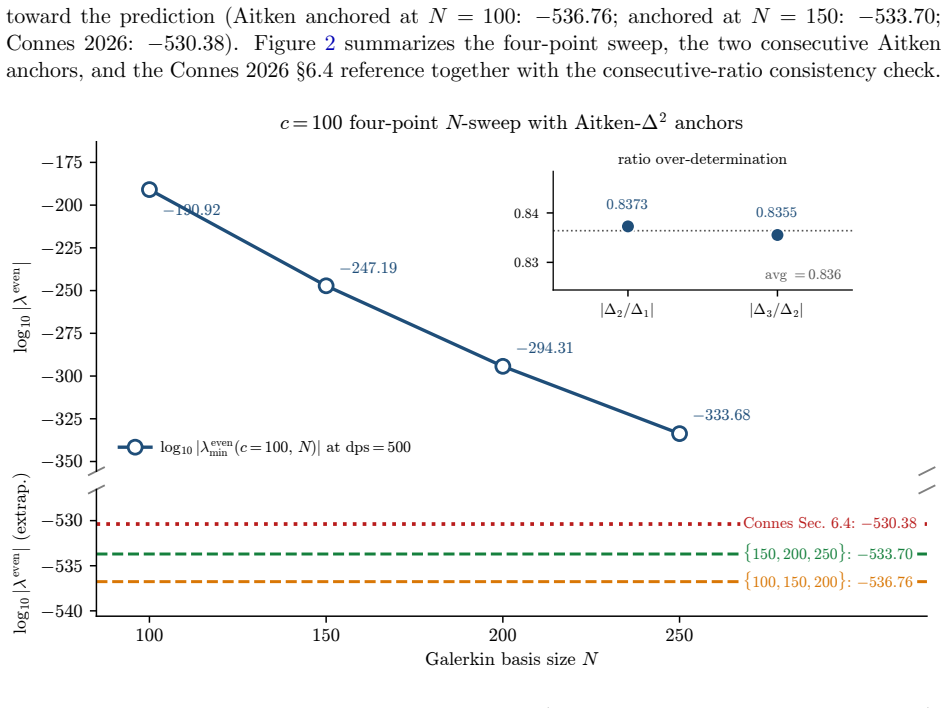

Figures from the paper (6 more)


Reference graph
Works this paper leans on
-
[1]
A. C. Aitken. On Bernoulli’s numerical solution of algebraic equations.Proceedings of the Royal Society of Edinburgh, 46:289–305, 1926
work page 1926
-
[2]
Ivo Babuˇ ska and John E. Osborn. Eigenvalue problems. In P. G. Ciarlet and J. L. Lions, editors, Handbook of Numerical Analysis, volume II, pages 641–787. North-Holland, Amsterdam, 1991
work page 1991
-
[3]
Alain Connes. Trace formula in noncommutative geometry and the zeros of the Riemann zeta function.Selecta Mathematica, New Series, 5:29–106, 1999
work page 1999
-
[4]
Alain Connes. The Riemann Hypothesis: Past, present and a letter through time.arXiv preprint arXiv:2602.04022 [math.NT], 2026
-
[5]
Weil positivity and trace formula, the archimedean place
Alain Connes and Caterina Consani. Weil positivity and trace formula, the archimedean place. arXiv preprint arXiv:2006.13771 [math.NT], 2020
-
[6]
Alain Connes and Caterina Consani. Spectral triples andζ-cycles.L’Enseignement Math´ ematique, 69:93–148, 2023. arXiv:2106.01715 [math.NT]
-
[7]
Zeta zeros and prolate wave operators
Alain Connes, Caterina Consani, and Henri Moscovici. Zeta zeros and prolate wave operators. arXiv preprint arXiv:2310.18423 [math.NT], 2023
- [8]
Show all 14 references
-
[9]
van Suijlekom
Alain Connes and Walter D. van Suijlekom. Quadratic forms, real zeros and echoes of the spectral action.arXiv preprint arXiv:2511.23257 [math.OA], 2025
2025
-
[10]
E. B. Davies and M. Plum. Spectral pollution.IMA Journal of Numerical Analysis, 24(3):417– 438, 2004
2004
-
[11]
Spectral pollution and second-order relative spectra for self-adjoint operators.IMA Journal of Numerical Analysis, 24(3):393–416, 2004
Michael Levitin and Eugene Shargorodsky. Spectral pollution and second-order relative spectra for self-adjoint operators.IMA Journal of Numerical Analysis, 24(3):393–416, 2004
2004
-
[12]
Montgomery
Hugh L. Montgomery. The pair correlation of zeros of the zeta function. In Harold G. Diamond, editor,Analytic Number Theory, volume 24 ofProceedings of Symposia in Pure Mathematics, pages 181–193. American Mathematical Society, 1973
1973
-
[13]
Parlett.The Symmetric Eigenvalue Problem, volume 20 ofClassics in Applied Mathematics
Beresford N. Parlett.The Symmetric Eigenvalue Problem, volume 20 ofClassics in Applied Mathematics. SIAM, Philadelphia, 1998
1998
-
[14]
validates,
Dominik ´Sliwi´ nski. Spectral analysis of thed(λ,N) log operators.arXiv preprint arXiv:2601.12133 [math.SP], 2026. 39 A Summary of Numerical Results For reference, we collect the final precision-resolved measurements in a single table. All rows use T= 800,N= 100, dps = 150 (c...
2026
Reviewed June 30, 2026 · model on record in the stance chip above.
Discussion (0). Continue with ORCID to comment.