pith. machine review for the scientific record. sign in

math.NT

Number Theory

Prime numbers, diophantine equations, analytic number theory, algebraic number theory, arithmetic geometry, Galois theory

0
math.NT 2026-05-13 Recognition

Rational simplices allow any positive rational squared edge length above codim 2

Squared edge lengths of regular simplices with rational vertices

The classification via quadratic forms shows complete freedom once ambient dimension exceeds simplex dimension by three or more.

abstract click to expand
We determine exactly which positive rational numbers occur as squared edge lengths of regular $d$-simplices with vertices in $\mathbb{Q}^n$. The answer exhibits a sharp stabilization phenomenon: once $n-d\geq 3$, every positive rational number occurs, while codimensions $0$, $1$, and $2$ are governed by explicit square-class, norm-group, and Hilbert-symbol conditions. The proof reduces simplex realizability to the Hasse--Minkowski classification of rational quadratic forms.
0
0
math.NT 2026-05-13 3 theorems

Weil group fails to make number fields K(π,1) spaces

Weil-Moore anima

A new anima with the Weil group as fundamental group adds higher homotopy to produce better-behaved cohomology.

abstract click to expand
The Weil group of a number field is a refinement of its absolute Galois group arising from class field theory. The passage from Galois to Weil is important in several places in number theory. However, we will argue that while from the Galois perspective, a number field is a ``K($\pi$,1)'', from the Weil perspective it is not. Thus we are led to further refine the Weil group, by constructing an object, the Weil-Moore anima, which has the Weil group as its fundamental group, but with nontrivial higher homotopy groups. Our motivation is that the cohomological properties of Weil-Moore anima are in several ways nicer than those of the Weil or Galois groups.
0
0
math.NT 2026-05-13 Recognition

Canonical quadratic points on genus-4 curves are big on key families

Bigness of Canonical Quadratic Points on Curves of Genus 4

This yields explicit non-torsion rational points on elliptic curves and Northcott finiteness for their heights.

abstract click to expand
A central problem in arithmetic geometry is to construct non-torsion rational points on elliptic curves. We study a canonical quadratic point $\xi_C \in {\rm Jac}(C)$ attached to a smooth non-hyperelliptic curve of genus 4 and use it to produce such points on elliptic curves arising from families of genus $4$ curves. We introduce a notion of bigness for sections of abelian schemes and establish a criterion in terms of modular variation of abelian quotients, using adelic line bundles and Betti maps. As applications, we prove that $\xi_C$ is big on the triple-involution locus and on certain CM families, obtaining in particular non-torsion rational points on the associated elliptic curves and Northcott-type finiteness results.
0
0
math.NT 2026-05-13 2 theorems

Structural conditions give explicit permutation quadrinomials over F_{q^2}

Explicit determination of a class of permutation rational functions in any characteristic

Analysis of rational functions permuting μ_{q+1} produces concrete forms for small-degree cases and unifies earlier results in any field.

abstract click to expand
In this paper, we make use of the classification results of low-degree permutation rational functions together with their geometric properties to investigate rational functions that induce permutations on the multiplicative subgroup mu_q+1, where q is a prime power. By carefully analyzing the structural conditions under which such rational functions permute muq+1, we obtain an explicit description of a broad class of permutation rational functions of small degree. As a direct application of these findings, we explicitly determine many permutation quadrinomials over Fq2 that are induced by degree-3 rational functions permuting muq+1. Our approach not only unifies and extends several existing results in the literature but also provides a concrete geometric perspective for characterizing permutation polynomials over Fq2.
0
0
math.NT 2026-05-12 2 theorems

2D progressions avoiding squares capped at T to the 20/27

Two dimensional arithmetic progressions avoiding squares

The bound improves earlier work and connects directly to the size of the least quadratic non-residue modulo a prime.

abstract click to expand
We show that any proper symmetric two dimensional arithmetic progression contained in the interval $[-T,T]$ which avoids non-zero perfect squares has at most $O_\varepsilon(T^{20/27+\varepsilon})$ elements. This improves on a result of Croot, Lyall and Rice. We also discuss lower bounds for this problem and their connections to bounds for the least quadratic non-residue modulo a prime.
0
0
math.NT 2026-05-12 3 theorems

K2 element proven 2-indivisible for elliptic curves

The 2-part of the Bloch-Kato conjecture, and indivisibility results, for K₂ of some elliptic curves

The proof aids verification of the 2-part of the Bloch-Kato conjecture at s=2 for a family of curves.

abstract click to expand
For certain integers $u$, we investigate the 2-part of the Bloch-Kato conjecture for $L(E_u,2)$, where $E_u: y^2=x(x+1)(x+u^2)$ is part of a (twisted) Legendre family that is 2-isogenous to a family studied by Boyd. For this, we first work out the corresponding 2-parts of the Tamagawa factors and Galois invariants. Then we give an explicit description of the 2-torsion in the Selmer group $H_f^1(\mathbb{Q},E_u[2^\infty](-1))$. We construct a specific element in the kernel of the tame symbol for $K_2$ on an integral model of $E_u$, with non-vanishing real and 2-adic regulators. Using techniques involving the norm residue isomorphism of Merkur'ev-Suslin, we prove indivisibility of this element by 2 in that kernel, even modulo torsion, even though it is explicitly divisible by 2 in the kernel of the tame symbol for $K_2$ on $E_u$. We also bound the 2-divisibility of the images of these elements under the 2-adic regulator map. Finally, in many cases we investigate numerically the validity of the 2-part of the Bloch-Kato conjecture.
0
0
math.NT 2026-05-12 2 theorems

Congruential Euler numbers satisfy p-adic congruences and yield zeta expressions

p-adic Congruencens of Generalized Euler Numbers and Relations to Even Zeta Value

The relations answer a Lehmer-number conjecture and connect the numbers to even zeta values via complex analysis.

abstract click to expand
In this article, we introduce congruential Euler numbers, which are a further generalization of generalized Euler numbers. We prove the $p$-adic congruences of congruential Euler numbers, which include answers to a conjecture related to Lehmer numbers. We also provide expressions of even zeta values using congruential Euler numbers via complex analysis.
0
0
math.NT 2026-05-12 2 theorems

Reciprocal sum over subsum polynomials has arithmetic properties

Reciprocals of Subsum Polynomials

For all partitions of n the sum connects to other combinatorial objects via proved polynomial traits.

abstract click to expand
We introduce the subsum polynomial of a partition $\lambda=(\lambda_1, \lambda_2, \ldots, \lambda_k)$ defined by $\mathrm{sp}(\lambda, x)=\prod_{i=1}^k(1+x^{\lambda_i})$. We study the sum of reciprocals of $\mathrm{sp}(\lambda, x)$ over all partitions of $n$. We prove arithmetic properties of related polynomials and offer connections to other combinatorial objects.
0
0
math.NT 2026-05-12 3 theorems

Proven: two-color partition function equals Hecke double sum

Proof of a conjecture of Andrews and Bachraoui on a Hecke sum

Generating function with odd smallest part matches conjectured analytic sum via indefinite theta functions.

abstract click to expand
In this paper, we prove a conjecture of Andrews and Bachraoui relating a generating function arising from two-color partitions (with odd smallest part and restrictions on the even parts) to a Hecke-type double sum. Our proof is based on Zwegers' theory of indefinite theta functions together with modular transformation properties of mock theta functions.
0
0
math.NT 2026-05-12 Recognition

Explicit Galois descent reduces max-height t-values to MZVs

An explicit Galois descent for multiple t-values of maximal height

The formula derived from iterated beta integrals makes Murakami's motivic result computable and yields concrete half-zeta evaluations.

abstract click to expand
We give an explicit formula for the Galois descent expressing multiple $t$-values of maximal height in terms of classical multiple zeta values, making precise Murakami's earlier motivic result. Our results rely on the theory of iterated beta integrals. We apply this formula to obtain evaluations of various multiple zeta-half values.
0
0
math.NT 2026-05-12 1 theorem

Serre derivative keeps zeros on modular form lower boundary

The Serre Derivatives and Zeros of Modular Forms

If every zero of a weakly holomorphic form sits on the lower arc, the derivative keeps them there too.

abstract click to expand
Since the work of F. Rankin and Swinnerton-Dyer on the zeros of Eisenstein series, many results have been obtained concerning the zeros of modular forms. In this paper, we study the zeros of Serre derivatives of modular forms. In particular, we prove that if all the zeros of a weakly holomorphic modular form in the standard fundamental domain lie on the lower boundary, then the same property holds for its Serre derivative.
0
0
math.NT 2026-05-12 2 theorems

Syntomic cohomology congruences match Breuil-Kisin modules at double precision

Congruences of first syntomic cohomology groups

For reflexive F-gauges on O_K, isomorphism of first cohomology groups mod p^n is equivalent to isomorphism of the attached modules mod p^{2n

abstract click to expand
Let O_K be the ring of integers of a finite extension K of Q_p. Given two reflexive F-gauges on O_K, we show that for large enough n, the mod p^n-reductions of their first syntomic cohomology groups, which might be regarded as a refinement of local Bloch--Kato Selmer groups, are isomorphic if and only if the mod p^{2n}-reductions of their attached Breuil--Kisin modules with G_K-actions and Nygaard filtrations are isomorphic.
0
0
math.NT 2026-05-11 1 theorem

Upper bound for smallest simultaneous Ramanujan prime in Maass forms

On Ramanujan Primes for Hecke-Maass Cusp Forms

The result also supplies an explicit lower bound on the density of primes satisfying the conjecture for at least one form in a finite set.

abstract click to expand
For a primitive Hecke-Maass cusp form $\phi$ of level $N$ with the $n$-th Hecke eigenvalue $\lambda_{\phi}(n)$ and a prime number $p\nmid N$, the celebrated Ramanujan conjecture at $p$ asserts the following sharp upper bound: \[ |\lambda_{\phi}(p)| \leq 2. \] In this work, we determine an upper bound for the least prime $p$ at which the Ramanujan conjecture holds for two or three distinct primitive Hecke-Maass cusp forms simultaneously. Moreover, given a set of distinct primitive Hecke-Maass cusp forms $\{\phi_i\}$, we also provide a lower bound for the lower natural density of the set of primes at which the Ramanujan conjecture holds for at least one of the $\phi_i$'s.
0
0
math.NT 2026-05-11 Recognition

Binary expansion of weight fixes exact 2-adic valuation of Eisenstein coefficients

Lacunary recurrences and 2-adic properties of Eisenstein series

The formula determines the lowest power of 2 dividing any coefficient when G_k is written as a polynomial in G_4 and G_6.

abstract click to expand
We study the rational coefficients that arise when the Eisenstein series $G_k$ is expressed as a polynomial in $G_4$ and $G_6$. We prove a recent conjecture giving an exact formula for the minimal 2-adic valuation of these coefficients in terms of the binary expansion of the weight. The proof uses lacunary recurrences for Eisenstein series.
0
0
math.NT 2026-05-11 2 theorems

Miller form zeros track unit arc or log Szegő curve by δ

The variation of zeros of the Miller basis

Below δ ≈ 0.6194 they stay on the unit circle at large weight; near δ = 1 they follow the logarithmic Szegő curve.

Figure from the paper full image
abstract click to expand
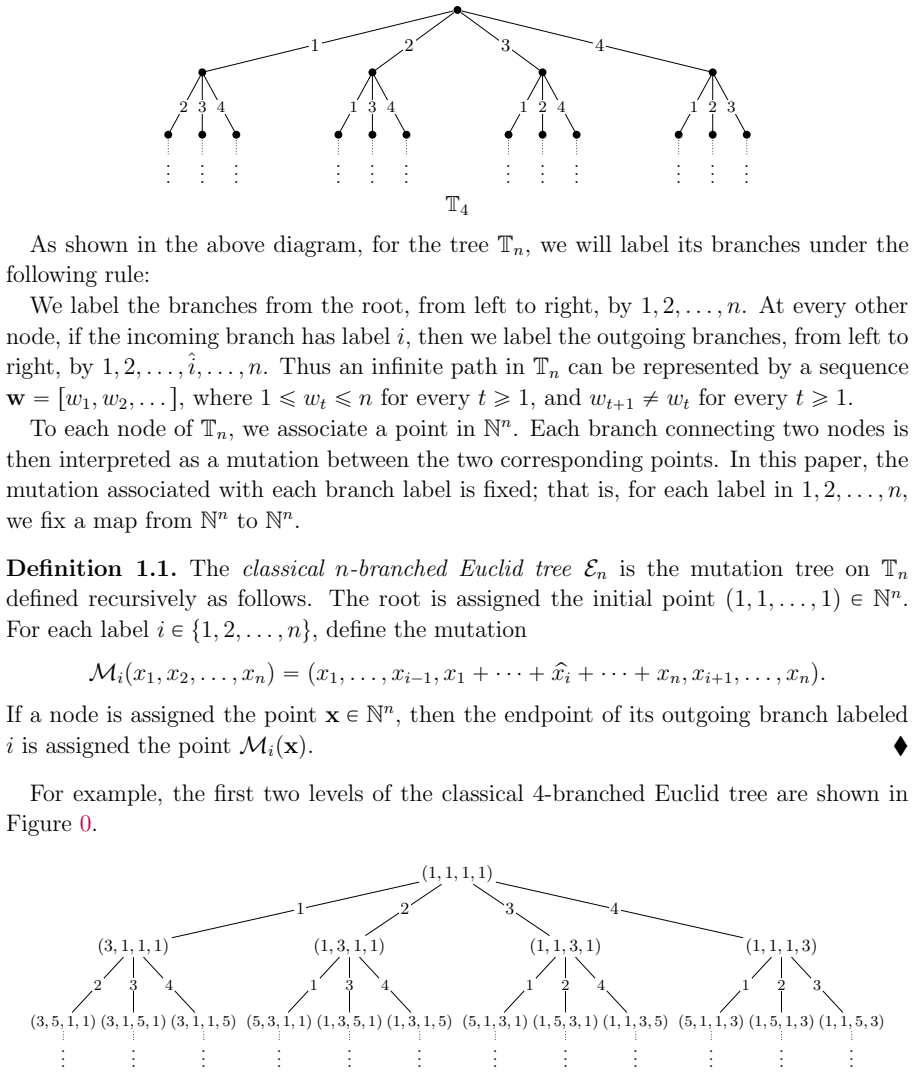
We exhibit a connection between the variation of zeros in the Miller basis of modular forms $q^m+O(q^{\ell+1})$ and a logarithmic version $\mathcal{S}_\delta$ of the Szeg\H{o} curve, where $\delta=m/\ell$. When $\delta<0.6194$ we show that all the zeros are on the unit arc for $k\gg 0$, while if $\delta$ is asymptotically close to 1, we show that all the zeros lie on $\mathcal{S}_{\delta}$. In general, we posit that for all $\delta$, the zeros are located on the union of the unit arc and the log Szeg\H{o} curve, obtaining a partial result, and find conjectural thresholds for $m/\ell$ with all zeros on the unit arc, and no zeros on the arc. Finally, we enumerate all algebraic zeros of Miller forms up to $\ell-m\leq 25$.
0
0
math.NT 2026-05-11 2 theorems

r_k(n) summation formula now covers Whittaker functions

An analogue of a formula of Popov II

The identity previously shown for Bessel functions extends to Whittaker functions with a new proof technique.

abstract click to expand
Let $r_{k}(n)$ denote the number of representations of the positive integer $n$ as the sum of $k$ squares. We prove a generalization of a summation formula already proved by us [Advances in Applied Mathematics, 175 (2026) 103201], which involves the arithmetical function $r_{k}(n)$ and the Bessel functions of the first kind. We extend the Bessel functions in the aforementioned formula to Whittaker functions, and our proof of this generalization is drastically different from the proof of the particular case presented in [Advances in Applied Mathematics, 175 (2026) 103201].
0
0
math.NT 2026-05-11 2 theorems

Cusp form eigenvalue convolution reaches distribution exponent 1/2 + 1/70

On the exponent of distribution for convolutions of operatorname{GL}(2) coefficients to smooth moduli

The bound holds when the modulus is square-free and has only small prime factors, giving a power saving beyond the square-root level.

abstract click to expand
Let $(\lambda_f(n))_{n\geqslant1}$ be the Hecke eigenvalues of a holomorphic cusp form $f$. We prove that the exponent of distribution of $\lambda_f*1$ in arithmetic progressions is as large as $\frac{1}{2}+\frac{1}{70}$ when the modulus $q$ is square-free and has only sufficiently small prime factors.
0
0
math.NT 2026-05-11 2 theorems

Sum of short-interval zeros for L-functions mod P exceeds T² P sqrt(log P)

Low-Lying Zeros on the Critical Line for Families of Dirichlet L-Functions

The total count across all characters holds for T down to 1/sqrt(log P) after a high-dimensional Mellin transform removes the mollifier's in

abstract click to expand
In this paper, we establish a new lower bound for the number of low-lying zeros of Dirichlet $L$-functions $L(s, \chi)$ on the critical line within extremely short intervals. Specifically, for a sufficiently large prime $P$ and real number $T \in [a_1/\sqrt{\log P}, 1]$, we prove that the sum of the number of zeros on the critical line $N_0(T, \chi)$ over characters $\chi \bmod P$ satisfies $$ \sum_{\chi \bmod P} N_0(T, \chi) \gg T^2 P\sqrt{\log P} .$$ Traditional approaches encounter significant technical barriers in this short-interval regime. The Levinson method fails due to its own inherent limitations in handling such restricted intervals , while standard applications of the Selberg mollifier are hindered by the emergence of complex, inseparable cross-terms that are difficult to evaluate. To overcome these obstacles, we introduce a novel analytic framework utilizing high-dimensional Mellin transforms. This approach systematically manages the multi-variable series generated by the mollifier calculations. By explicitly resolving these cross-term obstructions, we extract the localized lower bound, providing a robust method that circumvents the short-interval bottleneck and offers potential applicability to the zero statistics of higher-rank $L$-function families.
0
0
math.NT 2026-05-11 Recognition

GRH ensures nonvanishing Taylor coefficients for large quadratic twists

On the coefficients of the Taylor expansion of L-functions of elliptic curves

Conditional proof for all sufficiently large discriminants plus an unconditional lower bound on their count via moment estimates.

abstract click to expand
In this paper, we investigate the coefficients of the Taylor expansion of the complex $L$-series of any elliptic curve over $\mathbb{Q}$. We prove that, in the family of quadratic twists by all the discriminants $d$, these coefficients are nonvanishing under GRH when $d$ is sufficiently large. Unconditionally, we obtain a general lower bound for the number of nonvanishing coefficients in the family of quadratic twists, through a series of results from the moments of the central values of the derivatives of quadratic twists of modular $L$-function.
0
0
math.NT 2026-05-11 2 theorems

Improved bound limits rational points on smooth surfaces in P^3

Rational points on smooth surfaces in mathbb{P}³ over finite fields

Families attaining or approaching the bound have exact point counts computed explicitly.

abstract click to expand
We improve a bound due to the second author on number of rational points on smooth surfaces in $\mathbb{P}^3$ over finite fields and look at families of surfaces that achieve or nearly achieve this bound, for which we compute their exact number of rational points. These computations may have independent interest.
0
0
math.NT 2026-05-11 Recognition

λ₂ vanishes for certain real quadratic fields where 2 splits

On the Iwasawa λ-invariant of the cyclotomic mathbb{Z}₂-extension of a family of real quadratic fields in which 2 splits

Square-class computation of Hasse unit index ≤2 enables Greenberg's criterion to prove the result for K=Q(√(pq)) under symbol conditions.

abstract click to expand
We study Greenberg's conjecture for cyclotomic $\mathbb{Z}_2$-extensions of real quadratic fields. Let $K=\mathbb{Q}(\sqrt{pq})$, where $$ p\equiv 1 \mod 8,\qquad q\equiv 9 \mod {16},\qquad \left(\frac{p}{q}\right)=-1. $$ Under the additional assumptions $$ \left(\frac{2}{p}\right)_4 \left(\frac{2}{q}\right)_4 \left(\frac{pq}{2}\right)_4=-1 $$ and $$ \left(\frac{2}{p}\right)_4=-1 \quad\text{or}\quad \left(\frac{2}{q}\right)_4=-1, $$ we prove that $\lambda_2(K)=0$. The proof combines Greenberg's criterion for the split prime case with a capitulation argument modeled on Kumakawa. The main new input is a square-class computation of the Hasse unit index of the biquadratic extension $K_2=\mathbb{Q}(\sqrt{pq}, \sqrt{2+\sqrt{2}})/\mathbf{Q}_1=\mathbb{Q}(\sqrt{2})$, showing that $q(K_2)\le 2$.
0
0
math.NT 2026-05-11 2 theorems

Merkurjev construction yields non-R-trivial similitudes in degree 6

Non-R-trivial proper projective similitudes in type A₃equiv D₃

Algebras with orthogonal involution admit proper projective similitudes outside R-equivalence when the field has an anisotropic torsion 3-

abstract click to expand
Over an arbitrary field of characteristic different from $2$ admitting an anisotropic torsion $3$-fold Pfister form, we apply a construction due to Merkurjev to produce an algebra with orthogonal involution of degree $6$ which admits proper projective similitudes that are not $R$-trivial. In particular, such examples exist over every finitely generated transcendental extension of a local or global number field, as well as over every finitely generated extension of transcendence degree $3$ of $\mathbb{R}$.
0
0
math.NT 2026-05-11 Recognition

New integrals express Catalan's constant in one or more dimensions

Multiple integral representations of the Catalan's constant

A general theorem yields a single-integral form while the Lerch function supplies multiple-integral versions in two or higher dimensions.

abstract click to expand
In this paper, we present several novel integral representations of Catalan's constant. We begin by deriving an initial result expressed as a double integral. Subsequently, as a consequence of this result, we establish a general theorem that enables the representation of Catalan's constant in terms of a single integral. Finally, we provide a multiple integral representation of Catalan's constant in dimensions greater than or equal to two using the Lerch function. The results are accompanied by illustrative examples.
0
0
math.NT 2026-05-11 Recognition

Algorithm factors rational-power semiprimes in cubic log time

Rational Base Descent: A Deterministic Algorithm for Factoring Structured Semiprimes

It isolates a factor in O(log cubed N) steps when one prime approximates c times (a/b) to the n and includes a search for the right base.

abstract click to expand
We present a special-purpose algorithm for factoring semiprimes $N = pq$ in which one prime factor satisfies $p \approx c\,(a/b)^n$ for positive integers $a, b, c, n$ with $a > b$ and $\gcd(a,b) = 1$. Given the correct parameters $(a, b)$, the algorithm isolates a factor in ${O}(\log^3 N)$ time when $a/b$ is bounded away from $1$, and the cofactor $q$ is unconstrained beyond a mild size bound. We describe a search strategy over $(a, b)$ using primitivity filters, give a complexity analysis showing that the method poses no threat to balanced RSA semiprimes, and provide a gmpy2-based Python implementation.
0
0
math.NT 2026-05-11 2 theorems

Densities of k-th prime divisors not unimodal for k at least 4

A Complete Answer to ErdH{o}s Problem 690

An exact difference criterion plus one large prime gap force a descent followed by ascent for every such k.

abstract click to expand
Let \(d_k(p)\) denote the natural density of positive integers whose \(k\)-th smallest prime divisor is \(p\). Erd\H{o}s asked whether, for each fixed \(k\), the sequence \(p\mapsto d_k(p)\) is unimodal as \(p\) ranges over the primes. Cambie proved that unimodality holds for \(1\le k\le3\) and verified non-unimodality for \(4\le k\le20\). We prove that \(p\mapsto d_k(p)\) is not unimodal for every \(k\ge4\), completing the classification. An exact first-difference criterion reduces the problem to comparing a symmetric-polynomial ratio with prime gaps. Explicit estimates for prime-counting functions, certified finite computations, one certified large prime gap, one certified twin prime, and a uniform Chinese-remainder construction then produce, for every \(k\ge4\), a strict descent followed by a later strict ascent.
0
0
math.NT 2026-05-11 Recognition

Chang's lemma gains cosetwise correlation control

A strengthening of Chang's lemma

Characters outside the low-dimensional large-spectrum subspace now have small l1-average correlation over the cosets of its orthogonal, plus

abstract click to expand
We prove a strengthening of Chang's lemma for subsets of $\mathbb F_p^n$. The classical conclusion that the large spectrum is contained in a subspace of dimension at most $2\varepsilon^{-2}\log(1/\alpha)$ is refined to show that every character outside this subspace has small correlation with the set not only globally, but also on average over the cosets of the orthogonal complement, in a natural cosetwise $\ell^1$ norm. As a consequence, we obtain a localized counting lemma. We also give an extension of the argument to arbitrary finite abelian groups.
0
0
math.NT 2026-05-11 Recognition

Modified recipe fixes secondary term in L-function moments along cosets

Remarks on the distribution of Dirichlet L-functions along cosets

Dependence between root numbers and coefficients along cosets explains the extra term missed by the standard CFKRS prediction.

abstract click to expand
In a previous work with B. Garcia, the author considered the asymptotic for the second moment of Dirichlet $L$-functions along cosets, and exhibited a surprising secondary main term that is not predicted by the recipe of Conrey, Farmer, Keating, Rubinstein, and Snaith. In this paper, we re-examine this problem and propose a modified recipe that correctly predicts this secondary main term. The original recipe gives the incorrect answer for this family because the root number is not always independent of the Dirichlet series coefficients along certain cosets, and our proposed fix simply takes this feature into account. In addition, we consider a handful of other problems related to Dirichlet $L$-functions along cosets. One goal is to reformulate Heath-Brown's $q$-analog of van der Corput's shifting method in terms of cosets, which leads to an upper bound on a hybrid second moment. We also revisit the classical van der Corput bound and view it (in more modern terms) as an amplified second moment of a trigonometric polynomial.
0
0
math.NT 2026-05-11 3 theorems

CM orders in ordinary isogeny classes follow weighted class number laws

Weighted Distributions of Complex Multiplication Orders in Ordinary Isogeny Classes

This yields an explicit horizontal density of 1/(2h(D)) for primes admitting a fixed order, complementary to vertical conductor structure.

abstract click to expand
We develop a global arithmetic framework for studying endomorphism rings inside ordinary elliptic isogeny classes over finite fields. Let p be a prime and let I(t,p) be an ordinary isogeny class over the finite field F_p with Frobenius trace t. The discriminant Delta = t^2 - 4p can be written as Delta = v^2 D_K, where D_K is the fundamental discriminant of an imaginary quadratic field K. In this setting, the possible endomorphism rings are precisely the quadratic orders O_f = Z + f O_K, with f dividing v. Building on Deuring's correspondence, we express the distribution of these orders in terms of weighted class numbers h*(D) = h(D)/w(D), and obtain explicit formulas for global distributions across the entire isogeny class. This approach goes beyond the classical local viewpoint, where the endomorphism ring is constant along each level of an ell-isogeny volcano. In particular, we introduce weighted exact and cumulative distributions of endomorphism rings. These distributions induce canonical laws for the ell-adic valuation of conductors and recover the vertical stratification of ell-volcanoes in an averaged sense. On the global side, by varying the prime p, we relate the existence of curves with a prescribed CM order O_D to splitting conditions in the associated ring class field L_D. Using the Chebotarev density theorem, we obtain the natural density 1/(2h(D)) for primes admitting CM by O_D. This gives a horizontal distribution law complementary to the vertical conductor distribution. These results establish a unified perspective linking Deuring theory, isogeny graph geometry, and class field theory. They also provide a natural framework for quantitative and algorithmic studies of ordinary isogeny classes.
0
0
math.NT 2026-05-11 Recognition

Seed prime q constructs larger prime N via cubic congruence

A Deterministic Cryptographic Prime Generation Chain over Monogenic Cubic Number Fields and their Generalizations

Monogenic pure cubic fields prove primality of the constructed N with one modular exponentiation in quadratic log time.

abstract click to expand
Generating primes is a fundamental problem in modern cryptography. Deterministic primality tests work well for special integers such as Mersenne or Proth primes, but these forms are quite restrictive. In this paper, we give a direct method to construct new primes from known ones. Starting with a seed prime $q \equiv 1 \pmod{3}$, we construct an integer $N \equiv 1 \pmod{3}$ satisfying $(2N + 1)^2 \equiv -3 \pmod{q}$. We then prove that $N$ is prime using the structure of monogenic pure cubic fields $K = \mathbb{Q}(\sqrt[3]{d})$. The resulting test requires only a single modular exponentiation and runs in $\tilde{\mathcal{O}}(\log^2 N)$ time. Finally, we show how this construction extends to pure number fields of arbitrary prime degree.
0
0
math.NT 2026-05-11 2 theorems

Explicit Anderson generating functions for rank-one Drinfeld modules at higher-degree inf

Anderson generating function of rank-one Drinfeld Module over rational function fields

The standard residue formula fails for places of degree N greater than 1 due to Galois action, but an exponential modification restores it.

Figure from the paper full image
abstract click to expand
We establish a fundamental breakthrough in rank-one Drinfeld module arithmetic by deriving explicit formulas over the integral domain $\A = H^{0}(\mathbb{P}^1-P_{\rho}, \mathcal{O}_{\mathbb{P}^1})$, which generalizes the classical polynomial ring ($N=1$) to the projective line associated with an infinite place of degree $N \geqslant 2$. This fills a longstanding gap by developing a comprehensive parallel to Carlitz module theory foundational in positive characteristic arithmetic for the understudied case of infinite places of degree $>1$. We construct Anderson generating functions for these modules and link them to the Carlitz period via Pellarin's series, exponential torsion modules, and logarithmic deformations. These constructions provide powerful tools for studying such Drinfeld modules and their associated $L$-series, central to modern number theory. A key result reveals a critical distinction from Carlitz theory: the standard Anderson generating function residue formula fails due to Galois group action. We resolve this obstruction by introducing an exponential action, enabling simultaneous study of all twisted exponential functions a major methodological advance. We further show that Anderson generating function computation involves the dual of Drinfeld modules, leading to an appropriate residue formula modification. Notably, our natural approach generalizes to arbitrary Dedekind domains, extending our results beyond $\A$ and opening new avenues in Drinfeld module theory.
0
0
math.NT 2026-05-08 2 theorems

α n^d mod 1 shows Poissonian ℓ-point correlations for large d

Poissonian correlations of α n^d mod 1

For almost all α the sequence behaves like random points in the unit interval once the exponent grows with ℓ.

abstract click to expand
Let $x(n):=\alpha n^d \mod 1$ for integer $d >1$ and non-zero real $\alpha$. We show that $\{x(n)\}_{n>0}$ has Poissonian $\ell$-point correlations for almost all choices of $\alpha$ when $d$ is large (depending on $\ell$). This falls in line with the expected behavior from the Berry--Tabor conjecture. Further, in the spirit of a conjecture of Rudnick--Sarnak, we show Poissonian $\ell$-point correlations for a set of badly approximable $\alpha$ of full Hausdorff dimension by a Fourier analytic transference principle. The proof makes use of an application of the determinant method to count points on a diagonal hypersurface of degree $d$ in such a way as to capture the contribution of points belonging to lower dimensional varieties. As $d$ grows, these `special solutions' dominate the count and non-special solutions become increasingly rare. This stratified counting statement allows us to control the number of points on average very effectively.
0
0
math.NT 2026-05-08 Recognition

Odd-degree forms have many almost-prime solutions with enough variables

On almost primes solutions to forms of odd degrees in many variables

When s exceeds a bound depending only on R and d, the count of solutions where each coordinate is a bounded factor times a prime reaches N^{

abstract click to expand
Let $\mathcal{F}=\{f_1,\ldots,f_R\}$ be a family of forms of odd degrees at most $d$ in $s$ variables. We study the solutions to the system $f_1(\mathbf{x})=\ldots=f_R(\mathbf{x})=0$ of the form $x_i=y_ip_i$ with $|y_i|\leq Y_\mathcal{F}$ and $p_i$ being a prime for all $i\in [s]$ inside the box $[-N,N]^s$, for large $N$. We show that if the number of variables $s$ is sufficiently large with respect to the parameters $R$ and $d$, then there are at least $C_\mathcal{F} N^{s-D}/(\log\,N)^s$ such solutions for some constants $C_\mathcal{F}>0$ and $D\in\mathbb{N}$, with $D$ depending only on the initial parameters $R$ and $d$.
0
0
math.NT 2026-05-08 1 theorem

Arithmetic progressions predict frequency order of factorization ratios

Frequency Ordered Ratio Families Arising from the Factorization of p_{m-1}+1

A heuristic model based on primes in arithmetic progressions explains the observed ranking of R_m values from p_{m-1}+1 without parameter t

abstract click to expand
We investigate a ratio sequence derived from the factorization of $p_{m-1}+1$, where $p_n$ denotes the $n$th prime. For each $m \ge 3$, write $p_{m-1}+1 = L_m R_m$ with $L_m$ the largest prime factor. Restricting to those $m$ for which $L_m > m$ (equivalently, $m \in \mathrm{A223881}$), we obtain a multiset of values $R_m$. Sorting the distinct $R_m$ by decreasing frequency yields a new sequence beginning \[ 2,3,4,8,6,12,10,14,15,18,20,24,\dots. \] This article explains how this construction arises naturally from the structure of A223881, why the ``family'' phenomenon appears in plots of $p_{m-1}+1$, and how the frequency ordering of $R_m$ captures the dominant families. Additionally, we propose a heuristic asymptotic model explaining the observed frequency ordering via classical results on primes in arithmetic progressions and support the model with numerical log-log analysis.
0
0
math.NT 2026-05-08

Odd unimodal sequence ranks normalize to hyperbolic secant law

Asymptotic Statistics of Odd Unimodal Sequences: Rank Distributions and Probabilistic Structures

The result gives explicit limiting distributions for rank, peak size, and adjacent parts under the odd-part constraint.

abstract click to expand
Integer partitions have fascinated people for centuries, from Ramanujan's groundbreaking congruences to the modern theory of modular forms. This paper investigates the statistical properties of odd unimodal sequences--a natural refinement where sequences rise to a peak and then fall, but with the constraint that all parts must be odd, and develops a comprehensive statistical theory for their rank and shape parameters. We establish the asymptotic distribution of the rank statistic and demonstrate that, when properly normalized, it converges to the hyperbolic secant distribution. Beyond the rank distribution, limiting distributions of the peak, the largest parts on either side of the peak, and the joint behavior of small parts are also proved. These results reveal a rich probabilistic structure that parallels the classical theory of integer partitions while exhibiting distinctive new features arising from the odd-part constraint. The analysis employs a synthesis of modular transformation theory, false theta function asymptotics, and conditioned Boltzmann models. This extends the probabilistic machinery previously developed for unimodal sequences into a more general and analytically demanding setting, offering a unified approach that bridges modular forms and probability.
0
0
math.NT 2026-05-08

Dense n-dimensional sets contain power configurations

A multidimensional Szemer\'{e}di theorem in integers

Subsets of [N]^n with density (log N)^{-c} must contain x, x+r^{m1}e1, ..., x+r^{mn}en for strictly increasing m_i

abstract click to expand
For any integer $n \geq 2$, let $(m_{1},\ldots,m_{n})$ be a strictly increasing $n$-tuple of positive integers. We show that any subset $A\subset [N]^n$ of density at least $(\log N)^{-c}$ contains a nontrivial configuration of the form \begin{equation*} \boldsymbol{x},\boldsymbol{x}+r^{m_{1}}\boldsymbol{e_{1}},\ldots,\boldsymbol{x}+r^{m_{n}}\boldsymbol{e_{n}}, \end{equation*} where $c=c(n,m_{1},\ldots,m_{n} )$ is a positive constant. This quantitative multidimensional Szemer\'{e}di theorem extends a recent two-dimensional result of Peluse, Prendiville, and Shao concerning the configuration of the form $(x,y),(x+r,y),\left(x,y+r^{2}\right)$. The theorem is obtained as a consequence of an effective ``popular'' version.
0
0
math.NT 2026-05-08

Badly approximable numbers split into winning and losing sets

δ-Badly approximable numbers and ubiquitously losing sets

The Bad(δ) filtration is (1/3,18δ)-winning yet (1/2,18/δ)-ubiquitously losing, forcing its Hausdorff dimension strictly below one.

abstract click to expand
We construct a natural filtration $\boldsymbol{\operatorname{Bad}}(\delta) \subset \boldsymbol{\operatorname{Bad}}(\delta')$ for $\delta \geq \delta'>0$ on the set of badly approximable numbers to complement the filtration of the well approximable numbers by the $\tau$-well approximable numbers. We show that the set $\boldsymbol{\operatorname{Bad}}(\delta)$ is a $(1/3, 18 \delta)$-winning set and give a lower bound on its Hausdorff dimension. We introduce the notion of $(\alpha, \beta)$-$\textit{ubiquitously losing sets}$ to the theory of Schmidt games, give an upper bound on the Hausdorff dimension of an $(\alpha, \beta)$-ubiquitously losing set that is strictly less than full Hausdorff dimension, show that $\boldsymbol{\operatorname{Bad}}(\delta)$ is a $(1/2, 18/\delta)$-ubiquitously losing set, and give an upper bound on the Hausdorff dimension of $\boldsymbol{\operatorname{Bad}}(\delta)$ that is strictly less than one. Combined with a finite intersection property and a bilipschitz transfer property, we obtain results for finite intersections of translates of $\boldsymbol{\operatorname{Bad}}(\delta)$.
0
0
math.NT 2026-05-08

Nonlinear cubic Euler sums reduce to zeta and polylog values

Evaluation of eight different families of cubic Euler sums

All sums in the eight families for degrees four through six evaluate using only zeta numbers and Li4(1/2) to Li6(-1/8).

abstract click to expand
We present a study on cubic Euler sums of degree four, five and six, where three different types of denominators $1/k^n$, $1/((2k-1)^n)$ and $1/(k(2k-1))$ will be considered We demonstrate that for all three orders the complete variety of corresponding nonlinear Euler sums belonging to the eight different families can be explicitly calculated in terms of zeta values and polylogarithmic values $Li_4(1/2)$, $Li_5(1/2)$, $Li_6(1/2)$, $Li_6(-1/2)$ and $Li_6(-1/8)$.
0
0
math.NT 2026-05-08

Polynomial P reduces recurrence quotients to multi-recurrences

The quotient problem for linear recurrence sequences

For m ≠ n, d P(n) U(m)/V(n) satisfies a multi-recurrence while V(n)/P(n) satisfies a linear recurrence, constraining all nearly-integer quot

abstract click to expand
Let $\{U(m)\}_{m\in \N}$ and $\{V(n)\}_{n\in \N}$ be linear recurrence sequences. It is a well-known Diophantine problem to determine the finiteness of the set of natural numbers $n$ such that the ratio $U(n)/V(n)$ is an integer. We study the finiteness problem for the set $(m, n)\in \mathbb{N}^2$ such that there exist non-zero positive integers $d_{m, n}$ satisfying $\log |d_{m, n}|=o(n)$, and $d_{m, n}U(m)/V(n)$ is an element from a finitely generated subring of $\C$. In particular, we prove that for $m\neq n $, there exists a polynomial $P$ such that $d_{m, n}P(n)U(m)/V(n)$ is a multi-recurrence and $V(n)/P(n)$ is a linear recurrence and for $m=n$ both $d_{m, n}P(n)U(m)/V(n)$ and $V(n)/P(n)$ are linear recurrences. To prove our results, we employ Schmidt's subspace theorem, and the concept of moving hyperplanes, moving polynomials, and moving points.
0
0
math.NT 2026-05-08

Rankin-Selberg coefficients distribute at level 2/5 + 3/305 modulo prime powers

Rankin--Selberg coefficients in arithmetic progressions modulo prime powers

Assuming the Ramanujan-Petersson conjecture, the squares of these coefficients are shown to be well-distributed in arithmetic progressions p

abstract click to expand
Let $\varepsilon>0$ be given. For prime power moduli $q=p^k$ with $k\geq 2$ and $p\neq 3$, and assuming the Ramanujan--Petersson conjecture for $\GL_2$ Maass forms, we prove that the Rankin--Selberg coefficients $\{\lambda_f(n)^2\}_{n\geq 1}$ have a level of distribution $\theta=2/5+3/305-\varepsilon$ in arithmetic progressions $n \equiv a \bmod q$.
0
0
math.NT 2026-05-08

Modular iterated integrals match multiple L-functions for all forms

Multiple modular L-functions and modular iterated integrals

Prior proofs needed vanishing constant terms; this removes the limit and proves the general case via a specialized functional equation.

abstract click to expand
The connection between multiple modular L-functions, as defined by Manin in [5], and modular iterated integrals was made explicit by Choie and Ihara [3] under the restrictive assumption that all modular forms involved have vanishing constant terms in their q-expansions. In this paper, we remove the assumption and establish the relationship between modular iterated integrals and multiple modular L-functions for general modular forms, including those with nonzero constant terms. We also provide a proof of a functional equation for modular iterated integrals, which is a specialization of a general result obtained by Brown [2]. This leads us to a generalization of the result of Choie-Ihara [3]. In the final part of the paper, we compute explicit examples of modular iterated integrals. These calculations essentially reproduce the explicit initial computations carried out by Brown [2], but they also serve to validate the broader framework developed in this work.
0
0
math.NT 2026-05-07

Zeroth and first cohomology computed for LIP sheaf on Kirch topology

A Structure Sheaf for Kirch Topology

Basic open covers suffice for Cech calculations, extending analytic methods to the naturals via this connected topology.

abstract click to expand
Kirch topology on $\mathbb N$ goes back to 1969, and is remarkable for being Hausdorff, connected, and locally connected. In this sense, it is analogous to the usual topology on $\mathbb C,$ yet, to the author's knowledge, there have been no Kirch topology analogs of the sheaf of complex-analytic functions until very recently. In our latest paper we constructed such natural sheaf of rings, the sheaf of locally LIP functions. In this paper we investigate some of its basic properties, primarily regarding zeroth and first cohomology and Cech cohomology with respect to covers by basic open sets.
0
0
math.NT 2026-05-07 2 theorems

G_p at tenth root equals non-residue sign for p mod 40

On a polynomial involving quadratic residues modulo primes

The product over exp(2πi k²/p) equals (-1) to the non-residue count in a p/10-length interval, or that times ζ², when p ≡ 21 or 29 mod 40.

abstract click to expand
Let $p$ be an odd prime, and define $$G_p(x)=\prod_{k=1}^{(p-1)/2}\left(x-e^{2\pi i k^2/p}\right).$$ In this paper we study values of $G_p(x)$ at roots of unity via Galois theory, and confirm some previous conjectures. For example, for any primitive tenth root $\zeta$ of unity, we prove that $$G_p(\zeta)=\begin{cases}(-1)^{|\{1\le k\le \frac {p+9}{10}:\ (\frac kp)=-1\}|} &\text{if}\ p\equiv21\pmod{40}, \\(-1)^{|\{1\le k\le\frac {p+1}{10}:\ (\frac kp)=-1\}|}\zeta^{2}&\text{if}\ p\equiv 29\pmod{40}, \end{cases}$$ where $(\frac kp)$ denotes the Legendre symbol.
0
0
math.NT 2026-05-07

Non-residue count fixes G_p value at tenth root of unity

On a polynomial involving quadratic residues modulo primes

For p congruent to 21 or 29 mod 40 the product over exp(2 pi i k^2/p) equals (-1) to a Legendre count or that times zeta squared.

abstract click to expand
Let $p$ be an odd prime, and define $$G_p(x)=\prod_{k=1}^{(p-1)/2}\left(x-e^{2\pi i k^2/p}\right).$$ In this paper we study values of $G_p(x)$ at roots of unity via Galois theory, and confirm some previous conjectures. For example, for any primitive tenth root $\zeta$ of unity, we prove that $$G_p(\zeta)=\begin{cases}(-1)^{|\{1\le k\le \frac {p+9}{10}:\ (\frac kp)=-1\}|} &\text{if}\ p\equiv21\pmod{40}, \\(-1)^{|\{1\le k\le\frac {p+1}{10}:\ (\frac kp)=-1\}|}\zeta^{2}&\text{if}\ p\equiv 29\pmod{40}, \end{cases}$$ where $(\frac kp)$ denotes the Legendre symbol.
0
0
math.NT 2026-05-07

Appell functions prove Garvan-Mukhopadhyay mock theta identities

Appell function proofs of recent and old mock theta function identities

By placing them in the same framework as Ramanujan's tenth- and sixth-order notebook entries

abstract click to expand
In this note we give new proofs of two recent mock theta function identities discovered by Garvan and Mukhopadhyay. We also give a new proof of an old mock theta function identity of Watson. Using the setting of Appell function properties as first introduced and developed by Hickerson and Mortenson, we demonstrate that the identities are similar to certain tenth-order and sixth-order mock theta function identities found in Ramanujan's lost notebook. Our approach suggests more identities like those of Garvan and Mukhopadhyay.
0
0
math.NT 2026-05-07

Theta transformations prove McIntosh q-series conjectures

Theta functions and transformations of bilateral basic hypergeometric series

Bilateral basic hypergeometric series gain formulas that produce companion pairs with simple asymptotic quotients.

abstract click to expand
We establish new transformation formulas involving theta functions for certain bilateral basic hypergeometric series. From these, we construct companion $q$-series for a class of $q$-series such that the asymptotic expansion of their quotient admits a simple closed form. This allows us to prove some conjectures of McIntosh on asymptotic transformations of $q$-series.
0
0
math.NT 2026-05-07

Cohomology of SL_n congruence subgroups surjects onto building homology

The top cohomology of principal congruence subgroups of special linear groups over Euclidean number rings

For every prime p in any Euclidean number ring, with isomorphism under extra conditions on p.

Figure from the paper full image
abstract click to expand
For $R$ a Euclidean number ring, and let $\Gamma_n(p)$ be the level-$p$ principal congruence subgroup of $\text{SL}_n(R)$. Borel--Serre showed that the cohomology of $\Gamma_n(p)$ vanishes above a degree $\nu$ that is quadratic in $n$. Let $K$ be the fraction field of $R$, and $\mathcal{T}_n(K)$ the Tits building of $\text{SL}_n(K)$. For $R=\mathbb{Z}$, Lee--Szczarba asked when $\text{H}^\nu(\Gamma_n(p))$ is isomorphic to $\widetilde{\text{H}}_{n-2}(\mathcal{T}_n(K)/\Gamma_n(p))$, which was answered by Miller--Patzt--Putman. We study a generalized version of Lee--Szczarba's question. We prove that for a prime $p$ in a Euclidean number ring $R$ with fraction field $K$, that a natural map $\text{H}^\nu(\Gamma_n(p)) \to \widetilde{\text{H}}_{n-2}(\mathcal{T}_n(K)/\Gamma_n(p))$ is always surjective, and give a sufficent set of conditions on $p \in R$ that guarantee when this map is an isomorphism.
0
0
math.NT 2026-05-07

Generalized Markov-Hurwitz equations obey logarithmic asymptotics

The Logarithmic Asymptotic Phenomenon for Generalized Markov-Hurwitz Equations

Adding degree n-1 terms and extending to n variables still yields a logarithmic pattern for the positive integer solutions.

Figure from the paper full image
abstract click to expand
The purpose of this paper is twofold. First, we introduce a family of generalized Markov-Hurwitz equations, extending classical Markov-Hurwitz equations with additional degree n-1 interaction terms, Gyoda and Matsushita's generalized Markov equations from 3 variables to n variables. Second, we prove a logarithmic asymptotic phenomenon for the positive integer solutions of these equations.
0
0
math.NT 2026-05-07

Jacobi sum identities yield multiplicative f-ic forms on varieties

Multiplicative f-ic forms on algebraic varieties arising from Thaine's generalized Jacobi sums

Extending Davenport-Hasse to products of primes produces f-ic forms on complete intersections with compatible torus group law.

abstract click to expand
We study generalized Jacobi sums, cyclotomic numbers, and $d$-compositions in Thaine's framework, and prove new multiplicative identities extending Davenport and Hasse's lifting theorem from the classical prime-power setting to products of prime powers. As applications, we construct multiplicative forms of degree $f\ge2$, i.e. $f$-ic forms, on complete intersections of $f$-ics. This places Pfister's theory of multiplicative quadratic forms over fields within the broader setting of multiplicative $f$-ic forms on affine algebraic varieties, where new phenomena arise. Moreover, a dense open subset $W \subset V$ carries the structure of an algebraic torus, and the multiplicative form is compatible with the induced group law on $W$.
0
0
math.NT 2026-05-07

Minimal lengths found for Jordan matrix vector representations

Non-Expansive Matrix Based number Systems

For the 2 by 2 block with eigenvalue 1 and the two-vector digit set, the shortest sum length for any integer vector is characterized, with a

abstract click to expand
Let $M = \left(\begin{matrix} 1 & 1 \\ 0 & 1 \end{matrix}\right)$ be a $2 \times 2$ Jordan block with eigenvalue $1$, and let $\mathcal{D} = \{\left(\begin{smallmatrix}0 \\ 1 \end{smallmatrix}\right), \left(\begin{smallmatrix} 0 \\ -1 \end{smallmatrix} \right)\}$. In this paper, we answer a question of Caldwell, Hare, and V\'avra about the minimal length representation of $\left( \begin{smallmatrix} a \\ b \end{smallmatrix} \right) = \sum_{i=0}^{k-1} M^i d_i$ with $d_i \in \mathcal{D}$. Further, we extend the work of Caldwell, Hare, and V\'avra to consider the case of $n \times n$ Jordan blocks with eigenvalue $-1$.
0
0
math.NT 2026-05-07

Exponential sums over singular binary quintics get uniform bounds

Exponential sums over singular binary quintics

Waring decompositions yield estimates valid in every characteristic and extend prior quartic results to non-coregular spaces.

abstract click to expand
We give an estimate of exponential sums over singular binary quintic forms in a characteristic-free form, based on the Waring decomposition of binary forms. This extends the method on our preceding result on the space of binary quartics to a non-coregular space.
0
0
math.NT 2026-05-07

Genus numbers of S3×Cq fields have explicit averages and moments

Statistics of the Genus Number of S₃ times C₂ and D₄-fields

The same statistics extend to D4 and pure quartic fields; heuristics predict density zero for any fixed positive genus number in some larger

abstract click to expand
The genus number of a number field is a fundamental invariant which measures the contribution of ramification to its ideal class group. In this paper, we establish the statistics for the genus number for $S_3\times C_q$-fields for $q\neq 3$ a prime number, $D_4$-fields and pure quartic fields. We also obtain precise results on the average and higher moments of the genus distribution within the family of $S_3\times C_q$-fields. Finally, based on heuristics, we formulate a conjecture identifying families for which one should expect the genus density to be zero, i.e., only a density zero subset of fields in the family attains any fixed genus number.
0
0
math.NT 2026-05-07

Principal units filtration computes G_m-cohomology for p-adic Stein spaces

mathbb{G}_m-cohomology of p-adic Stein spaces

The split allows p-adic Hodge theory for the units subgroup and Kummer sequences for the quotient, applying to Drinfeld upper half-space.

abstract click to expand
We compute the \'etale $\mathbb{G}_m$-cohomology of some $p$-adic rigid analytic Stein spaces. The computation is done by considering the filtration induced by the subgroup of principal units $U=1+ \mathfrak{m} \mathcal{O}^+$ of $\mathbb{G}_m$. We then determine the $U$-cohomology via methods from $p$-adic Hodge theory (passage to the pro-\'etale site, comparison theorems with $p$-adic cohomologies), while the $\mathbb{G}_m/U$-cohomology is obtained using Kummer exact sequences. In particular, our formula applies to the case of Drinfeld upper-half space.
0
0
math.NT 2026-05-07

Multiplicative signs yield exponentially small logarithmic sums at many scales

Small values of signed harmonic sums and logarithmic means of multiplicative functions

The sums fall below exp(-c N^{1/3}/(log N)^{1/3}) for infinitely many N, even when restricted to dense subsets of the naturals.

abstract click to expand
We construct sequences $\{a_n\}_{n\in\mathbb{N}}\in\{-1,1\}^{\mathbb{N}}$ with small values of signed harmonic sums \[ \sum_{n\in\mathcal{A}\cap[1,N]}\frac{a_n}{n}, \] for any reasonably dense subsets $\mathcal{A}\subset\mathbb{N}.$ We apply these methods to further construct completely multiplicative functions $f:\mathbb{N}\to\{-1,1\}$ with unusually small logarithmic partial sums, that is, \[ \sum_{n \leq N}\frac{f(n)}{n} \ll \exp\left(-c_0 \frac{N^{1/3}}{(\log N)^{1/3}} \right) \] holds for infinitely many $N\to\infty$. The proofs combine careful analysis of the small-scale distribution of random harmonic sums over subsets of $\mathbb{N}$, together with deterministic inductive arguments inspired by the ``anatomy" of integers.
0
0
math.NT 2026-05-07

Ceiling continued fractions bound Erdős-Straus counterexamples

A Ceiling Continued Fraction Approach to the ErdH{o}s-Straus Conjecture: Heuristic finiteness of counterexamples

Super-polynomial failure probability decay and Borel-Cantelli suggest only finitely many exceptions

abstract click to expand
We introduce the Ceiling Continued Fractions (FCT) framework for constructing three-term Egyptian fraction representations in the Erdos-Straus conjecture. The approach exploits divisor structures of shifted integers p+i rather than congruence-based techniques. Computational tests on 10^9 primes in ranges around 10^17 and 10^52, and 10^7 primes around 10^131, show no counterexamples with very small search depth. We derive a super-polynomial upper bound on the failure probability; its convergence, together with the Borel-Cantelli lemma, provides heuristic evidence that counterexamples, if any exist, form a finite set.
0
0
math.NT 2026-05-07

Chebyshev maps fix explicit numbers of points modulo p^k

Fixed-point lifting and ghost periodic points for Chebyshev polynomials modulo odd prime powers

For p at least 5 the count is N1 plus d times (p to the min of k-1 and v_p(n^2-1) minus 1), with ghost points appearing on orbit lifts.

abstract click to expand
Let $p$ be an odd prime, let $n\ge2$, and let the $n$th Chebyshev polynomial $T_n$ act on $\Z/p^k\Z$. We count fixed and exact-periodic points, allowing non-permutation degrees, and organize the finite-field formulas by the two source groups needed for prime-power lifting. Over $\Fp$ we record the four-GCD fixed-point formula \[ N_1=\frac{\gcd(n-1,p-1)+\gcd(n+1,p-1)+\gcd(n-1,p+1)+\gcd(n+1,p+1)-2\delta}{2}, \] where $\delta=\gcd(n-1,2)$. The proof separates split and nonsplit source groups for $a=(\zeta+\zeta^{-1})/2$ and counts degenerate fixed residues branch-wise. For every odd $p$, \[ N_2=N_1+d(p-1). \] Here $d$ denotes the number of fixed residue classes $a\in\Fp$ for which \(T_n'(a)\equiv1\pmod p\). For $p\ge5$ and all $k\ge1$, \[ N_k=N_1+d\bigl(p^{\min(k-1,\nup(n^2-1))}-1\bigr). \] This all-level formula does not extend unchanged to $p=3$, where boundary $p$-adic estimates at $a=\pm1$ can fail; the first-lift formula remains valid. For periods, we use the Chebyshev order \[ \cord_e(n)=\min\{r\ge1:n^r\equiv\pm1\pmod e\}. \] A source-order-$e$ point is periodic over $\Fp$ exactly when $\gcd(n,e)=1$, with period $\cord_e(n)$. M\"obius inversion for the iterates $T_{n^j}$ gives exact-period point counts over $\Z/p^k\Z$ for all odd $p$; for $p\ge5$, the all-level fixed-point formula gives closed forms. When $p\nmid n$, orbitwise lifting modulo $p^2$ gives either full period retention or one Hensel lift plus ghost periodic points of period $\cord_{ep}(n)$. For $p\ge5$, higher lifts above a periodic residue are governed by the tower $\cord_{ep^q}(n)$.
0
0
math.NT 2026-05-07

Piatetski-Shapiro floors contain thin h-bases for h at least 5

Thin subbases of Piatetski-Shapiro sequences

Subsets of floor(n^c) can be thinned so their h-sums match any regularly varying count up to the density bound.

abstract click to expand
For a non-integral real number $c>1$, let $\mathbb{N}_{(c)}:=\{\lfloor n^c\rfloor ~|~ n\in\mathbb{N}\}$. We show that $\mathbb{N}_{(c)}$ contains thin subbases of every order $h\geq 5$ when $1<c<2$, and $h\geq (\lfloor 2c\rfloor+1)(\lfloor 2c\rfloor+2)+1$ when $c>2$. In fact, for every regularly varying function $F$ such that \[ \frac{F(x)}{\log x}\to\infty\quad\text{ and } \quad F(x)\leq (1+o(1))\frac{\Gamma(1+1/c)^h}{\Gamma(h/c)} x^{h/c-1}, \] there exists $A\subseteq\mathbb{N}_{(c)}$ with $r_{A,h}(n)\sim F(n)$. We also establish analogous results for $k$-th powers of Piatetski-Shapiro numbers and Piatetski-Shapiro primes for small $c$.
0
0
math.NT 2026-05-07 3 theorems

Most correspondences on P1 have only finitely many long rational orbits

Rational orbits under correspondences

For each n at least 12, only the known exceptional correspondences allow infinitely many rational p whose n-fold iterate meets a rational K

abstract click to expand
Consider an algebraic function like $F(x) = \sqrt{x^3 - 1}$. If $p \in \mathbb{Q}$ is a rational number, how many iterates of $p$ under $F$ can also be rational? The dynamics of algebraic functions may be formalized in the language of correspondences on curves and their iterates. In this paper we show that if $F$ is a correspondence from $\mathbb{P}^1$ to itself defined over a finitely generated field $K$ of characteristic 0 satisfying several minor constraints, then either for each $n \geq 12$ there are only finitely many $p \in \mathbb{Q}$ for which $F^n(p)$ contains a $K$-rational point or $F$ belongs to an explicit list of known exceptional correspondences.
0
0
math.NT 2026-05-07 2 theorems

Three non-tempered families proven for Gan-Gross-Prasad conjecture

Special periods and some non-tempered cases of the Gan-Gross-Prasad conjecture

Special periods and theta lift non-vanishing criteria confirm higher-corank cases via Rankin-Selberg integrals.

abstract click to expand
In this paper, we establish a relationship between special periods and special L-values of automorphic representations of classical groups, and prove the non-tempered global Gan--Gross--Prasad conjecture in several cases. Our approach consists of two main steps. First, inspired by Rallis' tower property, we study the interaction between special periods and the tower property for the genericity of global theta lifts. Second, we investigate the relationship between the analytic properties of L-functions and special periods via the Rankin--Selberg integral method. Combining these results with non-vanishing criteria for global theta lifts in terms of various L-values, we prove three explicit higher-corank families of non-tempered cases of the global Gan--Gross--Prasad conjecture.
0
0
math.NT 2026-05-06 3 theorems

Eisenstein Hecke algebra rank matches zeta vanishing order

A new perspective on the rank of Mazur's Eisenstein Hecke algebra

When the rank is two or three, it equals one plus the order of vanishing of the mod-p zeta element interpolating L-values at -1.

abstract click to expand
Let $N, p \geq 5$ be primes such that $N \equiv 1 \bmod p$. We study the rank $r$ of the Hecke algebra that parametrizes modular forms of weight 2 and level $N$ that are Eisenstein modulo $p$. When $r$ is $2$ or $3$, we prove that $r-1$ equals the order of vanishing of the mod-$p$ reduction of a zeta element that interpolates Dirichlet $L$-values at $-1$, thereby recovering results of Merel and Lecouturier. This equality can fail in some cases when $r \geq 4$, and we provide a heuristic explanation of this failure. Our approach handles all of these cases uniformly by studying the analogous Hecke algebra in level $N^2$. When exactly one of $r-1$ or the order of vanishing equals $3$, we provide precise information about Galois orbits of cuspidal newforms in level $N^2$ that are Eisenstein modulo $p$.
0
0
math.NT 2026-05-06

Strassmann theorem extends to several variables

A multivariate Strassmann theorem

Finiteness and cardinality of zeros of convergent power series are read off the reduction of their saturated ideal.

abstract click to expand
By a theorem of Strassmann, a non-zero convergent power series in one variable over a complete non-Archimedean field has finitely many zeros, with an explicit bound on their number. We generalize this result to convergent power series in several variables, characterizing finiteness of the zero set and bounding its cardinality in terms of the reduction of the saturated ideal defined by the power series. We discuss how to make our result effective, under suitable assumptions, when working with approximate power series.
0
0
math.NT 2026-05-06

Any number of L-functions can hit large values together on the critical line

Joint extreme values of L-functions on and off the critical line

Primitive GL(1) and GL(2) functions reach simultaneous high points unconditionally, improving on results that needed the Riemann hypothesis.

abstract click to expand
It is shown that any number of distinct primitive $\mathrm{GL}(1)$ and $\mathrm{GL}(2)$ $L$-functions can simultaneously attain large values on the critical line. This is an unconditional improvement of a general result due to Heap and Li who have assumed the Riemann Hypothesis for more than three such $L$-functions. The joint distribution of $\mathrm{GL}(m)$ $L$-functions to the right of the critical line is also studied under certain zero-density estimates. In particular, we can partially recover results of Inoue and Li on Dirichlet $L$-functions and generally improve upon the work of Mahatab, Pa\'nkowski and Vatwani on the class of $L$-functions introduced by Selberg. The main machinery in both cases, on and off the critical line, is the resonance method of Soundararajan and Hilberdink/Voronin, respectively. On the critical line we additionally introduce a variation of Heath-Brown's method for the fractional moments of the Riemann zeta-function which makes it possible to avoid using any information on the zero distribution of $L$-functions whose degree is less than three.
0
0
math.NT 2026-05-06

Cubic orders embed optimally into 1/3 or 2/3 of maximal orders

Optimal embeddings for maximal orders of central simple algebras of degree 3 over number fields

For degree-3 central simple algebras over number fields, an order from a cubic extension either fails to embed anywhere or succeeds in one-

abstract click to expand
Let $B$ be a central simple algebra of degree 3 over a number field $F$ and $K/F$ be a finite extension of degree 3. For an order $S$ of $K$, we determine exactly when $S$ cannot be optimally embedded into all maximal orders of $B$. Moreover, we further determine exactly when $S$ can be optimally embedded into $\frac{1}{3}$ isomorphism classes of maximal orders of $B$ and $\frac{2}{3}$ isomorphism classes of maximal orders of $B$ in the rest of cases.
0
0
math.NT 2026-05-06

Lectures recast topology as condensed sets for algebraic use

Lectures on Condensed Mathematics

The notes explain how to replace ordinary spaces with sheaves on profinite sets so limits and maps behave algebraically.

abstract click to expand
This is an updated version of the lectures notes for a course on condensed mathematics taught in the summer term 2019 at the University of Bonn. The material presented is joint work with Dustin Clausen. This is intended as a stable citable version of the original lectures, with mostly cosmetic changes to the original document, together with some small corrections.
1 0
0
math.NT 2026-05-06

GL_n cohomology vectors get infinitesimal characters from Galois Sen operators

Infinitesimal characters for the completed cohomology of GL_n over CM fields

Locally analytic parts of Hecke eigenspaces in completed cohomology over suitable CM fields have their infinitesimal characters fixed by the

abstract click to expand
Let $p$ be a prime, and let $F$ be a CM field containing an imaginary quadratic field in which $p$ splits. We show that the locally analytic vectors of Hecke eigenspaces in the ($p$-adic) completed cohomology of $\mathrm{GL}_n/F$, localized at a non-Eisenstein decomposed generic maximal ideal, admit infinitesimal characters determined by the Sen operators of the corresponding Galois representations, thus confirming a conjecture of Dospinescu-Pa\v{s}k\={u}nas-Schraen in this case.
0
0
math.NT 2026-05-06

Mod 2 reductions of crystalline Galois reps fixed by parameters alpha' and alpha

Behaviour of Certain Crystalline Representations modulo 2

Compatibility of 2-adic and mod-2 local Langlands gives explicit semisimplified forms at all slopes in (0,1].

Figure from the paper full image
abstract click to expand
We compute the explicit form of the semisimplified reduction modulo $2$ of the $2$-adic crystalline Galois representations $V_{k,a_2}$ at small slopes in $(0,1]$, using the compatibility of $2$-adic and mod-$2$ local Langlands correspondence. We find parameters $\alpha'(k,a_{2})$ and $\alpha(k,a_{2})$, which play a crucial role in determining the reduction of $V_{k,a_{2}}$ for slopes in the range $(0,1)$ and slope $1$ respectively.
0
0
math.NT 2026-05-06 2 theorems

Sieve finds all power bases in quintic fields in minutes

Monogenity of pure quintic fields: the power of sieving

After LLL reduction, a filter cuts the list of small exponents so every generator can be tested quickly.

abstract click to expand
We provide a simple algorithm for calculating all generators of power integral bases in pure quintic fields. This procedure involves the usual standard elements like Baker's method, LLL-reduction. The main purpose of the paper is to introduce a new idea to considerably diminish the number of small exponents to be considered after the reduction step. This new idea allows to test all remaining small exponents within a few minutes, using an appropriate sieve method, which turns out to be surprisingly fast. This idea will be applicable in many similar cases.
0
0
math.NT 2026-05-06

Sieve finds all power integral bases in quintic fields fast

Monogenity of pure quintic fields: the power of sieving

After Baker and LLL bounds, the sieve reduces candidates so every remaining small exponent can be checked in minutes.

abstract click to expand
We provide a simple algorithm for calculating all generators of power integral bases in pure quintic fields. This procedure involves the usual standard elements like Baker's method, LLL-reduction. The main purpose of the paper is to introduce a new idea to considerably diminish the number of small exponents to be considered after the reduction step. This new idea allows to test all remaining small exponents within a few minutes, using an appropriate sieve method, which turns out to be surprisingly fast. This idea will be applicable in many similar cases.
0
0
math.NT 2026-05-06

Liouville function changes sign in APs by q^{5/2+ε}

Sign changes of the Liouville function in arithmetic progressions

For large primes q the function takes both +1 and -1 values inside every residue class a mod q before reaching that explicit size.

abstract click to expand
We show that for any $\varepsilon > 0$, prime $q$ sufficiently large with respect to $1 / \varepsilon$ and residue class $(a,q) = 1$, there exist two integers $m, n \leq q^{5/2 + \varepsilon}$ with $m \equiv n \equiv a \pmod{q}$ such that $\lambda(m) = -1$ and $\lambda(n) = + 1$, where $\lambda$ denotes the Liouville function. Our result is motivated by Heath-Brown's explicit exponent in Linnik's theorem, establishing the existence of primes $p \equiv a \pmod{q}$ with $p \ll q^{5.5}$.
0
0
math.NT 2026-05-05 Recognition

Infinitely many powerful APs have d = 2√N + 1

Three-term arithmetic progressions of consecutive powerful numbers

The relation forces the first two terms to be consecutive squares while the third stays powerful infinitely often.

abstract click to expand
We show that infinitely many three-term arithmetic progressions $N, N+d, N+2d$ of powerful numbers exist with $d = 2\sqrt{N} + 1$. We further conjecture that infinitely many of these progressions consist of three consecutive terms in the sequence of powerful numbers, which would answer a question of Erd\H{o}s in the negative.
0
0
math.NT 2026-05-05 2 theorems

Conditions yield supercuspidal quotients in GL2 Banach reductions

Reductions of GL₂(mathbb Q_{p^f})-Banach spaces of slopes in (0,1)

For odd p and weights k, the irreducible pieces of filtrations on mod p reductions of integral structures with slope in (0,1) are supercuspi

abstract click to expand
Let $p$ be an odd prime and $f \geq 1$. We consider a $p$-adic locally algebraic $\text{GL}_2(\mathbb Q_{p^f})$-representation attached to a tuple of $f$ weights $k=(k_i)$ for $0 \leq i \leq f-1$ and a $p$-adic integer $a_p$ with valuation in $(0,1)$. We give conditions under which the irreducible quotients of the subquotients in a filtration on the reduction mod $p$ of the natural integral structure on this space are supercuspidal. We also check that for small $k$ and $f$ the integral structure is a lattice so that the mod $p$ reduction is nonzero.
0
0
math.NT 2026-05-05 2 theorems

Modular method for Ax^2 + By^r = Cz^p

The generalized Fermat equation Ax² + By^r = Cz^p and applications

Frey hyperelliptic curves inside Darmon's program let researchers attack mixed-exponent Fermat equations and test a conjecture on 5x^2 + q^{

abstract click to expand
In this paper, we develop the modular method for the generalized Fermat equation appearing in the title, within the framework of Darmon's program and using Frey hyperelliptic curves. As an application, we study a conjecture of Laradji, Mignotte, and Tzanakis concerning the equation $5x^2+q^{2n}=y^5$.
0
0
math.NT 2026-05-05 4 theorems

Cusp forms map to parabolic cohomology via integral transform

Cusp forms and parabolic cohomology classes for symmetric spaces of rank one

Explicit isomorphisms link cusp forms of parameter ν to specific cohomology subspaces uniformly on every rank-one symmetric space.

abstract click to expand
For any rank-one Riemannian symmetric space S of non-compact type and any discrete, cofinite, non-cocompact, torsion-free group $\Gamma$ of orientation-preserving Riemannian isometries on S, we develop a cohomological interpretation for the cusp forms of $\Gamma$. To that end, we identify certain $\Gamma$-submodules of smooth semi-analytic vectors in the spherical principal series representation with spectral parameter $\nu$ as well as certain subspaces of parabolic cohomology spaces of $\Gamma$ of degree dim S-1 with these $\Gamma$-submodules. We provide explicit isomorphisms between the spaces of cusp forms of spectral parameter $\nu$ and these specific cohomology subspaces. The isomorphisms from cusp forms to cohomology are given by an integral transform, and the explicit form of the inverse isomorphism takes advantage of a certain reproducing property of the integral transform. The result is uniform for all these symmetric spaces and does not rely on their classification.
0
0
math.NT 2026-05-05 3 theorems

Uniform expansion in SL2(Z/qZ) confirms Zaremba conjecture

Expansion in SL₂(mathbb Z/qmathbb Z) and Zaremba's conjecture

The new expansion result for every modulus q fits Shkredov's framework and proves that bounded partial quotients exist for some p/q with any

abstract click to expand
We establish an expansion theory for $\text{SL}_2(\mathbb Z/q\mathbb Z)$. Incorporating this into a framework recently developed by Shkredov, we confirm Zaremba's conjecture.
0
0
math.NT 2026-05-05 2 theorems

Every large integer equals a prime plus a non-square-free number

On the Sum of a Prime and a Number that is not Square-Free

Unconditional for all sufficiently large n; unconditional for odd n above 24; and for all n above 24 under the generalized Riemann hyp

abstract click to expand
We prove that every sufficiently large integer $n$ can be written as the sum of a prime and an integer that is not square-free. In addition, we expect this result holds for every $n > 24$ and prove two results to support this claim. First, we prove the result holds unconditionally for every odd $n > 24$. Second, assuming the Generalised Riemann Hypothesis for Dirichlet $L$-functions, we prove the result holds for every $n > 24$. We also discuss the obstruction which prohibits us from proving the result unconditionally for every $n > 24$.
0
0
math.NT 2026-05-04 3 theorems

Multiplicative Sidon sets cover [1,n] with gaps below n to the 0.47 power

Gaps in Multiplicative Sidon Sets

The gap function g(n) is at most n to a power less than 0.47, improving on the square-root bound.

abstract click to expand
For a positive integer $n$, let $g(n)$ denote the infimum of all real numbers $L$ such that there exists a multiplicative Sidon set $A\subseteq\{1,2,\dots,n\}$ that intersects every interval $[x,x+L]\subseteq[1,n]$. S\'ark\"ozy asked for estimates on $g(n)$, and he in particular asked whether one has $g(n)\le\sqrt n$ for every $n\in\mathbb{N}$. We first show that this estimate does indeed hold, with a proof that was autonomously discovered and formally verified in Lean by Aristotle. Next, we improve the upper bound further and, with $\rho = \frac{13-\sqrt{69}}{10} < 0.47$, prove that $g(n)\ll_{\varepsilon} n^{\rho+\varepsilon}$ for every $\varepsilon > 0$.
0
0
math.NT 2026-05-04

Dilogarithms express inverse tangent integrals with Catalan's constant ties

On the generalized inverse tangent integral and Catalan's constant

A two-parameter auxiliary integral analyzed by generating functions yields compact real and imaginary dilog representations.

abstract click to expand
In this paper, we develop new identities for the inverse tangent integral by connecting it to the dilogarithmic (polylogarithmic) structure and to a carefully designed auxiliary arctangent integral $Ti_2(a)$ with a tunable endpoint. The core idea is based on the introduction of an auxiliary integral depending on two parameters and analyzing it via a generating-function perspective. This converts the integral into an explicit formula, yielding a compact representation in terms of the real part of a dilogarithmic expression plus a companion dilogarithm contribution. In parallel, the inverse tangent integral is rewritten through standard integral transformations into a form governed by the imaginary part of a dilogarithm evaluated at a complex argument, producing a clean polylogarithmic description. Overall, we establish a coherent bridge between arctangent-type integrals, identities connected to Catalan's constant, and the systematic generation of new integral representations and decompositions.
0
0
math.NT 2026-05-04

Beatty sequences contain cyclic numbers at density 1/alpha

Numbers in a Beatty sequence which are orders only of cyclic, abelian or nilpotent groups

Counting functions for numbers that are orders only of cyclic, abelian or nilpotent groups equal the usual asymptotics multiplied by 1/alpha

abstract click to expand
Let \(C(x)\), \(A(x)\), and \(N(x)\) denote the counting functions of cyclic, abelian, and nilpotent numbers not exceeding \(x\), respectively. Their asymptotic formulas have been established in recent work by Pollack and Just. In this paper, by adapting the methods of Pollack and Just, we study the distribution of these numbers in Beatty sequences \(\mathcal{B}_{\alpha,\beta} = ([\alpha n + \beta])_{n=1}^{\infty}\), where \(\alpha > 1\) is an irrational number of finite type and \(\beta\) is a fixed real number. We prove that the counting functions \(\#C^*(x)\), \(\#A^*(x)\), and \(\#N^*(x)\) for cyclic, abelian, and nilpotent numbers in Beatty sequences satisfy asymptotic formulas that differ from those of Pollack and Just only by a factor \(1/\alpha\).
0

browse all of math.NT → full archive · search · sub-categories