AirfoilGen: A valid-by-construction and performance-aware latent diffusion model for airfoil generation
Pith reviewed 2026-05-21 07:25 UTC · model grok-4.3
The pith
AirfoilGen generates geometrically valid airfoils directly conditioned on target lift and drag via a latent diffusion process.
A machine-rendered reading of the paper's core claim, the machinery that carries it, and where it could break.
Core claim
AirfoilGen is a valid-by-construction and performance-aware latent diffusion model that first constrains airfoil shapes via circle sweeping representation and then uses a conditional diffusion process in latent space to control aerodynamic performance such as lift and drag coefficients.
What carries the argument
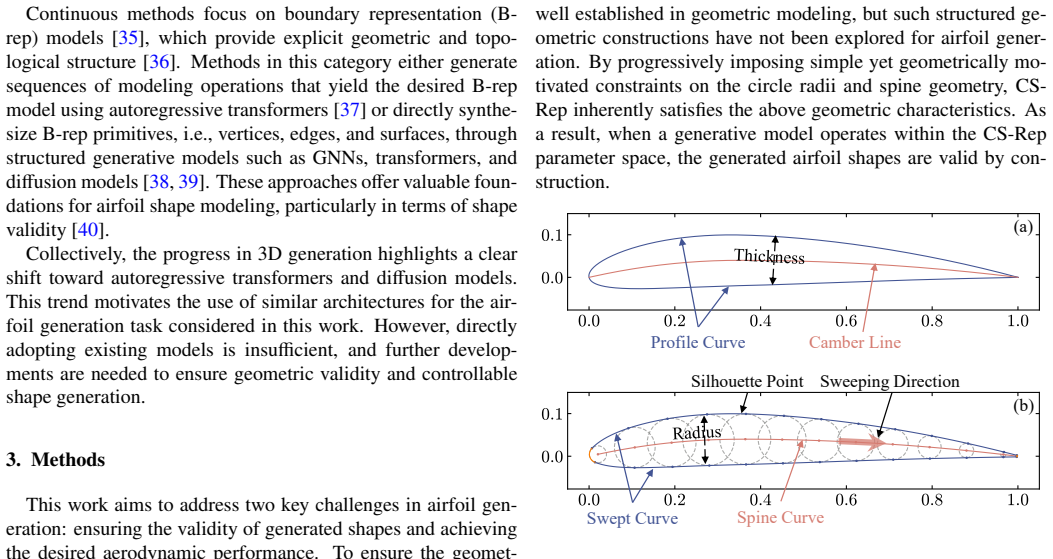
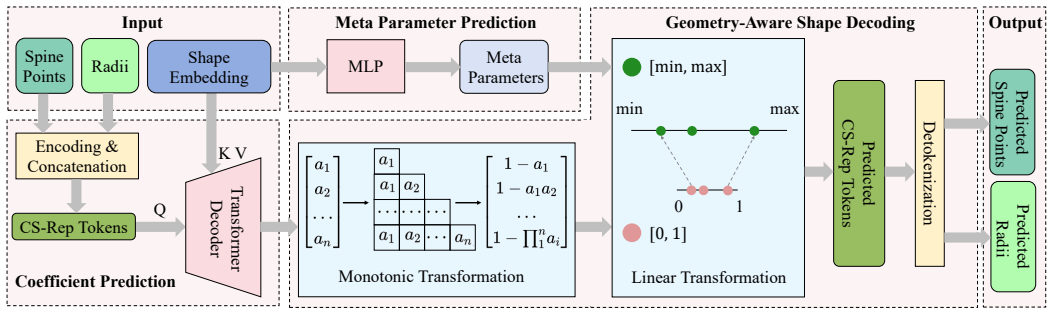
Circle sweeping representation that parameterizes airfoils to satisfy geometric constraints by construction, paired with a transformer encoder and a conditional denoising diffusion model operating on the resulting latent embeddings.
Load-bearing premise
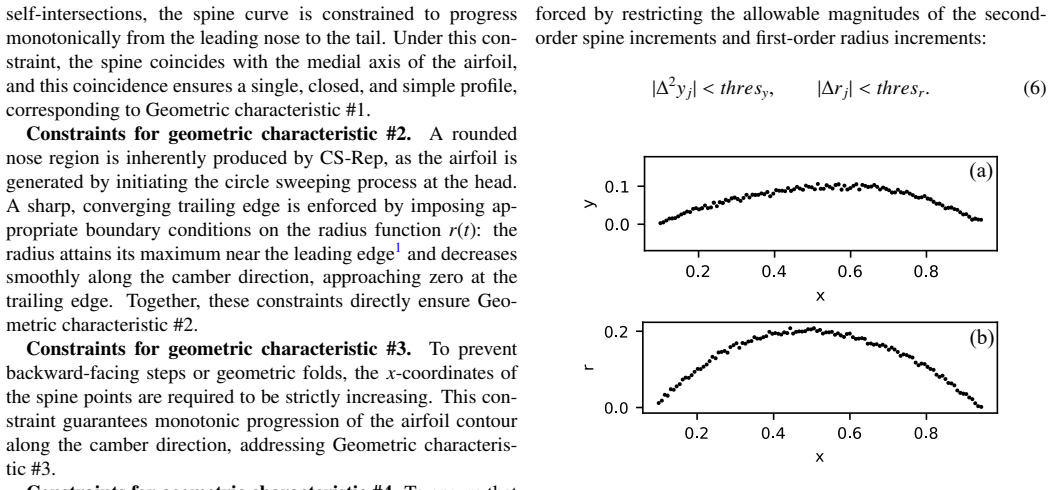
The circle sweeping representation is assumed to constrain the generative process sufficiently to respect essential airfoil characteristics without unduly restricting the reachable design space.
What would settle it
Generate thousands of shapes with specified lift and drag targets, then measure the fraction that fail basic geometric checks or whose simulated lift and drag deviate from the targets by more than a few percent.
Figures




read the original abstract
Airfoil shape design is a fundamental task in aerospace engineering, with a direct impact on flight stability and fuel consumption. Deep learning has recently emerged as a promising tool for this task, but existing deep generative approaches remain limited in both geometric validity and physical controllability. They offer little control over the generated shapes, yielding invalid geometries, and they typically do not condition effectively on aerodynamic performance. To address these issues, this paper proposes AirfoilGen, a valid-by-construction and performance-aware latent diffusion model for airfoil. It first introduces a novel airfoil representation scheme, the circle sweeping representation, to constrain the generative process so that output shapes respect essential airfoil characteristics. It then enables explicit control over aerodynamic performance (e.g., lift and drag coefficients) by operating in a learned latent space: a transformer model encodes airfoil shapes into vector embeddings, and a conditional diffusion model denoises Gaussian noise into these latent embeddings while incorporating target aerodynamic performance. In addition, this paper presents a new dataset of over 200,000 airfoils, which is substantially larger than the widely used UIUC airfoil dataset (1,650 airfoils) and more suitable for training modern deep generative models. Experiments demonstrate that AirfoilGen enables airfoil generation with far greater geometric validity and aerodynamic performance controllability than previously achievable, with an average performance-conditioning accuracy of 98.41%.
Editorial analysis
A structured set of objections, weighed in public.
Referee Report
Summary. The paper introduces AirfoilGen, a latent diffusion model for airfoil generation that enforces geometric validity by construction via a novel circle-sweeping representation and achieves performance controllability by conditioning a transformer-encoded latent diffusion process on target lift and drag coefficients. It also contributes a new dataset exceeding 200,000 airfoils. Experiments are reported to show substantially higher geometric validity and an average performance-conditioning accuracy of 98.41% relative to prior generative approaches.
Significance. If the central claims hold after verification of coverage and controls, the work would provide a practical advance in controllable generative design for aerodynamics, with the large dataset serving as a reusable resource for the community. The combination of validity-by-construction and explicit performance conditioning addresses two persistent limitations in existing deep generative airfoil methods.
major comments (2)
- [Abstract and Section 3 (representation scheme)] The central claim of 'far greater geometric validity and aerodynamic performance controllability' rests on the circle-sweeping representation constraining outputs to essential airfoil characteristics while still spanning the design space needed for meaningful performance conditioning. No quantification is provided of the fraction of UIUC airfoils or known high-performance optima that lie within the representable set, nor of any excluded classes (e.g., sharp leading-edge or highly cambered shapes). This leaves open whether the reported 98.41% conditioning accuracy is achieved inside a narrower subspace than prior methods.
- [Section 5 (experiments)] The experimental section reports an average performance-conditioning accuracy of 98.41% but does not detail the baseline models, the exact definition of accuracy (e.g., relative error threshold on Cl and Cd), the test-set distribution, or statistical controls for multiple comparisons. Without these, it is difficult to assess whether the improvement is load-bearing or partly an artifact of the restricted representation.
minor comments (2)
- [Section 4] Notation for the latent embedding and conditioning vectors should be introduced once and used consistently; the current description mixes 'vector embeddings' and 'latent embeddings' without a clear mapping.
- [Section 2.2] The dataset description would benefit from a table comparing key statistics (e.g., range of Cl, Cd, thickness, camber) against the UIUC set to substantiate the claim of suitability for modern generative models.
Simulated Author's Rebuttal
We thank the referee for their thorough review and constructive feedback on our paper. We address each of the major comments below and have revised the manuscript accordingly to strengthen the presentation of our results.
read point-by-point responses
-
Referee: [Abstract and Section 3 (representation scheme)] The central claim of 'far greater geometric validity and aerodynamic performance controllability' rests on the circle-sweeping representation constraining outputs to essential airfoil characteristics while still spanning the design space needed for meaningful performance conditioning. No quantification is provided of the fraction of UIUC airfoils or known high-performance optima that lie within the representable set, nor of any excluded classes (e.g., sharp leading-edge or highly cambered shapes). This leaves open whether the reported 98.41% conditioning accuracy is achieved inside a narrower subspace than prior methods.
Authors: We thank the referee for pointing out this potential limitation. The circle-sweeping representation is intended to capture the essential geometric properties of airfoils by constructing shapes through the sweeping of circles, ensuring closure and smoothness. To address the query on coverage, we will include in the revised Section 3 a quantitative evaluation of the fraction of UIUC airfoils that can be represented, as well as examples of excluded classes such as those with sharp leading edges or extreme camber. We believe this will confirm that the subspace is broad enough to support meaningful performance conditioning, consistent with the high accuracy reported. revision: yes
-
Referee: [Section 5 (experiments)] The experimental section reports an average performance-conditioning accuracy of 98.41% but does not detail the baseline models, the exact definition of accuracy (e.g., relative error threshold on Cl and Cd), the test-set distribution, or statistical controls for multiple comparisons. Without these, it is difficult to assess whether the improvement is load-bearing or partly an artifact of the restricted representation.
Authors: We agree with the referee that more details on the experimental setup would be beneficial. We have revised Section 5 to include descriptions of the baseline models, the precise definition of accuracy, the test-set distribution, and statistical controls for the comparisons. This will allow readers to better evaluate the results and confirm that the reported improvements are due to the proposed approach. revision: yes
Circularity Check
No circularity: validity by explicit representation design and empirical conditioning accuracy
full rationale
The paper introduces the circle sweeping representation as a deliberate scheme to enforce geometric validity by construction, which is an architectural choice rather than a derived claim that loops back to its own outputs. The performance-aware aspect operates via a separate transformer encoder producing latent embeddings and a conditional diffusion process that incorporates target coefficients as conditioning; the 98.41% accuracy is presented as an experimental measurement on a newly collected dataset of 200k airfoils. No quoted step equates a prediction or result to its inputs by definition, no fitted parameter is relabeled as a prediction, and no load-bearing self-citation chain is invoked to justify uniqueness or the central claims. The derivation therefore remains self-contained against external benchmarks.
Axiom & Free-Parameter Ledger
axioms (1)
- domain assumption The circle sweeping representation constrains generated shapes to respect essential airfoil characteristics.
Lean theorems connected to this paper
-
IndisputableMonolith/Foundation/RealityFromDistinction.leanreality_from_one_distinction unclear?
unclearRelation between the paper passage and the cited Recognition theorem.
novel airfoil representation scheme, the circle sweeping representation, to constrain the generative process so that output shapes respect essential airfoil characteristics
-
IndisputableMonolith/Cost/FunctionalEquation.leanwashburn_uniqueness_aczel unclear?
unclearRelation between the paper passage and the cited Recognition theorem.
unimodal constraints... smoothness... by construction
What do these tags mean?
- matches
- The paper's claim is directly supported by a theorem in the formal canon.
- supports
- The theorem supports part of the paper's argument, but the paper may add assumptions or extra steps.
- extends
- The paper goes beyond the formal theorem; the theorem is a base layer rather than the whole result.
- uses
- The paper appears to rely on the theorem as machinery.
- contradicts
- The paper's claim conflicts with a theorem or certificate in the canon.
- unclear
- Pith found a possible connection, but the passage is too broad, indirect, or ambiguous to say the theorem truly supports the claim.
Reference graph
Works this paper leans on
-
[1]
D. A. Masters, N. J. Taylor, T. Rendall, C. B. Allen, D. J. Poole, Review of aerofoil parameterisation methods for aerodynamic shape optimisation, in: AIAA Aerospace Sciences Meeting, 2015, p. 0761
work page 2015
-
[2]
Y . Wang, K. Shimada, A. Barati Farimani, Airfoil GAN: Encoding and synthesizing airfoils for aerodynamic shape optimization, Journal of Com- putational Design and Engineering 10 (4) (2023) 1350–1362
work page 2023
-
[3]
S. L. Brunton, J. N. Kutz, K. Manohar, A. Y . Aravkin, K. Morgansen, J. Klemisch, N. Goebel, J. Buttrick, J. Poskin, A. W. Blom-Schieber, et al., Data-driven aerospace engineering: Reframing the industry with machine learning, AIAA Journal 59 (8) (2021) 2820–2847
work page 2021
-
[4]
W. Chen, K. Chiu, M. D. Fuge, Airfoil design parameterization and op- timization using B ´ezier generative adversarial networks, AIAA Journal 58 (11) (2020) 4723–4735
work page 2020
-
[5]
T. Wagenaar, S. Mancini, A. Mateo-Gab´ın, Generative aerodynamic design with diffusion probabilistic models, arXiv:2409.13328
-
[6]
J. Ho, T. Salimans, Classifier-free diffusion guidance, in: Neural Informa- tion Processing Systems Workshop on Deep Generative Models and Down- stream Applications, 2021
work page 2021
-
[7]
N. J. Bagazinski, F. Ahmed, ShipGen: A diffusion model for parametric ship hull generation with multiple objectives and constraints, Journal of Marine Science and Engineering 11 (12) (2023) 2215
work page 2023
-
[8]
Q. Zou, L. Zhu, J. Wu, Z. Yang, SplineGen: Approximating unorganized points through generative AI, Computer-Aided Design 178 (2025) 103809
work page 2025
-
[9]
M. S. Selig, UIUC airfoil data site
- [10]
-
[11]
V . Braibant, C. Fleury, Shape optimal design using B-splines, Computer Methods in Applied Mechanics and Engineering 44 (3) (1984) 247–267
work page 1984
-
[12]
H. Sobieczky, Parametric airfoils and wings, in: Recent Development of Aerodynamic Design Methodologies: Inverse Design and Optimization, Springer, 1999, pp. 71–87
work page 1999
-
[13]
B. Kulfan, J. Bussoletti, “fundamental” parametric geometry representa- tions for aircraft component shapes, in: AIAA/ISSMO Multidisciplinary Analysis and Optimization Conference, 2006, p. 6948
work page 2006
-
[14]
W. He, X. Liu, Improved aerofoil parameterisation based on class/shape function transformation, The Aeronautical Journal 123 (1261) (2019) 310– 339
work page 2019
-
[15]
R. M. Pickett, Jr., M. F. Rubinstein, R. B. Nelson, Automated structural synthesis using a reduced number of design coordinates, AIAA Journal 11 (4) (1973) 489–494
work page 1973
-
[16]
R. M. Hicks, P. A. Henne, Wing design by numerical optimization, Journal of Aircraft 15 (7) (1978) 407–412
work page 1978
-
[17]
G. K. W. Kenway, J. R. R. A. Martins, Buffet-onset constraint formulation for aerodynamic shape optimization, AIAA Journal 55 (6) (2017) 1930– 1947
work page 2017
-
[18]
S. N. Leloudas, G. A. Strofylas, I. K. Nikolos, Constrained airfoil optimiza- tion using the area-preserving free-form deformation, Aircraft Engineering and Aerospace Technology 90 (6) (2018) 914–926
work page 2018
-
[19]
A. Srivastava, L. Valkov, C. Russell, M. U. Gutmann, C. Sutton, VeeGAN: Reducing mode collapse in GANs using implicit variational learning, Ad- vances in Neural Information Processing Systems 30
-
[20]
Z. Wei, E. R. Dufour, C. Pelletier, P. Fua, M. Bauerheim, DiffAirfoil: An efficient novel airfoil sampler based on latent space diffusion model for aerodynamic shape optimization, in: AIAA Aviation and Aeronautics Fo- rum and Exposition, 2024, p. 3755
work page 2024
- [21]
- [22]
-
[23]
X. Tan, D. Manna, J. Chattoraj, L. Yong, X. Xinxing, D. M. Ha, Y . Feng, Airfoil inverse design using conditional generative adversarial networks, in: International Conference on Control, Automation, Robotics and Vision, 2022, pp. 143–148
work page 2022
-
[24]
Q. Chen, J. Wang, P. Pope, W. Chen, M. Fuge, Inverse design of two- dimensional airfoils using conditional generative models and surrogate log- likelihoods, Journal of Mechanical Design 144 (2) (2022) 021712
work page 2022
-
[25]
J. Wu, C. Zhang, T. Xue, B. Freeman, J. Tenenbaum, Learning a probabilis- tic latent space of object shapes via 3D generative-adversarial modeling, Advances in Neural Information Processing Systems 29
-
[26]
M. Tatarchenko, A. Dosovitskiy, T. Brox, Octree generating networks: Ef- ficient convolutional architectures for high-resolution 3D outputs, in: IEEE International Conference on Computer Vision, 2017, pp. 2088–2096
work page 2017
-
[27]
X. Ren, J. Huang, X. Zeng, K. Museth, S. Fidler, F. Williams, Xcube: Large-scale 3D generative modeling using sparse voxel hierarchies, in: IEEE Conference on Computer Vision and Pattern Recognition, 2024, pp. 4209–4219
work page 2024
-
[28]
H. Chen, J. Gu, A. Chen, W. Tian, Z. Tu, L. Liu, H. Su, Single-stage dif- fusion NeRF: A unified approach to 3D generation and reconstruction, in: IEEE International Conference on Computer Vision, 2023, pp. 2416–2425
work page 2023
-
[29]
D. Valsesia, G. Fracastoro, E. Magli, Learning localized generative models for 3D point clouds via graph convolution, in: International Conference on Learning Representations, 2018
work page 2018
-
[30]
K. Mo, P. Guerrero, L. Yi, H. Su, P. Wonka, N. Mitra, L. Guibas, Struc- tureNet: Hierarchical graph networks for 3D shape generation, ACM Transactions on Graphics 38 (6) (2019) 242
work page 2019
- [31]
-
[32]
T. Groueix, M. Fisher, V . G. Kim, B. C. Russell, M. Aubry, A papier- mˆach´e approach to learning 3D surface generation, in: IEEE Conference on Computer Vision and Pattern Recognition, 2018, pp. 216–224
work page 2018
-
[33]
Y . Siddiqui, A. Alliegro, A. Artemov, T. Tommasi, D. Sirigatti, V . Rosov, A. Dai, M. Nießner, MeshGPT: Generating triangle meshes with decoder- only transformers, in: IEEE Conference on Computer Vision and Pattern Recognition, 2024, pp. 19615–19625
work page 2024
-
[34]
Z. Liu, Y . Feng, M. J. Black, D. Nowrouzezahrai, L. Paull, W. Liu, MeshD- iffusion: Score-based generative 3D mesh modeling, in: International Con- ference on Learning Representations, 2023
work page 2023
- [35]
-
[36]
Q. Zou, L. Zhu, Bringing attention to CAD: Boundary representation learn- ing via transformer, Computer-Aided Design (2025) 103940
work page 2025
-
[37]
R. Wu, C. Xiao, C. Zheng, DeepCAD: A deep generative network for computer-aided design models, in: IEEE International Conference on Computer Vision, 2021, pp. 6772–6782
work page 2021
-
[38]
P. K. Jayaraman, J. G. Lambourne, N. Desai, K. Willis, A. Sanghi, N. J. W. Morris, SolidGen: An autoregressive model for direct B-rep synthesis, Transactions on Machine Learning Research
- [39]
-
[40]
Q. Zou, Y . Wu, Z. Liu, W. Xu, S. Gao, Intelligent CAD 2.0, Visual Infor- matics 8 (4) (2024) 1–12
work page 2024
-
[41]
L. Yu, J. Lezama, N. B. Gundavarapu, L. Versari, K. Sohn, D. Minnen, Y . Cheng, A. Gupta, X. Gu, A. G. Hauptmann, Language model beats diffusion—tokenizer is key to visual generation, in: International Confer- ence on Learning Representations, 2024
work page 2024
-
[42]
J. Ho, A. Jain, P. Abbeel, Denoising diffusion probabilistic models, Ad- vances in Neural Information Processing Systems 33 (2020) 6840–6851
work page 2020
- [43]
discussion (0)
Sign in with ORCID, Apple, or X to comment. Anyone can read and Pith papers without signing in.