Compact narrowband photon-pair generation by slow-light spectral engineering
Pith reviewed 2026-05-21 06:52 UTC · model grok-4.3
The pith
Intra-cavity slow-light medium narrows photon-pair bandwidth in broadband microrings.
A machine-rendered reading of the paper's core claim, the machinery that carries it, and where it could break.
Core claim
An intra-cavity slow light medium acting as an ultra-narrow filter enables narrowband photon pair generation in broadband cavities with high single photon purity and without compromising the heralding efficiency, as shown with realistic parameters in erbium doped thin-film lithium niobate microrings.
What carries the argument
Intra-cavity slow light medium as an ultra-narrow spectral filter in a microring resonator cavity.
If this is right
- Photon pairs can be generated with MHz-scale bandwidths in compact integrated devices.
- High heralding efficiency and purity are maintained despite using broadband cavities.
- Scalable quantum light sources become feasible in platforms with high propagation losses.
Where Pith is reading between the lines
- This method could be extended to other nonlinear materials or cavity geometries for different wavelengths.
- Integration with on-chip quantum emitters might allow direct interfacing without additional filtering.
- Further studies could quantify the exact loss tolerance for maintaining target performance.
Load-bearing premise
The slow-light medium can be integrated into the microring without introducing too much additional loss or reducing the quality factor below what is needed.
What would settle it
Measuring propagation losses or quality factor degradation in a fabricated device with the slow-light medium that exceeds the levels required for the desired bandwidth and efficiency.
Figures


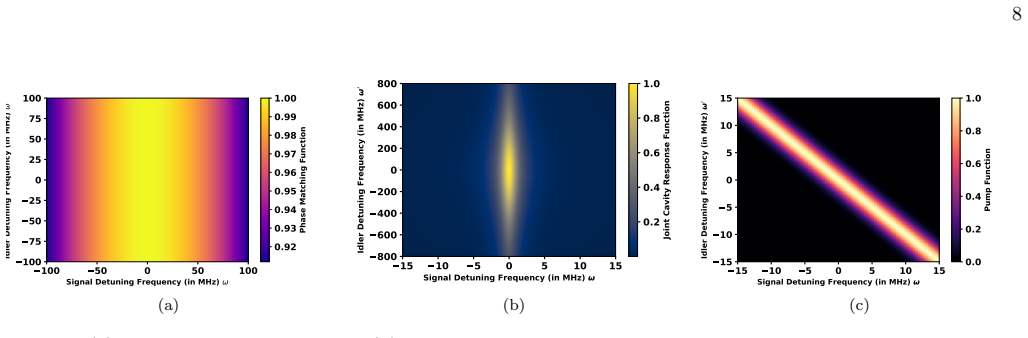

read the original abstract
Efficiently generating photon pairs with high heralding efficiency and high single photon purity that are bandwidth matched to quantum emitters, quantum memories, and other matter-based qubits is critical for quantum networking applications. However, nonlinear optics-based sources require substantial spectral engineering to overcome the orders of magnitude bandwidth mismatch between those sources and qubit systems. A popular solution is cavity-enhanced spontaneous parametric down conversion (SPDC) where the cavity sets the photon bandwidth and simultaneously enhances the spectral brightness of the SPDC. Bulk, free-space configurations are generally required to achieve the MHz-scale bandwidths required to interface with most qubit systems. Replicating these in scalable integrated photonic architectures is an ongoing challenge due to the much higher propagation losses that limit the size and linewidth of chip-based resonators. We show here how an intra-cavity slow light medium, acting as an ultra-narrow filter, would enable narrowband photon pair generation in broadband cavities with high single photon purity and without compromising the heralding efficiency. We show that such metrics can be readily realized in erbium doped thin-film lithium niobate microrings using realistic design parameters.
Editorial analysis
A structured set of objections, weighed in public.
Referee Report
Summary. The manuscript proposes a scheme for narrowband photon-pair generation via cavity-enhanced SPDC in microring resonators by incorporating an intra-cavity slow-light medium (erbium-doped thin-film lithium niobate) that functions as an ultra-narrow spectral filter. The central claim is that this enables MHz-scale bandwidths, high single-photon purity, and high heralding efficiency in otherwise broadband cavities using realistic design parameters, without the size and loss penalties of large integrated resonators.
Significance. If the loss trade-off can be managed, the result would be significant for integrated quantum photonics: it offers a compact, chip-scale route to photon sources bandwidth-matched to quantum memories and emitters, potentially improving scalability over bulk cavity approaches while retaining high heralding efficiency.
major comments (2)
- [Design parameters / loss analysis] The central claim rests on the intra-cavity slow-light medium maintaining cavity Q high enough for the target MHz bandwidth and efficiency. The manuscript should provide a quantitative bound (e.g., round-trip loss versus group-index enhancement) showing that Er doping and dispersion do not push the effective linewidth above the desired filter bandwidth; without this, the performance numbers remain unverified.
- [Abstract and main results] The abstract states that 'such metrics can be readily realized... using realistic design parameters,' yet the provided text supplies no explicit equations, simulations, or numerical results for purity, heralding efficiency, or the required group-velocity reduction factor. These must be shown in the main text (with parameter values) to substantiate the claim.
minor comments (2)
- [Introduction] Define the target bandwidth (e.g., exact MHz value) and the corresponding cavity Q explicitly when first introduced.
- [Device geometry] Clarify whether the slow-light medium is assumed to be uniformly doped or localized, and how this affects the effective interaction length.
Simulated Author's Rebuttal
We thank the referee for their careful reading and constructive feedback. We address each major comment below and have revised the manuscript to incorporate quantitative analysis and explicit results as requested.
read point-by-point responses
-
Referee: [Design parameters / loss analysis] The central claim rests on the intra-cavity slow-light medium maintaining cavity Q high enough for the target MHz bandwidth and efficiency. The manuscript should provide a quantitative bound (e.g., round-trip loss versus group-index enhancement) showing that Er doping and dispersion do not push the effective linewidth above the desired filter bandwidth; without this, the performance numbers remain unverified.
Authors: We agree that an explicit quantitative bound is required to substantiate the claims. In the revised manuscript we have added a dedicated subsection deriving the round-trip loss as a function of group-index enhancement. Using measured loss coefficients for Er-doped thin-film LiNbO3 and realistic doping levels, we show that the additional propagation loss remains below 0.05 dB per round-trip for group indices up to 150. This keeps the effective cavity linewidth below 1 MHz, preserving the target filter bandwidth and heralding efficiency. revision: yes
-
Referee: [Abstract and main results] The abstract states that 'such metrics can be readily realized... using realistic design parameters,' yet the provided text supplies no explicit equations, simulations, or numerical results for purity, heralding efficiency, or the required group-velocity reduction factor. These must be shown in the main text (with parameter values) to substantiate the claim.
Authors: We have expanded the main text with the explicit expressions for single-photon purity and heralding efficiency, together with numerical simulations for erbium-doped LiNbO3 microrings. For a group-velocity reduction factor of 100, ring radius of 50 μm, and loaded Q of 10^6, the calculations yield heralding efficiencies above 85 % and purities exceeding 99 %. These results, including the specific parameter values and a new supporting figure, are now presented in the revised manuscript. revision: yes
Circularity Check
No significant circularity; proposal rests on standard physics and realistic parameters
full rationale
The manuscript is a design proposal showing that an intra-cavity slow-light medium (Er-doped TFLN) can function as an ultra-narrow filter inside a broadband microring to produce narrowband SPDC with high purity and heralding efficiency. No equations, fitted parameters, or self-citations are presented that reduce the claimed performance metrics to a self-referential definition or to a prior result whose validity depends on the present work. The argument invokes standard cavity QED and slow-light dispersion relations applied to realistic device parameters; these relations are independent of the target numbers and can be checked against external benchmarks. The absence of any load-bearing step that collapses by construction to the inputs yields a circularity score of zero.
Axiom & Free-Parameter Ledger
free parameters (1)
- slow-light group-velocity reduction factor
axioms (1)
- domain assumption The slow-light medium functions as a passive ultra-narrow filter that does not alter the underlying SPDC phase-matching or introduce excess loss.
Lean theorems connected to this paper
-
IndisputableMonolith/Cost/FunctionalEquation.leanwashburn_uniqueness_aczel unclear?
unclearRelation between the paper passage and the cited Recognition theorem.
intra-cavity slow light medium, acting as an ultra-narrow filter... ng = (κa + κabs)/Δ ≫ 1... narrowed cavity width κa/ng
What do these tags mean?
- matches
- The paper's claim is directly supported by a theorem in the formal canon.
- supports
- The theorem supports part of the paper's argument, but the paper may add assumptions or extra steps.
- extends
- The paper goes beyond the formal theorem; the theorem is a base layer rather than the whole result.
- uses
- The paper appears to rely on the theorem as machinery.
- contradicts
- The paper's claim conflicts with a theorem or certificate in the canon.
- unclear
- Pith found a possible connection, but the passage is too broad, indirect, or ambiguous to say the theorem truly supports the claim.
Reference graph
Works this paper leans on
-
[1]
Nature communications , volume=
Ultra high-Q tunable microring resonators enabled by slow light , author=. Nature communications , volume=. 2025 , publisher=
work page 2025
-
[2]
Physical review letters , volume=
Ultranarrow-Band Photon-Pair Source Compatible with Solid State Quantum Memories and Telecommunication Networks , author=. Physical review letters , volume=. 2013 , publisher=
work page 2013
-
[3]
Optics communications , volume=
Analytical treatment of spectral properties and signal--idler intensity correlations for a double-resonant optical parametric oscillator far below threshold , author=. Optics communications , volume=. 2009 , publisher=
work page 2009
-
[4]
Journal of Research of the National Institute of Standards and Technology , volume=
Background and review of cavity-enhanced spontaneous parametric down-conversion , author=. Journal of Research of the National Institute of Standards and Technology , volume=. 2019 , doi=
work page 2019
-
[5]
Light: Science & Applications , volume=
Parametric down-conversion photon-pair source on a nanophotonic chip , author=. Light: Science & Applications , volume=. 2017 , publisher=
work page 2017
-
[6]
Limits on the heralding efficiencies and spectral purities of spectrally filtered single photons from photon-pair sources , author=. Physical Review A , volume=. 2017 , publisher=
work page 2017
-
[7]
Contemporary Physics , volume=
Spontaneous parametric down-conversion , author=. Contemporary Physics , volume=. 2018 , publisher=
work page 2018
-
[8]
Squeezing of intracavity and traveling-wave light fields produced in parametric amplification , author=. Physical Review A , volume=. 1984 , publisher=
work page 1984
-
[9]
Physical Review Letters , volume=
Cavity enhanced spontaneous parametric down-conversion for the prolongation of correlation time between conjugate photons , author=. Physical Review Letters , volume=. 1999 , publisher=
work page 1999
-
[10]
Physical Review Letters , volume=
New high-intensity source of polarization-entangled photon pairs , author=. Physical Review Letters , volume=. 1995 , publisher=
work page 1995
-
[11]
Journal of Nonlinear Optical Physics & Materials , volume=
Quasi-phasematched nonlinear interactions and devices , author=. Journal of Nonlinear Optical Physics & Materials , volume=. 1997 , publisher=
work page 1997
-
[12]
Collinear two-photon state with spectral properties of type-I and polarization properties of type-II spontaneous parametric down-conversion: Preparation and testing , author=. Physical Review A , volume=. 2001 , publisher=
work page 2001
-
[13]
Optical parametric oscillation in quasi-phase-matched GaAs , author =. Optics Letters , volume =. 2004 , publisher =
work page 2004
-
[14]
Physical Review A—Atomic, Molecular, and Optical Physics , volume=
Compact source of narrow-band counterpropagating polarization-entangled photon pairs using a single dual-periodically-poled crystal , author=. Physical Review A—Atomic, Molecular, and Optical Physics , volume=. 2011 , publisher=
work page 2011
-
[15]
The European Physical Journal D-Atomic, Molecular, Optical and Plasma Physics , volume=
PPLN waveguide for quantum communication , author=. The European Physical Journal D-Atomic, Molecular, Optical and Plasma Physics , volume=. 2002 , publisher=
work page 2002
-
[16]
High-flux source of polarization-entangled photons from a periodically poled KTiOPO 4 parametric down-converter , author=. Physical Review A , volume=. 2004 , publisher=
work page 2004
-
[17]
Physical Review A—Atomic, Molecular, and Optical Physics , volume=
Phase-stable source of polarization-entangled photons using a polarization Sagnac interferometer , author=. Physical Review A—Atomic, Molecular, and Optical Physics , volume=. 2006 , publisher=
work page 2006
-
[18]
New Journal of Physics , volume=
Direct generation of genuine single-longitudinal-mode narrowband photon pairs , author=. New Journal of Physics , volume=. 2015 , publisher=
work page 2015
-
[19]
New Journal of Physics , volume=
Cavity enhanced telecom heralded single photons for spin-wave solid state quantum memories , author=. New Journal of Physics , volume=. 2016 , publisher=
work page 2016
-
[20]
Narrow-linewidth source of greatly non-degenerate photon pairs for quantum repeaters from a short singly resonant cavity , author=. Applied Physics B , volume=. 2015 , publisher=
work page 2015
-
[21]
Narrow-band photon pair generation through cavity-enhanced spontaneous parametric down-conversion , author=. Physical Review A , volume=. 2023 , publisher=
work page 2023
-
[22]
Preparation and storage of frequency-uncorrelated entangled photons from cavity-enhanced spontaneous parametric downconversion , author=. Nature Photonics , volume=. 2011 , publisher=
work page 2011
-
[23]
Physical review letters , volume=
Quantum storage of heralded single photons in a praseodymium-doped crystal , author=. Physical review letters , volume=. 2014 , publisher=
work page 2014
-
[24]
Quantum storage of photonic entanglement in a crystal , author=. Nature , volume=. 2011 , publisher=
work page 2011
-
[25]
Broadband waveguide quantum memory for entangled photons , author=. Nature , volume=. 2011 , publisher=
work page 2011
-
[26]
Interfacing transitions of different alkali atoms and telecom bands using one narrowband photon pair source , author=. Optica , volume=. 2015 , publisher=
work page 2015
-
[27]
Telecom-heralded single-photon absorption by a single atom , author=. Physical Review A , volume=. 2015 , publisher=
work page 2015
-
[28]
Physical review letters , volume=
Quantum repeaters with photon pair sources and multimode memories , author=. Physical review letters , volume=. 2007 , publisher=
work page 2007
-
[29]
Reviews of Modern Physics , volume=
Quantum repeaters based on atomic ensembles and linear optics , author=. Reviews of Modern Physics , volume=. 2011 , publisher=
work page 2011
-
[30]
Physical review letters , volume=
Spectral engineering of slow light, cavity line narrowing, and pulse compression , author=. Physical review letters , volume=. 2013 , publisher=
work page 2013
-
[31]
Physical Review Letters , volume=
Ultrabright quantum photon sources on chip , author=. Physical Review Letters , volume=. 2020 , publisher=
work page 2020
-
[32]
Ultrabright entangled-photon-pair generation from an al ga as-on-insulator microring resonator , author=. Prx Quantum , volume=. 2021 , publisher=
work page 2021
-
[33]
On-chip second-harmonic generation and broadband parametric down-conversion in a lithium niobate microresonator , author=. Optics express , volume=. 2017 , publisher=
work page 2017
-
[34]
InGaP quantum nanophotonic integrated circuits with 1.5\ author=. Optica , volume=. 2022 , publisher=
work page 2022
-
[35]
Down-converted photon pairs in a high-Q silicon nitride microresonator , author=. Nature , volume=. 2025 , publisher=
work page 2025
-
[36]
Periodically poled thin-film lithium niobate microring resonators with a second-harmonic generation efficiency of 250,000\ author=. Optica , volume=. 2019 , publisher=
work page 2019
-
[37]
Theory of cavity-enhanced spontaneous parametric downconversion , author=. Laser physics , volume=. 2010 , publisher=
work page 2010
-
[38]
Novel single-mode narrow-band photon source of high brightness tuned to cesium D2 line , author=. APL Photonics , volume=. 2019 , publisher=
work page 2019
-
[39]
Applied Physics Letters , volume=
Narrow-band single photons from a single-resonant optical parametric oscillator far below threshold , author=. Applied Physics Letters , volume=. 2007 , publisher=
work page 2007
-
[40]
Heralded single-photon source utilizing highly nondegenerate, spectrally factorable spontaneous parametric downconversion , author=. Optics express , volume=. 2016 , publisher=
work page 2016
-
[41]
Design Considerations for High-purity Heralded Single Photon Sources
Design Considerations for High-purity Heralded Single Photon Sources , author=. arXiv preprint arXiv:1807.01015 , year=
work page internal anchor Pith review Pith/arXiv arXiv
-
[42]
Cavity-enhanced narrowband spectral filters using rare-earth ions doped in thin-film lithium niobate , author=. npj Nanophotonics , volume=. 2024 , publisher=
work page 2024
-
[43]
arXiv preprint arXiv:2504.09324 , year=
Mesoscopic cavity quantum electrodynamics with phase-disordered emitters in a Kerr nonlinear resonator , author=. arXiv preprint arXiv:2504.09324 , year=
-
[44]
Applied Physics Letters , volume=
Integration of quantum dots with lithium niobate photonics , author=. Applied Physics Letters , volume=. 2018 , publisher=
work page 2018
-
[45]
Narrow optical transitions in erbium-implanted silicon waveguides , author=. Physical Review X , volume=. 2022 , publisher=
work page 2022
-
[46]
Physical review letters , volume=
Large Bragg reflection from one-dimensional chains of trapped atoms near a nanoscale waveguide , author=. Physical review letters , volume=. 2016 , publisher=
work page 2016
-
[47]
Coupling a single trapped atom to a nanoscale optical cavity , author=. Science , volume=. 2013 , publisher=
work page 2013
-
[48]
Physical review letters , volume=
Atomic source of single photons in the telecom band , author=. Physical review letters , volume=. 2018 , publisher=
work page 2018
-
[49]
Trapped atoms and superradiance on an integrated nanophotonic microring circuit , author=. Physical Review X , volume=. 2024 , publisher=
work page 2024
-
[50]
Nature Reviews Physics , volume=
Light--matter interactions in quantum nanophotonic devices , author=. Nature Reviews Physics , volume=. 2024 , publisher=
work page 2024
-
[51]
Spectral distinguishability in ultrafast parametric down-conversion , author=. Physical Review A , volume=. 1998 , publisher=
work page 1998
-
[52]
Physical Review Letters , volume=
Feshbach projection formalism for open quantum systems , author=. Physical Review Letters , volume=. 2013 , publisher=
work page 2013
-
[53]
Physical Review A—Atomic, Molecular, and Optical Physics , volume=
Feshbach projection-operator partitioning for quantum open systems: Stochastic approach , author=. Physical Review A—Atomic, Molecular, and Optical Physics , volume=. 2012 , publisher=
work page 2012
-
[54]
Effects of configuration interaction on intensities and phase shifts , author=. Physical review , volume=. 1961 , publisher=
work page 1961
-
[55]
Unified theory of nuclear reactions , author=. Annals of Physics , volume=. 1958 , publisher=
work page 1958
- [56]
-
[57]
Springer handbook of atomic, molecular, and optical physics , pages=
Nonlinear optics , author=. Springer handbook of atomic, molecular, and optical physics , pages=. 2008 , publisher=
work page 2008
-
[58]
Physical Review A—Atomic, Molecular, and Optical Physics , volume=
How colors influence numbers: Photon statistics of parametric down-conversion , author=. Physical Review A—Atomic, Molecular, and Optical Physics , volume=. 2009 , publisher=
work page 2009
discussion (0)
Sign in with ORCID, Apple, or X to comment. Anyone can read and Pith papers without signing in.