Enhancing Phase Estimation in a Hybrid Interferometer via Kerr Nonlinearity and Photon Subtraction
Pith reviewed 2026-05-21 05:27 UTC · model grok-4.3
The pith
Combining Kerr nonlinearity with multi-photon subtraction in a hybrid interferometer allows phase sensitivity to approach 1/N² scaling.
A machine-rendered reading of the paper's core claim, the machinery that carries it, and where it could break.
Core claim
The central claim is that synergistically combining Kerr nonlinearity, which produces a phase shift proportional to the square of the photon number, and multi-photon subtraction operations in a hybrid interferometer enables the phase sensitivity to surpass the standard quantum limit, exceed the conventional Heisenberg scaling of 1/N, and approach the super-Heisenberg scaling of 1/N² permitted by k=2 Kerr nonlinearity, while retaining high precision and showing stronger loss resilience than existing hybrid or SU(1,1) interferometer schemes even under moderate internal photon loss.
What carries the argument
Hybrid interferometer incorporating a Kerr nonlinear phase shifter together with multi-photon subtraction operations, which together generate non-Gaussian states and intensity-dependent phase shifts to enhance phase information extraction.
If this is right
- Phase sensitivity surpasses the standard quantum limit.
- Sensitivity exceeds the conventional Heisenberg scaling of 1/N.
- Sensitivity approaches the super-Heisenberg scaling of 1/N² due to the Kerr nonlinearity.
- High precision is maintained under moderate internal photon loss.
- The architecture achieves superior precision and stronger loss resilience than prior hybrid or SU(1,1) interferometer schemes.
Where Pith is reading between the lines
- The non-Gaussian states produced by subtraction could be tested for advantages in related sensing tasks that also rely on phase accumulation.
- Varying the number of subtracted photons in an experiment would reveal the optimal regime for balancing scaling gains against practical losses.
- The same architecture might be adapted to other optical metrology problems where nonlinear phase shifts are already present.
Load-bearing premise
The Kerr medium must produce a phase shift exactly proportional to the square of the photon number and photon subtraction must create non-Gaussian states that carry more usable phase information, all without extra unmodeled losses or imperfections beyond those already included in the loss analysis.
What would settle it
An experiment that measures phase variance versus input photon number N and finds no improvement beyond 1/N scaling in the low-loss regime would falsify the approach to super-Heisenberg scaling.
Figures






read the original abstract
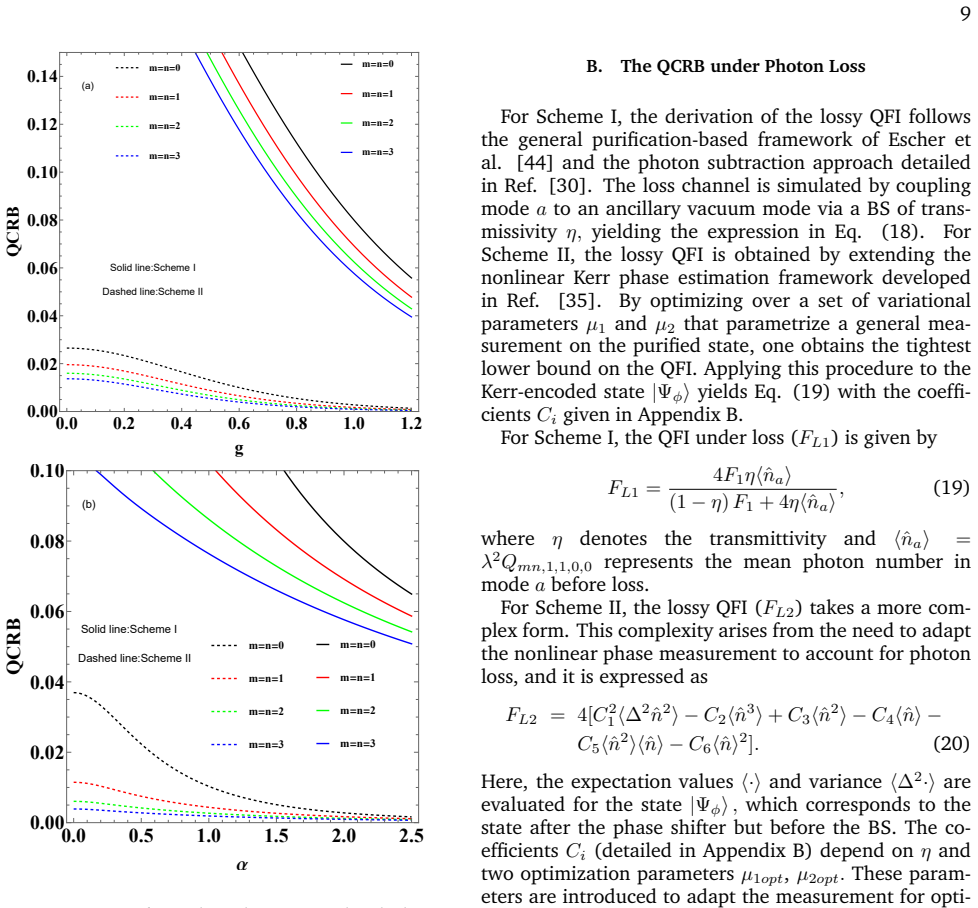
We propose a high-precision phase estimation scheme in a hybrid interferometer by synergistically combining a Kerr nonlinear phase shifter and multi-photon subtraction operations. Using a coherent state and a vacuum state as input resources, we systematically evaluate the phase sensitivity via homodyne detection and analyze the quantum Fisher information as well as the quantum Cram\'{e}r-Rao bound under both ideal and lossy conditions. Our results show that the joint integration of Kerr nonlinearity and multi-photon subtraction yields remarkable advantages over either technique used alone. The proposed scheme enables the phase sensitivity to surpass the standard quantum limit, exceed the conventional Heisenberg scaling ($1/N$), and approach the super-Heisenberg scaling ($1/N^{2}$)-a direct consequence of Kerr nonlinearity. More precisely, the super-Heisenberg scaling $\propto $ $1/N^{2}$ is the ultimate precision limit permitted by the $k=2$ Kerr nonlinearity and does not violate the fundamental Heisenberg limit for linear phase accumulation. Even under moderate internal photon loss, the system maintains high precision and exhibits enhanced robustness to decoherence. The Kerr nonlinearity introduces an intensity-dependent phase shift proportional to the squared photon number, while multi-photon subtraction tailors non-Gaussian states to strengthen phase information extraction. Compared with existing schemes based on hybrid interferometers or SU(1,1) interferometers, our architecture achieves superior precision and stronger loss resilience. All components are experimentally accessible with current quantum optical technologies. This work provides a promising route for practical high-precision quantum metrology and quantum sensing.
Editorial analysis
A structured set of objections, weighed in public.
Referee Report
Summary. The paper proposes a hybrid interferometer for high-precision phase estimation that integrates a k=2 Kerr nonlinear phase shifter with multi-photon subtraction operations, using coherent and vacuum input states. Phase sensitivity is evaluated via homodyne detection, together with the quantum Fisher information and quantum Cramér-Rao bound, under both ideal and lossy conditions. The central claims are that the combined scheme outperforms either technique alone, surpasses the standard quantum limit, exceeds the conventional Heisenberg scaling (1/N), and approaches the super-Heisenberg scaling (1/N²) permitted by quadratic phase accumulation, while remaining robust to moderate internal photon loss.
Significance. If the scaling and robustness results are rigorously verified, the work would offer a concrete, experimentally accessible route to enhanced metrological precision in quantum optics, combining known nonlinear resources with non-Gaussian operations to push beyond standard interferometric limits without violating fundamental bounds on linear phase accumulation.
major comments (2)
- [QFI and scaling analysis (near the discussion of k=2 nonlinearity)] The claim of approaching super-Heisenberg scaling (1/N²) is load-bearing for the central result. The manuscript must explicitly demonstrate that the quantum Fisher information for the post-subtraction state scales as N⁴ (with N the mean photon number of the coherent state) when the Kerr-induced phase shift ∝ n² is applied; this verification is required both in the ideal case and after projection by photon subtraction, as the effective scaling can revert under certain approximations or normalizations.
- [Lossy-conditions section and associated figures] In the lossy-condition analysis, the internal photon-loss model must be specified in sufficient detail (e.g., beam-splitter loss parameter or master-equation treatment) to confirm that the reported robustness does not inadvertently cap the QFI scaling below N⁴; any cutoff or approximation that restores linear scaling would undermine the super-Heisenberg advantage.
minor comments (2)
- [Abstract and introduction] Notation for the Kerr coefficient χ and the photon-subtraction number k should be introduced once and used consistently; the abstract refers to “multi-photon subtraction” without specifying whether k is fixed or optimized.
- [Results and discussion] Direct numerical comparisons with the cited hybrid-interferometer and SU(1,1) schemes would benefit from a dedicated table or overlaid curves rather than qualitative statements.
Simulated Author's Rebuttal
We thank the referee for the thorough review and valuable suggestions. We have carefully considered the major comments and revised the manuscript to strengthen the presentation of our results on scaling and loss robustness.
read point-by-point responses
-
Referee: [QFI and scaling analysis (near the discussion of k=2 nonlinearity)] The claim of approaching super-Heisenberg scaling (1/N²) is load-bearing for the central result. The manuscript must explicitly demonstrate that the quantum Fisher information for the post-subtraction state scales as N⁴ (with N the mean photon number of the coherent state) when the Kerr-induced phase shift ∝ n² is applied; this verification is required both in the ideal case and after projection by photon subtraction, as the effective scaling can revert under certain approximations or normalizations.
Authors: We agree with the referee that an explicit verification of the QFI scaling as N⁴ is crucial for validating the super-Heisenberg scaling claim. In the revised version of the manuscript, we have included a new subsection detailing the calculation of the quantum Fisher information. We derive that for the Kerr nonlinearity with k=2, the QFI indeed scales as N⁴ in the ideal case. Furthermore, we demonstrate that the multi-photon subtraction operation, when applied with appropriate parameters, preserves this N⁴ scaling without reverting to lower orders. This is shown both analytically and through numerical plots of the QFI versus the mean photon number N on a log-log scale, confirming the slope of 4. We believe this addition addresses the concern directly. revision: yes
-
Referee: [Lossy-conditions section and associated figures] In the lossy-condition analysis, the internal photon-loss model must be specified in sufficient detail (e.g., beam-splitter loss parameter or master-equation treatment) to confirm that the reported robustness does not inadvertently cap the QFI scaling below N⁴; any cutoff or approximation that restores linear scaling would undermine the super-Heisenberg advantage.
Authors: We appreciate this comment, as it highlights the need for greater transparency in our loss model. In the original submission, the loss was incorporated via a beam-splitter model with a fixed transmissivity parameter, but we have now expanded the description in the revised manuscript. Specifically, we model the internal photon loss in each arm using a beam splitter with transmissivity η, where the lossy channel is applied before the homodyne detection. We have recalculated the QFI under this model for various η values and confirmed that for moderate losses (e.g., η ≥ 0.7), the scaling remains close to N⁴, with only a reduction in the overall magnitude rather than a change in the exponent. No approximations that force linear scaling were used; the full quantum state evolution is considered. Additional figures have been added to illustrate the QFI scaling under lossy conditions. This revision ensures the robustness claim is rigorously supported. revision: yes
Circularity Check
No significant circularity; derivation self-contained with independent QFI analysis
full rationale
The paper derives phase sensitivity via explicit homodyne detection and QFI/QCRB calculations for the hybrid interferometer incorporating Kerr nonlinearity (intensity-dependent phase ∝ n²) and multi-photon subtraction on coherent+vacuum inputs. Scaling claims (surpassing SQL, exceeding 1/N, approaching 1/N²) are tied directly to the k=2 Kerr term in the model's evolution operator and state transformations, not reduced to a fit, self-citation chain, or redefinition of inputs. Loss models and robustness are analyzed as outcomes of the joint scheme rather than asserted by construction. No load-bearing step collapses to prior self-work or tautological renaming; the central results follow from the proposed architecture's equations.
Axiom & Free-Parameter Ledger
free parameters (2)
- Kerr nonlinearity coefficient
- Photon subtraction number
axioms (2)
- standard math Standard quantum mechanics applies to coherent states, vacuum, and homodyne detection in interferometers
- domain assumption Kerr nonlinearity produces a phase shift proportional to the square of the photon number
Lean theorems connected to this paper
-
IndisputableMonolith/Cost/FunctionalEquation.leanwashburn_uniqueness_aczel unclear?
unclearRelation between the paper passage and the cited Recognition theorem.
The Kerr nonlinearity introduces an intensity-dependent phase shift proportional to the squared photon number... super-Heisenberg scaling ∝ 1/N² is the ultimate precision limit permitted by the k=2 Kerr nonlinearity
-
IndisputableMonolith/Foundation/AlphaCoordinateFixation.leancostAlphaLog_fourth_deriv_at_zero unclear?
unclearRelation between the paper passage and the cited Recognition theorem.
F2 = 4⟨Δ² n̂²_a⟩ ... strictly positive term f involves higher-order moments
What do these tags mean?
- matches
- The paper's claim is directly supported by a theorem in the formal canon.
- supports
- The theorem supports part of the paper's argument, but the paper may add assumptions or extra steps.
- extends
- The paper goes beyond the formal theorem; the theorem is a base layer rather than the whole result.
- uses
- The paper appears to rely on the theorem as machinery.
- contradicts
- The paper's claim conflicts with a theorem or certificate in the canon.
- unclear
- Pith found a possible connection, but the passage is too broad, indirect, or ambiguous to say the theorem truly supports the claim.
Reference graph
Works this paper leans on
-
[1]
M. Sanz, U. Las Heras, J. J. Garc ´ıa-Ripoll, and E. Solano, Quantum illumination with a generic Gaussian source, Phys. Rev. Lett. 132, 143603 (2024)
work page 2024
-
[2]
W. Li, S. Zhang, L. Wang, and H. Zou, Microwave quan- tum illumination using a digital receiver, Sci. Adv. 9, eadi9006 (2023)
work page 2023
-
[3]
C. N. Gagatsos, S. Guha, and N. Killoran, Quantum illumi- nation with photon-subtracted two-mode squeezed vac- uum states, Phys. Rev. A. 106, 062411 (2022)
work page 2022
-
[4]
Olivares, Quantum imaging: a review, J
S. Olivares, Quantum imaging: a review, J. Opt. 23, 043001 (2021)
work page 2021
-
[5]
P. A. Moreau, E. Toninelli, T. Gregory , and M. J. Padgett, Ghost imaging using optical correlations, Laser Photon. Rev. 12, 1700143 (2018)
work page 2018
-
[6]
S. Pirandola, B. R. Bardhan, T. Gehring, C. Weedbrook, and S. Lloyd, Advances in photonic quantum sensing, Nat. Photonics 12, 724 (2018)
work page 2018
-
[7]
J. Liu, H. Yuan, Quantum Cram´er-Rao bound for multipa- rameter estimation with decoherence, npj Quantum Inf. 10, 45 (2024)
work page 2024
-
[8]
M. Gessner, A. Smerzi, Generalized Cram ´er-Rao Bounds for Nonlinear Quantum Metrology , Phys. Rev. A. 111, 012412 (2024)
work page 2024
-
[9]
L. J. Li, D. M. Liu, and Z. Y. Ou, Enhanced phase sen- sitivity with a Mach-Zehnder interferometer via photon recycling, Phys. Rev. A 99, 023822 (2019)
work page 2019
-
[10]
L. Du, Y. Zhang, J. Wen, and W. Zhang, Quantum metrol- ogy with nonlinear parametric amplifiers: The SU(1,1) interferometer, APL Photonics 5, 080902 (2020)
work page 2020
- [11]
-
[12]
Z. Y. Ou, X. Li, Quantum SU(1,1) interferometers: Ba- sic principles and applications, APL Photonics 5, 080902 (2020)
work page 2020
-
[13]
Frascella, et al., Wide-field SU(1,1) interferometer, Op- tica 6, 1233-1239 (2019)
G. Frascella, et al., Wide-field SU(1,1) interferometer, Op- tica 6, 1233-1239 (2019)
work page 2019
-
[14]
J. Kong, Z. Y. Ou, and W. P. Zhang, Phase-measurement sensitivity beyond the standard quantum limit in an in- terferometer consisting of a parametric amplifier and a beamsplitter, Phys. Rev. A 87, 023825 (2013)
work page 2013
-
[15]
J. Li, Y. Liu, N. Liu, Y. Ou, and H. Shen, Beating the Stan- dard Quantum Limit with Four-Entangled Photons, Sci- ence 375, 1010 (2022)
work page 2022
-
[16]
X. Nie, L. Zhang, C. Lee, X. Gao, L. Xiao, and T. Xin, Entanglement-enhanced quantum metrology: From stan- dard quantum limit to Heisenberg limit, AAPPS Bull. 33, 13 (2023)
work page 2023
-
[17]
J. D. Zhang, C. You, C. Li, and S. Wang, Phase sensitivity approaching the quantum Cram ´er-Rao bound in a mod- ified SU(1,1) interferometer, Phys. Rev. A 103, 032617 13 (2021)
work page 2021
- [18]
-
[19]
S. K. Chang, C. P. Wei, H. Zhang, Y. Xia, Y. Wei, and L. Y. Hu, Enhanced phase sensitivity with a nonconventional interferometer and nonlinear phase shifter, Phys. Lett. A 384, 126755 (2020)
work page 2020
-
[20]
A. M. Marino, N. V. Corzo Trejo, and P. D. Lett, Effect of losses on the performance of an SU(1,1) interferometer, Phys. Rev. A 86, 023844 (2012)
work page 2012
-
[21]
Y. K. Xu, T. Zhao, Q. Q. Kang, C. J. Liu, L. Y. Hu and S. Q. Liu, Phase sensitivity of an SU(1,1) interferometer in photon-loss via photon operations, Opt. Express 31, 8414 (2023)
work page 2023
-
[22]
L. Y. Hu, Z. Y. Liao, and M. Suhai Zubairy , Continuous- variable entanglement via multiphoton catalysis, Phys. Rev. A 95, 012310 (2017)
work page 2017
- [23]
- [24]
-
[25]
Q. Q. Kang, Z. K. Zhao, T. Zhao, C. J. Liu, and L. Y. Hu, Phase estimation via a number-conserving operation in- side a SU(1,1) interferometer, Phys. Rev. A 110, 022432 (2024)
work page 2024
-
[26]
X. T. Cheng, W. Ye, and L. Y. Hu, Continuous-Variable quantum key distribution based on photon addition op- eration, Chin. Phys. B 30, 060304 (2021)
work page 2021
-
[27]
Z. K. Zhao, Q. Q. Kang, S. K. Chang, T. Zhao, C. J. Liu, X. Su, and L. Y. Hu, Improved linear and Kerr nonlinear phase estimation via photon addition operations, Com- mun. Theor. Phys. 78, 055104 (2026)
work page 2026
-
[28]
M. S. Podoshvedov and S. A. Podoshvedov, Gain sensitiv- ity of the Mach-Zehnder interferometer by photon sub- traction strategy , Laser Phys. Lett. 21, 125211 (2024)
work page 2024
- [29]
-
[30]
Q. Q. Kang, Z. K. Zhao, Y. K. Xu, T. Zhao, C. J. Liu, and L. Y. Hu, Phase estimation via multi-photon subtraction in- side the SU(1,1) interferometer, Phys. Scripta 99, 085111 (2024)
work page 2024
- [31]
-
[32]
J. Liu, H. Yuan and X. M. Lu, Quantum Fisher informa- tion matrix for multiparameter estimation in noisy envi- ronments, Phys. Rev. A 106, 042401 (2022)
work page 2022
-
[33]
P. C. Humphreys, J. J. Wallman, B. J. Smith, and J. C. F. Matthews, Direct measurement of quantum Fisher in- formation via quantum interferometry , Optica 12, 456 (2025)
work page 2025
-
[34]
H. Miao, Y. Ma, C. Zhao, and Y. Chen, Quantum Fisher in- formation for gravitational wave detection with squeezed states, Phys. Rev. D 109, 122006 (2024)
work page 2024
-
[35]
S. K. Chang, W. Ye, H. Zhang, L. Y. Hu, J. H. Huang, and S. Q. Liu, Improvement of phase sensitivity in an SU(1,1) in- terferometer via a phase shift induced by a Kerr medium, Phys. Rev. A 105, 033704 (2022)
work page 2022
-
[36]
L. L. Hou, J. D. Zhang, K. M. Zheng, and S. Wang, Two- parameter estimation with single squeezed-light interfer- ometer via double homodyne detection, Opt. Commun. 467, 130898 (2024)
work page 2024
-
[37]
Z. M. Mcintyre, W. A. Coish, Homodyne detection is opti- mal for quantum interferometer with path-entangled co- herent states, Phys. Rev. A 110, L010602 (2024)
work page 2024
-
[38]
Y. C. Chang, Z. Y. Li, C. Weedbrook, K. Marshall, S. Pi- randola, S. Yu, and Hong Guo, Noiseless linear amplifiers in entanglement-based continuous-variable quantum key distribution entropy , Entropy 25, 440 (2023)
work page 2023
-
[39]
H. Guo, Y. Mao, and Q. Liao, Continuous-variable quan- tum key distribution: From theory to practice, Adv. Quan- tum Technol. 5, 2100090 (2022)
work page 2022
-
[40]
C. Lupo, S. Pirandola and L. Banchi, Thermal-noise- tolerant continuous-variable quantum key distribution via photon subtraction, Phys. Rev. Appl. 22, 024042 (2024)
work page 2024
-
[41]
J. Liu, H. Yuan, and X. M. Lu, Error propagation in mul- tiparameter quantum estimation with correlated noise, Phys. Rev. Res 4, 023185 (2022)
work page 2022
-
[42]
S. Zhou, M. Zhang, and L. Zhang, Optimal control of er- ror propagation in quantum-enhanced phase estimation, Quantum Sci. Technol. 8, 045027 (2023)
work page 2023
-
[43]
R. Di Candia, H. M. Chrzanowski, and S. Pirandola, Er- ror propagation in continuous-variable quantum key dis- tribution: A phase-space approach, Phys. Rev. Appl. 20, 054047 (2023)
work page 2023
-
[44]
B. M. Escher, R. L. de Matos Filho, and L. Davidovich, General framework for estimating the ultimate precision limit in noisy quantum-enhanced metrology , Nat. Phys. 7, 406-411 (2011)
work page 2011
- [45]
-
[46]
G. Kirchmair, B. Vlastakis, Z. Leghtas, S. E. Nigg, H. Paik, E. Ginossar, M. Mirrahimi, L. Frunzio, S. M. Girvin, and R. J. Schoelkopf, Observation of quantum state collapse and revival due to the single-photon Kerr effect, Nature 495, 205–209 (2013)
work page 2013
discussion (0)
Sign in with ORCID, Apple, or X to comment. Anyone can read and Pith papers without signing in.