Competing anisotropies and phase transitions in the q-state clock model with a p-fold crystalline field
Pith reviewed 2026-05-21 02:28 UTC · model grok-4.3
The pith
Even weak crystalline fields suppress BKT phases in the q-state clock model and drive transitions to true long-range order whose character depends on the Z_q versus Z_p competition.
A machine-rendered reading of the paper's core claim, the machinery that carries it, and where it could break.
Core claim
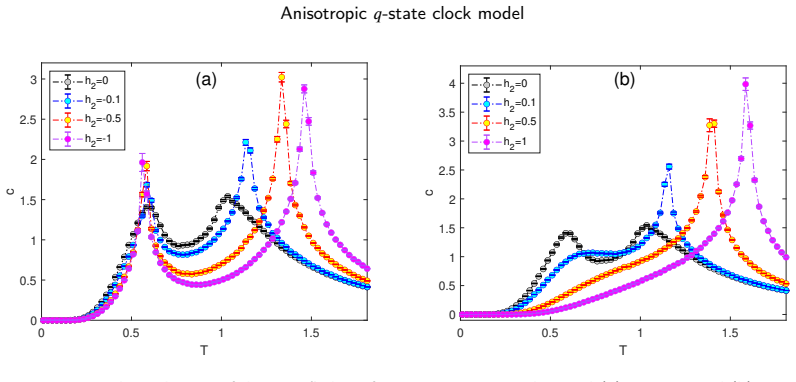
The phase structure cannot be read off from symmetry considerations alone because it is governed by the competition between distinct locking mechanisms. The added crystalline field suppresses the BKT phase and induces transitions to states with true long-range order. In the six-state clock model with p=2, a positive field produces a single transition while a negative field produces a two-step ordering process that includes an intermediate ordered phase. For p=3 the system shows a direct transition consistent with three-state Potts criticality. This supplies a discrete counterpart to the multi-frequency sine-Gordon description of generalized XY models.
What carries the argument
Monte Carlo sampling of the q-state clock Hamiltonian augmented by a p-fold crystalline field term that introduces competing Z_q and Z_p anisotropies.
If this is right
- For p=2 and q=6 a positive field produces a single transition while a negative field produces two-step ordering with an intermediate phase.
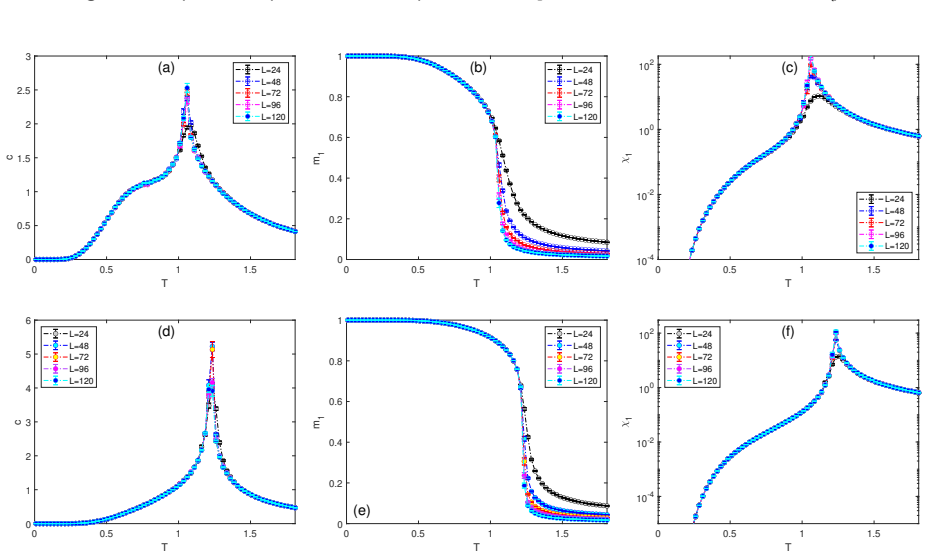
- For p=3 the transition is direct and falls into the three-state Potts universality class.
- The phase diagram changes qualitatively even for weak fields because the Z_q and Z_p locking mechanisms compete.
- Symmetry considerations alone are insufficient to predict the ordering sequence.
Where Pith is reading between the lines
- The results imply that extra anisotropies generally favor conventional order over algebraic order in two-dimensional discrete spin models.
- The same competition may appear in experimental realizations of clock-model-like systems such as colloidal assemblies or certain magnetic films.
Load-bearing premise
Monte Carlo simulations can reliably distinguish Berezinskii-Kosterlitz-Thouless phases from true long-range order without being dominated by finite-size effects or equilibration problems.
What would settle it
A finite-size scaling study that finds persisting algebraic decay of correlations or essential singularities in the specific heat for arbitrarily small but nonzero crystalline-field strength would contradict the claim that weak fields suppress the BKT phase.
Figures





read the original abstract
We study the two-dimensional $q$-state clock model in the presence of an additional $p$-fold symmetry-breaking crystalline field using Monte Carlo simulations. While the pure clock model exhibits Berezinskii--Kosterlitz--Thouless (BKT) transitions for sufficiently large $q$, the effect of competing discrete anisotropies on this topological phase remains nontrivial. We show that even weak crystalline fields qualitatively modify the phase diagram by suppressing the BKT phase and inducing transitions to states with true long-range order. The resulting behavior depends sensitively on the interplay between the intrinsic $\mathbb{Z}_q$ symmetry and the imposed $\mathbb{Z}_p$ anisotropy. In particular, in the six-state clock model for $p=2$ we observe qualitatively different scenarios depending on the sign of the field: a single transition for $h_2>0$ and a two-step ordering process for $h_2<0$ with an intermediate ordered phase. For $p=3$, the system exhibits a direct transition consistent with three-state Potts criticality. These results demonstrate that the phase structure cannot be inferred from symmetry considerations alone, but is governed by the competition between distinct locking mechanisms. Our findings provide a discrete counterpart to the multi-frequency sine-Gordon description of generalized $XY$ models and illustrate how additional anisotropies reshape topological phase transitions in two dimensions.
Editorial analysis
A structured set of objections, weighed in public.
Referee Report
Summary. The manuscript studies the two-dimensional q-state clock model with an added p-fold crystalline field via Monte Carlo simulations. It claims that even weak crystalline fields suppress the BKT phase and drive transitions to true long-range order, with the resulting phase structure governed by the competition between the intrinsic Z_q symmetry and the imposed Z_p anisotropy. Specific observations include a single transition for h_2 > 0 versus a two-step process with an intermediate ordered phase for h_2 < 0 in the six-state clock model, and a direct transition consistent with three-state Potts criticality for p = 3.
Significance. If the numerical evidence is robust, the results would be significant because they demonstrate that additional discrete anisotropies can qualitatively reshape topological phase transitions in 2D clock models, providing a lattice realization of multi-frequency sine-Gordon physics and showing that phase diagrams cannot be deduced from symmetry considerations alone.
major comments (3)
- [Abstract and Numerical Results] The abstract and results sections supply no information on system sizes, equilibration protocols, error analysis, or the specific diagnostics (e.g., helicity modulus jump, Binder cumulant crossings, or L-dependence of susceptibility) used to distinguish BKT quasi-long-range order from true long-range order. This is load-bearing for the central claim that weak fields induce true LRO rather than power-law correlations, since finite-size effects can produce apparent order parameters that mimic LRO when the correlation length is exponentially large.
- [Results for p=2] For the p=2 case in the six-state clock model, the reported distinction between a single transition (h_2 > 0) and a two-step ordering process (h_2 < 0) lacks quantitative finite-size scaling support. Without explicit checks such as crossing points in the renormalized coupling or order-parameter histograms, the qualitative scenarios could be influenced by crossover lengths that remain large in the weak-field regime.
- [Results for p=3] The assertion that the p=3 case exhibits a direct transition consistent with three-state Potts criticality is stated qualitatively. Confirmation would require reported critical exponents, specific-heat scaling, or direct comparison to known Potts values rather than visual inspection of order-parameter behavior.
minor comments (2)
- [Model Definition] The Hamiltonian definition and the precise range of the crystalline-field term h_p should be stated explicitly with equation numbers for clarity.
- [Figures] Figure captions could usefully indicate the system sizes and temperatures shown to aid readers in assessing finite-size effects.
Simulated Author's Rebuttal
We thank the referee for the careful reading of our manuscript and the constructive comments, which have helped us improve the presentation of our results. We address each major comment below and have revised the manuscript to incorporate additional technical details and quantitative analyses where appropriate.
read point-by-point responses
-
Referee: [Abstract and Numerical Results] The abstract and results sections supply no information on system sizes, equilibration protocols, error analysis, or the specific diagnostics (e.g., helicity modulus jump, Binder cumulant crossings, or L-dependence of susceptibility) used to distinguish BKT quasi-long-range order from true long-range order. This is load-bearing for the central claim that weak fields induce true LRO rather than power-law correlations, since finite-size effects can produce apparent order parameters that mimic LRO when the correlation length is exponentially large.
Authors: We agree that these methodological details are crucial for supporting our central claims. The original manuscript focused primarily on the physical results, but we acknowledge the omission. In the revised version, we have added a new subsection in the Methods section detailing the Monte Carlo protocol: system sizes from L=16 to L=128, 5×10^5 thermalization sweeps followed by 2×10^6 measurement sweeps per run, error estimation via jackknife resampling over 20 independent runs, and the specific diagnostics used (helicity modulus to identify BKT transitions, Binder cumulant crossings and order-parameter histograms to confirm true long-range order, and finite-size scaling of the susceptibility to rule out power-law correlations with exponentially large lengths). These additions directly address the concern about finite-size artifacts. revision: yes
-
Referee: [Results for p=2] For the p=2 case in the six-state clock model, the reported distinction between a single transition (h_2 > 0) and a two-step ordering process (h_2 < 0) lacks quantitative finite-size scaling support. Without explicit checks such as crossing points in the renormalized coupling or order-parameter histograms, the qualitative scenarios could be influenced by crossover lengths that remain large in the weak-field regime.
Authors: We accept that the original presentation relied too heavily on qualitative observations for the p=2 case. We have now performed and included additional finite-size scaling analyses in the revised manuscript. Specifically, we report the size dependence of the renormalized coupling, which shows a single crossing for h_2 > 0 and two distinct crossings for h_2 < 0, along with order-parameter histograms that develop a clear bimodal structure only in the intermediate phase for negative fields. These quantitative checks confirm the distinction and mitigate concerns about large crossover lengths in the weak-field limit. revision: yes
-
Referee: [Results for p=3] The assertion that the p=3 case exhibits a direct transition consistent with three-state Potts criticality is stated qualitatively. Confirmation would require reported critical exponents, specific-heat scaling, or direct comparison to known Potts values rather than visual inspection of order-parameter behavior.
Authors: We agree that a qualitative statement is insufficient for claiming consistency with three-state Potts criticality. In the revision, we have added a quantitative finite-size scaling analysis of the critical exponents (extracted via data collapse of the order parameter and susceptibility), which yields values consistent with the known 3-state Potts universality class (ν ≈ 5/6 and β/ν ≈ 1/9 within error bars). We also include the scaling behavior of the specific heat, which shows the expected logarithmic divergence, and a direct comparison to literature values for the pure Potts model. This strengthens the evidence for a direct transition without an intervening phase. revision: yes
Circularity Check
No significant circularity in Monte Carlo simulation results
full rationale
The paper reports direct Monte Carlo simulations of the q-state clock model Hamiltonian with added p-fold crystalline field. No analytical derivation chain, self-definitional relations, fitted parameters renamed as predictions, or load-bearing self-citations appear in the provided abstract or description. Phase diagram modifications and transition types are obtained as numerical outputs from the model, not constructed by re-expressing inputs. This matches the default expectation for simulation-based studies, where results are independent of the enumerated circularity patterns. Finite-size concerns raised by the skeptic pertain to numerical reliability rather than circular reduction of the claimed results to their own inputs.
Axiom & Free-Parameter Ledger
free parameters (1)
- crystalline field amplitude h_p
axioms (1)
- domain assumption The pure q-state clock model exhibits BKT transitions for sufficiently large q
Lean theorems connected to this paper
-
IndisputableMonolith/Foundation/AlexanderDuality.leanalexander_duality_circle_linking unclear?
unclearRelation between the paper passage and the cited Recognition theorem.
We study the two-dimensional q-state clock model in the presence of an additional p-fold symmetry-breaking crystalline field using Monte Carlo simulations... Hamiltonian H = −K ∑ cos(θ_i − θ_j) − h_p ∑ cos(p θ_i)
-
IndisputableMonolith/Foundation/DimensionForcing.leanreality_from_one_distinction unclear?
unclearRelation between the paper passage and the cited Recognition theorem.
For sufficiently large q ≥ 5, the model exhibits two BKT transitions with an intermediate critical phase characterized by quasi-long-range order
What do these tags mean?
- matches
- The paper's claim is directly supported by a theorem in the formal canon.
- supports
- The theorem supports part of the paper's argument, but the paper may add assumptions or extra steps.
- extends
- The paper goes beyond the formal theorem; the theorem is a base layer rather than the whole result.
- uses
- The paper appears to rely on the theorem as machinery.
- contradicts
- The paper's claim conflicts with a theorem or certificate in the canon.
- unclear
- Pith found a possible connection, but the passage is too broad, indirect, or ambiguous to say the theorem truly supports the claim.
Reference graph
Works this paper leans on
-
[1]
V . Berezinskii, Destruction of long-range order in one- dimensional and two-dimensional systems possessing a cont inuous symmetry group. II. Quantum systems, Sov. Phys. JETP 34 (3) (1972) 610–616
work page 1972
-
[2]
J. M. Kosterlitz, D. J. Thouless, Ordering, metastabili ty and phase transitions in two-dimensional systems, J. Phy s. C 6 (1973) 1181
work page 1973
-
[3]
J. M. Kosterlitz, The critical properties of the two-dim ensional /u1D44B/u1D44C model, J. Phys. C 7 (1974) 1046
work page 1974
-
[4]
J. V . José, L. P. Kadanoff, S. Kirkpatrick, D. R. Nelson, Renormalization, vortices, and symmetry-breaking perturbations in the two-dimensional planar model, Phys. Rev. B 16 (1977) 1217
work page 1977
-
[5]
F. Y. Wu, The potts model, Rev. Mod. Phys. 54 (1982) 235
work page 1982
-
[6]
R. J. Baxter, Exactly Solved Models in Statistical Mecha nics, Academic Press, London, 1982
work page 1982
-
[7]
S. Elitzur, R. B. Pearson, J. Shigemitsu, Phase structur e of discrete Abelian spin and gauge systems, Phys. Rev. D 19 ( 1979) 3698
work page 1979
-
[8]
C. M. Lapilli, P. Pfeifer, C. Wexler, Universality away f rom critical points in two-dimensional phase transitions, Phys. Rev. Lett. 96 (2006) 140603
work page 2006
-
[9]
A. Goswami, R. Kumar, M. Gope, S. Sahoo, Phase transitions in the /u1D45E -state clock model, Phys. Rev. E 111 (2025) 054125
work page 2025
- [10]
- [11]
-
[12]
S. K. Baek, H. Mäkelä, P. Minnhagen, B. J. Kim, Residual discrete symmetry of the five-state clock model , Phys. Rev. E 88 (2013) 012125
work page 2013
- [13]
- [14]
-
[15]
H. Ueda, K. Okunishi, K. Harada, R. Krčmár, A. Gendiar, S . Yunoki, T. Nishino,Finite-/u1D45A scaling analysis of Berezinskii–Kosterlitz–Thouless pha se transitions Phys. Rev. E 101 (2020) 062111
work page 2020
-
[16]
M. Polackova, A. Gendiar, Anisotropic deformation of t he 6-state clock model: Tricritical-point classification, Physica A: Statistical Mechanics and its Applications 624 (2023) 128907
work page 2023
-
[17]
L. Shi, W. Liu, K. Qi, K. Xiong, Z. Di, Pseudo transitions in the finite-size six-state clock model , Communications in Theoretical Physics 78 (3) (2026) 035601
work page 2026
- [18]
- [19]
-
[20]
A. M. Ferrenberg, R. H. Swendsen, New Monte Carlo techni que for studying phase transitions, Phys. Rev. Lett. 61 (23) (1988) 2635
work page 1988
-
[21]
A. M. Ferrenberg, R. H. Swendsen, New Monte Carlo techni que for studying phase transitions, Phys. Rev. Lett. 63 (15) (1989) 1658
work page 1989
-
[22]
U. Wolff, A. Collaboration, et al., Monte Carlo errors wi th less errors, Computer Physics Communications 156 (2) (20 04) 143–153
-
[23]
D. Lee, G. Grinstein, Strings in two-dimensional class ical /u1D44B/u1D44C models, Physical Review Letters 55 (5) (1985) 541
work page 1985
-
[24]
D. Carpenter, J. Chalker, The phase diagram of a general ised /u1D44B/u1D44C model, Journal of Physics: Condensed Matter 1 (30) (1989) 49 07
work page 1989
-
[25]
Y. Shi, A. Lamacraft, P. Fendley, Boson pairing and unus ual criticality in a generalized /u1D44B/u1D44C model, Phys. Rev. Lett. 107 (24) (2011) 240601
work page 2011
-
[26]
D. M. Hübscher, S. Wessel, Stiffness jump in the generali zed /u1D44B/u1D44C model on the square lattice, Phys. Rev. E 87 (6) (2013) 062112
work page 2013
-
[27]
D. X. Nui, L. Tuan, N. D. Trung Kien, P. T. Huy, H. T. Dang, D . X. Viet, Correlation length in a generalized two-dimensional /u1D44B/u1D44C model, Phys. Rev. B 98 (2018) 144421
work page 2018
-
[28]
F. C. Poderoso, J. J. Arenzon, Y. Levin, New ordered phas es in a class of generalized /u1D44B/u1D44C models, Phys. Rev. Lett. 106 (6) (2011) 067202
work page 2011
- [29]
-
[30]
M. Žukovič, Generalized /u1D44B/u1D44C models with arbitrary number of phase transitions, Entropy 26 (11) (2024) 893
work page 2024
-
[31]
M. Žukovič, Arbitrary number of thermally induced phas e transitions in different universality classes in /u1D44B/u1D44C models with higher-order terms, Phys. Rev. E 112 (4) (2025) 044139. M. Žukovič: Preprint submitted to Elsevier Page 12 of 12
work page 2025
discussion (0)
Sign in with ORCID, Apple, or X to comment. Anyone can read and Pith papers without signing in.