Alpha-Dependent Cross-Tidal Residuals Beyond the Diagonal Newtonian Lunar Tensor: A Halilsoy-Inspired 45{deg} Eigenframe Channel
Pith reviewed 2026-05-22 08:52 UTC · model grok-4.3
The pith
An alpha-dependent off-diagonal residual inspired by Halilsoy waves adds a distinct 45-degree cross-tidal channel to the lunar tensor beyond its diagonal Newtonian form.
A machine-rendered reading of the paper's core claim, the machinery that carries it, and where it could break.
Core claim
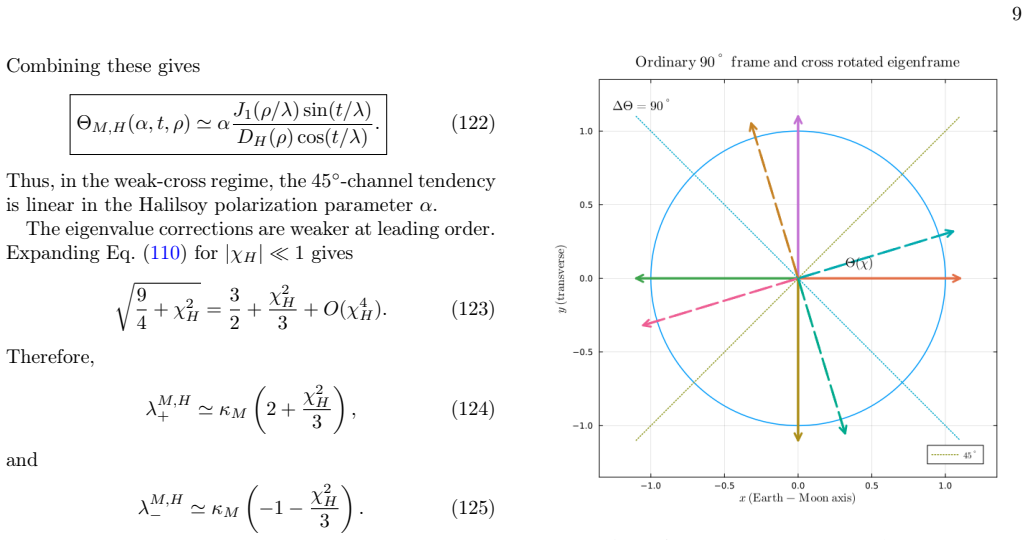
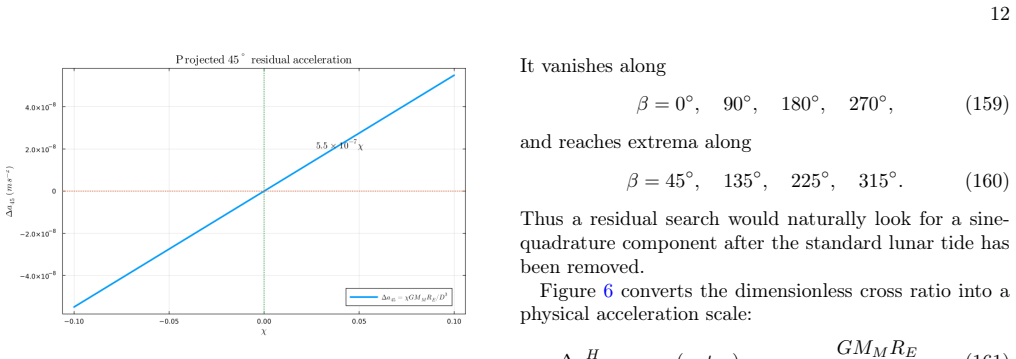
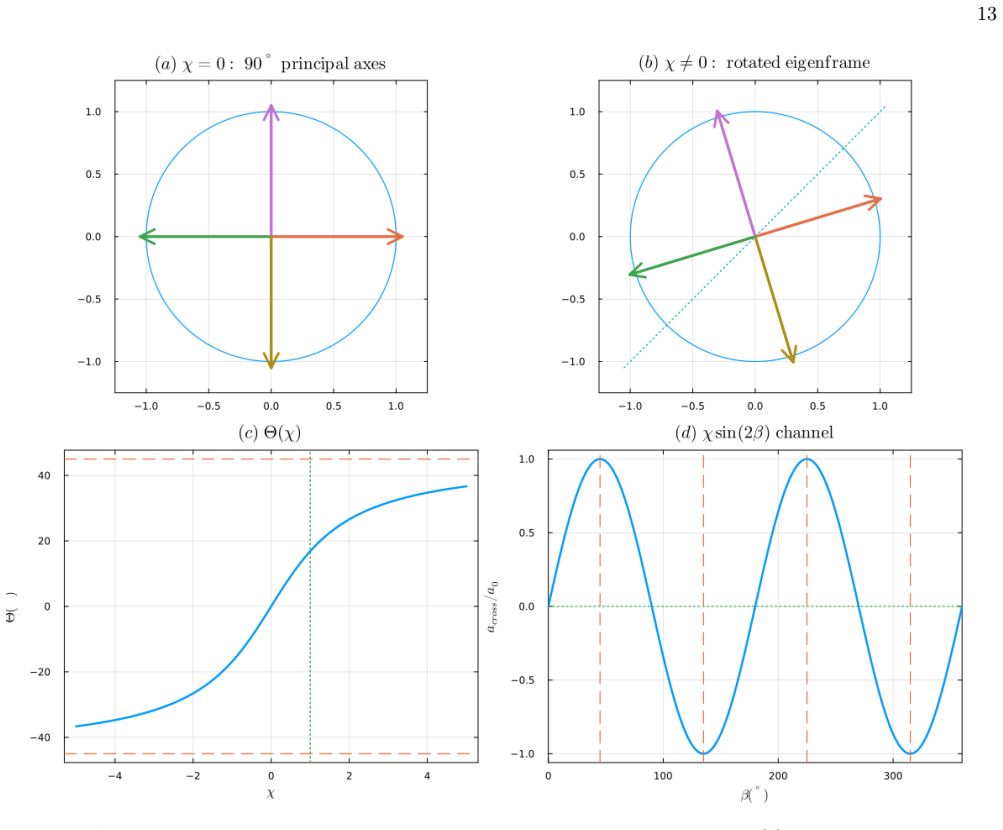
The central claim is that a Halilsoy-inspired off-diagonal tidal component, represented by the alpha-dependent coefficient chi_H(alpha,t,rho), can be introduced as a hidden residual in the lunar tidal tensor. This component rotates the entire eigenframe while preserving the ordinary 90-degree separation of principal axes, resulting in an additional sin(2 beta) residual channel with strongest directions at 45, 135, 225, and 315 degrees. The scale of the corresponding residual acceleration is governed by chi_H, providing a distinct 45-degree-type angular signature absent from the diagonal Newtonian principal-frame tensor.
What carries the argument
The Halilsoy-inspired residual coefficient chi_H(alpha,t,rho), which supplies the off-diagonal term that rotates the tidal eigenframe and generates the extra sin(2 beta) channel.
If this is right
- The residual acceleration carries a sin(2 beta) angular dependence whose peaks occur at the 45-degree directions.
- The ordinary 90-degree stretching and squeezing pattern of the principal tidal axes remains intact.
- The strength of the new channel is set by the value of the coefficient chi_H.
- The extension supplies a concrete ansatz that can be compared directly against tidal data without replacing standard Newtonian calculations.
Where Pith is reading between the lines
- Similar off-diagonal residuals could appear in other gravitational tidal systems if the cylindrical-wave analogy proves portable.
- Precise angular mapping of tidal forces at intermediate angles might expose small deviations from purely diagonal Newtonian predictions.
- The construction suggests a route for importing exact-solution features from general relativity as perturbative corrections in local gravitational environments.
Load-bearing premise
An off-diagonal tidal component can be added to the Earth-Moon system by direct analogy with the cross-polarized sector of cylindrical gravitational waves, without deriving it from the Einstein equations applied to lunar geometry.
What would settle it
High-precision measurements of Earth-Moon tidal accelerations that either detect or rule out an extra component varying as sin(2 beta) with amplitude maxima precisely at 45, 135, 225, and 315 degrees and scaling with the proposed chi_H parameter.
Figures



read the original abstract
The Earth-Moon tide is classically explained by the Newtonian quadrupolar tidal tensor. In its principal frame, this tensor gives the familiar 90-degree stretching-squeezing geometry and contains only the ordinary plus-type tidal channel. A projected acceleration can be evaluated along any direction, including the 45-degree direction, but this projection is not an independent cross-tidal residual. In this work, we propose a Halilsoy-inspired residual extension of the lunar tidal tensor. The motivation comes from Halilsoy's cross-polarized cylindrical gravitational waves, where an off-diagonal tidal sector naturally rotates the local tidal eigenframe. Using this relativistic mechanism as a guide, we introduce an alpha-dependent residual coefficient, chi_H(alpha,t,rho), representing a possible hidden off-diagonal tidal component beyond the diagonal Newtonian principal-frame tensor. The proposed residual does not destroy the ordinary 90-degree separation of the principal tidal axes. Instead, it rotates the whole eigenframe and produces a distinct 45-degree-type angular signature. This signature appears as an additional sin(2 beta) residual channel whose strongest directions are 45, 135, 225, and 315 degrees. The corresponding residual acceleration scale is controlled by chi_H. The model does not replace standard lunar tidal theory and does not identify the Earth-Moon system with a Halilsoy spacetime. Rather, it provides a testable residual ansatz: Newtonian gravity explains the dominant lunar tide, while the Halilsoy-inspired sector supplies an alpha-dependent off-diagonal cross channel that is absent from the diagonal Newtonian principal-frame description.
Editorial analysis
A structured set of objections, weighed in public.
Referee Report
Summary. The manuscript proposes extending the Newtonian quadrupolar lunar tidal tensor with a Halilsoy-inspired off-diagonal residual coefficient chi_H(alpha, t, rho). This term is claimed to rotate the tidal eigenframe without destroying the 90-degree principal axes and to generate an additional independent sin(2 beta) cross-tidal channel whose maxima lie at 45°, 135°, 225°, and 315°. The construction is presented as a testable ansatz that supplements rather than replaces standard tidal theory and does not equate the Earth-Moon system to a Halilsoy spacetime.
Significance. If the off-diagonal term could be derived from the Einstein equations in the weak-field lunar geometry or shown to produce falsifiable predictions with quantitative error bars, the work would supply a novel relativistic-motivated residual channel for high-precision tidal observations. The analogy to cross-polarized cylindrical waves is clearly stated and the disclaimer that the model remains an ansatz is explicit. At present the absence of any derivation, explicit tensor components, or numerical predictions limits the result to a phenomenological suggestion.
major comments (2)
- [Abstract and modeling section] The central claim that chi_H functions as a physically motivated, independent cross-tidal residual rests entirely on analogy to Halilsoy's off-diagonal sector; no expansion of the Einstein equations about the Newtonian Earth-Moon background, no weak-field matching, and no verification that the added term satisfies the linearized Bianchi identities are supplied. This is load-bearing for the assertion that the sin(2 beta) channel is a 'distinct' residual rather than an arbitrary modeling choice. (Abstract, paragraph 2; modeling section introducing chi_H)
- [Abstract, paragraph 3] The statement that the residual 'rotates the whole eigenframe' and produces a distinct 45-degree angular signature is asserted but not demonstrated by explicit diagonalization of the modified tidal tensor or by computation of the projected acceleration along beta. Without these steps the claimed 45/135/225/315-degree pattern follows tautologically from defining chi_H as the off-diagonal coefficient. (Abstract, paragraph 3)
minor comments (2)
- The parameter alpha is repeatedly invoked as controlling the scale of chi_H but is never defined or given a physical interpretation in the Earth-Moon context.
- The manuscript would benefit from a short table or figure showing the explicit form of the extended tidal tensor, its eigenvalues, and the resulting angular dependence of the residual acceleration.
Simulated Author's Rebuttal
We thank the referee for the detailed and constructive report. The comments correctly identify that the work presents a phenomenological ansatz rather than a derived result from the Einstein equations. We will revise the manuscript to make this status explicit, add the requested explicit calculations, and strengthen the presentation of the model as a testable supplement to Newtonian tidal theory.
read point-by-point responses
-
Referee: [Abstract and modeling section] The central claim that chi_H functions as a physically motivated, independent cross-tidal residual rests entirely on analogy to Halilsoy's off-diagonal sector; no expansion of the Einstein equations about the Newtonian Earth-Moon background, no weak-field matching, and no verification that the added term satisfies the linearized Bianchi identities are supplied. This is load-bearing for the assertion that the sin(2 beta) channel is a 'distinct' residual rather than an arbitrary modeling choice. (Abstract, paragraph 2; modeling section introducing chi_H)
Authors: We agree that the construction relies on analogy to the off-diagonal sector of Halilsoy's cylindrical wave solutions and is not obtained from a weak-field expansion of the Einstein equations for the Earth-Moon system. The manuscript already states that the proposal is an ansatz that supplements rather than replaces standard tidal theory and does not equate the Earth-Moon system to a Halilsoy spacetime. To address the concern, we will add a new paragraph in the modeling section explicitly labeling the term as a phenomenological extension motivated by the relativistic cross-polarized mechanism, without claiming derivation or satisfaction of the full linearized Bianchi identities. We will also note that any future matching to weak-field gravity would be a separate investigation. revision: yes
-
Referee: [Abstract, paragraph 3] The statement that the residual 'rotates the whole eigenframe' and produces a distinct 45-degree angular signature is asserted but not demonstrated by explicit diagonalization of the modified tidal tensor or by computation of the projected acceleration along beta. Without these steps the claimed 45/135/225/315-degree pattern follows tautologically from defining chi_H as the off-diagonal coefficient. (Abstract, paragraph 3)
Authors: The referee is correct that the current text asserts the rotation and 45-degree signature without showing the explicit steps. In the revised manuscript we will insert the explicit components of the modified tidal tensor (Newtonian diagonal terms plus the chi_H off-diagonal term), perform the diagonalization to demonstrate the rotation of the principal axes, and compute the projected acceleration as a function of beta to confirm the additional sin(2 beta) channel with maxima at 45°, 135°, 225°, and 315°. These calculations will be placed in a new subsection of the modeling section. revision: yes
Circularity Check
45° sin(2β) channel and eigenframe rotation are algebraic consequences of defining χ_H as off-diagonal residual
specific steps
-
self definitional
[Abstract]
"we introduce an alpha-dependent residual coefficient, chi_H(alpha,t,rho), representing a possible hidden off-diagonal tidal component beyond the diagonal Newtonian principal-frame tensor. The proposed residual does not destroy the ordinary 90-degree separation of the principal tidal axes. Instead, it rotates the whole eigenframe and produces a distinct 45-degree-type angular signature. This signature appears as an additional sin(2 beta) residual channel whose strongest directions are 45, 135, 225, and 315 degrees. The corresponding residual acceleration scale is controlled by chi_H."
The 45-degree directions and sin(2β) form are the direct mathematical outcome of adding an off-diagonal term to a diagonal tidal tensor; the eigenframe rotation to 45/135/etc. follows at once from the eigenvectors of the modified matrix, making the reported signature equivalent to the definition of χ_H rather than an independent result.
-
ansatz smuggled in via citation
[Abstract]
"we propose a Halilsoy-inspired residual extension of the lunar tidal tensor. The motivation comes from Halilsoy's cross-polarized cylindrical gravitational waves, where an off-diagonal tidal sector naturally rotates the local tidal eigenframe."
The specific off-diagonal form and its 45° consequence are adopted by direct analogy to the co-author's prior cylindrical-wave metric without deriving χ_H from the Einstein equations applied to the Earth-Moon geometry or verifying it satisfies the linearized constraints; the ansatz is imported via the Halilsoy reference.
full rationale
The paper introduces χ_H(α,t,ρ) explicitly as an off-diagonal tidal component by Halilsoy analogy and then states that this produces a distinct 45°-type sin(2β) residual channel whose maxima lie at 45/135/225/315°. This angular signature follows immediately from the linear algebra of a diagonal Newtonian tensor plus off-diagonal term; the claimed 'prediction' therefore reduces to the modeling choice itself. No derivation from the Einstein equations on lunar geometry, no weak-field matching, and no independent benchmark are supplied, leaving the result forced by the ansatz.
Axiom & Free-Parameter Ledger
free parameters (2)
- alpha
- chi_H(alpha,t,rho)
axioms (2)
- domain assumption Newtonian gravity explains the dominant lunar tide
- ad hoc to paper Halilsoy's cross-polarized cylindrical waves supply a valid guide for extending the tidal tensor
invented entities (1)
-
chi_H(alpha,t,rho)
no independent evidence
Lean theorems connected to this paper
-
IndisputableMonolith/Foundation/AlexanderDuality.leanalexander_duality_circle_linking unclear?
unclearRelation between the paper passage and the cited Recognition theorem.
The simplest residual tensor is E_χ = κ_M (2 χ; χ -1), eigenframe rotation Θ(χ)=½ arctan(2χ/3). ... χ_H(α,t,ρ)=3 sinhα J1(ρ/λ) sin(t/λ) / [DH(ρ) cos(t/λ)]
-
IndisputableMonolith/Cost/FunctionalEquation.leanwashburn_uniqueness_aczel unclear?
unclearRelation between the paper passage and the cited Recognition theorem.
Halilsoy-inspired residual extension ... does not identify the Earth-Moon system with a Halilsoy spacetime
What do these tags mean?
- matches
- The paper's claim is directly supported by a theorem in the formal canon.
- supports
- The theorem supports part of the paper's argument, but the paper may add assumptions or extra steps.
- extends
- The paper goes beyond the formal theorem; the theorem is a base layer rather than the whole result.
- uses
- The paper appears to rely on the theorem as machinery.
- contradicts
- The paper's claim conflicts with a theorem or certificate in the canon.
- unclear
- Pith found a possible connection, but the passage is too broad, indirect, or ambiguous to say the theorem truly supports the claim.
Reference graph
Works this paper leans on
-
[1]
the polarization parameterα, throughsinhα
-
[2]
radial locations where|J1(ρ/λ)/DH(ρ)|is large
-
[3]
Thus the cross channel is not a constant offset, but a structured residual
phases where|tan(t/λ)|is large. Thus the cross channel is not a constant offset, but a structured residual. The cross ratio vanishes when J1(ρ/λ) = 0(78) or sin(t/λ) = 0.(79) At such points, the Halilsoy cross-sector is absent and the effective lunar tensor returns to the plus-aligned form. Bycontrast, thecrossratiobecomeslargeneareffective plus-null surf...
-
[4]
the diagonal entries2and−1are the standard Newtonian lunar tide in a two-dimensional section
-
[5]
the off-diagonal entryχ H is an alpha-dependent cross sector motivated by the Halilsoy weak-field tidal block
-
[6]
the eigenframe angle of the effective tensor repro- duces the Halilsoy tidal rotation angle. 8 The model can be summarized by the compact relation EM,H =E N +E H cross. (102) HereE N is the ordinary Newtonian lunar tidal ten- sor, whileE H cross is the Halilsoy-inspiredα-dependent off-diagonal sector responsible for the45◦-type residual channel. The model...
-
[7]
I.Newton,Philosophiae Naturalis Principia Mathematica (Royal Society, London, 1687)
-
[8]
Laplace,Traite de Mecanique Celeste(Duprat, Paris, 1799)
P.-S. Laplace,Traite de Mecanique Celeste(Duprat, Paris, 1799)
-
[9]
A. E. H. Love,Some Problems of Geodynamics(Cam- bridge University Press, Cambridge, 1911)
work page 1911
-
[10]
Melchior,The Tides of the Planet Earth, 2nd ed
P. Melchior,The Tides of the Planet Earth, 2nd ed. (Pergamon Press, Oxford, 1983)
work page 1983
-
[11]
C. D. Murray and S. F. Dermott,Solar System Dynamics (Cambridge University Press, Cambridge, 1999)
work page 1999
-
[12]
E. Poisson and C. M. Will,Gravity: Newtonian, Post- Newtonian, Relativistic(Cambridge University Press, Cambridge, 2014)
work page 2014
-
[13]
F. A. E. Pirani, Acta Physica Polonica15, 389 (1956)
work page 1956
-
[14]
C. W. Misner, K. S. Thorne, and J. A. Wheeler,Gravi- tation(W. H. Freeman, San Francisco, 1973)
work page 1973
-
[15]
R. M. Wald,General Relativity(University of Chicago Press, Chicago, 1984)
work page 1984
-
[16]
M. Maggiore,Gravitational Waves. Volume 1: The- ory and Experiments(Oxford University Press, Oxford, 2007)
work page 2007
-
[17]
M. Maggiore,Gravitational Waves. Volume 2: Astro- physics and Cosmology(Oxford University Press, Ox- ford, 2018)
work page 2018
-
[18]
E. E. Flanagan and S. A. Hughes, New Journal of Physics 7, 204 (2005)
work page 2005
-
[19]
A. Einstein and N. Rosen, Journal of the Franklin Insti- tute223, 43 (1937)
work page 1937
- [20]
-
[21]
K. S. Thorne, Physical Review138, B251 (1965)
work page 1965
-
[22]
Halilsoy, Il Nuovo Cimento B102, 563 (1988)
M. Halilsoy, Il Nuovo Cimento B102, 563 (1988)
work page 1988
-
[23]
K. Glod, S. Sikora, and S. J. Szybka, Physical Review D 106, 124022 (2022)
work page 2022
-
[24]
S. J. Szybka and S. U. Naqvi, Physical Review D103, 024011 (2021)
work page 2021
-
[25]
K. Nikiel and S. J. Szybka, Physical Review D111, 104015 (2025), arXiv:2503.01726 [gr-qc]
- [26]
-
[27]
D. E. Cartwright,Tides: A Scientific History(Cam- bridge University Press, Cambridge, 1999)
work page 1999
-
[28]
D. C. Agnew, inTreatise on Geophysics, Vol. 3, edited by G. Schubert (Elsevier, Amsterdam, 2007) pp. 163–195
work page 2007
-
[29]
H. Stephani, D. Kramer, M. A. H. MacCallum, C. Hoenselaers, and E. Herlt,Exact Solutions of Ein- stein’s Field Equations, 2nd ed. (Cambridge University Press, Cambridge, 2003)
work page 2003
-
[30]
J. B. Griffiths and J. Podolsky,Exact Space-Times in Einstein’s General Relativity(Cambridge University Press, Cambridge, 2009)
work page 2009
discussion (0)
Sign in with ORCID, Apple, or X to comment. Anyone can read and Pith papers without signing in.