Information-Theoretic Appraisal of Electron Densities
Pith reviewed 2026-05-21 01:48 UTC · model grok-4.3
The pith
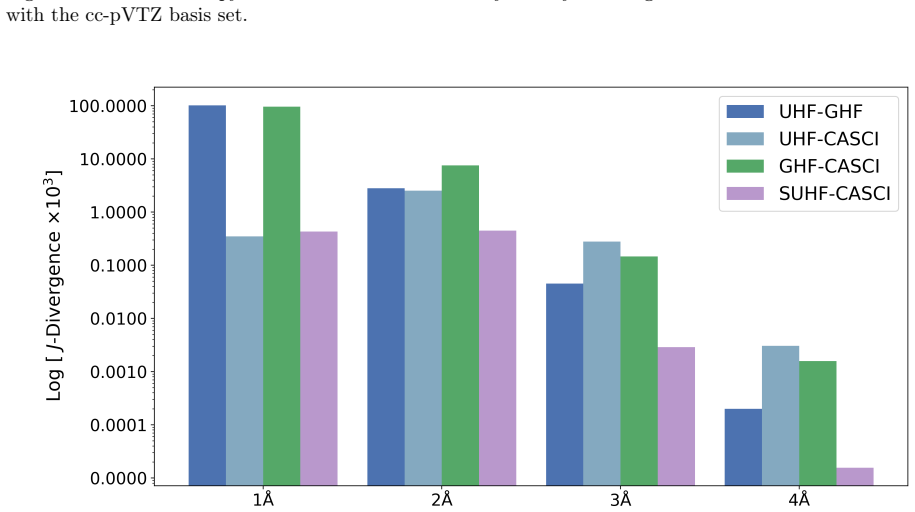
The J-divergence from position-space information entropy benchmarks electron densities obtained from single-reference methods against coupled cluster and configuration interaction references.
A machine-rendered reading of the paper's core claim, the machinery that carries it, and where it could break.
Core claim
Information entropy measures evaluated in position space allow comparisons across electron densities from single-reference methods, with the J-divergence serving as a key benchmarking metric against coupled cluster and configuration interaction references. The work covers ground-state and excited densities under confinement and ensemble conditions, compares mean-field orbital information to that of Brueckner and Dyson orbitals, and examines informational changes across multiple self-consistent-field solutions under symmetry-breaking conditions. It also relates entropic measures of electron delocalization to the accuracy of the CO dipole moment computed by different methods, yielding insights
What carries the argument
The J-divergence derived from information entropy measures evaluated in position space, used to benchmark and compare electron densities across quantum chemistry methods.
If this is right
- Single-reference densities can be ranked for closeness to high-level references using the J-divergence without direct computation of observables.
- Reference determinants for a given chemical application can be chosen by minimizing informational divergence to a target high-level density.
- Symmetry-breaking effects on electron densities can be quantified through changes in position-space entropy measures.
- Entropic delocalization measures correlate with the accuracy of properties such as the CO dipole moment across different methods.
- Incorporating information-entropy concepts may aid the systematic construction of improved density functionals.
Where Pith is reading between the lines
- The same divergence measures could be tested as a diagnostic tool inside self-consistent-field iterations to steer toward better reference states.
- Application to larger molecules might expose systematic trends in method performance that energy-based errors alone do not reveal.
- The approach could be extended to compare densities from different basis sets or to assess ensemble-averaged densities in thermal ensembles.
Load-bearing premise
Information entropy measures evaluated in position space provide a reliable and meaningful way to compare and benchmark densities obtained from single-reference methods against high-level references.
What would settle it
A direct comparison in which the density with the lowest J-divergence to a coupled-cluster reference fails to give the most accurate value for an observable such as the CO dipole moment or total energy.
Figures




read the original abstract
We present an information-theoretic assessment of atomic and molecular densities in the ground state and under a range of physical scenarios--excitation, confinement, and ensemblization. Comparisons across densities obtained from single-reference methods are facilitated through information entropy measures evaluated in position space. We demonstrate that the J-divergence serves as a key metric for benchmarking electron densities against coupled cluster and configuration interaction references. Mean-field orbital information is further compared with that of Brueckner and Dyson orbitals, and informational changes in multiple self-consistent-field solutions are examined under various symmetry-breaking conditions. We also explore the relationship between entropic measures of electron delocalization and the accuracy of the CO dipole moment computed with different methods. Our work offers insights into the selection of optimal reference determinants for a given chemical application and highlights potential benefits of incorporating information-entropy concepts in the development of new density functionals.
Editorial analysis
A structured set of objections, weighed in public.
Referee Report
Summary. The manuscript presents an information-theoretic assessment of atomic and molecular electron densities in the ground state and under excitation, confinement, and ensemblization. It employs position-space information entropy measures to compare densities from single-reference methods, positions the J-divergence as a key benchmarking metric against coupled-cluster and configuration-interaction references, compares mean-field orbital information with Brueckner and Dyson orbitals, examines informational changes under symmetry breaking, and explores links between entropic delocalization measures and CO dipole-moment accuracy across methods.
Significance. If the central claims hold, the work could supply a new lens for assessing approximate densities and selecting reference determinants, with possible implications for density-functional development. The introduction of J-divergence and related entropic quantities as diagnostic tools is conceptually novel, though its added value relative to established density or energy error metrics is not yet demonstrated.
major comments (2)
- [Abstract and §4] Abstract and §4 (Benchmarking section): the assertion that J-divergence 'serves as a key metric for benchmarking' is load-bearing for the central claim, yet the manuscript reports informational changes under various scenarios without showing that J-divergence orderings align with or improve upon known accuracy hierarchies (e.g., HF vs. CCSD(T) dipole or correlation-energy errors) on the same systems; a direct side-by-side comparison with integrated density differences is absent.
- [§5] §5 (CO dipole-moment analysis): the claimed relationship between entropic delocalization measures and dipole-moment accuracy is presented qualitatively; without reported correlation coefficients, regression statistics, or cross-validation across multiple molecules, the insight into 'optimal reference determinants' remains suggestive rather than conclusive.
minor comments (2)
- [Methods] Notation for the J-divergence and related entropy functionals is introduced without an explicit equation reference in the methods section; adding a numbered equation would improve clarity.
- [Figure 3] Figure captions for the symmetry-breaking panels do not state the basis set or level of theory used for the plotted densities.
Simulated Author's Rebuttal
We thank the referee for the constructive and detailed report. The comments help clarify how to strengthen the presentation of J-divergence as a benchmarking tool and the quantitative support for the CO dipole analysis. We address each major comment below and indicate the revisions we will make.
read point-by-point responses
-
Referee: [Abstract and §4] Abstract and §4 (Benchmarking section): the assertion that J-divergence 'serves as a key metric for benchmarking' is load-bearing for the central claim, yet the manuscript reports informational changes under various scenarios without showing that J-divergence orderings align with or improve upon known accuracy hierarchies (e.g., HF vs. CCSD(T) dipole or correlation-energy errors) on the same systems; a direct side-by-side comparison with integrated density differences is absent.
Authors: We agree that an explicit side-by-side comparison would make the benchmarking claim more robust. The current manuscript uses J-divergence to quantify density differences against CC and CI references and shows that it distinguishes methods in a manner consistent with their expected accuracy, but we did not tabulate this against integrated density errors or dipole/correlation-energy hierarchies on the same set of systems. In the revised manuscript we will add a table (new Table X in §4) that directly compares J-divergence rankings with both integrated |Δρ| and the known accuracy orderings (HF < MP2 < CCSD < CCSD(T)) for the ground-state and perturbed cases already studied. This addition will demonstrate alignment without asserting that J-divergence supersedes energy-based metrics. revision: yes
-
Referee: [§5] §5 (CO dipole-moment analysis): the claimed relationship between entropic delocalization measures and dipole-moment accuracy is presented qualitatively; without reported correlation coefficients, regression statistics, or cross-validation across multiple molecules, the insight into 'optimal reference determinants' remains suggestive rather than conclusive.
Authors: The referee correctly notes that the §5 discussion is qualitative. We will revise the section to include Pearson correlation coefficients and simple linear-regression statistics between the entropic delocalization measures (Shannon entropy and related quantities) and the absolute dipole errors for CO across the methods considered. In addition, we will extend the same quantitative analysis to two further molecules (N₂ and H₂O) that were already computed in the study, thereby providing a limited cross-validation. The revised text will state the correlation values and their statistical significance while retaining the original qualitative interpretation. revision: yes
Circularity Check
No circularity: direct empirical comparisons of entropic measures on computed densities
full rationale
The paper performs an information-theoretic assessment by evaluating J-divergence and related entropy measures directly on position-space electron densities obtained from different quantum chemistry methods (HF, CC, CI, etc.). These are straightforward numerical comparisons and rankings against reference densities; no derivation chain exists in which a claimed prediction or first-principles result is constructed by fitting a parameter to a subset of the same data and then re-presenting the fitted quantity as an independent prediction. No self-citation is invoked as a uniqueness theorem or load-bearing premise, and the abstract and scope describe observational benchmarking rather than a closed deductive loop. The central claim therefore remains independent of its inputs.
Axiom & Free-Parameter Ledger
Lean theorems connected to this paper
-
IndisputableMonolith/Cost/FunctionalEquation.leanwashburn_uniqueness_aczel echoes?
echoesECHOES: this paper passage has the same mathematical shape or conceptual pattern as the Recognition theorem, but is not a direct formal dependency.
We demonstrate that the J-divergence serves as a key metric for benchmarking electron densities against coupled cluster and configuration interaction references.
-
IndisputableMonolith/Cost.leanJcost echoes?
echoesECHOES: this paper passage has the same mathematical shape or conceptual pattern as the Recognition theorem, but is not a direct formal dependency.
J-D = KLD(ρ1∥ρ2) + KLD(ρ2∥ρ1). This is known as the Jeffreys divergence (J-D).
What do these tags mean?
- matches
- The paper's claim is directly supported by a theorem in the formal canon.
- supports
- The theorem supports part of the paper's argument, but the paper may add assumptions or extra steps.
- extends
- The paper goes beyond the formal theorem; the theorem is a base layer rather than the whole result.
- uses
- The paper appears to rely on the theorem as machinery.
- contradicts
- The paper's claim conflicts with a theorem or certificate in the canon.
- unclear
- Pith found a possible connection, but the passage is too broad, indirect, or ambiguous to say the theorem truly supports the claim.
Reference graph
Works this paper leans on
-
[1]
F.Perspectives in Electronic Structure Theory; Springer Berlin Heidelberg, 2011; p 415–452
Nalewajski, R. F.Perspectives in Electronic Structure Theory; Springer Berlin Heidelberg, 2011; p 415–452
work page 2011
-
[2]
Geerlings, P.; Borgoo, A.Phys. Chem. Chem. Phys.2011,13, 911–922
work page 2011
-
[3]
Ruedenberg, K.Rev. Mod. Phys.1962,34, 326–376
work page 1962
-
[4]
Bader, R.; Nguyen-Dang, T. InQuantum Theory of Atoms in Molecules–Dalton Revisited; Löwdin, P.- O., Ed.; Advances in Quantum Chemistry; Academic Press, 1981; Vol. 14; pp 63–124
work page 1981
-
[5]
Cremer, D.; Kraka, E.Croatica Chemica Acta1984,57, 1259–1281
-
[6]
Bader, R. F. W.; MacDougall, P. J.Journal of the American Chemical Society1985,107, 6788–6795
-
[7]
Bader, R. F. W.Accounts of Chemical Research1985,18, 9–15
-
[8]
Bader, R. F. W.Chemical Reviews1991,91, 893–928
- [9]
-
[10]
Bader, R. F. W.Monatshefte für Chemie - Chemical Monthly2005,136, 819–854
-
[11]
Proft, F. D.; Ayers, P. W.; Geerlings, P.The Chemical Bond; John Wiley & Sons, Ltd, 2014; Chapter 7, pp 233–270
work page 2014
-
[12]
Popelier, P. L. A.The Chemical Bond; John Wiley & Sons, Ltd, 2014; Chapter 8, pp 271–308
work page 2014
-
[13]
Koch, D.; Pavanello, M.; Shao, X.; Ihara, M.; Ayers, P. W.; Matta, C. F.; Jenkins, S.; Manzhos, S. Chemical Reviews2024,124, 12661–12737
- [14]
-
[15]
Gavin, R. M.; Bartell, L. S.The Journal of Chemical Physics1966,45, 4700–4703
-
[16]
D.Advances in Quantum Chemistry Volume 10; Elsevier, 1977; p 1–35
Coppens, P.; Stevens, E. D.Advances in Quantum Chemistry Volume 10; Elsevier, 1977; p 1–35
work page 1977
-
[17]
Coppens, P.Annual Review of Physical Chemistry1992,43, 663–692
-
[18]
Tsirelson, V. G.; Ozerov, R. P.Electron Density and Bonding in Crystals: Principles, Theory and X-ray Diffraction Experiments in Solid State Physics and Chemistry; Institute of Physics Publishing: Bristol, 1996
work page 1996
-
[19]
S.; Coppens, P.Chemical Reviews2001,101, 1583–1628
Koritsanszky, T. S.; Coppens, P.Chemical Reviews2001,101, 1583–1628
-
[20]
Miao, J.; Ishikawa, T.; Johnson, B.; Anderson, E. H.; Lai, B.; Hodgson, K. O.Phys. Rev. Lett.2002, 89, 088303
work page 2002
-
[21]
Chapman, H. N. et al.Nature2011,470, 73–77
-
[22]
Kasai, H.; Tolborg, K.; Sist, M.; Zhang, J.; Hathwar, V. R.; Filsø, M. Ø.; Cenedese, S.; Sugimoto, K.; Overgaard, J.; Nishibori, E.; Iversen, B. B.Nature Materials2018,17, 249–252
-
[23]
Gao, C.; Macetti, G.; Overgaard, J.Inorganic Chemistry2019,58, 2133–2139
-
[24]
Gruene, T.; Holstein, J. J.; Clever, G. H.; Keppler, B.Nature Reviews Chemistry2021,5, 660–668
-
[25]
J.Reports on Progress in Physics1985,48, 415–481
Cooper, M. J.Reports on Progress in Physics1985,48, 415–481
-
[26]
T.; Shiotani, N.; Mijnarends, P
Tanaka, Y.; Sakurai, Y.; Stewart, A. T.; Shiotani, N.; Mijnarends, P. E.; Kaprzyk, S.; Bansil, A.Phys. Rev. B2001,63, 045120. 19
-
[27]
M.Applied Radiation and Isotopes2004,60, 805–814
Achmad, B.; Hussein, E. M.Applied Radiation and Isotopes2004,60, 805–814
- [28]
-
[29]
Hiraoka, N.; Nomura, T.Scientific Reports2017,7
-
[30]
Feng, Z.; Zhang, X.; Sakurai, Y.; Wang, Z.; Li, H.; Hu, H.Scientific Reports2019,9
-
[31]
TALMANTAITE, A.; HUNT, M.; MENDIS, B.Journal of Microscopy2020,279, 185–188
-
[32]
Qiao, C.-K.; Wei, J.-W.; Chen, L.Crystals2021,11
-
[33]
T.Canadian Journal of Physics1957,35, 168–183
Stewart, A. T.Canadian Journal of Physics1957,35, 168–183
- [34]
-
[35]
J.; Saarinen, K.; Hautojärvi, P.; Nieminen, R
Alatalo, M.; Barbiellini, B.; Hakala, M.; Kauppinen, H.; Korhonen, T.; Puska, M. J.; Saarinen, K.; Hautojärvi, P.; Nieminen, R. M.Phys. Rev. B1996,54, 2397–2409
-
[36]
Brusa, R.; Deng, W.; Karwasz, G.; Zecca, A.Nuclear Instruments and Methods in Physics Research Section B: Beam Interactions with Materials and Atoms2002,194, 519–531
-
[37]
O.; Potzger, K.; Krause-Rehberg, R.AIP Conference Proceed- ings2018,1970, 040003
Wagner, A.; Butterling, M.; Liedke, M. O.; Potzger, K.; Krause-Rehberg, R.AIP Conference Proceed- ings2018,1970, 040003
work page 1970
-
[38]
Arias-Aragón, F.; Darmé, L.; Grilli di Cortona, G.; Nardi, E.Phys. Rev. Lett.2024,132, 261801
work page 2024
-
[39]
E.The Bell System Technical Journal1948,27, 379–423
Shannon, C. E.The Bell System Technical Journal1948,27, 379–423
-
[40]
Jaynes, E. T.Phys. Rev.1957,106, 620–630
work page 1957
-
[41]
Gadre, S. R.Reviews of Modern Quantum Chemistry: A Celebration of the Contributions of Robert G Parr (In 2 Volumes); World Scientific, 2002; pp 108–147
work page 2002
-
[42]
F.Information theory of molecular systems; Elsevier, 2006
Nalewajski, R. F.Information theory of molecular systems; Elsevier, 2006
work page 2006
-
[43]
Rong, C.; Wang, B.; Zhao, D.; Liu, S.WIREs Computational Molecular Science2020,10, e1461
- [44]
- [45]
- [46]
-
[47]
Gadre, S. R.; Bendale, R. D.; Gejji, S. P.Chemical Physics Letters1985,117, 138–142
-
[48]
Parr, R. G.; Rupnik, K.; Ghosh, S. K.Phys. Rev. Lett.1986,56, 1555–1558
work page 1986
-
[49]
Hô, M.; Weaver, D. F.; Smith, V. H.; Sagar, R. P.; Esquivel, R. O.Phys. Rev. A1998,57, 4512–4517
-
[50]
Restrepo Cuartas, J. P.; Sanz-Vicario, J. L.Phys. Rev. A2015,91, 052301
-
[51]
Schattschneider, P.; Löffler, S.; Gollisch, H.; Feder, R.Journal of Electron Spectroscopy and Related Phenomena2020,241, 146810, Sources, Interaction with Matter, Detection and Analysis of Low Energy Electrons (SIMDALEE2)
-
[52]
Lee, M.-J.; Jung, Y.-D.Entropy2020,22
- [53]
-
[54]
F.The Journal of Physical Chemistry A2000,104, 11940–11951
Nalewajski, R. F.The Journal of Physical Chemistry A2000,104, 11940–11951
-
[55]
F.The Journal of Physical Chemistry A2003,107, 3792–3802
Nalewajski, R. F.The Journal of Physical Chemistry A2003,107, 3792–3802. 20
- [56]
- [57]
-
[58]
Nalewajski, R. F. InApplications of Density Functional Theory to Chemical Reactivity; Putz, M. V., Mingos, D. M. P., Eds.; Springer Berlin Heidelberg: Berlin, Heidelberg, 2012; pp 51–93
work page 2012
-
[59]
K.; Liu, S.The Journal of Physical Chemistry A2019,123, 6751–6760
Wu, J.; Yu, D.; Liu, S.; Rong, C.; Zhong, A.; Chattaraj, P. K.; Liu, S.The Journal of Physical Chemistry A2019,123, 6751–6760
-
[60]
K.The Journal of Physical Chemistry A2022,126, 6801–6813
Pal, R.; Poddar, A.; Chattaraj, P. K.The Journal of Physical Chemistry A2022,126, 6801–6813
-
[61]
F.International Journal of Molecular Sciences2002,3, 237–259
Nalewajski, R. F.International Journal of Molecular Sciences2002,3, 237–259
-
[62]
Nalewajski, R. F.; Świtka, E.Phys. Chem. Chem. Phys.2002,4, 4952–4958
work page 2002
-
[63]
O.; Flores-Gallegos, N.; Iuga, C.; Carrera, E
Esquivel, R. O.; Flores-Gallegos, N.; Iuga, C.; Carrera, E. M.; Angulo, J. C.; Antolín, J.Theoretical Chemistry Accounts2009,124, 445–460
-
[64]
The Journal of Physical Chemistry A2010,114, 1906–1916
Esquivel,R.O.; Flores-Gallegos,N.; Dehesa,J.S.; Angulo,J.C.; Antolín,J.; López-Rosa,S.; Sen,K.D. The Journal of Physical Chemistry A2010,114, 1906–1916
work page 1906
-
[65]
A.; Balawender, R.; Holas, A.Phys
Welearegay, M. A.; Balawender, R.; Holas, A.Phys. Chem. Chem. Phys.2014,16, 14928–14946
work page 2014
-
[66]
a.Acta Physico-Chimica Sinica2016,32, 98–118
LIU, S.-B. a.Acta Physico-Chimica Sinica2016,32, 98–118
-
[67]
Flores-Gallegos, N.Journal of Mathematical Chemistry2022,60, 1405–1421
-
[68]
Flores-Gallegos, N.; G-Damián, O.Journal of Mathematical Chemistry2023,62, 300–311
-
[69]
Lin, S.-K.Journal of Chemical Information and Computer Sciences1996,36, 367–376
-
[70]
Hô, M.; Smith, J., Vedene H.; Weaver, D. F.; Gatti, C.; Sagar, R. P.; Esquivel, R. O.The Journal of Chemical Physics1998,108, 5469–5475
-
[71]
Nalewajski, R. F.; Parr, R. G.Proceedings of the National Academy of Sciences2000,97, 8879–8882
-
[72]
Godden, J. W.; Stahura, F. L.; Bajorath, J.Journal of Chemical Information and Computer Sciences 2000,40, 796–800
work page 2000
-
[73]
Nalewajski, R. F.; Parr, R. G.The Journal of Physical Chemistry A2001,105, 7391–7400
-
[74]
Flores-Gallegos, N.Journal of Mathematical Chemistry2021,60, 239–254
-
[75]
Flores-Gómez, L.; Flores-Gallegos, N.Journal of Mathematical Chemistry2024,63, 73–95
-
[76]
Löwdin, P. O.Adv. Chem. Phys.; John Wiley & Sons, Ltd, 1958; pp 207–322
work page 1958
- [77]
-
[78]
Collins, D. M.Z. Naturforsch. A1993,48, 68–74
-
[79]
Hô, M.; Sagar, R. P.; Pérez-Jordá, J. M.; Smith, V. H.; Esquivel, R. O.Chem. Phys. Lett.1994,219, 15–20
work page 1994
-
[80]
Löwdin, P. O.Int. J. Quantum Chem.1995,55, 77–102
work page 1995
discussion (0)
Sign in with ORCID, Apple, or X to comment. Anyone can read and Pith papers without signing in.