A Unified Framework for Uncertainty-Aware Explainable Artificial Intelligence: A Case Study in Power Quality Disturbance Classification
Pith reviewed 2026-05-21 06:09 UTC · model grok-4.3
The pith
The UA-RAO framework turns Bayesian neural network explanation distributions into summaries that improve localization over deterministic methods in power quality disturbance classification.
A machine-rendered reading of the paper's core claim, the machinery that carries it, and where it could break.
Core claim
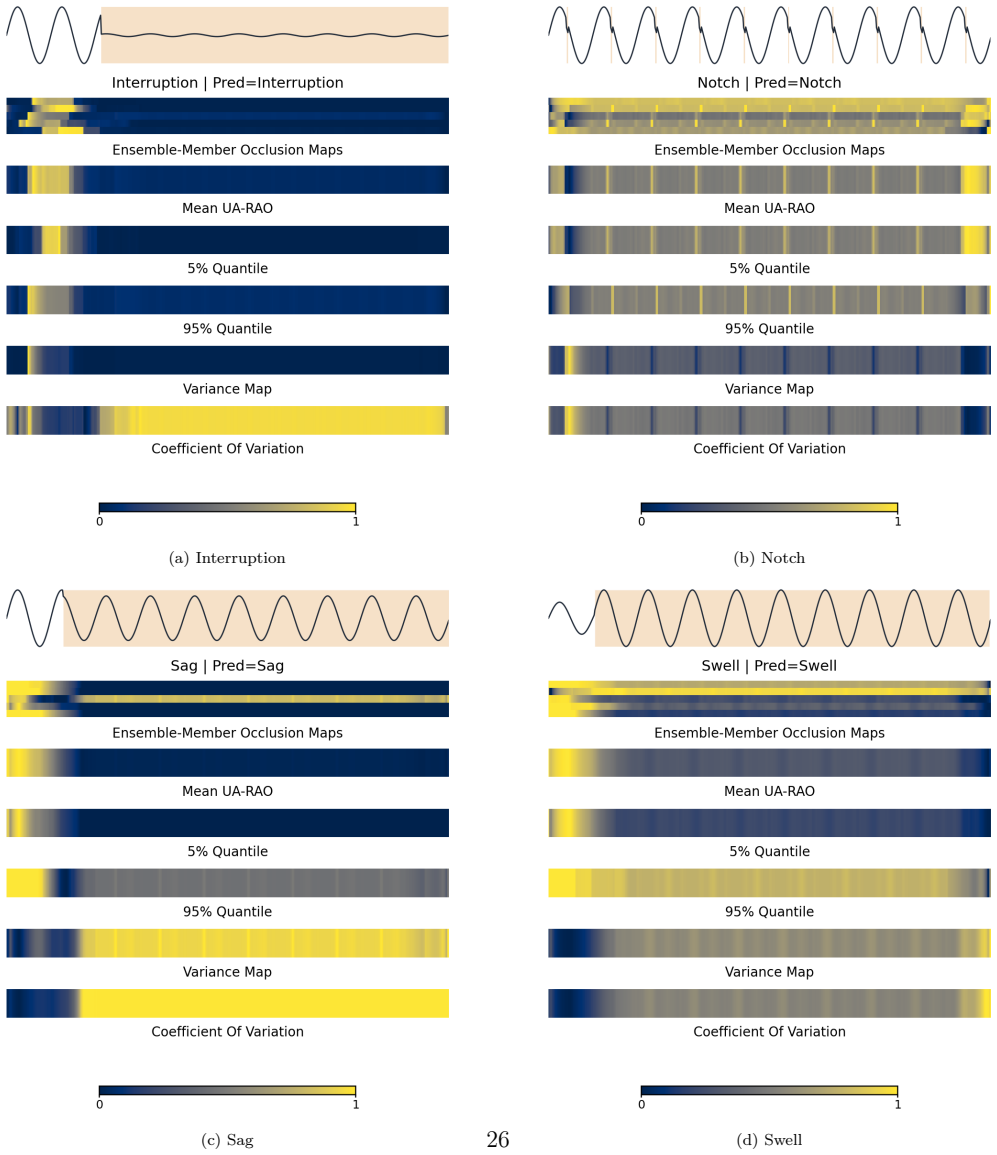
The central claim is that any Lipschitz-continuous attribution operator applied to a Bayesian neural network posterior induces an explanation distribution that can be summarized by the uncertainty-aware relevance attribution operator. This operator family includes the mean, variance, coefficient of variation, quantiles, and set-theoretic aggregates. Monte Carlo sampling renders the summaries accessible, and Wasserstein bounds control the approximation error. On the power quality disturbance classification task, deep ensembles using the mean UA-RAO deliver measurably better localisation than deterministic baselines, while variance and quantile summaries expose distinct uncertainty structures.
What carries the argument
The uncertainty-aware relevance attribution operator (UA-RAO), a family of summary functions applied to the push-forward explanation distribution induced by the BNN posterior.
If this is right
- Deep ensembles combined with the mean UA-RAO produce higher relevance mass accuracy and intersection-over-union scores than deterministic baselines on the fifteen-class PQD benchmark.
- Variance, coefficient of variation, and quantile summaries from UA-RAO expose uncertainty patterns that point-estimate attributions do not reveal.
- The same UA-RAO family applies to any Bayesian neural network paired with a Lipschitz-continuous attribution operator.
- Qualitative inspection of measured signals indicates that the observed uncertainty patterns extend beyond the synthetic training distribution.
Where Pith is reading between the lines
- Engineers could use variance summaries to flag inputs where an explanation is unreliable and additional sensing is required.
- The same push-forward construction and summary operators could be tested on time-series anomaly detection or medical image segmentation tasks.
- The Wasserstein bounds might be used to set minimum sample counts for real-time deployment of uncertainty-aware explanations.
Load-bearing premise
The attribution operators must be Lipschitz continuous to guarantee Monte Carlo accessibility and Wasserstein approximation bounds for the explanation distribution.
What would settle it
Repeating the power quality disturbance experiments and finding that deep ensembles paired with the mean UA-RAO do not produce higher relevance mass accuracy or intersection-over-union scores than the deterministic baseline would falsify the reported localisation improvement.
Figures

read the original abstract
Post-hoc explainable AI (XAI) methods typically produce deterministic attribution maps, whereas Bayesian neural networks (BNNs) induce a distribution over explanations. Capturing the variability of this distribution is important for uncertainty-aware decision-making. This paper formalises the \emph{explanation distribution} as the push-forward measure of the BNN posterior through any Lipschitz-continuous attribution operator. It further proposes the uncertainty-aware relevance attribution operator (UA-RAO), a general family of operators that summarises the explanation distribution using the mean, variance, coefficient of variation, quantiles, and set-theoretic aggregation measures. Theoretical support is provided through Monte Carlo accessibility and Wasserstein approximation bounds. The framework is evaluated on a 15-class power quality disturbance (PQD) classification benchmark, comparing three BNN approximations paired with three attribution operators using relevance mass accuracy and intersection-over-union as localisation metrics. Results show that deep ensembles with the mean UA-RAO improve localisation over the deterministic baseline, while other UA-RAO summaries reveal uncertainty patterns absent from point-estimate attributions. Qualitative results on measured signals further suggest that these patterns generalise beyond the synthetic training distribution. The framework is domain-agnostic and can be applied to any BNN paired with a Lipschitz-continuous attribution operator.
Editorial analysis
A structured set of objections, weighed in public.
Referee Report
Summary. The paper formalizes the explanation distribution as the push-forward of a BNN posterior through any Lipschitz-continuous attribution operator and introduces the uncertainty-aware relevance attribution operator (UA-RAO) family to summarize this distribution via mean, variance, coefficient of variation, quantiles, and set-theoretic measures. Theoretical support is claimed via Monte Carlo accessibility and Wasserstein approximation bounds. On a 15-class power quality disturbance classification benchmark, the work compares three BNN approximations with three attribution operators and reports that deep ensembles paired with the mean UA-RAO improve relevance mass accuracy and intersection-over-union localisation over a deterministic baseline, while other UA-RAO summaries expose uncertainty patterns absent from point estimates. Qualitative results on measured signals are presented to suggest generalization beyond the synthetic training distribution.
Significance. If the empirical claims hold under proper statistical controls, the framework offers a principled, domain-agnostic route to incorporate posterior uncertainty into post-hoc attributions, which is relevant for safety-critical applications such as power-system monitoring. The explicit treatment of the explanation distribution and the provision of summary operators that go beyond the mean constitute a clear conceptual advance over standard deterministic XAI pipelines.
major comments (3)
- [Results / Experimental Evaluation] Results section: the reported gains in relevance mass accuracy and IoU for deep ensembles with mean UA-RAO are presented without error bars, standard deviations across random seeds, or any hypothesis testing. Because deep ensembles are themselves stochastic, the absence of these statistics leaves open the possibility that observed deltas arise from training variance rather than the UA-RAO construction itself.
- [Theoretical Framework] Theoretical Framework: the Wasserstein approximation bounds and Monte Carlo accessibility claims for the explanation distribution are asserted, yet the manuscript supplies no derivation or proof sketch for these bounds. This directly affects the strength of the theoretical support offered for the UA-RAO family.
- [§3] §3 (Definition of UA-RAO): the Lipschitz-continuity assumption on the attribution operators is invoked to justify both the push-forward measure and the Wasserstein bounds, but no verification or bound on the Lipschitz constant is provided for the concrete operators (e.g., gradient-based or perturbation-based) used in the PQD experiments.
minor comments (2)
- [Abstract and Results] The abstract and results paragraphs should report the actual numerical values of relevance mass accuracy and IoU together with the precise train/validation/test splits used on the 15-class benchmark.
- [§3] Notation for the various UA-RAO summaries (mean, variance, quantiles, set measures) would benefit from a single consolidated table or explicit equations rather than prose descriptions.
Simulated Author's Rebuttal
We thank the referee for the careful reading and valuable suggestions. Below we respond to each major comment in turn and describe the revisions we intend to implement.
read point-by-point responses
-
Referee: [Results / Experimental Evaluation] Results section: the reported gains in relevance mass accuracy and IoU for deep ensembles with mean UA-RAO are presented without error bars, standard deviations across random seeds, or any hypothesis testing. Because deep ensembles are themselves stochastic, the absence of these statistics leaves open the possibility that observed deltas arise from training variance rather than the UA-RAO construction itself.
Authors: We concur that the current presentation would be strengthened by statistical controls. In the revised manuscript we will rerun all experiments across at least five independent random seeds, report means together with standard deviations, include error bars on the relevant bar plots, and apply paired statistical tests (e.g., Wilcoxon signed-rank) to assess whether the observed improvements over the deterministic baseline are significant. revision: yes
-
Referee: [Theoretical Framework] Theoretical Framework: the Wasserstein approximation bounds and Monte Carlo accessibility claims for the explanation distribution are asserted, yet the manuscript supplies no derivation or proof sketch for these bounds. This directly affects the strength of the theoretical support offered for the UA-RAO family.
Authors: We acknowledge that an explicit derivation would improve the theoretical section. We will add an appendix containing concise proof sketches: first, the Monte Carlo accessibility of the push-forward measure under the Lipschitz assumption, and second, the Wasserstein approximation bounds that justify the use of empirical quantiles and moments as UA-RAO summaries. revision: yes
-
Referee: [§3] §3 (Definition of UA-RAO): the Lipschitz-continuity assumption on the attribution operators is invoked to justify both the push-forward measure and the Wasserstein bounds, but no verification or bound on the Lipschitz constant is provided for the concrete operators (e.g., gradient-based or perturbation-based) used in the PQD experiments.
Authors: We agree that concrete verification strengthens the framework. In the revision we will insert a short analysis subsection that (i) recalls standard Lipschitz bounds for gradient-based operators such as Integrated Gradients under bounded network weights, and (ii) discusses the conditions under which the chosen perturbation-based operator remains Lipschitz, together with a brief numerical check on the operators actually employed. revision: yes
Circularity Check
No significant circularity in the derivation chain
full rationale
The paper defines the explanation distribution as the push-forward measure of the BNN posterior through any Lipschitz-continuous attribution operator and introduces the UA-RAO family as summaries (mean, variance, quantiles, etc.) of that distribution. Monte Carlo accessibility and Wasserstein approximation bounds follow directly from the Lipschitz assumption and the push-forward construction without reducing to fitted parameters or self-referential inputs. Evaluation proceeds on an external 15-class PQD benchmark using standard localisation metrics (relevance mass accuracy, IoU), and the reported improvements over the deterministic baseline are empirical outcomes on that benchmark rather than quantities defined by the same fitted values. No self-citation load-bearing steps, uniqueness theorems imported from prior author work, or ansatz smuggling via citation appear in the provided derivation; the framework is presented as domain-agnostic and applicable to any qualifying BNN-operator pair, confirming it is self-contained against external benchmarks.
Axiom & Free-Parameter Ledger
axioms (1)
- domain assumption Attribution operators are Lipschitz-continuous
invented entities (1)
-
UA-RAO
no independent evidence
Lean theorems connected to this paper
-
IndisputableMonolith/Cost/FunctionalEquation.leanwashburn_uniqueness_aczel unclear?
unclearRelation between the paper passage and the cited Recognition theorem.
formalises the explanation distribution as the push-forward measure of the BNN posterior through any Lipschitz-continuous attribution operator... UA-RAO... mean, variance, coefficient of variation, quantiles, and set-theoretic aggregation measures... Monte Carlo accessibility and Wasserstein approximation bounds
-
IndisputableMonolith/Foundation/RealityFromDistinction.leanreality_from_one_distinction unclear?
unclearRelation between the paper passage and the cited Recognition theorem.
deep ensembles with the mean UA-RAO improve localisation over the deterministic baseline
What do these tags mean?
- matches
- The paper's claim is directly supported by a theorem in the formal canon.
- supports
- The theorem supports part of the paper's argument, but the paper may add assumptions or extra steps.
- extends
- The paper goes beyond the formal theorem; the theorem is a base layer rather than the whole result.
- uses
- The paper appears to rely on the theorem as machinery.
- contradicts
- The paper's claim conflicts with a theorem or certificate in the canon.
- unclear
- Pith found a possible connection, but the passage is too broad, indirect, or ambiguous to say the theorem truly supports the claim.
Reference graph
Works this paper leans on
-
[1]
S.Ali, T.Abuhmed, S.El-Sappagh, K.Muhammad, J.M.Alonso-Moral, R. Confalonieri, R. Guidotti, J. Del Ser, N. Díaz-Rodríguez, F. Herrera, Explainable Artificial Intelligence (XAI): What we know and what is left to attain Trustworthy Artificial Intelligence, Information Fusion 99 (2023) 101805
work page 2023
- [2]
-
[3]
European Parliament and Council of the European Union, Regulation (EU) 2016/679 of the European Parliament and of the Council on the Protection of Natural Persons with Regard to the Processing of Personal Data and on the Free Movement of Such Data (General Data Protection Regulation), Official Journal of the European Union, L 119, 1–88 (2016)
work page 2016
-
[4]
M. Haslgrübler, B. Azadi, A. Ferscha, Visual saliency distribution maps for explaining time-series ai models used in continuous production of textile fibers, Information Fusion (2025) 103897
work page 2025
-
[5]
G. Yang, Q. Ye, J. Xia, Unbox the black-box for the medical explainable ai via multi-modal and multi-centre data fusion: A mini-review, two showcases and beyond, Information Fusion 77 (2022) 29–52. 29
work page 2022
- [6]
-
[7]
Y. Chen, S. S. Yu, Z. Li, J. K. Eshraghian, C. P. Lim, Interplay between Bayesian neural networks and deep learning: A survey, Knowledge- Based Systems 330 (2025) 114438
work page 2025
-
[8]
L. Han, X. Zhang, J. Wang, Adaptive probabilistic information fusion under concept drift: A generalized bayesian framework, Information Fusion (2025) 104010
work page 2025
- [9]
- [10]
-
[11]
D. Wood, T. Papamarkou, M. Benatan, R. Allmendinger, Model- agnostic variable importance for predictive uncertainty: an entropy- based approach, Data Mining and Knowledge Discovery 38 (2024) 4184– 4216
work page 2024
-
[12]
T. Peltola, Local interpretable model-agnostic explanations of Bayesian predictive models via kullback-leibler projections, arXiv preprint arXiv:1810.02678 (2018)
work page internal anchor Pith review Pith/arXiv arXiv 2018
- [13]
- [14]
-
[15]
M. U. Khan, S. Aziz, A. Usman, XPQRS: Expert power quality recog- nition system for sensitive load applications, Measurement 216 (2023) 112889
work page 2023
-
[16]
S. Wang, H. Chen, A novel deep learning method for the classification of power quality disturbances using deep convolutional neural network, Applied Energy 235 (2019) 1126–1140
work page 2019
-
[17]
R. Machlev, A. Chachkes, J. Belikov, Y. Beck, Y. Levron, Open source dataset generator for power quality disturbances with deep-learning ref- erence classifiers, Electric Power Systems Research 195 (2021) 107152
work page 2021
-
[18]
R. Machlev, M. Perl, J. Belikov, K. Y. Levy, Y. Levron, Measuring explainability and trustworthiness of power quality disturbances classi- fiers using XAI—explainable artificial intelligence, IEEE Transactions on Industrial Informatics 18 (8) (2021) 5127–5137
work page 2021
-
[19]
V. I. Bogachev, M. A. S. Ruas, Measure theory, Vol. 1, Springer, 2007
work page 2007
-
[20]
Billingsley, Probability and measure, John Wiley & Sons, 2017
P. Billingsley, Probability and measure, John Wiley & Sons, 2017
work page 2017
-
[21]
Durrett, Probability: theory and examples, Vol
R. Durrett, Probability: theory and examples, Vol. 49, Cambridge uni- versity press, 2019
work page 2019
-
[22]
B. Lakshminarayanan, A. Pritzel, C. Blundell, Simple and scalable pre- dictive uncertainty estimation using deep ensembles, in: Advances in Neural Information Processing Systems, Vol. 30, 2017
work page 2017
-
[23]
Y. Gal, Z. Ghahramani, Dropout as a Bayesian approximation: Repre- senting model uncertainty in deep learning, in: Proceedings of the 33rd International Conference on Machine Learning, 2016, pp. 1050–1059
work page 2016
- [24]
-
[25]
R.R.Selvaraju, M.Cogswell, A.Das, R.Vedantam, D.Parikh, D.Batra, Grad-CAM: Visual explanations from deep networks via gradient-based localization, in: Proceedings of the IEEE International Conference on Computer Vision, 2017, pp. 618–626. 31
work page 2017
-
[26]
M. T. Ribeiro, S. Singh, C. Guestrin, “Why should I trust you?”: Ex- plaining the predictions of any classifier, in: Proceedings of the 22nd ACM SIGKDD International Conference on Knowledge Discovery and Data Mining, 2016, pp. 1135–1144
work page 2016
-
[27]
M. D. Zeiler, R. Fergus, Visualizing and understanding convolutional networks, in: European Conference on Computer Vision, Springer, 2014, pp. 818–833
work page 2014
-
[28]
O. Florencias-Oliveros, M.-J. Espinosa-Gavira, J.-J. González-de-la Rosa, A. Agüera-Pérez, J.-C. Palomares-Salas, J.-M. Sierra-Fernández, Real-life power quality sags, IEEE Dataport, 2017. URLhttps://dx.doi.org/10.21227/H2K88D 32
discussion (0)
Sign in with ORCID, Apple, or X to comment. Anyone can read and Pith papers without signing in.