Observation of spin-free interatomic orbital angular momentum in a chiral crystal
Pith reviewed 2026-05-21 03:51 UTC · model grok-4.3
The pith
Chiral tellurium hosts spin-free orbital angular momentum from interatomic hopping alone
A machine-rendered reading of the paper's core claim, the machinery that carries it, and where it could break.
Core claim
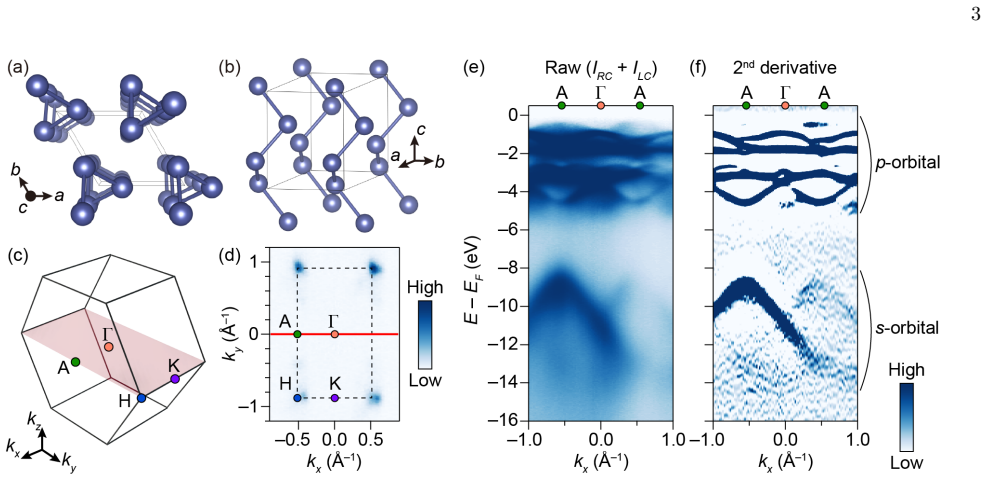
In a chiral Te crystal, angle-resolved photoemission spectroscopy resolves well-isolated s-orbital bands clearly separated from the p-orbital manifold. Combined circular dichroism ARPES and first-principles calculations reveal that these bands host OAM arising exclusively from interatomic hopping, with no intra-atomic contribution. Spin-resolved ARPES further confirms the absence of SAM, providing decisive evidence of spin-free OAM states.
What carries the argument
Interatomic orbital angular momentum generated by hopping within purely s-orbital bands of the chiral crystal, observed via circular dichroism ARPES
If this is right
- Spin-decoupled OAM states exist in crystalline solids.
- Interatomic OAM is the essential carrier of orbital angular momentum in these bands.
- A general framework is provided for designing spinless OAM states.
- Pure orbital currents become feasible for orbitronics.
Where Pith is reading between the lines
- Chiral crystals with similar band structures could be screened to find additional spin-free OAM platforms for orbitronic devices.
- Tuning lattice spacing or strain might allow electrical control of the interatomic OAM strength.
- These states may avoid spin-related decoherence, suggesting uses in orbital-based quantum information schemes.
Load-bearing premise
The circular dichroism ARPES signal comes solely from interatomic OAM in purely s-orbital bands, with negligible intra-atomic or extrinsic contributions and no significant p-orbital mixing.
What would settle it
Detection of nonzero spin polarization by spin-resolved ARPES on the same bands, or first-principles results showing substantial intra-atomic OAM, would disprove the claim of exclusively spin-free interatomic OAM.
Figures



read the original abstract
The inherent spin-orbit interaction of electrons inevitably couples spin to the orbital angular momentum (OAM), posing a fundamental challenge to spin-free orbital transport. Here, we propose a novel strategy to achieve spin-decoupled OAM states in crystalline solids. Using angle-resolved photoemission spectroscopy (ARPES), we resolve well-isolated s-orbital bands in a chiral Te crystal, clearly separated from the p-orbital manifold. Combined circular dichroism ARPES and first-principles calculations reveal that these bands host OAM arising exclusively from interatomic hopping, with no intra-atomic contribution. Spin-resolved ARPES further confirms the absence of SAM, providing decisive evidence of spin-free OAM states. These findings establish the existence of OAM without spin polarization in crystalline solids and highlight the essential role of inter-atomic OAM. This work provides a general framework for designing spinless OAM states, opening an opportunity toward pure orbital currents for orbitronics.
Editorial analysis
A structured set of objections, weighed in public.
Referee Report
Summary. The manuscript reports the observation of spin-free interatomic orbital angular momentum (OAM) in well-isolated s-orbital bands of a chiral tellurium crystal. Using ARPES, circular dichroism ARPES, spin-resolved ARPES, and first-principles calculations, the authors claim these bands host OAM arising exclusively from interatomic hopping with no intra-atomic contribution, and spin-resolved measurements confirm the absence of spin angular momentum, establishing spin-decoupled OAM states.
Significance. If the central claims hold, this work would provide direct experimental evidence for spin-free OAM states in crystalline solids driven by interatomic effects, offering a framework for designing pure orbital currents in orbitronics. The use of combined CD-ARPES with calculations to separate intra- vs inter-atomic OAM contributions is a notable strength, as is the focus on isolated s-bands in a chiral material.
major comments (2)
- The central claim that the resolved bands are purely s-orbital (hence zero intra-atomic OAM by construction) and that CD-ARPES directly reports interatomic OAM requires a quantitative bound on p-mixing or orbital decomposition. No such bound or explicit decomposition into intra- vs inter-atomic OAM components is referenced, which is load-bearing for the 'exclusively interatomic' and 'spin-free' assertions.
- The interpretation of the circular dichroism ARPES signal assumes negligible matrix-element or final-state effects that could mimic the reported dichroism. Explicit checks or simulations against these contributions are not described, undermining the claim that the signal arises solely from interatomic OAM.
minor comments (1)
- The abstract states that 'well-isolated s-orbital bands' are resolved but provides no quantitative error bars, detailed data-selection criteria, or explicit discussion of possible p-admixture in the experimental spectra.
Simulated Author's Rebuttal
We are grateful to the referee for their positive assessment of the significance of our work and for providing detailed comments that have prompted us to strengthen several aspects of the manuscript. We respond to each major comment in turn.
read point-by-point responses
-
Referee: The central claim that the resolved bands are purely s-orbital (hence zero intra-atomic OAM by construction) and that CD-ARPES directly reports interatomic OAM requires a quantitative bound on p-mixing or orbital decomposition. No such bound or explicit decomposition into intra- vs inter-atomic OAM components is referenced, which is load-bearing for the 'exclusively interatomic' and 'spin-free' assertions.
Authors: We agree that an explicit quantitative bound improves the rigor of the central claim. In the revised manuscript we have added an orbital-projected band-structure analysis from our DFT calculations. This shows that the bands under discussion carry >92% s-character with p-mixing below 8% throughout the relevant energy window. We have also included a direct decomposition of the calculated OAM into intra-atomic and inter-atomic contributions (following the partitioning described in the supplementary information), confirming that the intra-atomic term is negligible while the inter-atomic term accounts for essentially all of the observed OAM. These additions are now presented in a new figure panel and accompanying text. revision: yes
-
Referee: The interpretation of the circular dichroism ARPES signal assumes negligible matrix-element or final-state effects that could mimic the reported dichroism. Explicit checks or simulations against these contributions are not described, undermining the claim that the signal arises solely from interatomic OAM.
Authors: This concern is well taken. While the original manuscript emphasized the quantitative agreement between the measured CD-ARPES and the ground-state OAM texture, we have now added an explicit discussion of possible final-state and matrix-element contributions. Using a one-step photoemission model with a plane-wave final state, we show that matrix-element effects alone do not reproduce the observed momentum-dependent circular dichroism. The simulated dichroism remains consistent with the interatomic OAM once the ground-state wave functions are used. These model results and a brief comparison with literature on CD-ARPES in similar systems are incorporated in the revised text and supplementary information. revision: yes
Circularity Check
No significant circularity; claims rest on independent ARPES data and first-principles calculations
full rationale
The paper identifies isolated s-orbital bands via ARPES separation from the p-manifold and uses CD-ARPES plus ab initio calculations to attribute OAM to interatomic hopping while confirming zero SAM via spin-resolved measurements. No equation or claim reduces the target observable (interatomic OAM or spin-free states) to a fitted input or self-citation by construction; the orbital character assignment and OAM decomposition are outputs of the spectra and computations rather than tautological redefinitions. The derivation chain is self-contained against external experimental and theoretical benchmarks.
Axiom & Free-Parameter Ledger
axioms (2)
- domain assumption Circular dichroism ARPES intensity directly reflects orbital angular momentum texture without dominant matrix-element or final-state artifacts.
- domain assumption The resolved bands are purely s-orbital with negligible hybridization to p or other orbitals.
Lean theorems connected to this paper
-
IndisputableMonolith/Foundation/AlexanderDuality.leanalexander_duality_circle_linking unclear?
unclearRelation between the paper passage and the cited Recognition theorem.
Combined circular dichroism ARPES and first-principles calculations reveal that these bands host OAM arising exclusively from interatomic hopping, with no intra-atomic contribution.
-
IndisputableMonolith/Cost/FunctionalEquation.leanwashburn_uniqueness_aczel unclear?
unclearRelation between the paper passage and the cited Recognition theorem.
s-orbital electrons inherently carry no LAtom... finite LItin in the absence of LAtom
What do these tags mean?
- matches
- The paper's claim is directly supported by a theorem in the formal canon.
- supports
- The theorem supports part of the paper's argument, but the paper may add assumptions or extra steps.
- extends
- The paper goes beyond the formal theorem; the theorem is a base layer rather than the whole result.
- uses
- The paper appears to rely on the theorem as machinery.
- contradicts
- The paper's claim conflicts with a theorem or certificate in the canon.
- unclear
- Pith found a possible connection, but the passage is too broad, indirect, or ambiguous to say the theorem truly supports the claim.
Reference graph
Works this paper leans on
-
[1]
L. L. Hirst, The microscopic magnetization: concept an- dapplication, Rev. Mod. Phys.69, 607 (1997)
work page 1997
-
[2]
Kittel,Introduction to solid state physics, 8th ed
C. Kittel,Introduction to solid state physics, 8th ed. (Wi- ley, Hoboken, NJ, 2005)
work page 2005
-
[3]
Y.-G. Choi, D. Jo, K.-H. Ko, D. Go, K.-H. Kim, H. G. Park, C. Kim, B.-C. Min, G.-M. Choi, and H.-W. Lee, Observation of the orbital Hall effect in a light metal Ti, Nature619, 52 (2023)
work page 2023
-
[4]
A. El Hamdi, J.-Y. Chauleau, M. Boselli, C. Thibault, C. Gorini, A. Smogunov, C. Barreteau, S. Gariglio, J.-M. Triscone, and M. Viret, Observation of the orbital inverse Rashba–Edelstein effect, Nat. Phys.19, 1855 (2023)
work page 2023
- [5]
-
[6]
E. Redekop, C. Zhang, H. Park, J. Cai, E. Anderson, O. Sheekey, T. Arp, G. Babikyan, S. Salters, K. Watan- abe, T. Taniguchi, M. E. Huber, X. Xu, and A. F. Young, Direct magnetic imaging of fractional Chern insulators in twisted MoTe2, Nature635, 584 (2024)
work page 2024
-
[7]
T. Han, Z. Lu, G. Scuri, J. Sung, J. Wang, T. Han, K. Watanabe, T. Taniguchi, L. Fu, H. Park, and L. Ju, Orbital multiferroicity in pentalayer rhombohedral graphene, Nature623, 41 (2023)
work page 2023
-
[8]
M. Ünzelmann, H. Bentmann, P. Eck, T. Kißlinger, 6 B. Geldiyev, J. Rieger, S. Moser, R. C. Vidal, K. Kißner, L.Hammer, M.A.Schneider, T.Fauster, G.Sangiovanni, D. Di Sante, and F. Reinert, Orbital-Driven Rashba Ef- fect in a Binary Honeycomb Monolayer AgTe, Phys. Rev. Lett.124, 176401 (2020)
work page 2020
-
[9]
K. Hagiwara, Y. Chen, D. Go, X. L. Tan, S. Grytsiuk, K. O. Yang, G. Shu, J. Chien, Y. Shen, X. Huang, I. Co- jocariu, V. Feyer, M. Lin, S. Blügel, C. M. Schneider, Y. Mokrousov, and C. Tusche, Orbital Topology of Chi- ral Crystals for Orbitronics, Adv. Mater.37, 2418040 (2025)
work page 2025
-
[10]
S. Fukami, K.-J. Lee, and M. Kläui, Challenges and op- portunities in orbitronics, Nat. Phys. 10.1038/s41567- 025-03143-w (2025)
-
[11]
D. Oh, C. Pacella, X. Luo, C. Jozwiak, A. Bostwick, E. Rotenberg, M. Leandersson, C. Polley, A. Rubio, D. Di Sante, and R. Comin,p-Wave Orbital Angular Momentum Texture in a Chiral Crystal, preprint at https://arxiv.org/abs/2605.15544 (2026)
work page internal anchor Pith review Pith/arXiv arXiv 2026
-
[12]
D. Jo, D. Go, and H.-W. Lee, Gigantic intrinsic orbital Hall effects in weakly spin-orbit coupled metals, Phys. Rev. B98, 214405 (2018)
work page 2018
-
[13]
D. Go, D. Jo, H.-W. Lee, M. Kläui, and Y. Mokrousov, Orbitronics: Orbital currents in solids, EPL135, 37001 (2021)
work page 2021
-
[14]
T. Thonhauser, D. Ceresoli, D. Vanderbilt, and R. Resta, Orbital Magnetization in Periodic Insulators, Phys. Rev. Lett.95, 137205 (2005)
work page 2005
-
[15]
R. Burgos Atencia, A. , Amit, , and D. Culcer, Orbital angular momentum of Bloch electrons: equilibrium for- mulation, magneto-electric phenomena, and the orbital Hall effect, Adv. Phys.9, 2371972 (2024)
work page 2024
- [16]
-
[17]
S. Bhowal and G. Vignale, Orbital Hall effect as an al- ternative to valley Hall effect in gapped graphene, Phys. Rev. B103, 195309 (2021)
work page 2021
-
[18]
A. Pezo, D. García Ovalle, and A. Manchon, Orbital Hall effect in crystals: Interatomic versus intra-atomic contri- butions, Phys. Rev. B106, 104414 (2022)
work page 2022
-
[19]
A. Pezo, D. García Ovalle, and A. Manchon, Orbital Hall physics in two-dimensional Dirac materials, Phys. Rev. B 108, 075427 (2023)
work page 2023
-
[20]
T. P. Cysne, S. Bhowal, G. Vignale, and T. G. Rap- poport, Orbital Hall effect in bilayer transition metal dichalcogenides: From the intra-atomic approximation to the Bloch states orbital magnetic moment approach, Phys. Rev. B105, 195421 (2022)
work page 2022
-
[21]
S. R. Park, C. H. Kim, J. Yu, J. H. Han, and C. Kim, Orbital-Angular-Momentum Based Origin of Rashba- Type Surface Band Splitting, Phys. Rev. Lett.107, 156803 (2011)
work page 2011
-
[22]
S. R. Park, J. Han, C. Kim, Y. Y. Koh, C. Kim, H. Lee, H. J. Choi, J. H. Han, K. D. Lee, N. J. Hur, M. Arita, K. Shimada, H. Namatame, and M. Taniguchi, Chi- ral Orbital-Angular Momentum in the Surface States of Bi2Se3, Phys. Rev. Lett.108, 046805 (2012)
work page 2012
-
[23]
J.-H. Park, C. H. Kim, J.-W. Rhim, and J. H. Han, Or- bitalRashbaeffectanditsdetectionbycirculardichroism angle-resolved photoemission spectroscopy, Phys. Rev. B 85, 195401 (2012)
work page 2012
-
[24]
B. Kim, P. Kim, W. Jung, Y. Kim, Y. Koh, W. Kyung, J. Park, M. Matsunami, S.-i. Kimura, J. S. Kim, J. H. Han, and C. Kim, Microscopic mechanism for asymmet- ric charge distribution in Rashba-type surface states and the origin of the energy splitting scale, Phys. Rev. B88, 205408 (2013)
work page 2013
-
[25]
D. Go, D. Jo, C. Kim, and H.-W. Lee, Intrinsic Spin and Orbital Hall Effects from Orbital Texture, Phys. Rev. Lett.121, 086602 (2018)
work page 2018
-
[26]
M. Ünzelmann, H. Bentmann, T. Figgemeier, P. Eck, J. N. Neu, B. Geldiyev, F. Diekmann, S. Rohlf, J. Buck, M. Hoesch, M. Kalläne, K. Rossnagel, R. Thomale, T. Siegrist, G. Sangiovanni, D. D. Sante, and F. Rein- ert, Momentum-space signatures of Berry flux monopoles in the Weyl semimetal TaAs, Nat. Commun.12, 3650 (2021)
work page 2021
- [27]
- [28]
-
[29]
G. Gatti, D. Gosálbez-Martínez, S. Tsirkin, M. Fanciulli, M. Puppin, S. Polishchuk, S. Moser, L. Testa, E. Mar- tino, S. Roth, P. Bugnon, L. Moreschini, A. Bostwick, C. Jozwiak, E. Rotenberg, G. Di Santo, L. Petaccia, I. Vobornik, J. Fujii, J. Wong, D. Jariwala, H. Atwa- ter, H. Rønnow, M. Chergui, O. Yazyev, M. Grioni, and A. Crepaldi, Radial Spin Textur...
work page 2020
-
[30]
M. Sakano, M. Hirayama, T. Takahashi, S. Akebi, M. Nakayama, K. Kuroda, K. Taguchi, T. Yoshikawa, K. Miyamoto, T. Okuda, K. Ono, H. Kumigashira, T. Ideue, Y. Iwasa, N. Mitsuishi, K. Ishizaka, S. Shin, T. Miyake, S. Murakami, T. Sasagawa, and T. Kondo, Radial Spin Texture in Elemental Tellurium with Chiral Crystal Structure, Phys. Rev. Lett.124, 136404 (2020)
work page 2020
- [31]
-
[32]
K. Nakayama, A. Tokuyama, K. Yamauchi, A. Moriya, T. Kato, K. Sugawara, S. Souma, M. Kitamura, K. Horiba, H. Kumigashira, T. Oguchi, T. Takahashi, K. Segawa, and T. Sato, Observation of edge states derived from topological helix chains, Nature631, 54 (2024)
work page 2024
-
[33]
Moser, A toy model for dichroism in angle resolved photoemission, J
S. Moser, A toy model for dichroism in angle resolved photoemission, J. Electron Spectrosc. Relat. Phenom. 262, 147278 (2023)
work page 2023
-
[34]
T. Figgemeier, M. Ünzelmann, P. Eck, J. Schusser, L. Crippa, J. Neu, B. Geldiyev, P. Kagerer, J. Buck, M. Kalläne, M. Hoesch, K. Rossnagel, T. Siegrist, L.-K. Lim, R. Moessner, G. Sangiovanni, D. Di Sante, F. Rein- ert, and H. Bentmann, Imaging Orbital Vortex Lines in Three-Dimensional Momentum Space, Phys. Rev. X15, 011032 (2025)
work page 2025
-
[35]
D. Oh, H. Bentmann, and R. Comin, Interplay of orbital angular momentum and chirality, Nat. Phys. 10.1038/s41567-025-03113-2 (2025)
-
[36]
S. S. Brinkman, X. L. Tan, B. Brekke, A. C. Mathisen, O. Finnseth, R. J. Schenk, K. Hagiwara, M.-J. Huang, J. Buck, M. Kalläne, M. Hoesch, K. Rossnagel, K.-H. Ou Yang, M.-T. Lin, G.-J. Shu, Y.-J. Chen, C. Tusche, and H. Bentmann, Chirality-driven orbital angular mo- 7 mentum and circular dichroism in cosi, Phys. Rev. Lett. 132, 196402 (2024)
work page 2024
-
[37]
G. Kresse and J. Furthmüller, Efficiency of ab-initio total energy calculations for metals and semiconductors using a plane-wave basis set, Computational Materials Science 6, 15 (1996)
work page 1996
-
[38]
G. Kresse and J. Furthmüller, Efficient iterative schemes for ab initio total-energy calculations using a plane-wave basis set, Physical Review B54, 11169 (1996)
work page 1996
-
[39]
P. E. Blöchl, Projector augmented-wave method, Physi- cal Review B50, 17953 (1994)
work page 1994
-
[40]
G. Kresse and D. Joubert, From ultrasoft pseudopoten- tials to the projector augmented-wave method, Physical Review B59, 1758 (1999)
work page 1999
-
[41]
J. P. Perdew, K. Burke, and M. Ernzerhof, Generalized gradient approximation made simple, Physical Review Letters77, 3865 (1996)
work page 1996
- [42]
-
[43]
S. Steiner, S. Khmelevskyi, M. Marsman, and G. Kresse, Calculation of the magnetic anisotropy with projected- augmented-wave methodology and the case study of dis- ordered fe1−xcox alloys, Physical Review B93, 224425 (2016)
work page 2016
- [44]
-
[45]
N. Marzari and D. Vanderbilt, Maximally localized gen- eralized wannier functions for composite energy bands, Physical Review B56, 12847 (1997)
work page 1997
-
[46]
A. A. Mostofi, J. R. Yates, Y.-S. Lee, I. Souza, D. Van- derbilt, and N. Marzari, wannier90: A tool for ob- tainingmaximally-localisedwannierfunctions,Computer Physics Communications178, 685 (2008)
work page 2008
-
[47]
G. Pizzi, V. Vitale, R. Arita, S. Blügel, F. Freimuth, G. Géranton, M. Gibertini, D. Gresch, C. Johnson, T. Koretsune, J. Ibañez-Azpiroz, H. Lee, J.-H. Lihm, D. Marchand, A. Marrazzo, Y. Mokrousov, J. I. Mustafa, Y. Nohara, Y. Nomura, L. Paulatto, S. Poncé, T. Pon- weiser, J. Qiao, F. Thöle, S. S. Tsirkin, M. Wierzbowska, N. Marzari, D. Vanderbilt, I. Sou...
work page 2020
-
[48]
Postwan,https://github.com/philipp-eck/post_ wan.git
discussion (0)
Sign in with ORCID, Apple, or X to comment. Anyone can read and Pith papers without signing in.