Optimization of Secret Key Rate for BB84 under Collective Rotation Noise
Pith reviewed 2026-05-21 04:42 UTC · model grok-4.3
The pith
BB84 under collective rotation noise allows a noise engineering strategy that minimizes eavesdropper information while keeping secret key rate degradation modest.
A machine-rendered reading of the paper's core claim, the machinery that carries it, and where it could break.
Core claim
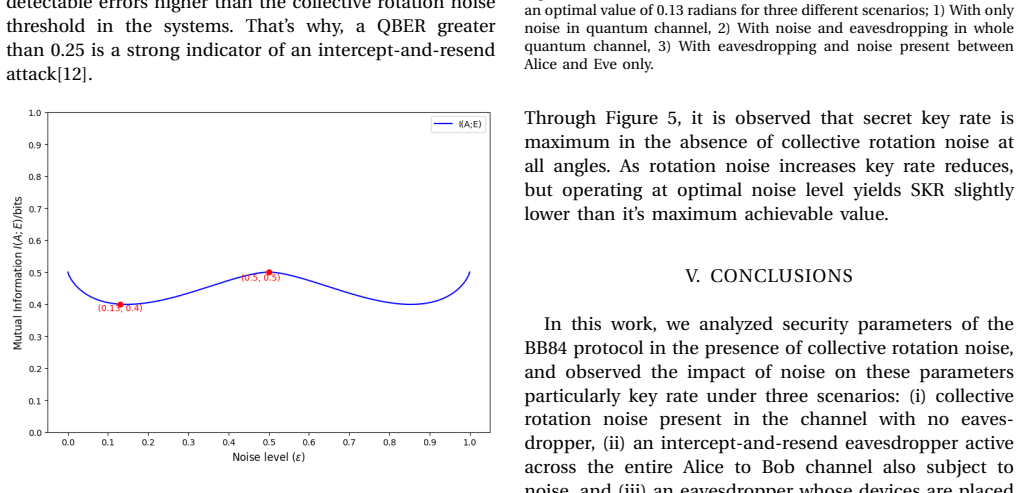
Under collective rotation noise, BB84 exhibits a non-zero noise range where information accessed by an eavesdropper performing intercept-and-resend attacks is minimized while the corresponding degradation in secret key rate remains relatively small.
What carries the argument
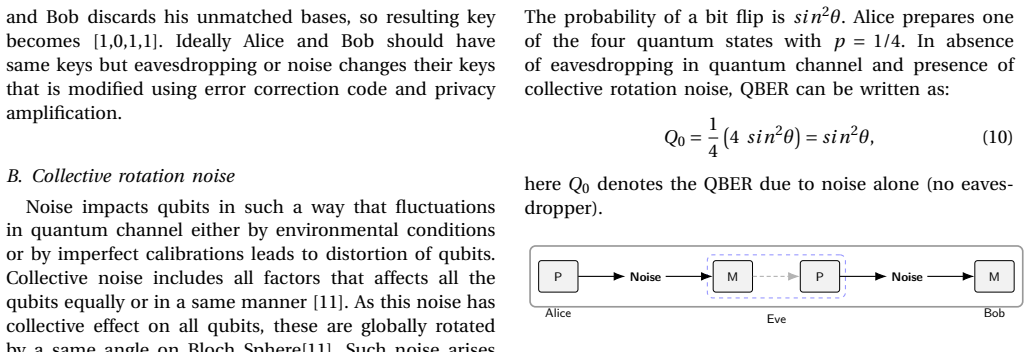
Formulas for quantum bit error rate, mutual information, and secret key rate derived under a collective rotation noise model combined with intercept-and-resend eavesdropping.
If this is right
- QKD systems could operate effectively by tuning or accepting noise levels within the identified favorable range instead of eliminating noise entirely.
- Practical BB84 implementations may gain resilience against rotation errors common in optical fibers or free-space channels.
- The noise range provides a concrete target for channel engineering to improve the trade-off between security and key generation speed.
Where Pith is reading between the lines
- The same noise-engineering idea could be tested in other prepare-and-measure protocols under comparable rotation errors.
- Laboratory verification with actual rotation noise sources would show whether the predicted range appears in hardware.
- Adding photon loss or other imperfections to the model could determine if the favorable noise window survives in more complete channel descriptions.
Load-bearing premise
The security analysis assumes collective rotation noise is the dominant channel imperfection and that intercept-and-resend attacks suffice to bound the eavesdropper's information.
What would settle it
An experiment applying controlled collective rotation noise to a BB84 setup and measuring both secret key rate and estimated eavesdropper information across noise strengths, to check whether a minimum in eavesdropper information occurs at a non-zero noise level with limited key rate loss.
Figures


read the original abstract
Practical quantum key distribution (QKD) systems operate under noise, but security of most protocols have been analyzed under ideal noiseless scenarios. In this work, we investigated security performance of BB84 protocol under effect of collective rotation noise. Using theoretical quantum information frameworks, we analyzed key security parameters including quantum bit error rate (QBER), mutual information and secret key rate (SKR). Security of protocol is studied under various eavesdropping scenarios based on intercept and resend attacks. Our results show that collective rotation noise has a significant impact on the information shared between the two parties. Particularly, we extended prior treatments by suggesting a noise engineering strategy where we identified a non-zero noise range where information accessed by Eve is minimized while corresponding SKR degradation remains relatively small. This analysis provide insights into robustness of BB84 protocol under realistic noisy channels and may contribute towards development of more resilient QKD systems.
Editorial analysis
A structured set of objections, weighed in public.
Referee Report
Summary. The manuscript analyzes the BB84 protocol under collective rotation noise using standard quantum-information calculations of QBER, mutual information I(A:B) and I(A:E), and secret key rate. Security is evaluated exclusively under intercept-and-resend attacks. The central claim is the existence of a non-zero range of collective rotation strength in which Eve's mutual information is minimized while SKR degradation remains relatively small, which the authors propose as a noise-engineering strategy for practical QKD.
Significance. If the attack model is shown to bound Eve's information and the numerical optimization is reproducible, the result would be of moderate practical interest: it suggests that controlled introduction of collective rotation noise could improve the security margin relative to signal degradation, contrary to the usual view of noise as purely harmful. The work extends prior BB84 noise analyses by focusing on this optimization rather than pure degradation.
major comments (2)
- [Eavesdropping scenarios and security analysis] The security analysis is restricted to intercept-and-resend attacks (abstract and eavesdropping-scenarios section). Collective rotation applies an identical unitary to every qubit and therefore permits coherent or collective attacks in which Eve correlates her ancilla across multiple transmissions; such attacks can extract more information than individual intercept-resend for the same observed QBER. This directly undermines the proposed noise-engineering strategy, which relies on the calculated I(A:E) being the relevant quantity to minimize.
- [Results and optimization] The abstract and results claim identification of a specific non-zero noise range, yet no explicit expressions for QBER(θ), I(A:E;θ), or SKR(θ) (where θ parametrizes the rotation strength), no numerical values, and no description of the optimization procedure or error bars are supplied. Without these, the location and width of the claimed range cannot be verified or reproduced.
minor comments (2)
- [Abstract] Abstract contains grammatical errors: 'security of most protocols have been analyzed' should read 'has'; 'This analysis provide insights' should read 'provides'.
- [Model] The parameterization of the collective rotation noise (angle or strength) and the precise definition of the intercept-and-resend attack on the noisy states should be stated explicitly in the model section before the calculations begin.
Simulated Author's Rebuttal
We thank the referee for the careful reading and constructive comments on our manuscript analyzing BB84 under collective rotation noise. We address each major comment point by point below, indicating planned revisions where appropriate.
read point-by-point responses
-
Referee: [Eavesdropping scenarios and security analysis] The security analysis is restricted to intercept-and-resend attacks (abstract and eavesdropping-scenarios section). Collective rotation applies an identical unitary to every qubit and therefore permits coherent or collective attacks in which Eve correlates her ancilla across multiple transmissions; such attacks can extract more information than individual intercept-resend for the same observed QBER. This directly undermines the proposed noise-engineering strategy, which relies on the calculated I(A:E) being the relevant quantity to minimize.
Authors: We agree that the security analysis is limited to intercept-and-resend attacks, as stated in the abstract and eavesdropping-scenarios section. The referee is correct that collective rotation noise, as a coherent channel, could in principle allow Eve to mount stronger collective attacks that extract additional information beyond individual intercept-resend for the same QBER. Our noise-engineering strategy is therefore proposed specifically within the individual-attack model used throughout the work. In the revised manuscript we will add an explicit discussion of this scope limitation and note that the optimization applies under the considered attack class, while acknowledging that a full collective-attack analysis would be a natural extension for future work. revision: partial
-
Referee: [Results and optimization] The abstract and results claim identification of a specific non-zero noise range, yet no explicit expressions for QBER(θ), I(A:E;θ), or SKR(θ) (where θ parametrizes the rotation strength), no numerical values, and no description of the optimization procedure or error bars are supplied. Without these, the location and width of the claimed range cannot be verified or reproduced.
Authors: We acknowledge that greater detail is required for reproducibility. In the revised version we will supply the explicit analytical expressions for QBER(θ), I(A:E; θ) and SKR(θ), a step-by-step description of the numerical optimization procedure used to locate the non-zero noise range, and the corresponding numerical values together with any error bars or uncertainty estimates obtained from the calculations. revision: yes
Circularity Check
Derivation applies standard QKD formulas to parameterized noise model without reduction to inputs by construction
full rationale
The paper computes QBER, mutual information I(A:E), and secret key rate directly from the collective rotation noise model (parameterized by rotation angle) combined with the intercept-and-resend attack assumption using conventional quantum information expressions. These steps are explicit calculations on the input noise strength and attack model rather than self-definitional loops, fitted parameters renamed as predictions, or load-bearing self-citations. The identification of a non-zero noise range is an analysis of the resulting functions over the parameter space, not a circular prediction. No uniqueness theorems, ansatzes via prior self-work, or renaming of known results are invoked in the provided text. The derivation chain remains self-contained against the stated assumptions.
Axiom & Free-Parameter Ledger
free parameters (1)
- collective rotation angle or strength
axioms (2)
- domain assumption Collective rotation noise model accurately captures the dominant channel effect
- domain assumption Intercept-and-resend attack bounds Eve's accessible information
Reference graph
Works this paper leans on
-
[1]
Quantum cryptography: Public key distribution and coin tossing,
C. H. Bennett and G. Brassard, “Quantum cryptography: Public key distribution and coin tossing,” Bangalore, India, Tech. Rep., December 1984
work page 1984
-
[2]
Simple proof of security of the BB84 quantum key distribution protocol,
P . W . Shor and J. Preskill, “Simple proof of security of the BB84 quantum key distribution protocol,”Physical Review Letters, vol. 85, no. 2, pp. 441–444, July 2000
work page 2000
-
[3]
Limita- tions on practical quantum cryptography,
G. Brassard, N. Lütkenhaus, T . Mor, and B. C. Sanders, “Limita- tions on practical quantum cryptography,”Physical Review Letters, vol. 85, no. 6, pp. 1330–1333, August 2000
work page 2000
-
[4]
Hacking commercial quantum cryptography systems by tailored bright illumination,
L. Lydersen, C. Wiechers, C. Wittmann, D. Elser, J. Skaar, and V . Makarov, “Hacking commercial quantum cryptography systems by tailored bright illumination,”Nature Photonics, vol. 4, no. 10, pp. 686–689, October 2010
work page 2010
-
[5]
Time-shift attack in practical quantum cryptosystems,
B. Qi, C. H. F . Fung, H. K. Lo, and X. Ma, “Time-shift attack in practical quantum cryptosystems,”Quantum Information and Computation, vol. 7, no. 1–2, pp. 73–82, January 2007
work page 2007
-
[6]
Experimental quantum key distribution with source flaws,
F . Xu, K. Wei, S. Sajeed, S. Kaiser, S. Sun, Z. Tang, L. Qian, V . Makarov, and H. K. Lo, “Experimental quantum key distribution with source flaws,”Physical Review A, vol. 92, no. 3, p. 032305, September 2015
work page 2015
-
[7]
Distillation of secret key and entan- glement from quantum states,
I. Devetak and A. Winter, “Distillation of secret key and entan- glement from quantum states,”Proceedings of the Royal Society A: Mathematical, Physical and Engineering Sciences, vol. 461, no. 2053, pp. 207–235, January 2005
work page 2053
-
[8]
Secret-key reconciliation by public discussion,
G. Brassard and L. Salvail, “Secret-key reconciliation by public discussion,” inAdvances in Cryptology – EUROCRYPT ’93, ser. Lecture Notes in Computer Science, vol. 765. Berlin: Springer, 1994, pp. 410–423
work page 1994
-
[9]
Information recon- ciliation for quantum key distribution,
D. Elkouss, J. Martinez-Mateo, and V . Martín, “Information recon- ciliation for quantum key distribution,”Quantum Information and Computation, vol. 11, no. 3–4, pp. 226–238, March 2011
work page 2011
-
[10]
Privacy amplification by public discussion,
C. H. Bennett, G. Brassard, and J. M. Robert, “Privacy amplification by public discussion,”SIAM Journal on Computing, vol. 17, no. 2, pp. 210–229, April 1988
work page 1988
-
[11]
D. A. Lidar and K. B. Whaley,Decoherence-Free Subspaces and Subsystems. Berlin: Springer, 2003, pp. 83–120
work page 2003
-
[12]
M. Mafu, C. Sekga, and M. Senekane, “Security of Bennett–Brassard 1984 quantum-key distribution under a collective-rotation noise channel,”Photonics, vol. 9, no. 12, p. 941, December 2022
work page 1984
-
[13]
M. M. Wilde,Quantum Information Theory, 2nd ed. Cambridge, U.K.: Cambridge University Press, 2017. 5
work page 2017
discussion (0)
Sign in with ORCID, Apple, or X to comment. Anyone can read and Pith papers without signing in.