Minimal Wigner-SU(4) Interaction in Microscopic Cluster Models for α-Conjugate Nuclei
Pith reviewed 2026-05-21 01:24 UTC · model grok-4.3
The pith
Minimal SU(4)-symmetric interaction resolves structural tension between 12C and 16O ground states.
A machine-rendered reading of the paper's core claim, the machinery that carries it, and where it could break.
Core claim
Retaining only an SU(4)-invariant two-body attraction and a local three-body repulsion mitigates the long-standing structural tension between the 12C and 16O ground states within this restricted operator space. The results indicate that Wigner-SU(4) symmetry serves as an effective organizing principle for N alpha clustering, providing a fundamental baseline for complex cluster structures.
What carries the argument
The minimal Wigner-SU(4) interaction, consisting of an SU(4)-invariant two-body attraction and a local three-body repulsion, which organizes the clustering dynamics in the generator coordinate method calculations.
If this is right
- It reproduces alpha-alpha scattering phase shifts.
- It describes the low-lying spectrum and transition properties of 12C.
- It accounts for the cluster spectrum of 16O.
- It offers a symmetry-based baseline for N alpha clustering without additional complexity.
Where Pith is reading between the lines
- This framework may simplify modeling for other alpha-conjugate nuclei such as 20Ne or 24Mg.
- Symmetry principles like SU(4) could reduce reliance on phenomenological parameters in broader nuclear structure calculations.
- Direct comparison with experimental transition rates in 12C would test the approach further.
Load-bearing premise
That an SU(4)-invariant two-body attraction together with a local three-body repulsion is enough to capture the key clustering features in these nuclei.
What would settle it
A mismatch between the calculated low-lying spectrum or transition strengths in 12C and the corresponding experimental values would indicate the approach falls short.
Figures

read the original abstract
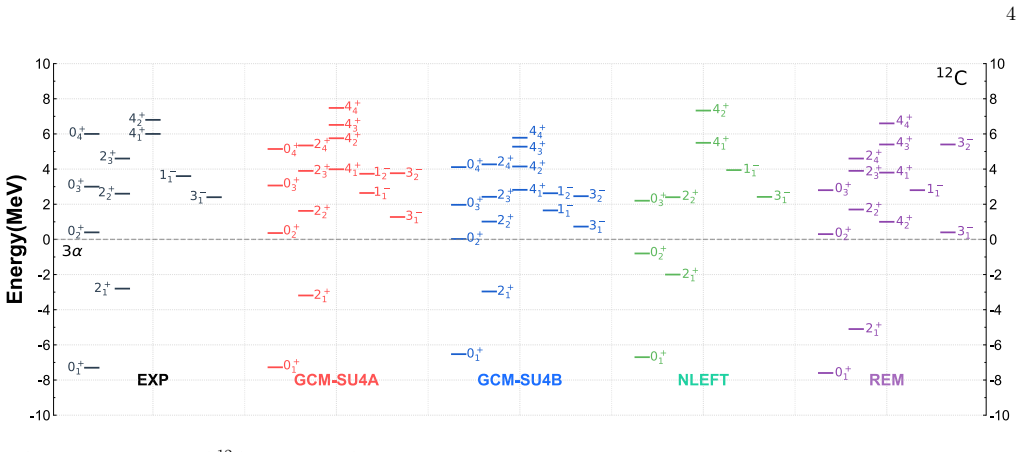
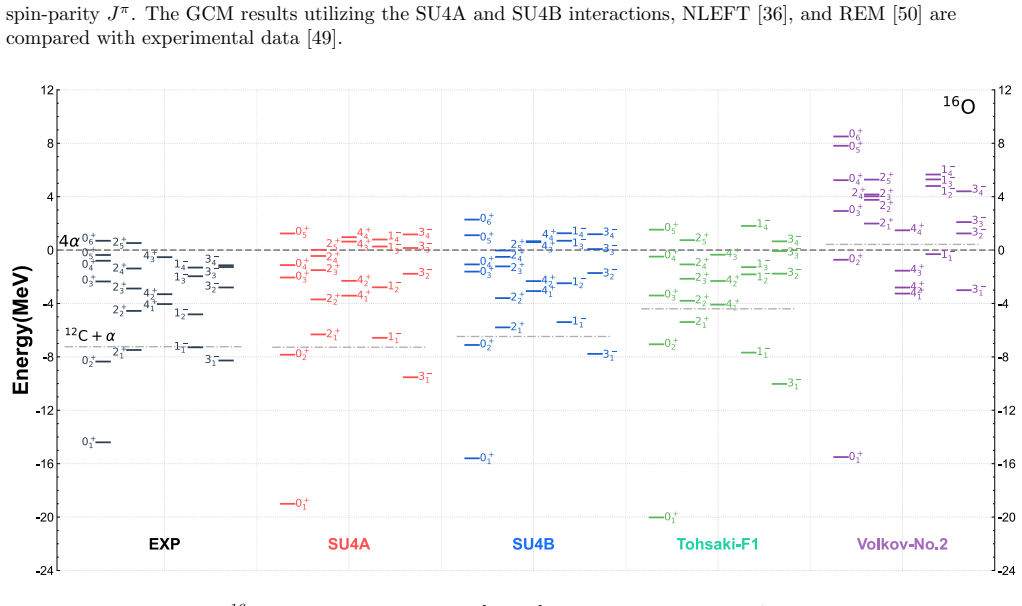
We present a minimalist, symmetry-guided interaction for microscopic cluster models based on Wigner-$SU(4)$ symmetry. Retaining only an $SU(4)$-invariant two-body attraction and a local three-body repulsion, this framework is implemented via the generator coordinate method (GCM) to describe $\alpha$--$\alpha$ scattering phase shifts, the low-lying spectrum and transition properties of $^{12}\mathrm{C}$, and the cluster spectrum of $^{16}\mathrm{O}$. We show that the long-standing structural tension between the $^{12}\mathrm{C}$ and $^{16}\mathrm{O}$ ground states can be mitigated within this restricted $SU(4)$ operator space without introducing additional phenomenological complexity. These results indicate that Wigner-$SU(4)$ symmetry provides an effective organizing principle for $N\alpha$ clustering, offering a more fundamental baseline for understanding complex cluster structures.
Editorial analysis
A structured set of objections, weighed in public.
Referee Report
Summary. The manuscript introduces a minimalist, symmetry-guided interaction for microscopic cluster models of α-conjugate nuclei, based on Wigner-SU(4) symmetry. It retains only an SU(4)-invariant two-body attraction and a local three-body repulsion, implemented via the generator coordinate method (GCM). The framework is applied to α–α scattering phase shifts, the low-lying spectrum and transition properties of ¹²C, and the cluster spectrum of ¹⁶O. The central claim is that this restricted SU(4) operator space mitigates the long-standing structural tension between the clustered ground state of ¹²C and the more compact ground state of ¹⁶O without introducing additional phenomenological complexity.
Significance. If the central results hold, the work supplies a symmetry-based organizing principle for Nα clustering that could serve as a more fundamental baseline for cluster structures in light nuclei. The explicit retention of only two adjustable strengths (SU(4)-invariant two-body attraction and local three-body repulsion) and the use of GCM for multiple observables represent a genuine attempt at minimality; confirmation of cross-nucleus parameter consistency would strengthen the case for reduced phenomenological complexity in cluster models.
major comments (1)
- [Abstract] Abstract and framework description: the claim that the structural tension between the ¹²C and ¹⁶O ground states is mitigated 'without introducing additional phenomenological complexity' requires explicit evidence that the two free parameters (SU(4)-invariant two-body attraction strength and local three-body repulsion strength) are fixed once from a joint fit to α–α phase shifts, ¹²C data, and ¹⁶O data and then held fixed across all systems. The current description leaves open the possibility that parameters or GCM basis choices were adjusted separately per nucleus, which would reintroduce the very complexity the restricted operator space is intended to avoid.
minor comments (1)
- [Abstract] The abstract refers to 'transition properties' of ¹²C without specifying which electromagnetic transitions are computed; a brief enumeration in the results section would improve clarity.
Simulated Author's Rebuttal
We thank the referee for the thorough review and constructive feedback on our manuscript. We address the major comment below and will revise the manuscript accordingly to improve clarity.
read point-by-point responses
-
Referee: [Abstract] Abstract and framework description: the claim that the structural tension between the ¹²C and ¹⁶O ground states is mitigated 'without introducing additional phenomenological complexity' requires explicit evidence that the two free parameters (SU(4)-invariant two-body attraction strength and local three-body repulsion strength) are fixed once from a joint fit to α–α phase shifts, ¹²C data, and ¹⁶O data and then held fixed across all systems. The current description leaves open the possibility that parameters or GCM basis choices were adjusted separately per nucleus, which would reintroduce the very complexity the restricted operator space is intended to avoid.
Authors: We agree that explicit documentation of the parameter procedure is essential to substantiate the minimality claim. In the calculations presented, the two parameters were determined from a combined analysis of the α–α phase shifts and the ¹²C low-lying spectrum and transition properties within a single GCM framework; these identical fixed values were then applied without readjustment to compute the ¹⁶O cluster spectrum. No per-nucleus retuning or additional parameters were introduced. To eliminate any ambiguity, we will revise the abstract and add a dedicated paragraph (with a table of parameter values) in the methods/results section that explicitly states the parameters are universal and held fixed across all systems studied. This will be incorporated in the revised manuscript. revision: yes
Circularity Check
No significant circularity in the derivation chain.
full rationale
The paper defines a restricted SU(4)-invariant operator space consisting of one two-body attraction term and one local three-body repulsion term, then implements this space inside the GCM to compute observables for α-α scattering, 12C, and 16O. The central claim is that this restricted space is sufficient to mitigate the known structural tension between the two nuclei. Because the two strength parameters are explicitly treated as adjustable and are calibrated to data, the demonstration remains a test of model sufficiency rather than a derivation that reduces to its own inputs by construction. No self-definitional step, fitted quantity renamed as prediction, or load-bearing self-citation chain appears in the abstract or framework description. The work is therefore self-contained against external benchmarks and receives the default non-circularity finding.
Axiom & Free-Parameter Ledger
free parameters (2)
- SU(4)-invariant two-body attraction strength
- local three-body repulsion strength
axioms (1)
- domain assumption Wigner SU(4) symmetry is an effective organizing principle for N-alpha clustering
Lean theorems connected to this paper
-
IndisputableMonolith/Cost/FunctionalEquation.leanwashburn_uniqueness_aczel unclear?
unclearRelation between the paper passage and the cited Recognition theorem.
Retaining only an SU(4)-invariant two-body attraction and a local three-body repulsion... V_N_SU(4) = C sum exp(-Lambda^2 r_ij^2 / 4 hbar^2 c^2) + D sum exp(-Lambda^2 (r_ij^2 + ...))
-
IndisputableMonolith/Foundation/DimensionForcing.leanalexander_duality_circle_linking unclear?
unclearRelation between the paper passage and the cited Recognition theorem.
long-standing structural tension between the 12C and 16O ground states can be mitigated within this restricted SU(4) operator space
What do these tags mean?
- matches
- The paper's claim is directly supported by a theorem in the formal canon.
- supports
- The theorem supports part of the paper's argument, but the paper may add assumptions or extra steps.
- extends
- The paper goes beyond the formal theorem; the theorem is a base layer rather than the whole result.
- uses
- The paper appears to rely on the theorem as machinery.
- contradicts
- The paper's claim conflicts with a theorem or certificate in the canon.
- unclear
- Pith found a possible connection, but the passage is too broad, indirect, or ambiguous to say the theorem truly supports the claim.
Reference graph
Works this paper leans on
-
[1]
W. von Oertzen, M. Freer, and Y. Kanada-En’yo, Phys. Rep.432, 43 (2006)
work page 2006
- [2]
- [3]
-
[4]
K.-J. Sun, R. Wang, C. M. Ko, Y.-G. Ma, and C. Shen, Nat. Commun.15, 1074 (2024)
work page 2024
-
[5]
W. B. He, Y. G. Ma, X. G. Cao, X. Z. Cai, and G. Q. Zhang, Phys. Rev. Lett.113, 032506 (2014)
work page 2014
-
[6]
W. Broniowski and E. Ruiz Arriola, Phys. Rev. Lett.112, 112501 (2014)
work page 2014
- [7]
- [8]
-
[9]
P. Li, B. Zhou, and G. L. Ma, Phys. Rev. Lett.136, 082302 (2026)
work page 2026
-
[10]
G. R¨ opke, A. Schnell, P. Schuck, and P. Nozi` eres, Phys. Rev. Lett.80, 3177 (1998)
work page 1998
-
[11]
B. Zhou, Y. Funaki, H. Horiuchi, Y.-G. Ma, G. R¨ opke, P. Schuck, A. Tohsaki, and T. Yamada, Nat. Commun. 14, 8206 (2023)
work page 2023
- [12]
-
[13]
B. Zhou, Y. Funaki, H. Horiuchi, and A. Tohsaki, Front. Phys.15, 14401 (2019)
work page 2019
-
[14]
Y. F. Liu, B. Zhou, and Y. G. Ma, Nucl. Sci. Tech.36, 196 (2025)
work page 2025
- [15]
- [16]
-
[17]
B. Zhou, Y. Funaki, H. Horiuchi, and A. Tohsaki, Front. Phys.15, 14401 (2020)
work page 2020
- [18]
- [19]
- [20]
- [21]
- [22]
-
[23]
G. E. Mitchell, E. B. Carter, and R. H. Davis, Phys. Rev. 133, B1434 (1964)
work page 1964
- [24]
- [25]
- [26]
- [27]
-
[28]
R. Machleidt and F. Sammarruca, Prog. Part. Nucl. Phys.137, 104117 (2024)
work page 2024
- [29]
-
[30]
L. Wu, S. Elhatisari, U.-G. Meißner, S. Shen, L.-S. Geng, and Y. Kim, Phys. Rev. Lett.136, 142502 (2026)
work page 2026
- [31]
-
[32]
D. B. Kaplan and M. J. Savage, Phys. Lett. B365, 244 (1996)
work page 1996
-
[33]
D. B. Kaplan and A. V. Manohar, Phys. Rev. C56, 76 (1997)
work page 1997
-
[34]
B.-N. Lu, N. Li, S. Elhatisari, D. Lee, E. Epelbaum, and U.-G. Meißner, Phys. Lett. B797, 134863 (2019)
work page 2019
- [35]
-
[36]
S. Shen, S. Elhatisari, T. A. L¨ ahde, D. Lee, B.-N. Lu, and U.-G. Meißner, Nat. Commun.14, 2777 (2023)
work page 2023
-
[37]
S. Shen, S. Elhatisari, D. Lee, U.-G. Meißner, and Z. Ren, Phys. Rev. Lett.134, 162503 (2025)
work page 2025
- [38]
-
[39]
D. M. Brink,The Alpha-Particle Model of Light Nuclei (Academic Press, New York, 1966)
work page 1966
-
[40]
D. L. Hill and J. A. Wheeler, Phys. Rev.89, 1102 (1953)
work page 1953
-
[41]
D. R. Phillips and C. Schat, Phys. Rev. C88, 034002 (2013)
work page 2013
-
[42]
E. Epelbaum, A. M. Gasparyan, H. Krebs, and C. Schat, Eur. Phys. J. A51, 26 (2015)
work page 2015
-
[43]
minimal wigner-SU(4) inter- action in microscopic cluster models forα-conjugate nu- clei
G.-P. Li, S.-Y. Zhou, D. Bai, B. Zhou, and Y.-G. Ma, Supplemental material for “minimal wigner-SU(4) inter- action in microscopic cluster models forα-conjugate nu- clei” (2026), see Supplemental Material for details on the parameter determination, cutoff dependence, basis con- struction, and additional results for 20Ne
work page 2026
- [44]
- [45]
- [46]
- [47]
- [48]
- [49]
-
[50]
R. Imai, T. Tada, and M. Kimura, Phys. Rev. C99, 064327 (2019)
work page 2019
- [51]
- [52]
-
[53]
R. J. deBoer, J. G¨ orres, M. Wiescher, R. E. Azuma, A. Best, C. R. Brune, C. E. Fields, S. Jones, M. Pig- natari, D. Sayre, K. Smith, F. X. Timmes, and E. Uberseder, Rev. Mod. Phys.89, 035007 (2017)
work page 2017
-
[54]
C. L. Jiang, K. E. Rehm, B. B. Back, and R. V. F. Janssens, Phys. Rev. C75, 015803 (2007)
work page 2007
-
[55]
Y.-A. Li, S. Zhang, and Y.-G. Ma, Phys. Rev. C102, 054907 (2020)
work page 2020
-
[56]
I. J. Abualrobet al.(ALICE Collaboration), Phys. Rev. Lett. (2026)
work page 2026
-
[57]
Hayrapetyanet al.(CMS Collaboration), Phys
A. Hayrapetyanet al.(CMS Collaboration), Phys. Rev. Lett. (2026)
work page 2026
-
[58]
J. Chen, Y. Ye, K. Ma, J. Han, D. Wang, C. Lin, H. Jia, L. Yang, G. Li, L. Yang, Z. Hu, Z. Tan, K. Wei, W.-L. Pu, Y. Chen, J. Lou, X. Yang, Q. Li, Z. Yang, T. Luo, D. Huang, S. Zhong, Z. Li, and J. Xu, Sci. Bull.68, 1119 (2023)
work page 2023
- [59]
-
[60]
T. Matsuse, M. Kamimura, and Y. Fukushima, Prog. Theor. Phys.53, 706 (1975)
work page 1975
-
[61]
B. Zhou, Y. Funaki, H. Horiuchi, Z. Ren, G. R¨ opke, P. Schuck, A. Tohsaki, C. Xu, and T. Yamada, Phys. Rev. Lett.110, 262501 (2013)
work page 2013
- [62]
- [63]
-
[64]
S.-Y. Zhou, B. Zhou, N. Itagaki, and A. Tohsaki, under review (2026)
work page 2026
- [65]
discussion (0)
Sign in with ORCID, Apple, or X to comment. Anyone can read and Pith papers without signing in.