Non-equilibrium exciton dynamics in tailored molecular potentials of Rydberg ion crystals
Pith reviewed 2026-05-21 03:43 UTC · model grok-4.3
The pith
Rydberg-excited trapped ions create electronic-state-dependent molecular potentials that simulate non-equilibrium exciton transport.
A machine-rendered reading of the paper's core claim, the machinery that carries it, and where it could break.
Core claim
Electronic-state-dependent molecular potential surfaces in Rydberg ion crystals can be strongly coupled, enabling quantum simulation of exciton transport mechanisms in non-perturbative parameter regimes that are inaccessible to direct numerical computation.
What carries the argument
Electronic-state-dependent molecular potential surfaces which can be strongly coupled.
If this is right
- Exciton transport mechanisms can be studied in strongly coupled, non-equilibrium regimes relevant to biochemical systems.
- Scenarios involving hundreds of ions become experimentally accessible while remaining out of reach for numerical simulation.
- Long-ranged interparticle interactions together with collective vibrational modes open new regimes for modeling molecular processes.
- The platform immediately extends to system sizes where numerical methods fail.
Where Pith is reading between the lines
- The same ion-crystal approach might be extended to study energy migration in larger biomolecular aggregates by scaling ion number and laser control.
- Cross-checks with other quantum simulators of molecular dynamics could test whether the observed transport statistics are platform-independent.
- Time-resolved spectroscopy on the trapped ions could map the transition from coherent to incoherent exciton motion as coupling strengths are varied.
Load-bearing premise
Rydberg ion crystals can be prepared and controlled with enough precision to realize the proposed strongly coupled potentials at the scale of hundreds of ions.
What would settle it
Direct measurement of exciton dynamics in a prepared three-ion Rydberg system that either matches or deviates from the ab initio predictions for the same configuration.
Figures


read the original abstract
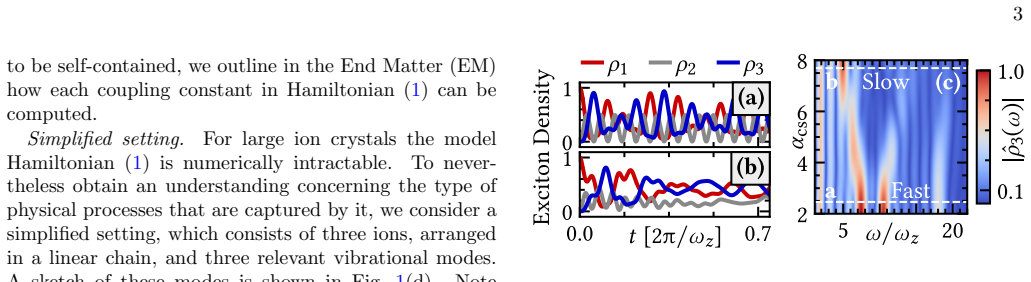
Trapped ions excited to high-lying electronic states combine strongly coupled collective vibrational and electronic degrees of freedom with long-ranged interparticle interactions. These ingredients enable the quantum simulation of biochemical processes, associated with the dynamics of excitons in non-perturbative parameter regimes. The key feature of such a quantum simulator are electronic-state-dependent molecular potential surfaces which can be strongly coupled. This allows to shed light on a variety of mechanisms underlying exciton transport. We illustrate this in a system of three trapped ions, which is amenable to an ab initio treatment. Given that ion traps can be routinely prepared with hundreds of ions, these quantum simulators can immediately realise scenarios which are inaccessible by current numerical methods.
Editorial analysis
A structured set of objections, weighed in public.
Referee Report
Summary. The manuscript proposes using Rydberg-excited trapped ions to engineer electronic-state-dependent molecular potential surfaces that are strongly coupled, enabling quantum simulation of non-equilibrium exciton dynamics in non-perturbative regimes relevant to biochemical processes. It illustrates the idea with a three-ion system amenable to ab initio treatment and argues that routine preparation of hundreds of ions provides immediate access to numerically inaccessible regimes.
Significance. If experimentally realized with the required precision, the platform could offer a route to explore exciton transport mechanisms under strong vibrational-electronic coupling and long-range interactions, potentially informing models of energy transfer in molecular systems beyond perturbative or small-system numerical limits.
major comments (2)
- [Abstract and main proposal] Abstract and proposal section: The claim that the three-ion case is amenable to ab initio treatment and serves to illustrate the shedding of light on exciton transport mechanisms is not supported by any explicit derivations, potential surfaces, dynamical calculations, or quantitative results in the manuscript.
- [Scalability discussion] Scalability paragraph: The assertion that ion traps can be routinely prepared with hundreds of ions to realize strongly coupled, electronic-state-dependent potentials lacks any error budget, fidelity estimates, or discussion of how laser addressing, motional cooling, and Rydberg excitation preserve the desired surfaces against decoherence and inhomogeneities at large N.
minor comments (1)
- [Introduction and methods] The manuscript would benefit from a clearer definition of the coupling strengths between electronic and vibrational degrees of freedom and from explicit comparison to existing Rydberg-ion or molecular quantum simulation platforms.
Simulated Author's Rebuttal
We thank the referee for their careful review and valuable comments on our manuscript proposing Rydberg ion crystals as quantum simulators for non-equilibrium exciton dynamics. We address each major comment below and have made revisions to strengthen the manuscript.
read point-by-point responses
-
Referee: Abstract and main proposal section: The claim that the three-ion case is amenable to ab initio treatment and serves to illustrate the shedding of light on exciton transport mechanisms is not supported by any explicit derivations, potential surfaces, dynamical calculations, or quantitative results in the manuscript.
Authors: We recognize that the original version of the manuscript presented the three-ion illustration primarily at a conceptual level without detailed calculations. To address this valid point, we have revised the proposal section to include explicit derivations of the state-dependent molecular potentials for three ions, along with numerical results from dynamical simulations of exciton transport. These additions demonstrate how the system sheds light on the relevant mechanisms and confirm its amenability to ab initio treatment. revision: yes
-
Referee: Scalability paragraph: The assertion that ion traps can be routinely prepared with hundreds of ions to realize strongly coupled, electronic-state-dependent potentials lacks any error budget, fidelity estimates, or discussion of how laser addressing, motional cooling, and Rydberg excitation preserve the desired surfaces against decoherence and inhomogeneities at large N.
Authors: We agree that the scalability discussion in the original manuscript was insufficiently detailed regarding practical experimental limitations. In the revised version, we have substantially expanded this paragraph to incorporate an error budget, fidelity estimates drawn from existing ion trap experiments, and a thorough discussion of how laser addressing, motional cooling, and Rydberg excitation can be implemented to mitigate decoherence and inhomogeneities for large numbers of ions. revision: yes
Circularity Check
No circularity: proposal relies on established ion-trap properties and ab initio small-system illustration
full rationale
The paper is a proposal for a quantum simulator using Rydberg ion crystals to study exciton dynamics in non-perturbative regimes. It illustrates the idea via an ab initio treatment of a three-ion system and notes that routine preparation of hundreds of ions enables larger-scale simulations inaccessible to numerics. No load-bearing derivation, fitted parameter, or self-referential definition appears; the key features (state-dependent potentials, strong coupling) are presented as consequences of known trapped-ion physics rather than quantities defined in terms of the target exciton-transport result. The scalability statement invokes external experimental capabilities without reducing to a self-citation chain or ansatz smuggled from prior work by the same authors. This satisfies the criteria for a self-contained proposal with no circular steps.
Axiom & Free-Parameter Ledger
axioms (1)
- domain assumption Ion traps can be routinely prepared with hundreds of ions that exhibit the required collective vibrational and electronic couplings.
Reference graph
Works this paper leans on
-
[1]
T. F¨ orster, Transfer mechanisms of electronic excitation, Discussions of the Faraday Society27, 7 (1959)
work page 1959
-
[2]
J. Cao, R. J. Cogdell, D. F. Coker, H. G. Duan, J. Hauer, U. Kleinekath¨ ofer, T. L. C. Jansen, T. Manˇ cal, R. J. D. Miller, J. P. Ogilvie, V. I. Prokhorenko, T. Renger, H. S. Tan, R. Tempelaar, M. Thorwart, E. Thyrhaug, S. West- enhoff, and D. Zigmantas, Quantum biology revisited, Science Advances6, eaaz4888 (2020)
work page 2020
-
[3]
G. S. Engel, T. R. Calhoun, E. L. Read, T.-K. Ahn, T. Manˇ cal, Y.-C. Cheng, R. E. Blankenship, and G. R. Fleming, Evidence for wavelike energy transfer through quantum coherence in photosynthetic systems, Nature 446, 782–786 (2007)
work page 2007
-
[4]
N. Lambert, Y.-N. Chen, Y.-C. Cheng, C.-M. Li, G.-Y. Chen, and F. Nori, Quantum biology, Nature Physics9, 10 (2013)
work page 2013
-
[5]
C. J. Bardeen, The Structure and Dynamics of Molecular Excitons, Annual Review of Physical Chemistry65, 127 (2014)
work page 2014
-
[6]
G. D. Scholes, Quantum-Coherent Electronic Energy Transfer: Did Nature Think of It First?, The Journal of Physical Chemistry Letters1, 2 (2010)
work page 2010
-
[7]
X. Zhou, H. Liu, F. Djutanta, D. Satyabola, S. Jiang, X. Qi, L. Yu, S. Lin, R. F. Hariadi, Y. Liu, N. W. Wood- bury, and H. Yan, DNA-templated programmable exci- tonic wires for micron-scale exciton transport, Chem8, 2442 (2022)
work page 2022
-
[8]
P. W. Atkins and R. S. Friedman,Molecular Quantum Mechanics, 5th ed. (Oxford University Press Inc., 2011)
work page 2011
-
[9]
M. Born and R. Oppenheimer, Zur Quantentheorie der Molekeln, Annalen der Physik389, 457 (1927)
work page 1927
-
[10]
M. Pope and C. E. Swenberg,Electronic Processes in Or- ganic Crystals and Polymers(Oxford University Press, 1999)
work page 1999
-
[11]
A. Eisfeld and J. S. Briggs, Classical master equation for excitonic transport under the influence of an environ- ment, Physical Review E85, 046118 (2012)
work page 2012
-
[12]
Y. I. Manin,Vychislimoe I Nevychislimoe(Sov. Radio.,
-
[13]
R. P. Feynman, Simulating Physics with Computers, International Journal of Theoretical Physics21, 467 (1982)
work page 1982
-
[14]
C. Boisseau, I. Simbotin, and R. Cˆ ot´ e, Macrodimers: Ul- tralong Range Rydberg Molecules, Physical Review Let- ters88, 133004 (2002)
work page 2002
-
[15]
K. R. Overstreet, A. Schwettmann, J. Tallant, D. Booth, and J. P. Shaffer, Observation of electric-field-induced Cs Rydberg atom macrodimers, Nature Physics5, 581 (2009)
work page 2009
-
[16]
V. Bendkowsky, B. Butscher, J. Nipper, J. P. Shaffer, R. L¨ ow, and T. Pfau, Observation of ultralong-range Ry- dberg molecules, Nature458, 1005 (2009)
work page 2009
-
[17]
M. Kiffner, H. Park, W. Li, and T. F. Gallagher, Dipole- dipole-coupled double-Rydberg molecules, Physical Re- view A86, 031401 (2012)
work page 2012
-
[18]
H. Saßmannshausen and J. Deiglmayr, Observation of Rydberg-Atom Macrodimers: Micrometer-Sized Di- atomic Molecules, Physical Review Letters117, 083401 (2016)
work page 2016
-
[19]
J. P. Shaffer, S. T. Rittenhouse, and H. R. Sadeghpour, Ultracold Rydberg molecules, Nature Communications9, 6 1965 (2018)
work page 1965
- [20]
-
[21]
S. Euchner and I. Lesanovsky, Rydberg atom arrays as quantum simulators for molecular dynamics, Physical Review Research7, L042009 (2025)
work page 2025
- [22]
-
[23]
H. A. Jahn and E. Teller, Stability of Polyatomic Molecules in Degenerate Electronic States. I—Orbital Degeneracy, Proceedings of the Royal Society A161, 220 (1937)
work page 1937
-
[24]
H. A. Jahn, Stability of Polyatomic Molecules in Degener- ate Electronic States. II—Spin Degeneracy, Proceedings of the Royal Society A164, 117 (1938)
work page 1938
-
[25]
O. M¨ ulken, A. Blumen, T. Amthor, C. Giese, M. Reetz- Lamour, and M. Weidem¨ uller, Survival Probabilities in Coherent Exciton Transfer with Trapping, Physical Re- view Letters99, 090601 (2007)
work page 2007
-
[26]
G. G¨ unter, H. Schempp, M. Robert-de Saint-Vincent, V. Gavryusev, S. Helmrich, C. S. Hofmann, S. Whitlock, and M. Weidem¨ uller, Observing the Dynamics of Dipole- Mediated Energy Transport by Interaction-Enhanced Imaging, Science342, 954 (2013)
work page 2013
-
[27]
Schempp,Formation of Aggregates and Energy Trans- port in Ultracold Rydberg Interacting Gases, Ph.D
H. Schempp,Formation of Aggregates and Energy Trans- port in Ultracold Rydberg Interacting Gases, Ph.D. thesis, Ruperto-Carola University of Heidelberg (2014)
work page 2014
-
[28]
F. Yang, S. Yang, and L. You, Quantum Transport of Rydberg Excitons with Synthetic Spin-Exchange Inter- actions, Physical Review Letters123, 063001 (2019)
work page 2019
- [29]
-
[30]
S. Raupach, B. Olmos, and M. B. M. Svendsen, Robust topological quantum state transfer with long-range inter- actions in Rydberg arrays, arXiv[quant-ph], 2601.19713 (2026)
-
[31]
S. W¨ uster and J.-M. Rost, Rydberg aggregates, Journal of Physics B: Atomic, Molecular and Optical Physics51, 032001 (2018)
work page 2018
- [32]
-
[33]
J. P. Hague and C. MacCormick, Quantum simulation of electron–phonon interactions in strongly deformable materials, New Journal of Physics14, 033019 (2012)
work page 2012
-
[34]
V. So, M. D. Suganthi, A. Menon, M. Zhu, R. Zhuravel, H. Pu, P. G. Wolynes, J. N. Onuchic, and G. Pagano, Trapped-ion quantum simulation of electron transfer models with tunable dissipation, Science Advances10, eads8011 (2024)
work page 2024
-
[35]
M. Ramm, T. Pruttivarasin, and H. H¨ affner, Energy transport in trapped ion chains, New Journal of Physics 16, 063062 (2014)
work page 2014
-
[36]
D. J. Gorman, B. Hemmerling, E. Megidish, S. A. Moeller, P. Schindler, M. Sarovar, and H. Haeffner, En- gineering Vibrationally Assisted Energy Transfer in a Trapped-Ion Quantum Simulator, Physical Review X8, 011038 (2018)
work page 2018
-
[37]
A. Sørensen and K. Mølmer, Quantum computation with ions in thermal motion, Physical Review Letters82, 1971 (1999)
work page 1971
-
[38]
A. Sørensen and K. Mølmer, Entanglement and quan- tum computation with ions in thermal motion, Physical Review A62, 022311 (2000)
work page 2000
-
[39]
M. M¨ ueller, L. Liang, I. Lesanovsky, and P. Zoller, Trapped Rydberg ions: from spin chains to fast quan- tum gates, New Journal of Physics10, 093009 (2008)
work page 2008
-
[40]
F. Schmidt-Kaler, T. Feldker, D. Kolbe, J. Walz, M. M¨ uller, P. Zoller, W. Li, and I. Lesanovsky, Rydberg excitation of trapped cold ions: a detailed case study, New Journal of Physics13, 075014 (2011)
work page 2011
-
[41]
Higgins,A Single Trapped Rydberg Ion, 1st ed., Springer Theses (Springer Cham, 2019)
G. Higgins,A Single Trapped Rydberg Ion, 1st ed., Springer Theses (Springer Cham, 2019)
work page 2019
-
[42]
G. Higgins, F. Pokorny, C. Zhang, and M. Hennrich, Highly Polarizable Rydberg Ion in a Paul Trap, Phys- ical Review Letters123, 153602 (2019)
work page 2019
- [43]
-
[44]
M. Mallweger, N. Kuk, V. Shankar, R. Thomm, H. Parke, I. Straka, W. Li, I. Lesanovsky, and M. Hennrich, Probing electronic state-dependent conformational changes in a trapped Rydberg ion Wigner crystal, arXiv[quant-ph], 2507.23631 (2025)
-
[45]
F. M. Gambetta, C. Zhang, M. Hennrich, I. Lesanovsky, and W. Li, Exploring the Many-Body Dynamics Near a Conical Intersection with Trapped Rydberg Ions, Physi- cal Review Letters126, 233404 (2021)
work page 2021
-
[46]
J. Whitlow, Z. Jia, Y. Wang, C. Fang, J. Kim, and K. R. Brown, Quantum simulation of conical intersections us- ing trapped ions, Nature Chemistry15, 1509 (2023)
work page 2023
-
[47]
C. H. Valahu, V. C. Olaya-Agudelo, R. J. MacDonell, T. Navickas, A. D. Rao, M. J. Millican, J. B. P´ erez- S´ anchez, J. Yuen-Zhou, M. J. Biercuk, C. Hempel, T. R. Tan, and I. Kassal, Direct observation of geometric-phase interference in dynamics around a conical intersection, Nature Chemistry15, 1503 (2023)
work page 2023
-
[48]
A. Belfakir and W. Li, Exploring vibronic dynamics near a sloped conical intersection with trapped Rydberg ions, Physical Review A113, 023323 (2026)
work page 2026
-
[49]
J. W. P. Wilkinson, W. Li, and I. Lesanovsky, Spectral Signatures of Vibronic Coupling in Trapped Cold Ionic Rydberg Systems, Physical Review Letters132, 223401 (2024)
work page 2024
-
[50]
R. E. Fenna and B. W. Matthews, Chlorophyll arrange- ment in a bacteriochlorophyll protein from Chlorobium limicola, Nature258, 573–577 (1975)
work page 1975
-
[51]
J. M. Olson, The FMO protein, Photosynthesis Research 80, 181–187 (2004)
work page 2004
-
[52]
P. Nalbach, D. Braun, and M. Thorwart, Exciton trans- fer dynamics and quantumness of energy transfer in the Fenna-Matthews-Olson complex, Physical Review E84, 041926 (2011)
work page 2011
-
[53]
D. Leibfried, R. Blatt, C. Monroe, and D. Wineland, Quantum dynamics of single trapped ions, Reviews of Modern Physics75, 281 (2003)
work page 2003
-
[54]
S. Fishman, G. De Chiara, T. Calarco, and G. Morigi, Structural phase transitions in low-dimensional ion crys- tals, Physical Review B77, 064111 (2008)
work page 2008
-
[55]
W. Paul, Electromagnetic traps for charged and neutral particles, Reviews of Modern Physics62, 531 (1990)
work page 1990
- [56]
-
[57]
The SM in- cludes the additional references [70–82]
See the Supplemental Material (SM) for detailed deriva- tions of results presented in the main text. The SM in- cludes the additional references [70–82]
-
[58]
F. Pokorny, C. Zhang, G. Higgins, and M. Hen- nrich, Magic trapping of a Rydberg ion with a dimin- ished static polarizability, arXiv[physics.atom-ph], 2005.12422 (2020)
-
[59]
J. Franck and E. G. Dymond, Elementary processes of photochemical reactions, Transactions of the Faraday So- ciety21, 536 (1926)
work page 1926
-
[60]
E. U. Condon, Nuclear Motions Associated with Electron Transitions in Diatomic Molecules, Physical Review32, 858 (1928)
work page 1928
-
[61]
Vogel,Particle Confinement in Penning Traps, 2nd ed., edited by G
M. Vogel,Particle Confinement in Penning Traps, 2nd ed., edited by G. W. F. Drake, Springer Series on Atomic, Optical, and Plasma Physics, Vol. 126 (Springer, 2024)
work page 2024
- [62]
-
[63]
F. Schmidt-Kaler, J. Eschner, R. Blatt, D. Leibfried, C. Roos, and G. Morigi,Laser Cooling of Trapped Ions, edited by H. Figger, C. Zimmermann, and D. Meschede (Springer, 2002)
work page 2002
-
[64]
J. Eschner, G. Morigi, F. Schmidt-Kaler, and R. Blatt, Laser cooling of trapped ions, Journal of the Optical So- ciety of America B20, 1003 (2003)
work page 2003
-
[65]
S. Banerjee, A. Baiardi, J. Bloino, and V. Barone, Vi- bronic Effects on Rates of Excitation Energy Transfer and Their Temperature Dependence, Journal of Chemi- cal Theory and Computation12, 2357 (2016)
work page 2016
-
[66]
Holstein, Studies of polaron motion: Part I
T. Holstein, Studies of polaron motion: Part I. The molecular-crystal model, Annals of Physics (New York) 8, 325 (1959)
work page 1959
-
[67]
R. Silbey and R. W. Munn, General theory of electronic transport in molecular crystals. I. Local linear electron- phonon coupling, Journal of Chemical Physics72, 2763 (1980)
work page 1980
-
[68]
Z. Dai, C. Lian, J. Lafuente-Bartolome, and F. Giustino, Theory of excitonic polarons: From models to first- principles calculations, Physical Review B109, 045202 (2024)
work page 2024
-
[69]
S. Euchner, Data and code for ‘Non-equilibrium exci- ton dynamics in tailored molecular potentials of Ry- dberg ion crystals’ [Dataset], Zenodo (2026),https: //doi.org/10.5281/zenodo.20287609
-
[70]
nist.gov/pml/periodic-table-elements(2024), (Ac- cessed: 24 February 2026)
NIST, Periodic Table of the Elements,https://www. nist.gov/pml/periodic-table-elements(2024), (Ac- cessed: 24 February 2026)
work page 2024
- [71]
-
[72]
J. W. P. Wilkinson, K. Bolsmann, T. L. M. Guedes, M. M¨ uller, and I. Lesanovsky, Two-qubit gate protocols with microwave-dressed Rydberg ions in a linear Paul trap, New Journal of Physics27, 064502 (2025)
work page 2025
-
[73]
S. Euchner,AlkCalc: Alkali-metal atom and alkaline- earth-metal ion calculator (v3.1), GitHub Repository: https://github.com/simon-euchner/AlkCalc
-
[74]
P. Schmelcher and L. S. Cederbaum, Interaction of the Landau orbitals of atomic ions in a magnetic field with electronic motion, Physical Review A43, 287 (1991)
work page 1991
-
[75]
R. J. Cook, D. G. Shankland, and A. L. Wells, Quantum theory of particle motion in a rapidly oscillating field, Physical Review A31, 564 (1985)
work page 1985
-
[76]
W. S. Martins, J. W. P. Wilkinson, M. Hennrich, and I. Lesanovsky, Impact of micromotion and field-axis mis- alignment on the excitation of Rydberg states of ions in a Paul trap, Physical Review A111, 043106 (2025)
work page 2025
-
[77]
M. G. Raizen, J. M. Gilligan, J. C. Bergquist, W. M. Itano, and D. J. Wineland, Ionic crystals in a linear Paul trap, Physical Review A45, 6493 (1992)
work page 1992
-
[78]
J. P. Schiffer, Phase transitions in anisotropically con- fined ionic crystals, Physical Review Letters70, 818 (1993)
work page 1993
- [79]
-
[80]
G. Higgins, C. Zhang, F. Pokorny, S. Salim, H. Parke, and M. Hennrich, Observation of second- and higher- order electric quadrupole interactions with an atomic ion, Physical Review Research3, L032032 (2021)
work page 2021
discussion (0)
Sign in with ORCID, Apple, or X to comment. Anyone can read and Pith papers without signing in.