A Compression-Directional Entropic Stress Method for Shock-Regularized Compressible Flow
Pith reviewed 2026-05-21 02:51 UTC · model grok-4.3
The pith
A directional tensor stress regularizes shocks selectively while vanishing in expansions, contacts and shear.
A machine-rendered reading of the paper's core claim, the machinery that carries it, and where it could break.
Core claim
CoDeS constructs the stress tensor Π_Σ = σ M, where M is the compressive eigenspace matrix of the symmetric velocity-gradient tensor, σ is obtained from a modified-Helmholtz equation, and the entire term is gated by volumetric and principal-strain compression; the same tensor enters both the momentum and energy fluxes, recovering the one-dimensional IGR mechanism at shocks while remaining zero in smooth expansion, rigid-body rotation, and ideal contacts.
What carries the argument
The compressive eigenspace matrix M derived from the symmetric velocity-gradient tensor, which orients the entropic stress exactly along the principal axes of compression.
If this is right
- CoDeS supplies localized stress only at compressive shocks.
- The regularization concentrates along compressive wave structures while staying weak in shear- and vorticity-dominated regions.
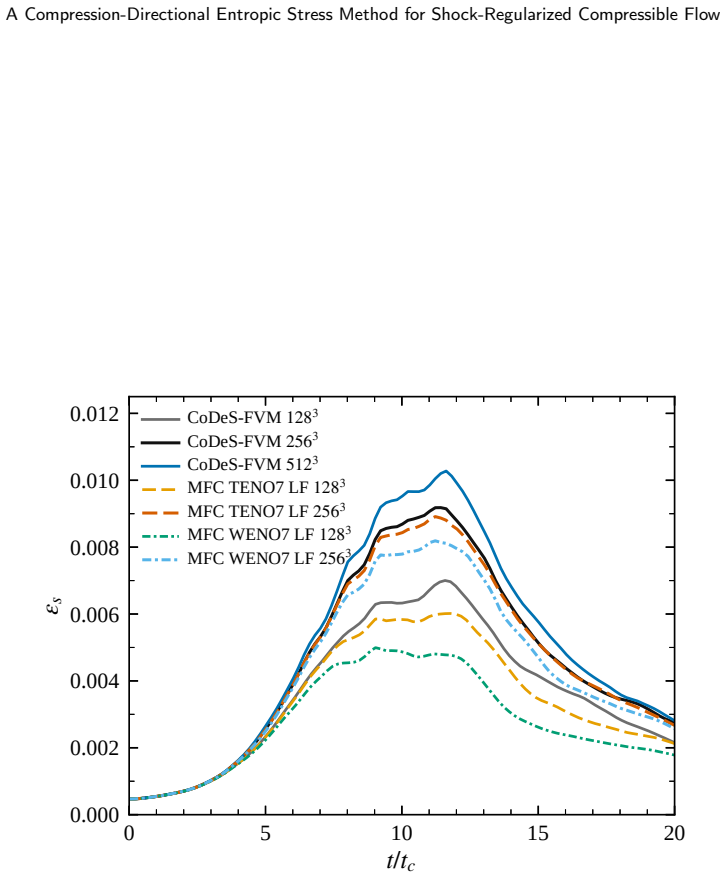
- At matched resolutions the three-dimensional Taylor-Green results are comparable to or more energetic than seventh-order WENO/TENO references.
- CoDeS remains compatible with high-order finite-volume resolution of contacts, interfaces, and vortical structures.
Where Pith is reading between the lines
- The same directional gating idea could be applied to other stabilization techniques that currently rely on isotropic sensors.
- Coarser grids might suffice for shock-capturing problems if the method preserves accuracy in smooth rotational and shear regions.
- Further tests on strong multidimensional shock interactions would directly check whether the gating prevents the new instabilities the authors assume will not appear.
Load-bearing premise
The compressive eigenspace matrix M together with volumetric and principal-strain gating will not create new artifacts or instabilities in genuinely multidimensional shock interactions beyond those already present in the one-dimensional limit.
What would settle it
A simulation of a multidimensional shock interaction (such as the two-fluid triple point or Mach-3 slot jet) that exhibits oscillations, instabilities, or excess dissipation absent from the corresponding one-dimensional planar-shock test.
Figures






read the original abstract
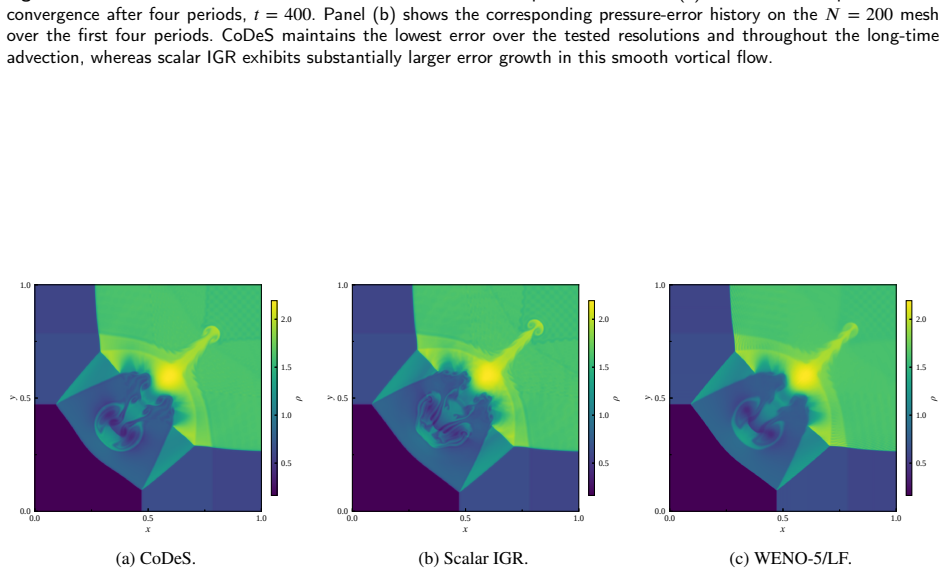
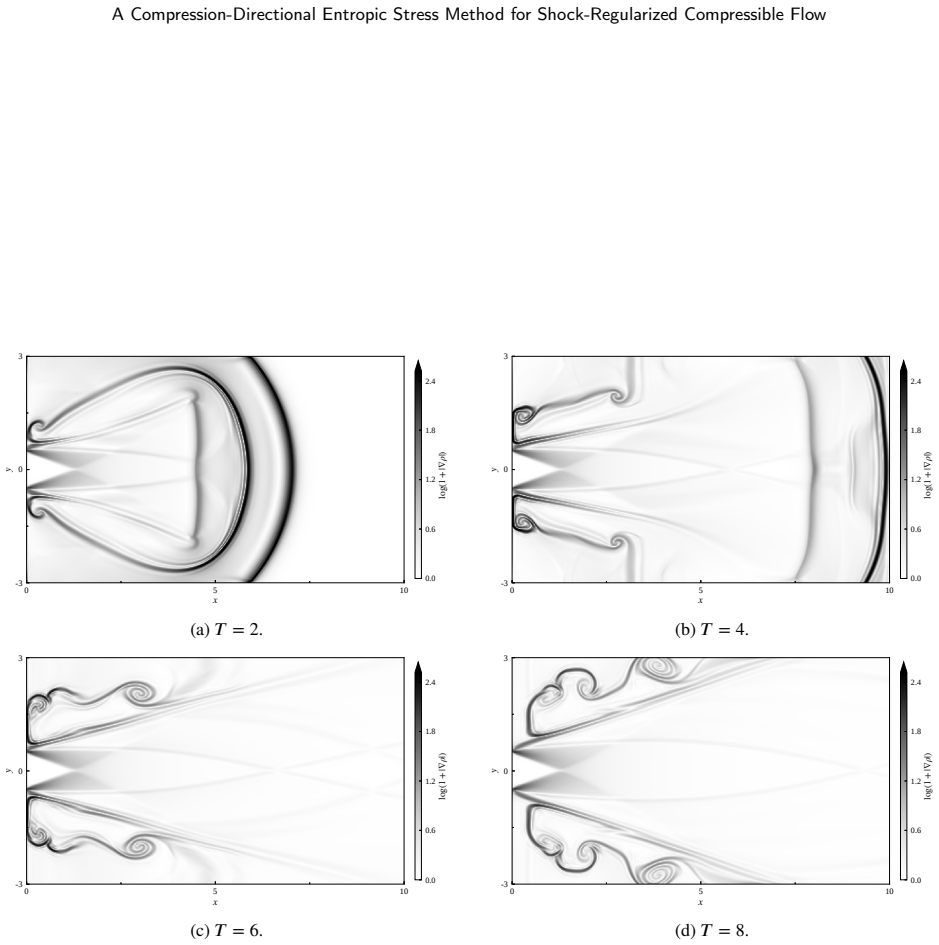
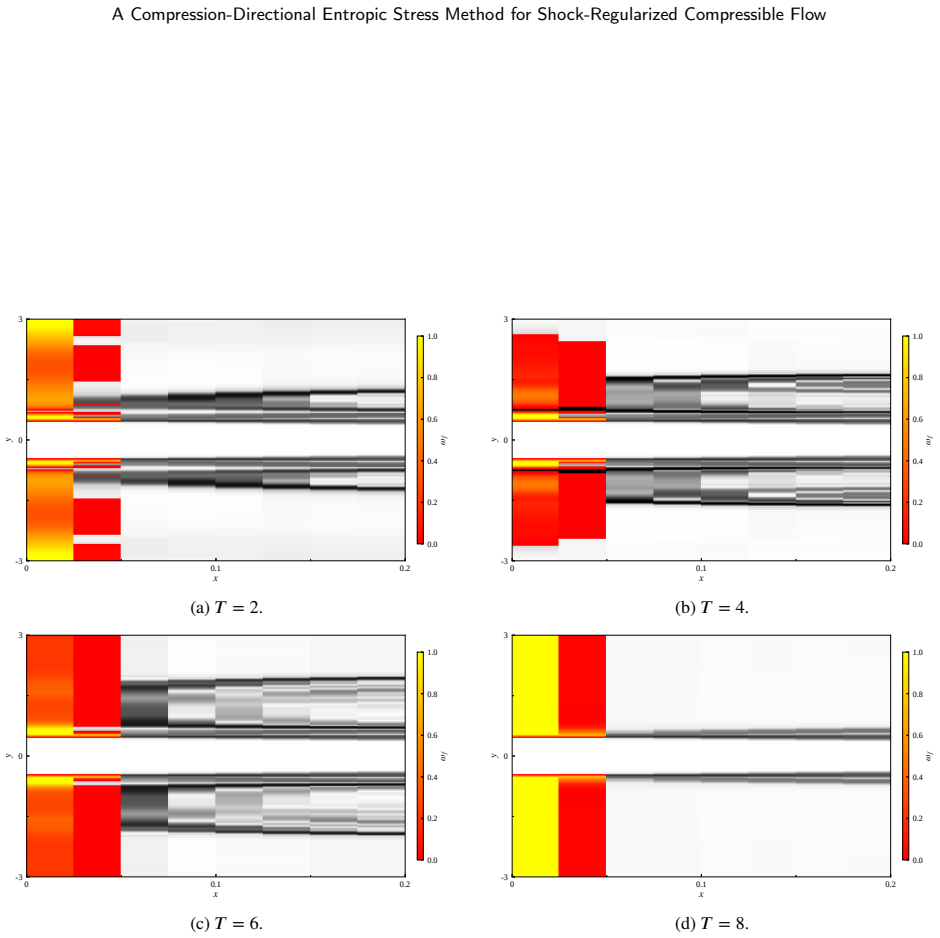
We introduce the Compression-Directional Entropic Stress (CoDeS) method inspired by information geometric regularization. CoDeS replaces scalar multidimensional entropic pressure with a tensor stress aligned with the principal directions of compression. The stress has the form $\boldsymbol{\Pi}_{\Sigma}=\sigma\boldsymbol{M}$, where $\sigma$ is obtained from a modified-Helmholtz equation and $\boldsymbol{M}$ is constructed from the compressive eigenspace of the symmetric velocity-gradient tensor. The source is gated by volumetric and principal-strain compression, so the regularization vanishes in smooth expansion, rigid-body rotation, and ideal contacts, while recovering the compressive one-dimensional IGR mechanism at planar shocks. The same tensor stress is used in the conservative momentum flux and the stress-work energy flux. CoDeS is tested on one-, two-, and three-dimensional problems including smooth expansion, double rarefaction, the Sod shock tube, multidimensional Riemann flow, a viscous shock tube, a two-fluid triple point, a Mach-3 slot jet, and a supersonic Taylor--Green vortex. The results show that CoDeS remains inactive in expansive and contact regions, supplies localized stress at shocks, and concentrates regularization along compressive wave structures while remaining weak in shear- and vorticity-dominated regions. At matched resolutions, the three-dimensional Taylor--Green results are comparable to or more energetic than seventh-order WENO/TENO references. These results indicate that CoDeS provides a compression-selective shock regularization compatible with high-order finite-volume resolution of contacts, interfaces, shear layers, and vortical structures. All the code, case settings, and code for plotting figures of this paper are available at https://github.com/xubonan/code\_for\_CoDeS.
Editorial analysis
A structured set of objections, weighed in public.
Referee Report
Summary. The paper introduces the Compression-Directional Entropic Stress (CoDeS) method for shock regularization in compressible flows. It replaces scalar entropic pressure with a tensor stress Π_Σ = σ M, where M is constructed from the compressive eigenspace of the symmetric velocity-gradient tensor and σ is obtained from a modified-Helmholtz equation. The source is gated by volumetric and principal-strain compression indicators. The method is claimed to recover the 1-D IGR mechanism at planar shocks, remain inactive in expansive, contact, and shear regions, and provide localized regularization along compressive structures. Numerical tests on 1D Sod shock tube, 2D Riemann problems, viscous shock tube, triple point, Mach-3 jet, and 3D supersonic Taylor-Green vortex demonstrate the expected selective behavior and competitive performance against high-order WENO/TENO schemes.
Significance. If the selectivity claims hold under rigorous validation, CoDeS could represent a meaningful advance in shock-capturing techniques for high-resolution simulations of compressible flows involving shocks, interfaces, and turbulence. By aligning regularization with principal compression directions and gating it appropriately, the method aims to reduce numerical dissipation in non-compressive regions compared to traditional scalar approaches. The 3D Taylor-Green results suggesting maintained or higher energy levels are potentially important for under-resolved turbulent flows, but require quantitative substantiation to confirm significance.
major comments (3)
- [§3.2, definition of M] The construction of the compressive eigenspace matrix M from the symmetric velocity-gradient tensor, combined with volumetric and principal-strain gating, is asserted to keep the stress strictly compressive and inactive outside shocks. However, no analytic demonstration is provided that this holds for oblique, curved, or interacting shocks (e.g., in the multidimensional Riemann problem), which is load-bearing for the claim that the method remains weak in shear- and vorticity-dominated regions without introducing artifacts.
- [§5, Taylor-Green vortex test] The claim that at matched resolutions the three-dimensional Taylor-Green results are comparable to or more energetic than seventh-order WENO/TENO references lacks supporting quantitative data such as kinetic energy decay curves, L2 error norms, or direct residual comparisons. This is critical for evaluating the method's performance and the assertion of reduced interference with vortical structures.
- [Abstract and §5] The central claims of expected behavior and improved selectivity are supported only by qualitative descriptions of the test suite results. The manuscript supplies no quantitative error tables, convergence rates, or side-by-side comparisons against established regularization methods, which undermines the strength of the evidence for the method's advantages.
minor comments (3)
- [§2] Additional references to related work on tensor-based artificial viscosity or directional shock sensors would strengthen the background section.
- [Figure captions] The figure captions for the 3D results should include more details on the resolution and reference scheme parameters for easier comparison.
- [Notation] The modified-Helmholtz equation for σ should be presented with an explicit equation number to improve clarity.
Simulated Author's Rebuttal
We thank the referee for the constructive and detailed review of our manuscript on the CoDeS method. We address each major comment point by point below, providing our responses and indicating planned revisions to the manuscript.
read point-by-point responses
-
Referee: [§3.2, definition of M] The construction of the compressive eigenspace matrix M from the symmetric velocity-gradient tensor, combined with volumetric and principal-strain gating, is asserted to keep the stress strictly compressive and inactive outside shocks. However, no analytic demonstration is provided that this holds for oblique, curved, or interacting shocks (e.g., in the multidimensional Riemann problem), which is load-bearing for the claim that the method remains weak in shear- and vorticity-dominated regions without introducing artifacts.
Authors: We agree that a complete analytic demonstration for arbitrary oblique, curved, and interacting shocks is not supplied in the current manuscript. By construction, M is formed exclusively from the compressive eigenvectors of the symmetric velocity-gradient tensor, and the source term is multiplied by indicators that are identically zero for pure shear, rotation, and expansion. This ensures the stress vanishes outside compressive regions by design. The multidimensional Riemann problem test in §5 numerically confirms localization to shock structures without visible artifacts in adjacent shear layers. We will add a clarifying paragraph in §3.2 describing this design rationale and its implications for multidimensional flows. revision: partial
-
Referee: [§5, Taylor-Green vortex test] The claim that at matched resolutions the three-dimensional Taylor-Green results are comparable to or more energetic than seventh-order WENO/TENO references lacks supporting quantitative data such as kinetic energy decay curves, L2 error norms, or direct residual comparisons. This is critical for evaluating the method's performance and the assertion of reduced interference with vortical structures.
Authors: The referee correctly identifies the absence of quantitative support for the energy comparison. In the revised manuscript we will include time histories of total kinetic energy for the 3D supersonic Taylor-Green vortex at the reported resolutions, plotted against the seventh-order WENO and TENO reference solutions. We will also report L2 velocity norms at selected times to quantify the differences and substantiate the claim of maintained or higher energy levels due to reduced dissipation outside compressive regions. revision: yes
-
Referee: [Abstract and §5] The central claims of expected behavior and improved selectivity are supported only by qualitative descriptions of the test suite results. The manuscript supplies no quantitative error tables, convergence rates, or side-by-side comparisons against established regularization methods, which undermines the strength of the evidence for the method's advantages.
Authors: We acknowledge that the current presentation emphasizes qualitative field visualizations to demonstrate selective activation. For the Sod shock tube the numerical solution matches the exact Riemann solution to visual accuracy, providing implicit quantitative validation. We will revise §5 to include a summary table of L1 and L2 error norms for the 1D Sod and selected 2D Riemann cases, together with a short discussion of observed accuracy in smooth regions. Direct comparisons against other artificial-viscosity or entropic regularizations are outside the present scope and will be noted as future work. The abstract will be updated to reflect these additions and to moderate the language on selectivity advantages. revision: yes
Circularity Check
No significant circularity; construction is explicit modeling choice, not reduction to inputs
full rationale
The paper explicitly constructs the tensor M from the eigendecomposition of the symmetric velocity-gradient tensor and gates the source term using local volumetric and principal-strain compression indicators. These choices ensure by definition that regularization vanishes outside compressive regions and recovers the 1D IGR limit at normal shocks. However, this is an independent ansatz for the method rather than a derivation that reduces tautologically to fitted data or prior results within the paper. Numerical experiments on multiple test cases then demonstrate the intended behavior, but the core selectivity follows directly from the stated definitions without statistical forcing or self-referential loops. No load-bearing self-citations, uniqueness theorems, or fitted parameters renamed as predictions appear in the derivation chain.
Axiom & Free-Parameter Ledger
free parameters (1)
- Helmholtz diffusion or relaxation coefficient
axioms (1)
- domain assumption The principal directions of the symmetric part of the velocity gradient correctly identify the local compression axes for regularization purposes.
invented entities (1)
-
Compression-directional entropic stress tensor Π_Σ
no independent evidence
Lean theorems connected to this paper
-
IndisputableMonolith/Cost/FunctionalEquation.leanwashburn_uniqueness_aczel unclear?
unclearRelation between the paper passage and the cited Recognition theorem.
The stress has the form Π_Σ = σ M, where σ is obtained from a modified-Helmholtz equation and M is constructed from the compressive eigenspace of the symmetric velocity-gradient tensor. The source is gated by volumetric and principal-strain compression
-
IndisputableMonolith/Foundation/AlexanderDuality.leanalexander_duality_circle_linking unclear?
unclearRelation between the paper passage and the cited Recognition theorem.
In one spatial dimension, the closure recovers the compressive part of the scalar IGR entropic-pressure equation
What do these tags mean?
- matches
- The paper's claim is directly supported by a theorem in the formal canon.
- supports
- The theorem supports part of the paper's argument, but the paper may add assumptions or extra steps.
- extends
- The paper goes beyond the formal theorem; the theorem is a base layer rather than the whole result.
- uses
- The paper appears to rely on the theorem as machinery.
- contradicts
- The paper's claim conflicts with a theorem or certificate in the canon.
- unclear
- Pith found a possible connection, but the passage is too broad, indirect, or ambiguous to say the theorem truly supports the claim.
discussion (0)
Sign in with ORCID, Apple, or X to comment. Anyone can read and Pith papers without signing in.