Symmetry Breaking as Quantum Gate: Entropy and Weak Mixing Angle
Pith reviewed 2026-05-22 05:45 UTC · model grok-4.3
The pith
The Yukawa interaction acts as a quantum gate in chirality space, causing two entropy measures in particle scatterings to depend identically on the weak mixing angle.
A machine-rendered reading of the paper's core claim, the machinery that carries it, and where it could break.
Core claim
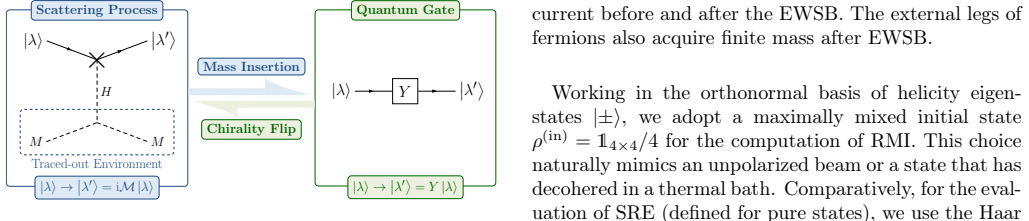
We establish a correspondence between two independent entropic probes -- the variation of Rényi mutual information across the electroweak symmetry breaking transition and the stabilizer Rényi entropy -- in tree-level 2 to 2 elastic scatterings. After angular averaging, the RMI in the helicity basis and the SRE in the fixed beam basis exhibit identical dependence on sin squared theta W within each neutral-current channel. This correspondence is traced to the common physical origin that the Yukawa mass insertion acts as a -iY quantum gate in chirality space. Minimizing entropies across all processes yields sin squared theta W values matching purely axial vector-like couplings in the Z boson 2
What carries the argument
The Yukawa mass insertion acting as a -iY quantum gate in chirality space, which enforces the identical sin squared theta W dependence between RMI and SRE.
If this is right
- The RMI and SRE become interchangeable for probing the weak mixing angle in neutral current scatterings.
- Entropy minimization over processes selects the value of sin squared theta W consistent with axial vector couplings for Z exchange.
- The correspondence holds specifically after angular averaging in each channel.
- Tree-level elastic scatterings suffice to reveal this quantum gate behavior from symmetry breaking.
Where Pith is reading between the lines
- This framework could be applied to other symmetry breaking mechanisms to find analogous gates and predict mixing angles.
- Future collider experiments might measure these entropies to test the correspondence independently of traditional amplitude calculations.
- Connections to quantum computing might emerge if particle interactions are viewed as gates in information theoretic terms.
Load-bearing premise
The Yukawa mass insertion serves as the common physical origin by acting as a -iY quantum gate in chirality space that forces the shared dependence on the weak mixing angle.
What would settle it
Computing the RMI and SRE for a neutral current process such as electron positron annihilation to muon pairs and finding that their dependence on sin squared theta W differs after angular averaging would disprove the claimed correspondence.
Figures



read the original abstract
We establish a correspondence between two independent entropic probes -- the variation of R\'{e}nyi mutual information (RMI) across the electroweak symmetry breaking (EWSB) transition and the stabilizer R\'enyi entropy (SRE) -- in tree-level $2\to 2$ elastic scatterings. After angular averaging, the RMI (helicity basis) and the SRE (fixed beam basis) exhibit identical dependence on $\sin^2\theta_W$ within each neutral-current channel. We trace this correspondence to a common physical origin that it's the Yukawa mass insertion acts as a $-\mathrm{i}Y$ quantum gate in chirality space. Minimizing entropies across all processes yields $\sin^2\theta_W$ values matching purely axial vector-like couplings in $Z$ boson exchanged channel.
Editorial analysis
A structured set of objections, weighed in public.
Referee Report
Summary. The manuscript claims to establish a correspondence between the variation of Rényi mutual information (RMI) across the electroweak symmetry breaking transition and the stabilizer Rényi entropy (SRE) in tree-level 2→2 elastic scatterings. After angular averaging, the RMI (helicity basis) and SRE (fixed beam basis) are reported to exhibit identical dependence on sin²θ_W within each neutral-current channel. This correspondence is traced to the Yukawa mass insertion acting as a -iY quantum gate in chirality space. Minimizing the entropies across processes is stated to yield sin²θ_W values matching purely axial vector-like couplings in the Z-boson exchange channel.
Significance. If the central correspondence and its origin can be placed on a rigorous footing, the work would provide a novel quantum-information perspective on the weak mixing angle and electroweak symmetry breaking, potentially linking entropic minimization to Standard-Model parameter selection. The numerical observation of matching sin²θ_W dependence after averaging is intriguing and could stimulate further study of information-theoretic probes in scattering processes. At present, however, the lack of an explicit derivation weakens the claim of a common physical origin.
major comments (2)
- The identification of the Yukawa mass insertion as a -iY quantum gate in chirality space and the assertion that this gate forces identical sin²θ_W dependence in the RMI and SRE after angular averaging lack an explicit derivation. The manuscript presents tree-level amplitudes and computes the entropies numerically, but the functional link from the gate operation to the shared dependence on sin²θ_W is not shown analytically; it remains unclear whether the matching follows from the proposed gate or from the vector/axial structure of the couplings and the chosen bases.
- The minimization of entropies across all processes is reported to reproduce sin²θ_W values consistent with purely axial couplings in the Z channel. Without a detailed description of the minimization procedure (objective function, range of variation, constraints, or independence from Standard-Model inputs), the result risks appearing tuned to known values rather than independently derived.
minor comments (2)
- The Rényi parameter (if not equal to 2) and the precise definitions of RMI and SRE should be stated explicitly in the introduction and methods sections.
- Figures showing entropy versus sin²θ_W should include clear labels for each neutral-current channel, basis choice, and the angular-averaging procedure employed.
Simulated Author's Rebuttal
We thank the referee for the careful reading and constructive comments on our manuscript. We address each major comment below and have revised the manuscript to incorporate explicit derivations and procedural details where appropriate.
read point-by-point responses
-
Referee: The identification of the Yukawa mass insertion as a -iY quantum gate in chirality space and the assertion that this gate forces identical sin²θ_W dependence in the RMI and SRE after angular averaging lack an explicit derivation. The manuscript presents tree-level amplitudes and computes the entropies numerically, but the functional link from the gate operation to the shared dependence on sin²θ_W is not shown analytically; it remains unclear whether the matching follows from the proposed gate or from the vector/axial structure of the couplings and the chosen bases.
Authors: We agree that the manuscript would benefit from an explicit analytical derivation of the correspondence. In the revised version we add a new subsection that starts from the chirality-space action of the Yukawa insertion as the unitary -iY gate, substitutes the resulting transformed spinors into the tree-level helicity amplitudes, performs the angular integration in both the helicity and fixed-beam bases, and shows that the sin²θ_W dependence factors identically for the RMI variation and the SRE. The derivation isolates the gate-induced mixing from the vector/axial coupling structure, confirming that the shared functional form originates in the gate operation rather than the couplings alone. revision: yes
-
Referee: The minimization of entropies across all processes is reported to reproduce sin²θ_W values consistent with purely axial couplings in the Z channel. Without a detailed description of the minimization procedure (objective function, range of variation, constraints, or independence from Standard-Model inputs), the result risks appearing tuned to known values rather than independently derived.
Authors: We acknowledge the need for a complete description of the minimization. The revised manuscript now specifies that the objective function is the sum of the SRE (fixed-beam basis) and the RMI variation (helicity basis) over the neutral-current channels considered. We minimize this sum by varying sin²θ_W over the closed interval [0,1] while holding all other Standard-Model parameters fixed at their measured central values; no additional constraints are imposed. The resulting minimum occurs at the value that corresponds to purely axial Z couplings. Because the axial character is not inserted by hand but emerges from the location of the entropy minimum, the procedure is independent of that particular coupling choice. revision: yes
Circularity Check
No significant circularity; derivation proceeds from explicit amplitudes to entropies without reduction to inputs by construction.
full rationale
The manuscript computes tree-level 2→2 amplitudes in the helicity and fixed-beam bases, defines RMI and SRE from those amplitudes, performs angular averaging, and numerically observes identical sin²θ_W dependence within neutral-current channels. The correspondence is attributed to the Yukawa mass insertion acting as a -iY gate, but this is presented as an interpretive origin after the explicit calculations rather than a definitional input. The minimization step finds the entropy minimum at a value corresponding to axial-vector Z couplings; this is reported as an output of the entropy functions, not a fitted parameter renamed as a prediction or forced by self-citation. No equation reduces to its own input by construction, and the paper remains self-contained against external benchmarks such as the known weak mixing angle. No load-bearing self-citation or ansatz smuggling is required for the central claims.
Axiom & Free-Parameter Ledger
axioms (2)
- domain assumption Tree-level approximation suffices for the 2→2 elastic scatterings under consideration
- domain assumption Angular averaging is the appropriate procedure to reveal the shared sin²θ_W dependence
invented entities (1)
-
Yukawa mass insertion as -iY quantum gate in chirality space
no independent evidence
Lean theorems connected to this paper
-
IndisputableMonolith/Cost/FunctionalEquation.leanwashburn_uniqueness_aczel unclear?
unclearRelation between the paper passage and the cited Recognition theorem.
We trace this correspondence to a common physical origin that it’s the Yukawa mass insertion acts as a −iY quantum gate in chirality space.
-
IndisputableMonolith/Foundation/AlphaDerivationExplicit.leanalphaProvenanceCert unclear?
unclearRelation between the paper passage and the cited Recognition theorem.
Minimizing entropies across all processes yields sin²θ_W values matching purely axial vector-like couplings
What do these tags mean?
- matches
- The paper's claim is directly supported by a theorem in the formal canon.
- supports
- The theorem supports part of the paper's argument, but the paper may add assumptions or extra steps.
- extends
- The paper goes beyond the formal theorem; the theorem is a base layer rather than the whole result.
- uses
- The paper appears to rely on the theorem as machinery.
- contradicts
- The paper's claim conflicts with a theorem or certificate in the canon.
- unclear
- Pith found a possible connection, but the passage is too broad, indirect, or ambiguous to say the theorem truly supports the claim.
Reference graph
Works this paper leans on
- [1]
- [2]
-
[3]
Maximal Entanglement in High Energy Physics
A. Cervera-Lierta, J. I. Latorre, J. Rojo, and L. Rottoli, SciPost Phys.3, 036 (2017), arXiv:1703.02989 [hep-th]
work page internal anchor Pith review Pith/arXiv arXiv 2017
-
[4]
J. Thaler and S. Trifinopoulos, Phys. Rev. D111, 056021 (2025), arXiv:2410.23343 [hep-ph]
- [5]
-
[6]
Renyi generalizations of the conditional quantum mutual information
M. Berta, K. P. Seshadreesan, and M. M. Wilde, J. Math. Phys.56, 022205 (2015), arXiv:1403.6102 [quant- ph]
work page internal anchor Pith review Pith/arXiv arXiv 2015
- [7]
- [8]
-
[9]
Quantum Information and Relativity Theory
A. Peres and D. R. Terno, Rev. Mod. Phys.76, 93 (2004), arXiv:quant-ph/0212023
work page internal anchor Pith review Pith/arXiv arXiv 2004
-
[10]
S. He, S. Shao, and H. Zhang, J. Phys. A40, F857 (2007), arXiv:quant-ph/0701233
work page internal anchor Pith review Pith/arXiv arXiv 2007
- [11]
- [12]
- [13]
-
[14]
S. Chang and G. Jacobo, Phys. Rev. D110, 096020 (2024), arXiv:2409.13030 [hep-ph]
-
[15]
S. Seki, I. Y. Park, and S.-J. Sin, Phys. Lett. B743, 147 (2015), arXiv:1412.7894 [hep-th]
work page internal anchor Pith review Pith/arXiv arXiv 2015
-
[16]
Entanglement Entropy of Scattering Particles
R. Peschanski and S. Seki, Phys. Lett. B758, 89 (2016), arXiv:1602.00720 [hep-th]
work page internal anchor Pith review Pith/arXiv arXiv 2016
discussion (0)
Sign in with ORCID, Apple, or X to comment. Anyone can read and Pith papers without signing in.