Bootstrapping Two-Nucleon Effective Field Theories
Pith reviewed 2026-05-22 02:28 UTC · model grok-4.3
The pith
Next-to-leading order chiral effective field theory for two-nucleon scattering remains consistent with data over a wider energy range than leading order.
A machine-rendered reading of the paper's core claim, the machinery that carries it, and where it could break.
Core claim
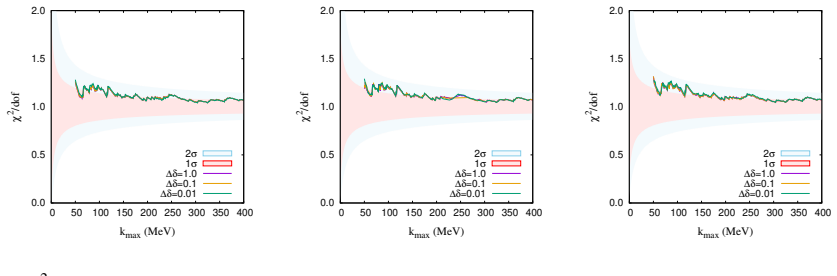
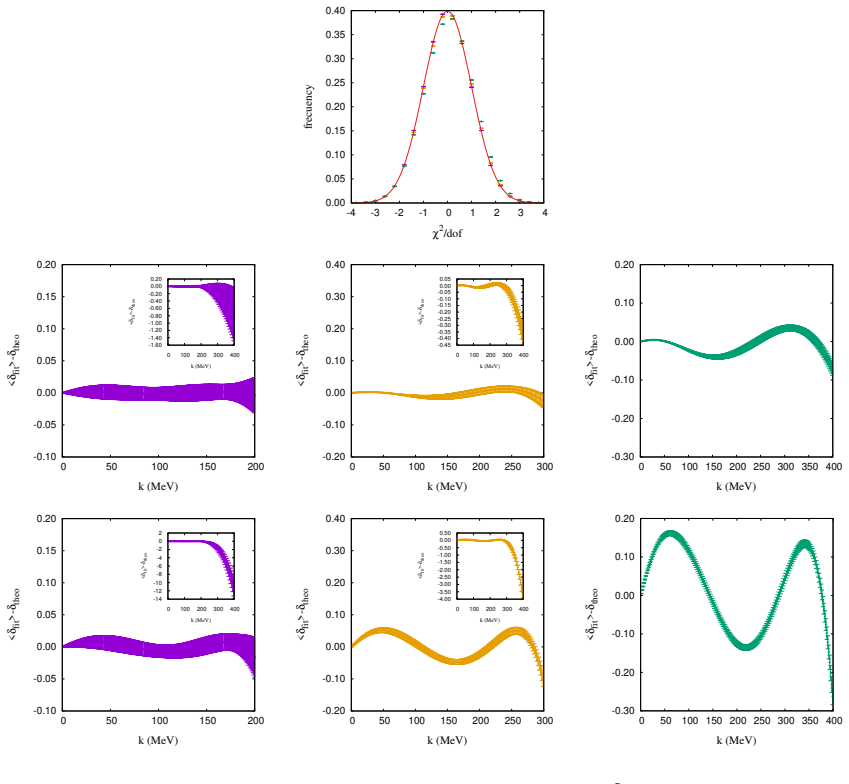
Using renormalization by contact terms and the N/D method with multiple subtractions, the authors show through bootstrap resampling on a toy model and on the 1S0 wave that the NLO potential significantly extends the energy range over which the renormalized effective field theory stays statistically consistent with the full theory or Granada phase-shift analysis.
What carries the argument
Bootstrap resampling applied to residuals between renormalized EFT predictions and reference phase shifts after fixing low-energy constants in either contact-term or N/D subtraction schemes.
If this is right
- The NLO potential can be used reliably up to higher laboratory energies than LO in the two-nucleon system.
- Both renormalization schemes gain from the bootstrap assessment of consistency.
- Statistical resampling provides a systematic way to determine the domain of validity for successive orders of chiral EFT.
- The wider validity window at NLO reduces the immediate requirement for higher-order terms in low-energy applications.
Where Pith is reading between the lines
- The same bootstrap procedure could be applied to additional partial waves to map order-by-order improvements across the full two-nucleon interaction.
- If the method proves robust, it offers a route to test consistency in three-nucleon forces where data are sparser.
- Validated energy ranges could inform cutoff choices in practical calculations of nuclear binding and reactions.
Load-bearing premise
The bootstrap resampling procedure accurately captures the statistical consistency between the renormalized EFT predictions and the full theory or Granada phase-shift data without introducing bias from the choice of energy bins or subtraction points.
What would settle it
Finding that actual deviations between NLO EFT phase shifts and Granada data exceed the bootstrap-derived uncertainty bands at energies where consistency is claimed would falsify the reported extension of the validity range.
Figures





read the original abstract
Chiral EFT yields singular potentials that require regularization and renormalization when implemented in a dynamical equation such as the Lippmann--Schwinger equation. We employ two different approaches, renormalization with contact terms -- as is most commonly done in chiral EFT -- and the exact N/D method with multiple subtractions. We start with a toy model in which we can control the finite-range expansion of the potential, treating the full potential as the `exact' theory. To assess the statistical consistency of the approaches with the full theory, we use the bootstrap technique. We apply the same framework to study the consistency of chiral EFT at LO and NLO with the Granada phase-shift analysis in the $^1S_0$ two-nucleon partial wave. Our results show that the NLO potential significantly extends the energy range over which the theory remains valid.
Editorial analysis
A structured set of objections, weighed in public.
Referee Report
Summary. The paper examines renormalization of singular potentials in chiral EFT for two-nucleon scattering via two schemes: conventional contact-term renormalization and the exact N/D method with multiple subtractions. A toy model with controllable finite-range expansion serves as the 'exact' theory for bootstrap-based statistical consistency tests. The same framework is applied to the 1S0 channel against Granada phase-shift data, with the central result that the NLO potential extends the energy range of validity relative to LO.
Significance. If the bootstrap analysis is free of bias from binning and subtraction choices, the work supplies a statistically grounded, quantitative metric for the range of applicability of chiral EFT in the NN sector. The dual renormalization approaches plus external-data comparison constitute a useful diagnostic tool for assessing order-by-order convergence.
major comments (2)
- [methods section on bootstrap resampling] The bootstrap resampling procedure (described in the methods section on statistical consistency) employs fixed energy bins and specific subtraction points in the N/D implementation without reported variation or sensitivity tests. Because the claim that NLO extends the validity range rests on the consistency metric remaining stable, any dependence on these discrete choices would undermine the statistical grounding of the result.
- [application to Granada phase-shift analysis] When the framework is applied to the Granada 1S0 phase shifts, the manuscript does not detail how data exclusions, bin widths, or weighting enter the bootstrap; without this, it is unclear whether the reported extension of the valid energy range is robust or sensitive to analysis choices that differ from the toy-model section.
minor comments (2)
- [Abstract] The abstract states that NLO 'significantly extends' the range but does not quote the quantitative intervals (e.g., up to what lab energy) obtained from the bootstrap; adding these numbers would improve clarity.
- [N/D method description] Notation for the subtraction constants in the N/D method could be introduced with an explicit equation rather than inline description.
Simulated Author's Rebuttal
We thank the referee for the constructive comments, which highlight important aspects of the statistical robustness of our bootstrap analysis. We address each major comment below and will revise the manuscript accordingly to provide the requested details and tests.
read point-by-point responses
-
Referee: [methods section on bootstrap resampling] The bootstrap resampling procedure (described in the methods section on statistical consistency) employs fixed energy bins and specific subtraction points in the N/D implementation without reported variation or sensitivity tests. Because the claim that NLO extends the validity range rests on the consistency metric remaining stable, any dependence on these discrete choices would undermine the statistical grounding of the result.
Authors: We agree that the absence of explicit sensitivity tests to binning and subtraction-point choices leaves open the possibility of dependence on these discrete selections. In the revised manuscript we will add a dedicated subsection reporting bootstrap results for several alternative bin widths (spanning the range used in the Granada analysis) and varied subtraction points, demonstrating that the NLO extension of the validity range remains stable within the reported uncertainties. This addition will directly address the concern and strengthen the statistical grounding of the central claim. revision: yes
-
Referee: [application to Granada phase-shift analysis] When the framework is applied to the Granada 1S0 phase shifts, the manuscript does not detail how data exclusions, bin widths, or weighting enter the bootstrap; without this, it is unclear whether the reported extension of the valid energy range is robust or sensitive to analysis choices that differ from the toy-model section.
Authors: We acknowledge that the manuscript does not provide a sufficiently explicit description of how the Granada data set is prepared for the bootstrap procedure. In the revision we will expand the relevant section to specify the precise data exclusions applied, the bin widths adopted for resampling, and the weighting scheme (including any covariance information from the phase-shift analysis). These details will be presented in parallel with the toy-model implementation so that readers can directly assess consistency between the two applications and confirm the robustness of the NLO result. revision: yes
Circularity Check
No significant circularity; claims grounded in external comparisons
full rationale
The derivation chain relies on treating a toy model as an exact reference and performing bootstrap consistency checks against independent Granada phase-shift data in the 1S0 wave. The NLO extension of validity range is evaluated statistically via these external benchmarks rather than by fitting parameters that are then renamed as predictions or by self-definitional reductions. No load-bearing self-citations, ansatz smuggling, or uniqueness theorems imported from prior author work are indicated in the manuscript description; the statistical procedure compares renormalized EFT outputs to outside references without reducing the consistency metric to the inputs by construction.
Axiom & Free-Parameter Ledger
Lean theorems connected to this paper
-
IndisputableMonolith/Cost/FunctionalEquation.leanwashburn_uniqueness_aczel unclear?
unclearRelation between the paper passage and the cited Recognition theorem.
We employ two different approaches, renormalization with contact terms... and the exact N/D method with multiple subtractions... bootstrap technique... consistency of chiral EFT at LO and NLO with the Granada phase-shift analysis
-
IndisputableMonolith/Foundation/AbsoluteFloorClosure.leanreality_from_one_distinction unclear?
unclearRelation between the paper passage and the cited Recognition theorem.
Our results show that the NLO potential significantly extends the energy range over which the theory remains valid.
What do these tags mean?
- matches
- The paper's claim is directly supported by a theorem in the formal canon.
- supports
- The theorem supports part of the paper's argument, but the paper may add assumptions or extra steps.
- extends
- The paper goes beyond the formal theorem; the theorem is a base layer rather than the whole result.
- uses
- The paper appears to rely on the theorem as machinery.
- contradicts
- The paper's claim conflicts with a theorem or certificate in the canon.
- unclear
- Pith found a possible connection, but the passage is too broad, indirect, or ambiguous to say the theorem truly supports the claim.
Reference graph
Works this paper leans on
- [1]
- [2]
- [3]
- [4]
- [5]
-
[6]
D. B. Kaplan, M. J. Savage, and M. B. Wise, Nucl. Phys. B478, 629 (1996), arXiv:nucl-th/9605002
work page internal anchor Pith review Pith/arXiv arXiv 1996
-
[7]
D. B. Kaplan, M. J. Savage, and M. B. Wise, Phys. Lett. B424, 390 (1998), arXiv:nucl-th/9801034
work page internal anchor Pith review Pith/arXiv arXiv 1998
-
[8]
D. B. Kaplan, M. J. Savage, and M. B. Wise, Nucl. Phys. B534, 329 (1998), arXiv:nucl-th/9802075 . 21
work page internal anchor Pith review Pith/arXiv arXiv 1998
- [9]
-
[10]
M. C. Birse, Phys. Rev. C74, 014003 (2006)
work page 2006
- [11]
- [12]
-
[13]
Renormalizing Chiral Nuclear Forces: A Case Study of 3P0
B. Long and C. J. Yang, Phys. Rev. C84, 057001 (2011), arXiv:1108.0985 [nucl-th]
work page internal anchor Pith review Pith/arXiv arXiv 2011
-
[14]
Renormalizing Chiral Nuclear Forces: Triplet Channels
B. Long and C. J. Yang, Phys. Rev. C85, 034002 (2012), arXiv:1111.3993 [nucl-th]
work page internal anchor Pith review Pith/arXiv arXiv 2012
-
[15]
Short-range nuclear forces in singlet channels
B. Long and C. J. Yang, Phys. Rev. C86, 024001 (2012), arXiv:1202.4053 [nucl-th]
work page internal anchor Pith review Pith/arXiv arXiv 2012
- [16]
-
[17]
E. Epelbaum and J. Gegelia, The European Physical Journal A41, 341 (2009)
work page 2009
-
[18]
R. Machleidt and D. R. Entem, Journal of Physics G: Nuclear and Particle Physics37, 064041 (2010)
work page 2010
- [19]
-
[20]
E. Epelbaum, A. M. Gasparyan, J. Gegelia, U.-G. Meißner, and X.-L. Ren, The European Physical Journal A56, 152 (2020)
work page 2020
-
[21]
E. Epelbaum, J. Gegelia, and U.-G. Meißner, Nucl. Phys. B925, 161 (2017), arXiv:1705.02524 [nucl- th]
work page internal anchor Pith review Pith/arXiv arXiv 2017
-
[22]
E. Epelbaum, J. Gegelia, and U.-G. Meißner, Commun. Theor. Phys.69, 303 (2018), arXiv:1710.04178 [nucl-th]
work page internal anchor Pith review Pith/arXiv arXiv 2018
-
[23]
How (not) to renormalize integral equations with singular potentials in effective field theory
E. Epelbaum, A. M. Gasparyan, J. Gegelia, and U.-G. Meißner, Eur. Phys. J. A54, 186 (2018), arXiv:1810.02646 [nucl-th]
work page internal anchor Pith review Pith/arXiv arXiv 2018
-
[24]
E. Epelbaum, A. M. Gasparyan, J. Gegelia, and U.-G. Meißner, Eur. Phys. J. A55, 56 (2019), arXiv:1903.01273 [nucl-th]
work page internal anchor Pith review Pith/arXiv arXiv 2019
-
[25]
U. van Kolck, Front. in Phys.8, 79 (2020), arXiv:2003.06721 [nucl-th]
-
[26]
R. Peng, B. Long, and F.-R. Xu, Phys. Rev. C110, 054001 (2024)
work page 2024
- [27]
- [28]
- [29]
- [30]
-
[31]
K. M. Case, Phys. Rev.80, 797 (1950)
work page 1950
- [32]
-
[33]
Renormalization of the Deuteron with One Pion Exchange
M. Pavón Valderrama and E. Ruiz Arriola, Phys. Rev. C72, 054002 (2005), arXiv:nucl-th/0504067 . 22
work page internal anchor Pith review Pith/arXiv arXiv 2005
-
[34]
M. Pavón Valderrama and E. Ruiz Arriola, Phys. Rev. C74, 054001 (2006), arXiv:nucl-th/0506047
work page internal anchor Pith review Pith/arXiv arXiv 2006
-
[35]
Renormalization of NN Interaction with Chiral Two Pion Exchange Potential. Non-Central Phases
M. Pavón Valderrama and E. Ruiz Arriola, Phys. Rev. C74, 064004 (2006), [Erratum: Phys.Rev.C 75, 059905 (2007)], arXiv:nucl-th/0507075
work page internal anchor Pith review Pith/arXiv arXiv 2006
-
[36]
Infinite-cutoff renormalization of the chiral nucleon-nucleon interaction at N3LO
C. Zeoli, R. Machleidt, and D. R. Entem, Few Body Syst.54, 2191 (2013), arXiv:1208.2657 [nucl-th]
work page internal anchor Pith review Pith/arXiv arXiv 2013
-
[37]
Chiral effective field theory and nuclear forces
R. Machleidt and D. R. Entem, Phys. Rept.503, 1 (2011), arXiv:1105.2919 [nucl-th]
work page internal anchor Pith review Pith/arXiv arXiv 2011
-
[38]
Modern Theory of Nuclear Forces
E. Epelbaum, H.-W. Hammer, and U.-G. Meissner, Rev. Mod. Phys.81, 1773 (2009), arXiv:0811.1338 [nucl-th]
work page internal anchor Pith review Pith/arXiv arXiv 2009
-
[39]
G. F. Chew and S. Mandelstam, Phys. Rev.119, 467 (1960)
work page 1960
-
[40]
D. R. Entem and J. A. Oller, Phys. Lett. B773, 498 (2017), arXiv:1610.01040 [nucl-th]
work page internal anchor Pith review Pith/arXiv arXiv 2017
- [41]
- [42]
- [43]
-
[44]
S. R. Beane and M. J. Savage, Nucl. Phys. A694, 511 (2001), arXiv:nucl-th/0011067
work page internal anchor Pith review Pith/arXiv arXiv 2001
-
[45]
E. Epelbaum, A. M. Gasparyan, J. Gegelia, and U.-G. Meissner, The European Physical Journal A54 (2018)
work page 2018
-
[46]
J. A. Oller, Phys. Rev. C93, 024002 (2016), arXiv:1402.2449 [nucl-th]
work page internal anchor Pith review Pith/arXiv arXiv 2016
-
[47]
R. J. Furnstahl, N. Klco, D. R. Phillips, and S. Wesolowski, Phys. Rev. C92, 024005 (2015), arXiv:1506.01343 [nucl-th]
work page internal anchor Pith review Pith/arXiv arXiv 2015
-
[48]
J. A. Meléndez, S. Wesolowski, and R. J. Furnstahl, Phys. Rev. C96, 024003 (2017), arXiv:1704.03308 [nucl-th]
work page internal anchor Pith review Pith/arXiv arXiv 2017
- [49]
-
[50]
Efron, The Annals of Statistics7, 1 (1979)
B. Efron, The Annals of Statistics7, 1 (1979)
work page 1979
-
[51]
Bootstrapping the statistical uncertainties of NN scattering data
R. Navarro Pérez, J. E. Amaro, and E. Ruiz Arriola, Phys. Lett. B738, 155 (2014), arXiv:1407.3937 [nucl-th]
work page internal anchor Pith review Pith/arXiv arXiv 2014
- [52]
-
[53]
Partial Wave Analysis of Nucleon-Nucleon Scattering below pion production threshold
R. Navarro Pérez, J. E. Amaro, and E. Ruiz Arriola, Phys. Rev. C88, 024002 (2013), [Erratum: Phys.Rev.C 88, 069902 (2013)], arXiv:1304.0895 [nucl-th]
work page internal anchor Pith review Pith/arXiv arXiv 2013
-
[54]
R. N. Pérez, J. E. Amaro, and E. R. Arriola, Phys. Rev. C88, 064002 (2013). 23
work page 2013
discussion (0)
Sign in with ORCID, Apple, or X to comment. Anyone can read and Pith papers without signing in.