Emulation of Optically Interconnected Quantum Data Centers Topologies for Cost-Fidelity Benchmarking
Pith reviewed 2026-05-22 06:34 UTC · model grok-4.3
The pith
Star topology provides the best cost-fidelity trade-off among ring, star, and line layouts for optically linked quantum processors.
A machine-rendered reading of the paper's core claim, the machinery that carries it, and where it could break.
Core claim
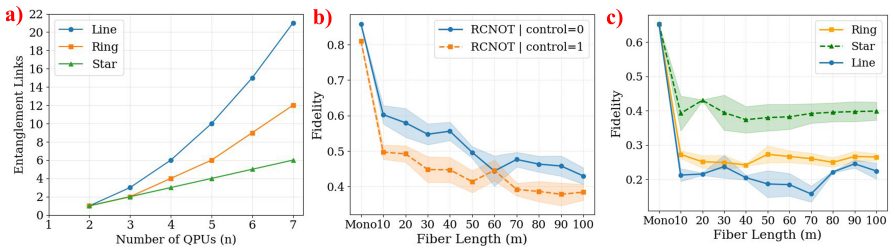
By emulating ring, star, and line topologies of quantum processors connected by optical links and evaluating them with GHZ benchmarks that include transduction and fiber noise, the work establishes that the star topology supplies the most favorable balance between total cost and achieved fidelity.
What carries the argument
GHZ state benchmarks run on emulations of the three topologies under models of transduction noise and fiber propagation noise.
If this is right
- Designers of quantum data centers should prioritize star-shaped optical interconnections to reach higher usable fidelity at lower overall cost.
- The same emulation approach can rank additional network layouts or noise levels before hardware is built.
- Line and ring topologies will require extra error mitigation or higher-quality components to match the performance of a star layout under identical noise.
Where Pith is reading between the lines
- The same benchmarking method could later incorporate quantum error correction to see how topology choice affects logical qubit performance.
- Results point to minimizing the number of transduction interfaces as a high-leverage design rule for any distributed quantum system.
- If the ranking holds, standards bodies may eventually favor star-like module arrangements for modular quantum computers.
Load-bearing premise
The noise models for transduction and fiber propagation used in the emulation accurately represent the dominant error sources that would appear in a real optically interconnected quantum data center.
What would settle it
A physical experiment that builds small ring, star, and line optical networks of quantum processors, measures their GHZ fidelities under real transduction and fiber noise, and finds that the star no longer shows the best cost-fidelity trade-off would falsify the central claim.
Figures


read the original abstract
We emulate optically interconnected quantum processors in ring, star, and line topologies using a quantum computer. GHZ benchmarks show that the star provides the best trade-off between cost and fidelity under transduction and fiber noise.
Editorial analysis
A structured set of objections, weighed in public.
Referee Report
Summary. The manuscript emulates ring, star, and line topologies for optically interconnected quantum processors on a quantum computer. GHZ-state fidelity benchmarks under added transduction and fiber-propagation noise channels are used to conclude that the star topology yields the best cost-fidelity trade-off.
Significance. If the noise models are representative, the emulation framework offers a practical route to topology benchmarking for future quantum data centers without requiring physical optical links. The direct use of quantum hardware for the emulation is a methodological strength that supports reproducibility.
major comments (2)
- [Noise model section] The transduction and fiber noise models (loss, dephasing, etc.) are introduced without experimental calibration or citation to measured parameters from real transducers or fiber links. This is load-bearing for the central claim because the reported GHZ fidelities and the resulting star-topology ranking are computed directly from these channels.
- [Results (GHZ benchmarks)] No sensitivity analysis or parameter sweep over the noise strengths is reported. Without it, it is impossible to determine whether the star topology remains optimal under plausible variations in the transduction or propagation rates.
minor comments (2)
- [Abstract] The abstract states the conclusion but supplies no quantitative cost definition, noise parameter values, or error-bar information.
- [Benchmarking metric] Clarify the precise definition of 'cost' used in the cost-fidelity metric and how it is computed from the emulation resources.
Simulated Author's Rebuttal
We thank the referee for the constructive comments on our manuscript. We address each major comment below and have revised the paper to strengthen the grounding of the noise models and to include additional analysis.
read point-by-point responses
-
Referee: [Noise model section] The transduction and fiber noise models (loss, dephasing, etc.) are introduced without experimental calibration or citation to measured parameters from real transducers or fiber links. This is load-bearing for the central claim because the reported GHZ fidelities and the resulting star-topology ranking are computed directly from these channels.
Authors: We agree that the noise models are central to the conclusions. In the revised manuscript we will add citations to recent experimental works reporting measured loss, dephasing, and transduction noise parameters from superconducting and photonic transducers as well as fiber links. We will also clarify that the chosen values are representative of current state-of-the-art devices and briefly discuss the sensitivity of the ranking to these parameters. revision: yes
-
Referee: [Results (GHZ benchmarks)] No sensitivity analysis or parameter sweep over the noise strengths is reported. Without it, it is impossible to determine whether the star topology remains optimal under plausible variations in the transduction or propagation rates.
Authors: We concur that a sensitivity analysis is necessary to support the robustness of the topology ranking. In the revision we will add a parameter sweep over transduction and fiber noise strengths, presenting the resulting GHZ fidelities for all three topologies in a new figure. This will explicitly show the range of noise parameters for which the star topology retains the best cost-fidelity trade-off. revision: yes
Circularity Check
No circularity: results are direct outputs of topology emulations on a quantum computer with explicit noise channels
full rationale
The manuscript reports GHZ-state fidelities obtained by emulating ring, star, and line topologies with added transduction and fiber noise models. No step in the provided abstract or described workflow reduces the cost-fidelity ranking to a fitted parameter, a self-citation chain, or a definitional equivalence. The star-topology advantage is presented as an observed outcome of the emulation runs rather than an input that is renamed or forced by construction. The derivation therefore remains self-contained against the stated emulation framework and noise assumptions.
Axiom & Free-Parameter Ledger
Reference graph
Works this paper leans on
-
[2]
Aghaee Rad , et al., Nature 638, 912--919 (2025)
H. Aghaee Rad , et al., Nature 638, 912--919 (2025). DOI: 10.1038/s41586-024-08406-9 https://doi.org/10.1038/s41586-024-08406-9
-
[3]
Liu, et al., IEEE Network 38, 160--166 (2024)
J. Liu, et al., IEEE Network 38, 160--166 (2024). DOI: 10.1109/MNET.2024.3397836 https://doi.org/10.1109/MNET.2024.3397836
-
[4]
Cuomo, et al., ACM Transactions on Quantum Computing 4, 1--25 (2023)
D. Cuomo, et al., ACM Transactions on Quantum Computing 4, 1--25 (2023). DOI: 10.1145/3579367 https://doi.org/10.1145/3579367
-
[6]
S. N. ElyasiGitHub repository (2025). https://github.com/nelyasi/QDC-OFC
work page 2025
-
[7]
K. Campbell and A. Lawey and M. Razavi. Modular quantum computing with a cat-comm architecture. Quantum Science and Technology. 2024. doi:10.1088/2058-9565/10/1/015052
-
[8]
D. Ferrari and S. Carretta and M. Amoretti , title =. IEEE Transactions on Quantum Engineering , volume =. 2023 , doi =
work page 2023
-
[9]
Scaling and networking a modular photonic quantum computer , journal =
H. Scaling and networking a modular photonic quantum computer , journal =. 2025 , doi =
work page 2025
-
[10]
Junyu Liu and Liang Jiang , title =. IEEE Network , volume =. 2024 , publisher =
work page 2024
-
[11]
A Framework for Quantum Data Center Emulation Using Digital Quantum Computers
Elyasi, Seyed Navid and Ahmadian, Seyed Morteza and Monti, Paolo and Li, Jun and Lin, Rui , title =. arXiv preprint arXiv:2509.04029 , year =
work page internal anchor Pith review Pith/arXiv arXiv
-
[12]
ACM Transactions on Quantum Computing , volume =
Cuomo, Daniele and Caleffi, Michele and Krsulich, Kevin and Tramonto, Filippo and Agliardi, Gabriele and Amoretti, Michele and Cacciapuoti, Angela Sara , title =. ACM Transactions on Quantum Computing , volume =. 2023 , publisher =
work page 2023
- [13]
discussion (0)
Sign in with ORCID, Apple, or X to comment. Anyone can read and Pith papers without signing in.