Aggregation-Fragmentation Processes with Broken Detailed Balance
Pith reviewed 2026-05-22 04:02 UTC · model grok-4.3
The pith
Mass-independent aggregation and fragmentation rates break detailed balance yet permit exact nonequilibrium steady states via the Laplace transform.
A machine-rendered reading of the paper's core claim, the machinery that carries it, and where it could break.
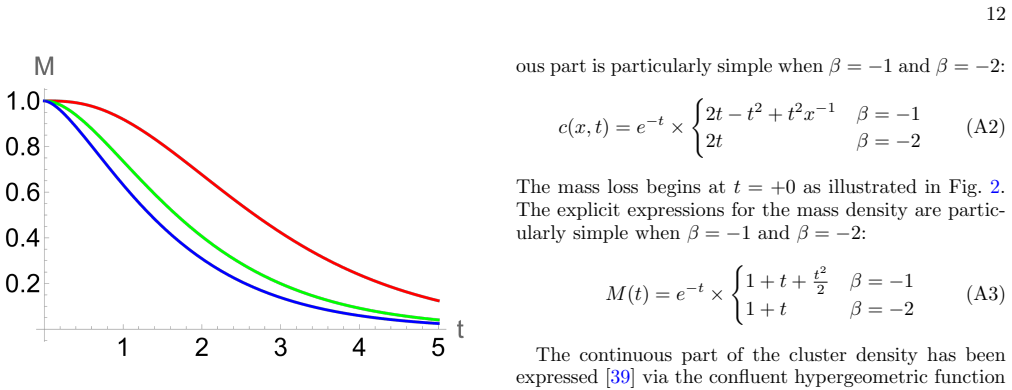
Core claim
For mass-independent rates, detailed balance is violated but the steady-state cluster distribution is still obtained from the exact Laplace transform of the generating function. When fragmentation rates scale as mass to the power beta with fixed aggregation rates, detailed balance is recovered solely at beta equals one; away from this point the steady states for beta greater than or equal to zero share the same qualitative features as the beta-zero case, whereas beta less than zero produces an instantaneous shattering transition with continuous mass loss.
What carries the argument
The Laplace transform of the cluster-size generating function, which converts the infinite system of master equations into a solvable ordinary differential equation for mass-independent rates and permits asymptotic analysis for power-law fragmentation.
If this is right
- Steady-state cluster distributions remain computable exactly even when detailed balance is absent.
- For beta greater than or equal to zero the steady states qualitatively match those of the mass-independent model.
- Negative beta produces an instantaneous shattering transition accompanied by continuous mass loss.
- Detailed balance is restored only when the fragmentation exponent equals one.
Where Pith is reading between the lines
- The robustness of the Laplace-transform method hints that exact steady states may exist for other smooth rate functions beyond pure power laws.
- The shattering transition for negative beta offers a simple kinetic mechanism that could describe sudden breakup phenomena in granular or colloidal systems.
- Numerical checks of the predicted mass-loss rate for beta less than zero would test whether the continuous-loss regime persists in finite systems.
Load-bearing premise
The aggregation and fragmentation rates must be either completely independent of mass or exactly proportional to mass to the power beta so that the Laplace-transform reduction and the subsequent asymptotic analysis remain valid.
What would settle it
A direct stochastic simulation of the master equations truncated at a large but finite maximum cluster size, started from a monodisperse initial condition with mass-independent rates, should converge to the inverse-Laplace steady-state distribution predicted by the analytic solution.
Figures

read the original abstract
We study aggregation-fragmentation processes in which pairs of clusters can aggregate, and each cluster can break into two fragments. If the rates of aggregation and fragmentation do not depend on the masses, detailed balance does not hold, but nonequilibrium steady states can still be deduced from an exact solution for the Laplace transform. For models in which aggregation rates remain constant but fragmentation rates scale as $(\text{mass})^\beta$, detailed balance holds only when $\beta=1$. Away from this solvable case, we employ asymptotic techniques and show that when $\beta\geq 0$, the steady states share similarities with those from the mass-independent ($\beta=0$) model. An instantaneous shattering transition with continuous mass loss occurs when $\beta<0$.
Editorial analysis
A structured set of objections, weighed in public.
Referee Report
Summary. The paper studies aggregation-fragmentation processes with mass-independent rates and with fragmentation rates scaling as mass^beta. For constant rates, detailed balance is broken yet an exact Laplace-transform solution for the steady-state cluster density is derived, yielding nonequilibrium steady states. For beta-dependent fragmentation, detailed balance holds only at beta=1; asymptotic analysis shows steady-state similarities for beta >=0 and an instantaneous shattering transition with continuous mass loss for beta<0.
Significance. If the Laplace-transform derivation is complete with all boundary conditions stated and the asymptotics are rigorously justified, the work supplies exact closed-form results and clear asymptotic classifications for nonequilibrium steady states in broken-detailed-balance coagulation-fragmentation models. The explicit identification of the shattering transition for beta<0 is a concrete, testable prediction that strengthens the contribution.
major comments (2)
- [§3] §3 (Laplace-transform solution for constant rates): the algebraic or first-order ODE obtained for L(s) after transforming the master equation requires an explicit boundary condition at m=0 (or equivalently a normalization or flux condition such as lim s→∞ s L(s) = n(0)) to select the unique non-negative physical solution. The manuscript does not appear to state or verify this condition, leaving open the possibility that the reported steady state is incomplete or unphysical.
- [§4] §4 (asymptotics for beta<0): the claim of an instantaneous shattering transition with continuous mass loss is central to the beta<0 regime, yet the supporting evidence (moment evolution or direct substitution back into the original equation) is not shown; without this check the transition remains formally asserted rather than demonstrated.
minor comments (2)
- [Abstract] The abstract states that steady states 'follow from an exact Laplace-transform solution' but does not indicate the inversion procedure or the small-mass asymptotics used to recover n(m); a brief sentence on this step would improve clarity.
- [Notation] Notation for the aggregation and fragmentation kernels should be introduced once and used consistently; occasional redefinition of symbols across sections can be avoided by a short nomenclature table.
Simulated Author's Rebuttal
We thank the referee for their thorough review and constructive feedback on our manuscript. We address each of the major comments below and have made revisions to the manuscript to incorporate the suggested clarifications and additional evidence.
read point-by-point responses
-
Referee: [§3] §3 (Laplace-transform solution for constant rates): the algebraic or first-order ODE obtained for L(s) after transforming the master equation requires an explicit boundary condition at m=0 (or equivalently a normalization or flux condition such as lim s→∞ s L(s) = n(0)) to select the unique non-negative physical solution. The manuscript does not appear to state or verify this condition, leaving open the possibility that the reported steady state is incomplete or unphysical.
Authors: We appreciate the referee highlighting this important point regarding the boundary condition. In our original derivation, the condition lim_{s → ∞} s L(s) = n(0) is used to fix the integration constant and ensure non-negativity of the cluster density. To address this, we have revised §3 to explicitly state this boundary condition, derive it from the normalization of the total number density, and verify that our closed-form solution for L(s) satisfies it, thereby confirming the uniqueness of the physical steady state. revision: yes
-
Referee: [§4] §4 (asymptotics for beta<0): the claim of an instantaneous shattering transition with continuous mass loss is central to the beta<0 regime, yet the supporting evidence (moment evolution or direct substitution back into the original equation) is not shown; without this check the transition remains formally asserted rather than demonstrated.
Authors: We agree that providing explicit supporting evidence strengthens the presentation of the shattering transition. In the revised version, we have included in §4 the time evolution equation for the total mass (first moment) and show that for β < 0, the mass decreases continuously to zero in finite time, indicating the instantaneous shattering. Additionally, we perform a direct substitution of the asymptotic form into the steady-state master equation to verify consistency in the appropriate scaling limit. revision: yes
Circularity Check
No circularity: Laplace-transform solution follows directly from the master equation without self-referential reduction.
full rationale
The derivation begins from the standard master equation for aggregation-fragmentation kinetics and converts it to an algebraic or ODE form for the Laplace transform L(s) under mass-independent rates. This is a direct mathematical transformation, not a fit or redefinition of the target steady-state density. Asymptotic analysis for beta-dependent cases likewise proceeds from the transformed equation and stated scaling assumptions without invoking self-citations as load-bearing uniqueness theorems or smuggling ansatzes. No step equates the output steady state to an input parameter by construction, and the approach remains self-contained against the model equations.
Axiom & Free-Parameter Ledger
axioms (1)
- domain assumption The system reaches a nonequilibrium steady state under the given aggregation and fragmentation rules.
Lean theorems connected to this paper
-
IndisputableMonolith/Cost/FunctionalEquation.leanwashburn_uniqueness_aczel unclear?
unclearRelation between the paper passage and the cited Recognition theorem.
If the rates of aggregation and fragmentation do not depend on the masses, detailed balance does not hold, but nonequilibrium steady states can still be deduced from an exact solution for the Laplace transform.
What do these tags mean?
- matches
- The paper's claim is directly supported by a theorem in the formal canon.
- supports
- The theorem supports part of the paper's argument, but the paper may add assumptions or extra steps.
- extends
- The paper goes beyond the formal theorem; the theorem is a base layer rather than the whole result.
- uses
- The paper appears to rely on the theorem as machinery.
- contradicts
- The paper's claim conflicts with a theorem or certificate in the canon.
- unclear
- Pith found a possible connection, but the passage is too broad, indirect, or ambiguous to say the theorem truly supports the claim.
Reference graph
Works this paper leans on
-
[1]
Near the minimum ρ=ρ min + log2 3(log2 3−1) ln 4 (1−2r) 2 +. . .(49) In the limit of very unequal splitting,R≪1, the expo- nent slowly approaches to unity: 1−ρ≃ ln 2 ln(1/R) (50) We now apply the Laplace transform to (41) and arrive at a neat functional equation 3C(s) =λ −1C 2(s) +C(rs) +C(s−rs) (51) 6 The small-mass tail (46) is reflected by the largesas...
-
[2]
SubstitutingA(σ/2 n) =a n into Eq. (65) we deduce the nonlinear difference equation an+1 = 1 2 an(1−a n), a 0 = 1 2 (66) Equations (64) and (66) are special cases of the logistic map, a very simple equation xn+1 =µx n(1−x n) (67) 7 with very complicated behaviors arising whenµincreases [45]; e.g., chaos occurs whenµpasses 3.56995. . .. The exact solutions...
-
[3]
For instance, if 1 2 < β <1, a more accurate small-mass expansion c(x) c(0) = 1− λ N 1 2 + 1 β xβ + Mβ−1 2Mβ x+. . .(73) shows that the steady-state mass density is a decreasing function ofxwhen the massxis small; apparently, it is a decreasing function in the entire mass range 0< x <∞. B. String model:β= 1 In a string model, the splitting rate is constan...
-
[4]
The steady state is never reached
-
[5]
The loss of mass be- gins att= +0, i.e., the shattering transition is instantaneous
The system undegoes a shattering transition: the mass is lost, which is interpreted as the emergence of dust, an infinite number of zero-mass fragments having overall positive mass. The loss of mass be- gins att= +0, i.e., the shattering transition is instantaneous. These two features of the solutions of Eqs. (68) are related: Instantaneous shattering, wh...
-
[6]
The small-mass behavior (46) is characterized by the exponent given by Eq
We established the qualitative behaviors of the steady-state mass distribu- tion in the limits of small and large mass. The small-mass behavior (46) is characterized by the exponent given by Eq. (47), and unknown amplitudeA(r). The large-mass behavior (55) resembles behavior in the model with ran- dom splitting. The amplitudesB(r) andσ(r) appearing in (55...
-
[7]
P. J. Blatz and A. V. Tobolsky, “Note on the kinet- ics of systems manifesting simultaneous polymerization- depolymerization phenomena,” J. Phys. Chem.49, 77–80 (1945)
work page 1945
-
[8]
Z. A. Melzak, “A scalar transport equation,” Trans. Amer. Math. Soc.85, 547–560 (1957)
work page 1957
-
[9]
Convergence to equilib- rium in a system of reacting polymers,
M. Aizenman and T. A. Bak, “Convergence to equilib- rium in a system of reacting polymers,” Commun. Math. Phys.65, 203–230 (1979)
work page 1979
-
[10]
Hot string soup: Ther- modynamics of strings near the Hagedorn transition,
D. A. Lowe and L. Thorlacius, “Hot string soup: Ther- modynamics of strings near the Hagedorn transition,” Phys. Rev. D51, 665–670 (1995)
work page 1995
-
[11]
On equilibrium solutions of aggregation- fragmentation problems,
R. D. Vigil, “On equilibrium solutions of aggregation- fragmentation problems,” J. Colloid and Interface Sci. 336, 642–647 (2009)
work page 2009
-
[12]
P. L. Krapivsky, S. Redner, and E. Ben-Naim,A Kinetic View of Statistical Physics(Cambridge University Press, Cambridge, UK, 2010)
work page 2010
-
[13]
Oscillations in aggregation-shattering processes,
S. A. Matveev, P. L. Krapivsky, A. P. Smirnov, E. E. Tyrtyshnikov, and N. V. Brilliantov, “Oscillations in aggregation-shattering processes,” Phys. Rev. Lett.119, 260601 (2017)
work page 2017
-
[14]
Steady oscillations in aggregation-fragmentation pro- cesses,
N. V. Brilliantov, W. Otieno, S. A. Matveev, A. P. Smirnov, E. E. Tyrtyshnikov, and P. L. Krapivsky, “Steady oscillations in aggregation-fragmentation pro- cesses,” Phys. Rev. E98, 012109 (2018)
work page 2018
-
[15]
Temporal oscillations in Becker–D¨ oring equations with atomization,
R. L. Pego and J. J. L. Vel´ azquez, “Temporal oscillations in Becker–D¨ oring equations with atomization,” Nonlin- earity33, 1812–1846 (2020)
work page 2020
-
[16]
Bursts characterize coagula- tion of rods in a quiescent fluid,
J. S lomka and R. Stocker, “Bursts characterize coagula- tion of rods in a quiescent fluid,” Phys. Rev. Lett.124, 258001 (2020)
work page 2020
-
[17]
Hopf bifurcation in addition-shattering kinetics,
S. S. Budzinskiy, S. A. Matveev, and P. L. Krapivsky, “Hopf bifurcation in addition-shattering kinetics,” Phys. Rev. E103, L040101 (2021)
work page 2021
-
[18]
Stochastic gel-shatter cycles in coalescence- fragmentation models,
B. T. Fagan, N. J. MacKay, D. O. Pushkin, and 13 A. J. Wood, “Stochastic gel-shatter cycles in coalescence- fragmentation models,” EPL133, 53001 (2021)
work page 2021
-
[19]
Oscillations in Becker–D¨ oring model with in- jection and depletion,
B. Niethammer, R. L. Pego, A. Schlichting, and J. J. L. Vel´ azquez, “Oscillations in Becker–D¨ oring model with in- jection and depletion,” SIAM J. Appl. Math.82, 1194– 1219 (2022)
work page 2022
-
[20]
J.-Y. Fortin and M. Y. Choi, “Stability condition of the steady oscillations in aggregation models with shattering process and self-fragmentation,” J. Phys. A56, 385004 (2023)
work page 2023
-
[21]
B. T. Fagan, N. J. MacKay, and A. J. Wood, “Robust- ness of steady state and stochastic cyclicity in generalized coalescence-fragmentation models,” Eur. Phys. J. B97, 21 (2024)
work page 2024
-
[22]
Phase transition with nonthermodynamic states in reversible polymerization,
E. Ben-Naim and P. L. Krapivsky, “Phase transition with nonthermodynamic states in reversible polymerization,” Phys. Rev. E77, 061132 (2008)
work page 2008
-
[23]
Transitional aggregation kinetics in dry and damp environments,
P. L. Krapivsky and S. Redner, “Transitional aggregation kinetics in dry and damp environments,” Phys. Rev. E 54, 3553–3561 (1996)
work page 1996
-
[24]
Nonequilibrium phase transitions in models of aggre- gation, adsorption, and dissociation,
S. N. Majumdar, S. Krishnamurthy, and M. Barma, “Nonequilibrium phase transitions in models of aggre- gation, adsorption, and dissociation,” Phys. Rev. Lett. 81, 3691–3694 (1998)
work page 1998
-
[25]
Phase transition in a traffic model with passing,
I. Ispolatov and P. L. Krapivsky, “Phase transition in a traffic model with passing,” Phys. Rev. E62, 5935–5939 (2000)
work page 2000
-
[26]
Exact phase diagram of a model with aggregation and chipping,
R. Rajesh and S. N. Majumdar, “Exact phase diagram of a model with aggregation and chipping,” Phys. Rev. E63, 036114 (2001)
work page 2001
-
[27]
Phases of a conserved mass model of aggregation with fragmentation at fixed sites,
K. Jain and M. Barma, “Phases of a conserved mass model of aggregation with fragmentation at fixed sites,” Phys. Rev. E64, 016107 (2001)
work page 2001
-
[28]
R. Rajesh, D. Das, B. Chakraborty, and M. Barma, “Ag- gregate formation in a system of coagulating and frag- menting particles with mass-dependent diffusion rates,” Phys. Rev. E66, 056104 (2002)
work page 2002
-
[29]
M. V. Smoluchowski, “Versuch einer mathematischen theorie der koagulationskinetic kolloider l¨ osungen [A mathematical theory of coagulation kinetics of colloidal solutions],” Z. Phys. Chem.92, 129–168 (1917)
work page 1917
-
[30]
Stochastic problems in physics and astronomy,
S. Chandrasekhar, “Stochastic problems in physics and astronomy,” Rev. Mod. Phys.15, 1–89 (1943)
work page 1943
-
[31]
P. J. Flory,Principles of Polymer Chemistry(Cornell University Press, 1953)
work page 1953
-
[32]
A general mathematical survey of the coag- ulation equation,
R. L. Drake, “A general mathematical survey of the coag- ulation equation,” inTopics in Current Aerosol Research, part 2, edited by G. M. Hidy and J. R. Brock (Pergamon Press, New York, 1972) pp. 201–376
work page 1972
-
[33]
Scaling theory and exactly solved models in the kinetics of irreversible aggregation,
F. Leyvraz, “Scaling theory and exactly solved models in the kinetics of irreversible aggregation,” Phys. Reports 383, 95–212 (2003)
work page 2003
-
[34]
Dynamical aspects of animal grouping: Swarms, schools, flocks, and herds,
A. Okubo, “Dynamical aspects of animal grouping: Swarms, schools, flocks, and herds,” Adv. Biophys.22, 1–94 (1986)
work page 1986
-
[35]
A. Okubo and S. A. Levin,Diffusion and Ecological Prob- lems: Modern Perspectives, Vol. 14 of Interdisciplinary Applied Mathematics, 2nd edn. (Springer, New York, NY, 2001)
work page 2001
-
[36]
Mathematical model for the size distribu- tion of fish schools,
H.-S. Niwa, “Mathematical model for the size distribu- tion of fish schools,” Computers & Math. Appl.32, 79–88 (1996)
work page 1996
-
[37]
Scaling in animal group-size distributions,
E. Bonabeau, L. Dagorn, and P. Fr´ eon, “Scaling in animal group-size distributions,” PNAS96, 4472–4477 (1999)
work page 1999
-
[38]
Space-irrelevant scaling law for fish school sizes,
H.-S. Niwa, “Space-irrelevant scaling law for fish school sizes,” J. Theor. Biol.228, 347–357 (2004)
work page 2004
-
[39]
A first principles derivation of animal group size distributions,
Q. Ma, A. Johansson, and D. J. T. Sumpter, “A first principles derivation of animal group size distributions,” J. Theor. Biol.283, 35–43 (2011)
work page 2011
-
[40]
Coagulation- fragmentation model for animal group-size statistics,
P. Degond, J.-G. Liu, and R. L. Pego, “Coagulation- fragmentation model for animal group-size statistics,” J. Nonlinear Sci.27, 379–424 (2017)
work page 2017
-
[41]
Aggregation- fragmentation-diffusion model for trail dynamics,
K. Kawagoe, G. Huber, M. Pradas, M. Wilkin- son, A. Pumir, and E. Ben-Naim, “Aggregation- fragmentation-diffusion model for trail dynamics,” Phys. Rev. E96, 012142 (2017)
work page 2017
-
[42]
Flux-conserving directed percolation,
B. Cucurull, G. Huber, K. Kawagoe, M. Pradas, A. Pumir, and M. Wilkinson, “Flux-conserving directed percolation,” J. Phys. A57, 075001 (2024)
work page 2024
-
[43]
On the distribution of the sizes of par- ticles which undergo splitting,
A. F. Filippov, “On the distribution of the sizes of par- ticles which undergo splitting,” Theory Prob. Appl.6, 275–294 (1961)
work page 1961
-
[44]
The kinetics of clus- ter fragmentation and depolymerisation,
R. M. Ziff and E. D. McGrady, “The kinetics of clus- ter fragmentation and depolymerisation,” J. Phys. A18, 3027–3037 (1985)
work page 1985
-
[45]
Kinetics of polymer degradation,
R. M. Ziff and E. D. McGrady, “Kinetics of polymer degradation,” Macromolecules19, 2513–2519 (1986)
work page 1986
-
[46]
Shattering transition in fragmentation,
E. D. McGrady and R. M. Ziff, “Shattering transition in fragmentation,” Phys. Rev. Lett.58, 892–895 (1987)
work page 1987
-
[47]
Z. Cheng and S. Redner, “Kinetics of fragmentation,” J. Phys. A23, 1233–1258 (1990)
work page 1990
-
[48]
M. H. Ernst and G. Szamel, “Fragmentation kinetics,” J. Phys. A26, 6085–6091 (1993)
work page 1993
-
[49]
This is sequence A001763 in the On-line Encyclopedia of Integer Sequences; it represents the number of dissections of a ball
-
[50]
P. Flajolet and R. Sedgewick,Analytic Combinatorics (Cambridge University Press, Cambridge, UK, 2009)
work page 2009
-
[51]
K. T. Alligood, T. D. Sauer, and J. A. Yorke,Chaos (Springer, New York, NY, 1996)
work page 1996
-
[52]
E. Schr¨ oder, “Ueber iterirte functionen,” Math. Ann.3, 296–322 (1870)
-
[53]
A note on Verhulst’s logistic equation and related logistic maps,
M. R. Guti´ errez, M. A. Reyes, and H. C. Rosu, “A note on Verhulst’s logistic equation and related logistic maps,” J. Phys. A43, 205204 (2010)
work page 2010
-
[54]
A note on exact solutions of the logistic map,
M. F. Maritz, “A note on exact solutions of the logistic map,” Chaos30, 033136 (2020)
work page 2020
-
[55]
Dynamic scaling in the kinetics of clustering,
P. G. J. van Dongen and M. H. Ernst, “Dynamic scaling in the kinetics of clustering,” Phys. Rev. Lett.54, 1396– 1399 (1985)
work page 1985
-
[56]
Strong fragmen- tation and coagulation with power-law rates,
J. Banasiak, W. Lamb, and M. Langer, “Strong fragmen- tation and coagulation with power-law rates,” J. Eng. Math.49, 199–215 (2013)
work page 2013
-
[57]
Sailing the deep blue sea of decaying Burgers turbulence,
M. Bauer and D. Bernard, “Sailing the deep blue sea of decaying Burgers turbulence,” J. Phys. A32, 5179–5199 (1999)
work page 1999
-
[58]
Statistical theory for the stochastic Burgers equation in the inviscid limit,
W. E and E. Vanden Eijnden, “Statistical theory for the stochastic Burgers equation in the inviscid limit,” Comm. Pure Appl. Math.53, 852–901 (2000)
work page 2000
-
[59]
J. Bec and K. Khanin, “Burgers turbulence,” Physics Re- ports447, 1–66 (2007)
work page 2007
-
[60]
New type of anomaly in turbulence,
A. Frishman and G. Falkovich, “New type of anomaly in turbulence,” Phys. Rev. Lett.113, 024501 (2014)
work page 2014
-
[61]
On an infinite set of non-linear differen- tial equations,
J. B. McLeod, “On an infinite set of non-linear differen- tial equations,” Q. J. Math.13, 119–128 (1962)
work page 1962
-
[62]
On the scalar transport equation,
J. B. McLeod, “On the scalar transport equation,” Proc. London Math. Soc.14, 445–458 (1964). 14
work page 1964
-
[63]
The establishment of thermal equi- librium between quanta and electrons,
A. S. Kompaneets, “The establishment of thermal equi- librium between quanta and electrons,” Sov. Phys. JETP 4, 730–737 (1969)
work page 1969
-
[64]
Bose condensation and shock waves in photon spectra,
Y. B. Zeldovich and E. V. Levich, “Bose condensation and shock waves in photon spectra,” Sov. Phys. JETP 28, 1287–1290 (1969)
work page 1969
-
[65]
Equilibrium for radiation in a homogeneous plasma,
R. E. Caflisch and C. D. Levermore, “Equilibrium for radiation in a homogeneous plasma,” Phys. Fluids29, 748–752 (1986)
work page 1986
-
[66]
M. A. Herrero M. Escobedo and J. J. L. Velazquez, “A nonlinear Fokker-Planck equation modelling the approach to thermal equilibrium in a homogeneous plasma,” Trans. Amer. Math. Soc.350, 3837–3901 (1998)
work page 1998
-
[67]
Global dy- namics of Bose–Einstein condensation for a model of the Kompaneets equation,
C. D. Levermore, H. Liu, and R. L. Pego, “Global dy- namics of Bose–Einstein condensation for a model of the Kompaneets equation,” SIAM J. Math. Anal.48, 2454– 2494 (2016)
work page 2016
-
[68]
Global dynamics and photon loss in the Kom- paneets equation,
J. Ballew, G. Iyer, C. D. Levermore, H. Liu, and R. L. Pego, “Global dynamics and photon loss in the Kom- paneets equation,” SIAM J. Math. Anal.55, 5715–5750 (2023)
work page 2023
discussion (0)
Sign in with ORCID, Apple, or X to comment. Anyone can read and Pith papers without signing in.