Maximum Lifetime of the Vegetative Biosphere
Pith reviewed 2026-05-22 02:15 UTC · model grok-4.3
The pith
Earth's vegetative biosphere could persist until 1.84 billion years from now if strong weathering draws CO2 down to 1 ppm, or until 1.87 billion years before overheating under weak weathering.
A machine-rendered reading of the paper's core claim, the machinery that carries it, and where it could break.
Core claim
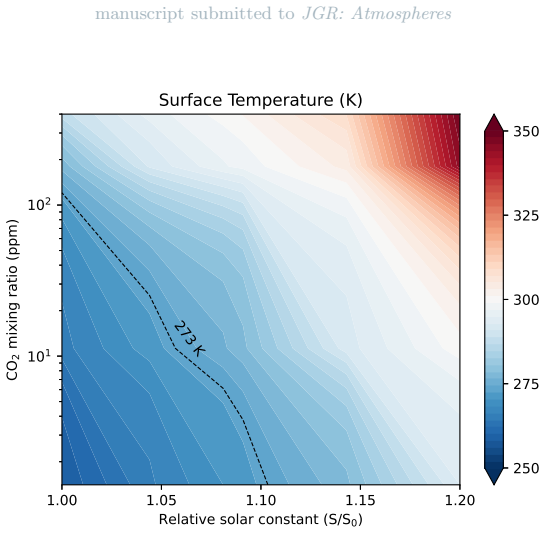
Using a three-dimensional climate model we calculate steady-state climates across a range of increasing solar constant and decreasing CO2 mixing ratio. Under strong weathering, in which temperature is held constant while CO2 is drawn down, the conventional 10 ppm CO2 starvation limit occurs at 1.35 Gyr, but CAM photosynthesis or aquatic macrophytes could permit the vegetative biosphere to continue until 1.84 Gyr if the starvation limit is taken at 1 ppm. Under weak weathering, in which CO2 is held constant while temperature rises, Earth becomes too hot for most land plants at 1.68 Gyr and too hot for all land plants at 1.87 Gyr, times that approach the moist and runaway greenhouse limits.
What carries the argument
Three-dimensional climate model that produces steady-state climates for future combinations of higher insolation and lower CO2 mixing ratio, with two weathering trajectories used as limiting cases.
If this is right
- The 10 ppm CO2 starvation limit for C4 photosynthesis is reached at 1.35 Gyr under strong weathering.
- CAM photosynthesis or bicarbonate-using aquatic macrophytes could extend the biosphere lifetime to 1.84 Gyr.
- Global mean temperature exceeds 323 K at 1.68 Gyr and 338 K at 1.87 Gyr under weak weathering, ending most and then all land plant viability.
- The calculated lifetimes approach but do not reach the moist and runaway greenhouse limits for Earth.
- Technological intervention or evolutionary adaptation could allow the biosphere to persist beyond these thermal and CO2 limits.
Where Pith is reading between the lines
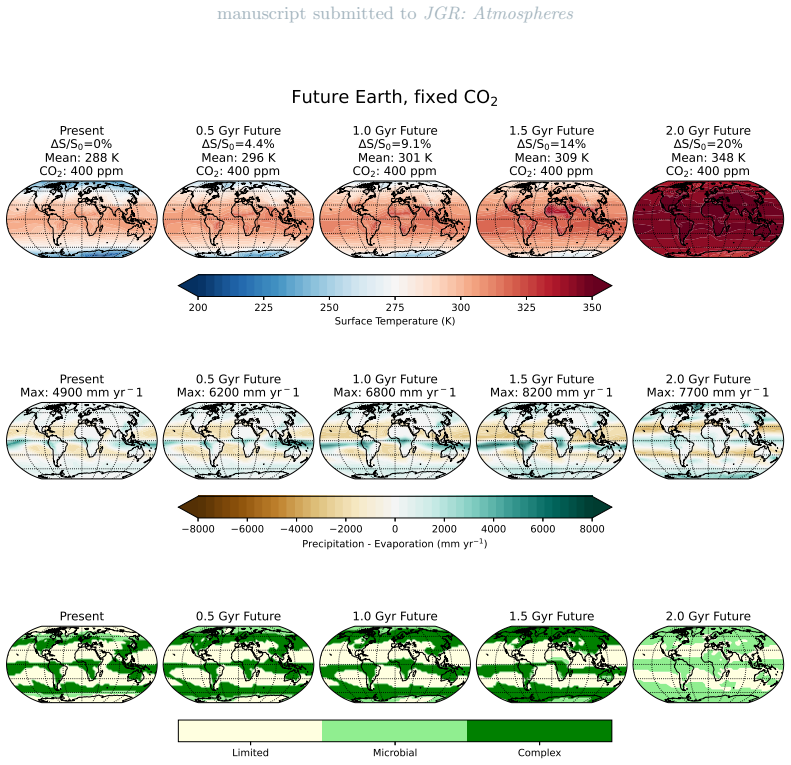
- Prior one-dimensional model estimates of future warming were too high when solar constant rises and CO2 is held fixed, so earlier biosphere lifetime calculations may have been too short.
- The same 3D modeling approach could be applied to exoplanets around Sun-like stars to refine estimates of when photosynthetic biospheres become impossible.
- If evolutionary shifts toward more heat-tolerant or low-CO2-adapted plant lineages occur over geologic time, the effective lifetime could exceed the 1.87 Gyr thermal limit.
- The distinction between strong and weak weathering provides a simple bounding framework that could be tested against paleoclimate records of past CO2 and temperature changes.
Load-bearing premise
The assumption that CAM photosynthesis or aquatic macrophytes can sustain the biosphere at CO2 levels as low as 1 ppm, or that the chosen temperature thresholds of 323 K and 338 K accurately mark the end of land plant viability.
What would settle it
A laboratory or field measurement showing that no terrestrial or aquatic plants can photosynthesize at atmospheric CO2 concentrations below 5 ppm, or that global mean temperatures above 323 K immediately eliminate all land plant cover.
Figures




read the original abstract
We use a three-dimensional model to calculate steady-state climates at various intervals in Earth's future, across a parameter space of increasing insolation and decreasing CO$_2$ mixing ratio. Comparison with prior results shows an overestimation of warming by one-dimensional models when solar constant is increased and CO$_2$ mixing ratio is fixed. We consider two future trajectories as limiting cases: strong weathering, in which surface temperature remains constant but CO$_2$ is drawn down; and weak weathering, in which CO$_2$ remains constant and surface temperature increases. Under strong weathering, we find the conventional 10 ppm CO$_2$ starvation limit for C4 photosynthesis occurs at 1.35 Gyr; however, we suggest that crassulacean acid metabolism (CAM) photosynthesis could persist below this limit and note that aquatic macrophytes can utilize dissolved bicarbonate if atmospheric CO$_2$ is low. If we take the CO$_2$ starvation limit at 1 ppm instead, then the vegetative biosphere could continue until 1.84 Gyr. Thermal limits apply instead under weak weathering, in which Earth would be too hot for most land plants at 1.68 Gyr (>323 K) and too hot for all land plants (>338 K) at 1.87 Gyr. These lifetimes approach the moist and runaway greenhouse limits for Earth. We discuss other possible mechanisms for extending the lifetime of Earth's biosphere, noting that both technological intervention and evolutionary processes could enable life to adapt to a brightening sun.
Editorial analysis
A structured set of objections, weighed in public.
Referee Report
Summary. The paper uses a three-dimensional climate model to compute steady-state future climates across a grid of increasing insolation and decreasing CO2 mixing ratio. It reports that one-dimensional models overestimate warming under these conditions. Two limiting weathering trajectories are examined: strong weathering (constant surface temperature with CO2 drawdown) and weak weathering (constant CO2 with rising temperature). Under strong weathering the conventional 10 ppm C4 starvation limit is reached at 1.35 Gyr, but the authors propose that CAM photosynthesis and bicarbonate-utilizing aquatic macrophytes could extend viability to a 1 ppm limit at 1.84 Gyr. Under weak weathering, land plants are limited by temperature thresholds of 323 K at 1.68 Gyr and 338 K at 1.87 Gyr. These lifetimes are stated to approach the moist and runaway greenhouse limits.
Significance. If the central lifetime estimates hold, the work supplies a useful update to biosphere-habitability projections by replacing one-dimensional models with three-dimensional simulations that explicitly demonstrate reduced warming. The framing of strong and weak weathering as limiting cases and the explicit comparison to prior 1D results constitute a clear methodological advance. The discussion of possible extensions through CAM photosynthesis, macrophytes, and evolutionary or technological adaptation is also a constructive contribution to planetary habitability literature.
major comments (2)
- [strong weathering trajectory and CO2 starvation discussion] The headline extension to 1.84 Gyr under strong weathering is obtained by adopting a 1 ppm CO2 starvation limit instead of the conventional 10 ppm C4 limit reached at 1.35 Gyr. This substitution rests on the statements that CAM photosynthesis 'could persist' and that aquatic macrophytes 'can utilize dissolved bicarbonate,' yet the manuscript supplies no leaf-level assimilation curves, compensation-point calculations, or biosphere-fraction estimates demonstrating that net primary productivity would remain positive and globally significant at 1 ppm under the elevated insolation of that epoch.
- [weak weathering trajectory and thermal limits] The thermal limits under weak weathering (323 K at 1.68 Gyr for most land plants and 338 K at 1.87 Gyr for all land plants) are applied directly to the 3D-model output without regional analysis or acclimation adjustments. Because the strong-weathering trajectory supplies the longer of the two reported lifetimes, the unquantified 1 ppm biological assumption is load-bearing for the central claim.
minor comments (2)
- The abstract and main text would benefit from a clearer separation between the conventional 10 ppm limit (supported by the model runs) and the proposed 1 ppm extension (supported only by qualitative suggestion) to prevent readers from conflating the two.
- Additional citations to quantitative studies on CAM compensation points at sub-10 ppm CO2 or on the global contribution of bicarbonate-using macrophytes would help anchor the biological arguments.
Simulated Author's Rebuttal
We thank the referee for their constructive review and for recognizing the methodological advance in using 3D simulations to demonstrate reduced warming relative to 1D models. We address each major comment below, indicating where revisions will be made to clarify assumptions and limitations while preserving the core results on climate trajectories.
read point-by-point responses
-
Referee: The headline extension to 1.84 Gyr under strong weathering is obtained by adopting a 1 ppm CO2 starvation limit instead of the conventional 10 ppm C4 limit reached at 1.35 Gyr. This substitution rests on the statements that CAM photosynthesis 'could persist' and that aquatic macrophytes 'can utilize dissolved bicarbonate,' yet the manuscript supplies no leaf-level assimilation curves, compensation-point calculations, or biosphere-fraction estimates demonstrating that net primary productivity would remain positive and globally significant at 1 ppm under the elevated insolation of that epoch.
Authors: We agree that the 1.84 Gyr figure depends on adopting a 1 ppm CO2 limit as a hypothetical extension. The manuscript presents CAM photosynthesis and bicarbonate utilization by macrophytes as plausible mechanisms that could allow persistence below the 10 ppm C4 threshold, but does not include quantitative leaf-level curves, compensation points, or global productivity estimates. These would require dedicated physiological and ecological modeling outside the scope of our climate-focused study. We will revise the text to frame the 1.84 Gyr value more explicitly as a speculative upper bound contingent on these adaptations, add stronger caveats, and reference relevant literature on low-CO2 photosynthesis without claiming new quantitative support. revision: partial
-
Referee: The thermal limits under weak weathering (323 K at 1.68 Gyr for most land plants and 338 K at 1.87 Gyr for all land plants) are applied directly to the 3D-model output without regional analysis or acclimation adjustments. Because the strong-weathering trajectory supplies the longer of the two reported lifetimes, the unquantified 1 ppm biological assumption is load-bearing for the central claim.
Authors: The 323 K and 338 K thresholds are taken from established literature on land-plant thermal tolerances and applied to global-mean temperatures from the 3D simulations as bounding cases for the weak-weathering trajectory, following the approach of prior 1D studies. We acknowledge that a full regional analysis of temperature distributions, potential acclimation, or species migration is not performed here. The 3D results already show milder warming than 1D models for equivalent insolation/CO2 changes, which remains a key finding. We will expand the discussion to note these limitations of the uniform thresholds and to emphasize that both weathering trajectories are presented as limiting cases rather than definitive forecasts. The central claims concern the climate projections themselves; the biological limits serve to contextualize them. revision: partial
- Providing new leaf-level assimilation curves, compensation-point calculations, or quantitative biosphere-fraction estimates for CAM and macrophyte productivity at 1 ppm CO2 under future insolation would require additional biological and ecological research beyond the climate-modeling scope of this manuscript.
Circularity Check
No significant circularity; lifetimes are direct outputs of external model under stated external assumptions
full rationale
The paper applies an external three-dimensional climate model to compute steady-state climates at future intervals under two externally defined limiting weathering trajectories (strong: constant temperature with CO2 drawdown; weak: constant CO2 with temperature rise). The reported lifetimes (1.35 Gyr at 10 ppm, 1.84 Gyr at 1 ppm under strong weathering; 1.68 Gyr and 1.87 Gyr thermal limits under weak weathering) are obtained by running the model to the chosen CO2 or temperature thresholds. These thresholds are adopted from prior literature on C4/CAM photosynthesis and land-plant viability rather than fitted inside the paper or defined in terms of the model outputs themselves. No equation reduces a prediction to a fitted parameter by construction, no self-citation chain supplies the central result, and the derivation remains self-contained against external benchmarks.
Axiom & Free-Parameter Ledger
free parameters (1)
- CO2 starvation threshold
axioms (1)
- domain assumption Strong weathering maintains constant surface temperature while drawing down CO2; weak weathering maintains constant CO2 while temperature rises.
Reference graph
Works this paper leans on
-
[1]
Baraffe, I., Homeier, D., Allard, F., & Chabrier, G. (2015). New evolut ionary models for pre-main sequence and main sequence low-mass stars do wn to the hydrogen-burning limit. Astronomy & Astrophysics , 577 , A42. –21– manuscript submitted to JGR: Atmospheres Baum, M., Fu, M., & Bourguet, S. (2022). Sensitive dependence of g lobal climate to continental ...
-
[2]
de Sousa Mello, F., & Fria¸ ca, A. C. S. (2020). The end of life on earth is not the end of the world: converging to an estimate of life span of the biosphere ? Interna- tional Journal of Astrobiology , 19 (1), 25–42. Donn, W. L., Donn, B. D., & Valentine, W. G. (1965). On the early histo ry of the earth. Geological Society of America Bulletin , 76 (3), 2...
work page 2020
-
[3]
Feulner, G. (2012). The faint young sun problem. Reviews of Geophysics , 50 (2). Franck, S., Block, A., von Bloh, W., Bounama, C., Schellnhuber, H. J., & Svirezhev, Y. (2000). Reduction of biosphere life span as a consequence of ge odynamics. Tellus B , 52 (1), 94–107. Goldblatt, C., & Watson, A. J. (2012). The runaway greenhouse: im plications for fu- tu...
work page 2012
-
[4]
Haqq-Misra, J., & Hayworth, B. P. (2022). An energy balance mode l for rapidly and synchronously rotating terrestrial planets. The Planetary Science Journal , 3 (2),
work page 2022
-
[5]
Haqq-Misra, J., & Wolf, E. (2025). Maximum lifetime of the vegetative biosphere: Model data. [Software]. Zenodo. doi: 10.5281/zenodo.16584870 Jansen, T., Scharf, C., Way, M., & Del Genio, A. (2019). Climates of w arm earth- like planets. ii. rotational “goldilocks” zones for fractional habitab ility and –22– manuscript submitted to JGR: Atmospheres silica...
-
[6]
Kasting, J. F. (2010). Faint young sun redux. Nature, 464 (7289), 687–689. Kasting, J. F., Chen, H., & Kopparapu, R. K. (2015). Stratospher ic temperatures and water loss from moist greenhouse atmospheres of earth-like p lanets. The Astrophysical Journal Letters , 813 (1), L3. Kasting, J. F., Whitmire, D. P., & Reynolds, R. T. (1993). Habitable zo nes aro...
work page 2010
-
[7]
Leconte, J., Forget, F., Charnay, B., Wordsworth, R., & Pottier, A . (2013). In- creased insolation threshold for runaway greenhouse processes on earth-like planets. Nature, 504 (7479), 268–271. Lehmer, O. R., Catling, D. C., & Krissansen-Totton, J. (2020). Car bonate-silicate cycle predictions of earth-like planetary climates and testing the ha bitable z...
work page 2013
-
[8]
Lenton, T. M., & von Bloh, W. (2001). Biotic feedback extends the lif e span of the biosphere. Geophysical research letters , 28 (9), 1715–1718. Lovelock, J. E., & Whitfield, M. (1982). Life span of the biosphere. Nature, 296 (5857), 561–563. Nimer, N. A., Iglesias-Rodriguez, M. D., & Merrett, M. J. (1997). Bic arbonate uti- lization by marine phytoplankto...
work page 2001
-
[9]
O’Malley-James, J. T., Greaves, J. S., Raven, J. A., & Cockell, C. S. (2 013). Swan- song biospheres: refuges for life and novel microbial biospheres o n terrestrial planets near the end of their habitable lifetimes. International Journal of Astrobiology, 12 (2), 99–112. Otto-Bliesner, B. L. (1995). Continental drift, runoff, and weat hering feed- backs: I...
-
[10]
Tortell, P. D., Reinfelder, J. R., & Morel, F. M. (1997). Active uptake of bicarbon- ate by diatoms. Nature, 390 (6657), 243–244. Walker, J. C., Hays, P., & Kasting, J. F. (1981). A negative feedbac k mechanism for the long-term stabilization of earth’s surface temperature. Journal of Geophys- ical Research: Oceans , 86 (C10), 9776–9782. Walker, J. C., Sc...
work page 1997
-
[11]
Wolf, E., & Toon, O. (2014). Delayed onset of runaway and moist gre enhouse cli- mates for earth. Geophysical Research Letters , 41 (1), 167–172. Wolf, E., & Toon, O. (2015). The evolution of habitable climates under the bright- ening sun. Journal of Geophysical Research: Atmospheres , 120 (12), 5775–
work page 2014
-
[12]
Woodward, H. L., Rushby, A. J., & Mayne, N. J. (2025). A novel met ric for assess- ing climatological surface habitability. The Planetary Science Journal , 6 (8),
work page 2025
-
[13]
Wordsworth, R., & Cockell, C. (2024). Self-sustaining living habitats in extraterres- trial environments. Astrobiology, 24 (12), 1187–1195. Wordsworth, R., Forget, F., & Eymet, V. (2010). Infrared collision -induced and far- line absorption in dense co2 atmospheres. Icarus, 210 (2), 992–997. Wordsworth, R., Quayum, R., Kocharian, E., Pearson, A., Portillo...
work page 2024
-
[14]
The top panel shows surface temperature as a function of time. The weak weatheri ng limit (red) shows increasing temperatures that eventually become too hot for most land pl ants (the traditional limit of 323 K (c.f., Caldeira & Kasting, 1992)) at 1.68 Gyr and eventually too hot for all land plants (the opti- mistic limit of 338 K (c.f., Graham et al., 20...
work page 1992
discussion (0)
Sign in with ORCID, Apple, or X to comment. Anyone can read and Pith papers without signing in.