The cell fluid model with Curie-Weiss interactions: special cases and analytical results
Pith reviewed 2026-05-22 03:54 UTC · model grok-4.3
The pith
In the strong-repulsion limit the cell fluid model reduces exactly to the van der Waals lattice gas with a Curie-Weiss order parameter.
A machine-rendered reading of the paper's core claim, the machinery that carries it, and where it could break.
Core claim
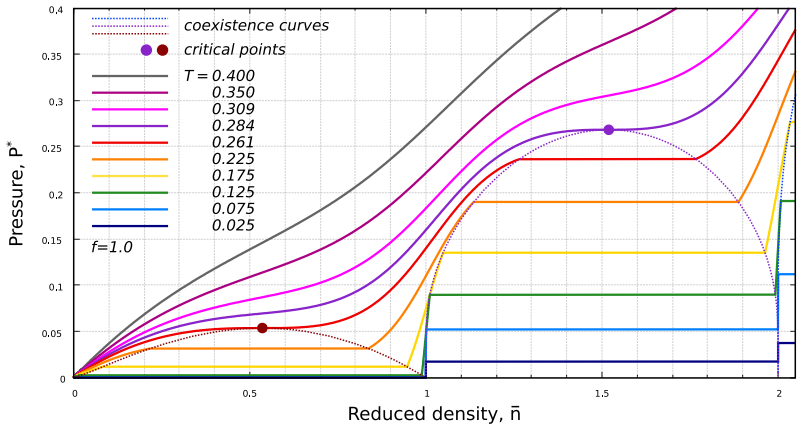
For J2 ≫ J1 explicit expressions are derived for the critical point parameters, the equation of state, and the binodal and spinodal curves. The equation of state is found to be in full agreement with that of the van der Waals lattice gas, and the order parameter satisfies the standard Curie-Weiss equation. In a neighborhood of the critical point a Landau expansion has the same form and symmetry as that of the classical lattice gas within the mean-field approximation. The asymptotic expansion of the deformed exponential function is extended to the marginal thermodynamic-stability case J1 = J2, rendering the ideal-gas limit formally legitimate.
What carries the argument
The asymptotic expansion of the deformed exponential function that governs the cell model's grand potential and thereby produces the explicit reduction to van der Waals thermodynamics when J2 greatly exceeds J1.
If this is right
- The equation of state coincides exactly with the van der Waals lattice-gas equation when J2 ≫ J1.
- The order parameter satisfies the standard Curie-Weiss mean-field equation.
- Binodal and spinodal curves are available in closed form.
- The Landau expansion near the critical point has identical form and symmetry to the mean-field lattice gas.
Where Pith is reading between the lines
- The closed-form expressions supply exact benchmarks that numerical simulations of competing-interaction fluids can be tested against.
- The extension to J1 = J2 indicates that the model's thermodynamic description remains internally consistent even when strict repulsion dominance is relaxed.
- Analogous reductions to van der Waals behavior may appear in other microscopic models that combine long-range attraction with short-range repulsion.
Load-bearing premise
The asymptotic expansion of the deformed exponential function remains valid when extended to the marginal case of equal coupling constants J1 equal to J2.
What would settle it
Compute the equation of state numerically for a sequence of increasing J2/J1 ratios and test whether the results converge to the closed-form van der Waals expression; systematic deviation at large ratios would falsify the claimed reduction.
Figures



read the original abstract
Inspired by previous extensive numerical studies of a cell fluid model with Curie-Weiss interactions, we concentrate on some analytically tractable special cases in its description. The key ingredient of the model is a competition between global attraction and local repulsion interactions between particles with coupling constants $J_1$ and $J_2$, respectively. We provide analytical results in several limiting cases, including the ideal-gas limit $J_1=J_2=0$ and the strong-repulsion limit $J_2\gg J_1$. For $J_2\gg J_1$, a detailed analytical study is presented. We derive explicit expressions for the critical point parameters, the equation of state, and the binodal and spinodal curves in closed form. The equation of state is found to be in full agreement with that of the van der Waals lattice gas, and the order parameter satisfies the standard Curie-Weiss equation. In a neighborhood of the critical point, a Landau expansion is shown to have the same form and symmetry as that of the classical lattice gas within the mean-field approximation. Moreover, based on the explicit knowledge of a few leading terms in the asymptotic expansion of the deformed exponential function governing the physics of the cell model, we extend its validity range to include the marginal case of thermodynamic stability, $J_1=J_2$. In particular, this extension makes a consideration of the ideal-gas limit $J_1=J_2=0$ formally legitimate. For the generic marginal case $J_1=J_2\ne0$ systematically avoided in previous works, we present numerical data and phase diagrams that augment their findings for $J_2>J_1$.
Editorial analysis
A structured set of objections, weighed in public.
Referee Report
Summary. The manuscript analyzes special cases of a cell fluid model with competing global attraction (J1) and local repulsion (J2) interactions. For the limit J2 ≫ J1 it derives explicit closed-form expressions for the critical-point parameters, the equation of state (reported to agree fully with the van der Waals lattice gas), the binodal and spinodal curves, and shows that the order parameter obeys the standard Curie-Weiss equation. A Landau expansion near the critical point is shown to match the classical lattice-gas mean-field form. The authors further extend the leading terms of the asymptotic expansion of the deformed exponential to the marginal-stability line J1 = J2, thereby including the ideal-gas limit J1 = J2 = 0, and supply numerical phase diagrams for the generic marginal case J1 = J2 ≠ 0.
Significance. If the derivations are controlled, the work supplies analytical benchmarks that confirm and extend previous numerical studies of the model. The explicit agreement with the van der Waals and Curie-Weiss mean-field results, together with the closed-form binodal/spinodal expressions, offers concrete reference points for the competition between attraction and repulsion. The extension to the marginal line J1 = J2, if justified, would also make the ideal-gas limit formally accessible within the same framework.
major comments (1)
- [asymptotic extension to marginal stability (J1 = J2)] The central analytical results for J2 ≫ J1 rest on the cell-model partition function expressed via the deformed exponential. To reach the marginal line J1 = J2 (and thereby the ideal-gas limit), the manuscript invokes a truncation to a few leading asymptotic terms. No explicit remainder estimate or proof is supplied showing that omitted higher-order terms remain sub-dominant in the thermodynamic limit as J1 approaches J2 from above. If those terms contribute at the same order to the pressure or chemical potential, the claimed closed-form equation of state, binodal, and spinodal would acquire uncontrolled corrections precisely on the boundary the authors wish to reach. This issue is load-bearing for the legitimacy of the ideal-gas limit and for the numerical augmentation of the marginal case.
minor comments (1)
- [abstract] The abstract and introduction would benefit from a clearer separation between the fully analytical results obtained for J2 ≫ J1 and the numerical data presented for the marginal line J1 = J2.
Simulated Author's Rebuttal
We thank the referee for their careful reading of the manuscript and for the constructive comment on the asymptotic extension. We respond to the major comment below.
read point-by-point responses
-
Referee: [asymptotic extension to marginal stability (J1 = J2)] The central analytical results for J2 ≫ J1 rest on the cell-model partition function expressed via the deformed exponential. To reach the marginal line J1 = J2 (and thereby the ideal-gas limit), the manuscript invokes a truncation to a few leading asymptotic terms. No explicit remainder estimate or proof is supplied showing that omitted higher-order terms remain sub-dominant in the thermodynamic limit as J1 approaches J2 from above. If those terms contribute at the same order to the pressure or chemical potential, the claimed closed-form equation of state, binodal, and spinodal would acquire uncontrolled corrections precisely on the boundary the authors wish to reach. This issue is load-bearing for the legitimacy of the ideal-gas limit and for the numerical augmentation of the marginal case.
Authors: We thank the referee for raising this point on the rigor of the truncation. The asymptotic expansion of the deformed exponential follows from its integral representation or recurrence relation, yielding successive corrections that are systematically smaller by powers of the inverse coupling. In the thermodynamic limit the free energy is obtained from the leading saddle-point contribution, so that higher-order terms in the expansion of the deformed exponential enter only as sub-extensive corrections that vanish upon taking the appropriate derivatives for pressure and chemical potential. We nevertheless acknowledge that an explicit uniform remainder bound as J1 approaches J2 from above is not supplied in the present text. In the revised version we will insert a short paragraph that recalls the origin of the expansion, states the expected suppression of the remainder, and adds a direct numerical comparison of the truncated analytic expressions against the full (numerically evaluated) partition function for several values of J1/J2 approaching unity. This will furnish concrete evidence supporting the extension to the marginal line and the ideal-gas limit. revision: partial
Circularity Check
No significant circularity in analytical derivations
full rationale
The paper derives closed-form expressions for critical point parameters, equation of state, binodal and spinodal curves in the J2 ≫ J1 limit directly from the cell-model partition function and deformed exponential. These match van der Waals and Curie-Weiss forms via explicit algebra rather than fitting, renaming, or self-referential definition. The extension of the asymptotic expansion to the marginal J1 = J2 case is presented as an approximation using known leading terms to legitimize the ideal-gas limit; this does not force the main results by construction. Prior numerical studies are referenced for inspiration but are not load-bearing for the new analytical outputs. No self-definitional loops, fitted predictions, or uniqueness theorems imported from self-citations reduce the claims to their inputs.
Axiom & Free-Parameter Ledger
free parameters (1)
- J1 and J2
axioms (2)
- domain assumption The cell fluid model is defined by competition between global attraction (J1) and local repulsion (J2) interactions.
- ad hoc to paper A few leading terms in the asymptotic expansion of the deformed exponential function suffice to extend validity to the marginal stability case J1 = J2.
Reference graph
Works this paper leans on
-
[1]
Yu. V. Kozitsky, M. P. Kozlovskii and O. A. Dobush,A phase transition in a Curie-Weiss system with binary interactions,Condens. Matter Phys.23(2020) 23502
work page 2020
-
[2]
Yu. V. Kozitsky, M. P. Kozlovskii and O. A. Dobush,Phase transitions in a continuum Curie-Weiss system: A quantitative analysis, inModern Problems of Molecular Physics (L. A. Bulavin and A. V. Chalyi, eds.), pp. 229 – 251. Springer International Publishing, Cham, 2018. DOI
work page 2018
-
[3]
M. P. Kozlovskii and O. A. Dobush,Phase behavior of a cell model with Curie-Weiss interaction,J. Mol. Liq.353(2022) 118843
work page 2022
-
[4]
R. V. Romanik, O. A. Dobush, M. P. Kozlovskii, I. V. Pylyuk and M. A. Shpot,A multiple occupancy cell fluid model with competing attraction and repulsion interactions,J. Stat. Phys.193(2026) 14
work page 2026
-
[5]
T. Eisele and R. S. Ellis,Multiple phase transitions in the generalized Curie-Weiss model, J. Stat. Phys.52(1988) 161–202
work page 1988
-
[6]
T. Neuhaus and C. N. Likos,Phonon dispersions of cluster crystals,J. Phys.: Condens. Matter23(2011) 234112
work page 2011
-
[7]
N. B. Wilding and P. Sollich,A Monte Carlo method for chemical potential determination in single and multiple occupancy crystals,Europhys. Lett.101(2013) 10004
work page 2013
-
[8]
M. de Mello, R. D´ ıaz-M´ endez and A. Mendoza-Coto,Ultrasoft classical systems at zero temperature,Entropy25(2023) 356
work page 2023
-
[9]
Prestipino,Cluster phases of penetrable rods on a line,Phys
S. Prestipino,Cluster phases of penetrable rods on a line,Phys. Rev. E90(2014) 042306
work page 2014
-
[10]
S. Prestipino, D. Gazzillo and N. Tasinato,Probing the existence of phase transitions in one-dimensional fluids of penetrable particles,Phys. Rev. E92(2015) 022138
work page 2015
-
[11]
R. V. Romanik, O. A. Dobush, M. P. Kozlovskii, I. V. Pylyuk and M. A. Shpot,Entropy of the cell fluid model with Curie–Weiss interaction,Eur. Phys. J. B99(2026) 13
work page 2026
- [12]
-
[13]
A. D. Scott and A. D. Sokal,The repulsive lattice gas, the independent-set polynomial, and the Lov´ asz local lemma,J. Stat. Phys.118(2005) 1151 – 1261. 31
work page 2005
-
[14]
A. D. Sokal,The leading root of the partial theta function,Adv. Math.229(2012) 2603 – 2621
work page 2012
-
[15]
N. G. de Bruijn,The asymptotically periodic behavior of the solutions of some linear func- tional equations,Amer. J. Math.71(1949) 313 – 330
work page 1949
-
[16]
N. G. de Bruijn,The difference-differential equationF1pxq “e αx`βFpx´1q. I, II,Indag. Math. (Proceedings, Ser. A)15(1953) 449 – 464
work page 1953
-
[17]
S. Gerhold and M. A. Shpot,Asymptotics of a deformed exponential function via discrete Laplace’s method, to be published, 2026
work page 2026
-
[18]
D. Pirjol and C. Schat,Thermodynamics of a lattice gas with linear attractive potential,J. Math. Phys.56(2015) 013303
work page 2015
-
[19]
S. Friedli and Y. Velenik,Statistical Mechanics of Lattice Systems. A Concrete Mathemat- ical Introduction. Cambridge University Press, Cambridge, New York, Port Melbourne, New Delhi, 2018, 10.1017/9781316882603
-
[20]
Yu. Kozitsky and M. Kozlovskii,A phase transition in a continuum particle system with binary Curie-Weiss interactions,1610.01845v1
-
[21]
O. A. Dobush, M. P. Kozlovskii, I. V. Pylyuk and Yu. O. Plevachuk,Influence of micro- scopic parameters on phase behavior of a cell model with Curie-Weiss interaction,Physica A681(2026) 131133
work page 2026
-
[22]
Oxford University Press, Oxford, 2014
A.Campa, T.Dauxois, D.FanelliandS.Ruffo,Physics of Long-Range Interacting Systems. Oxford University Press, Oxford, 2014
work page 2014
-
[23]
Kastner,Long-range systems, (non)extensivity, and the rescaling of energies, 2506.22296
M. Kastner,Long-range systems, (non)extensivity, and the rescaling of energies, 2506.22296
-
[24]
C. N. Likos,Effective interactions in soft condensed matter physics,Phys. Rep.348(2001) 267
work page 2001
-
[25]
Ruelle,Superstable interactions in classical statistical mechanics,Commun
D. Ruelle,Superstable interactions in classical statistical mechanics,Commun. Math. Phys. 18(1970) 127 – 159
work page 1970
-
[26]
J.-P. Hansen and I. R. McDonald,Theory of Simple Liquids: with Applications to Soft Matter. Academic Press, 4th ed., 2013
work page 2013
-
[27]
M. V. Fedoryuk,Asymptotic methods in analysis, inAnalysis I. Integral Representations and Asymptotis Methods(R. V. Gamkrelidze, ed.), vol. 13 ofEncyclopedia of Mathematical Sciences, pp. 83 – 191. Springer, 1989. DOI
work page 1989
-
[28]
Wong,Asymptotic Approximations of Integrals
R. Wong,Asymptotic Approximations of Integrals. Academic Press, New York, 1989, 10.1016/C2013-0-07651-7
-
[29]
Cambridge University Press, Cambridge, 2009.doi:10.1017/CBO9780511801655
P. Flajolet and R. Sedgewick,Analytic Combinatorics. Cambridge University Press, Cam- bridge, 2009, 10.1017/CBO9780511801655
-
[30]
I. V. Pylyuk, O. A. Dobush, M. P. Kozlovskii, R. V. Romanik and M. A. Shpot,Influence of attractive parts of interaction potentials on critical point parameters,Ukr. J. Phys.70 (2025) 787 – 793. 32
work page 2025
-
[31]
N. G. de Bruijn,Asymptotic methods in analysis. North-Holland Publishing Co., Amster- dam, 1958
work page 1958
-
[32]
C. M. Bender and S. A. Orszag,Advanced Mathematical Methods for Scientists and Engi- neers. McGraw-Hill, New York, 1978
work page 1978
-
[33]
R. B. Paris,The discrete analogue of Laplace’s method,Comp. Math. Appl.61(2011) 3024 – 3034
work page 2011
-
[34]
T. L. Hill,Statistical Mechanics. McGraw-Hill, New York, 1956
work page 1956
-
[35]
M. P. Kozlovskii, O. A. Dobush, I. V. Pylyuk, R. V. Romanik and M. A. Shpot,Triple point in a cell fluid model with effective temperature-dependent attraction,Physica A692 (2026) 131510
work page 2026
-
[36]
R. M. Corless, G. H. Gonnet, D. E. G. Hare, D. J. Jeffrey and D. E. Knuth,On the Lambert Wfunction,Adv. Comput. Math.5(1996) 329 – 359
work page 1996
-
[37]
S. R. A. Salinas,Introduction to Statistical Methods. Springer, New York, 2001, 10.1007/978-1-4757-3508-6. 33
discussion (0)
Sign in with ORCID, Apple, or X to comment. Anyone can read and Pith papers without signing in.