Benchmarking Machine Learning Architectures for Antimicrobial Stewardship in Pediatric ICUs
Pith reviewed 2026-05-22 06:49 UTC · model grok-4.3
The pith
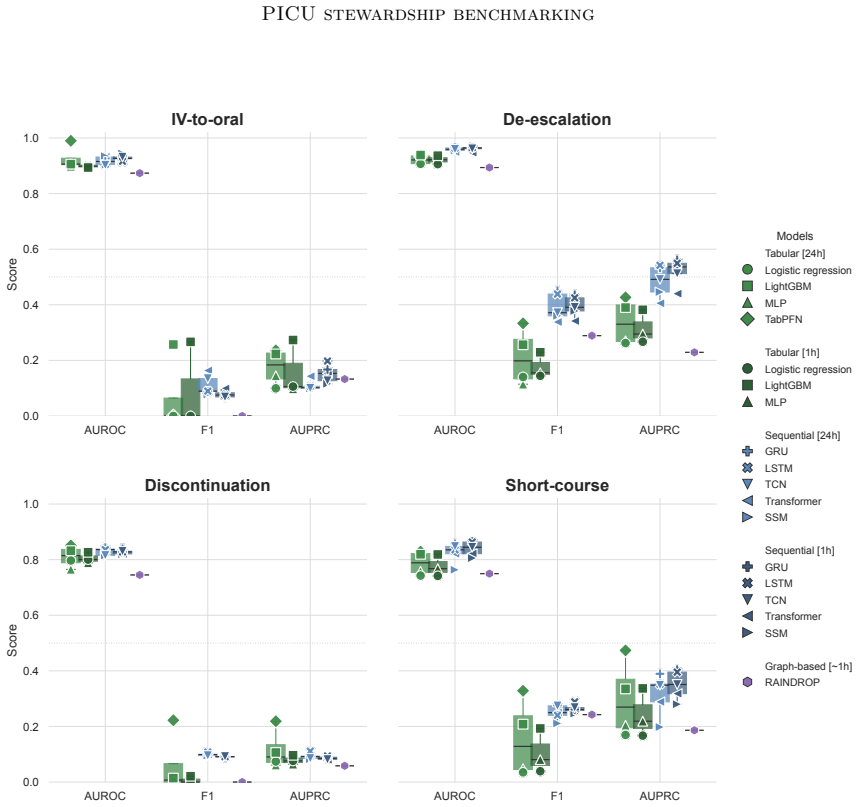
Predictive performance for antimicrobial stewardship in pediatric ICUs depends more on target prevalence and dataset characteristics than on model complexity.
A machine-rendered reading of the paper's core claim, the machinery that carries it, and where it could break.
Core claim
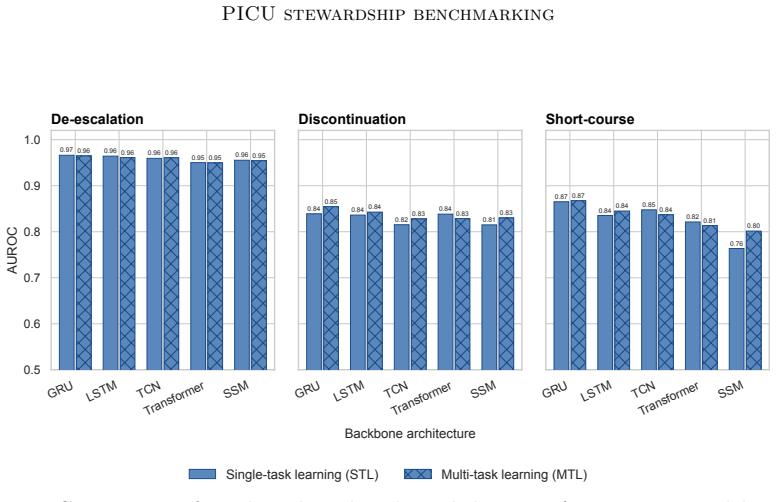
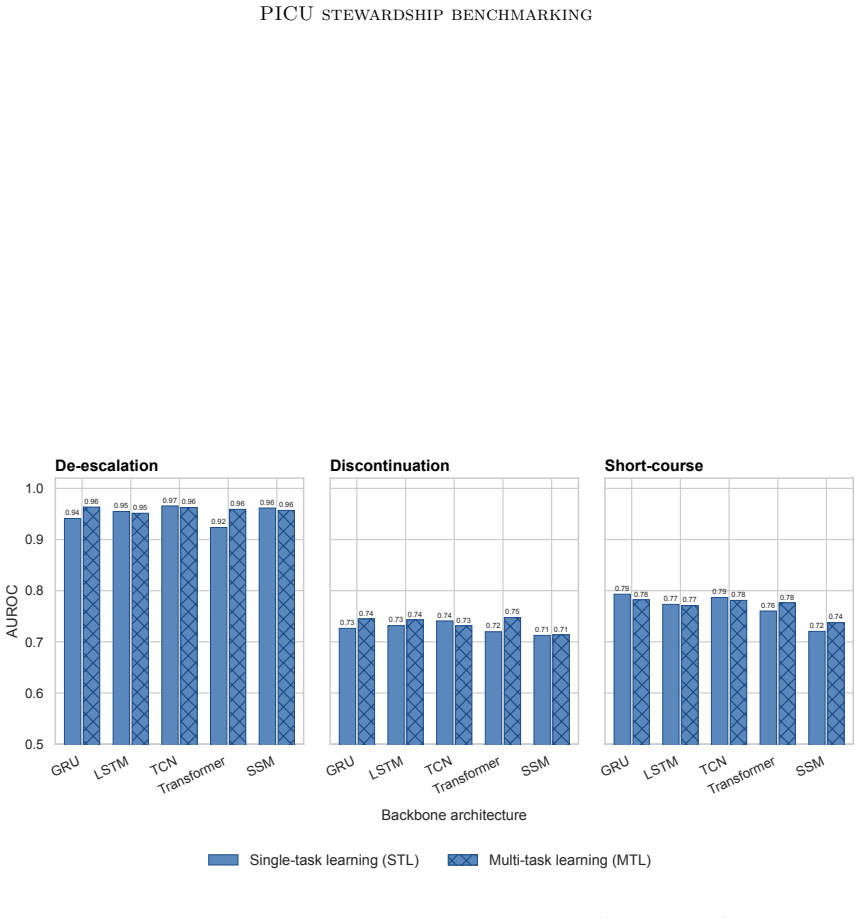
The central discovery is that across public and institutional datasets, model performance for predicting the four proxy antimicrobial stewardship targets is primarily determined by target prevalence and dataset characteristics rather than by the choice of machine learning architecture. Sequence models enhance the precision-recall trade-off over tabular approaches specifically at coarse 24-hour resolution, whereas finer temporal modeling offers minimal additional gains. These performance improvements come with the drawback of reduced calibration, making simpler tabular models more suitable when reliable probability outputs are required. Multi-task learning across the targets provides onlymarg
What carries the argument
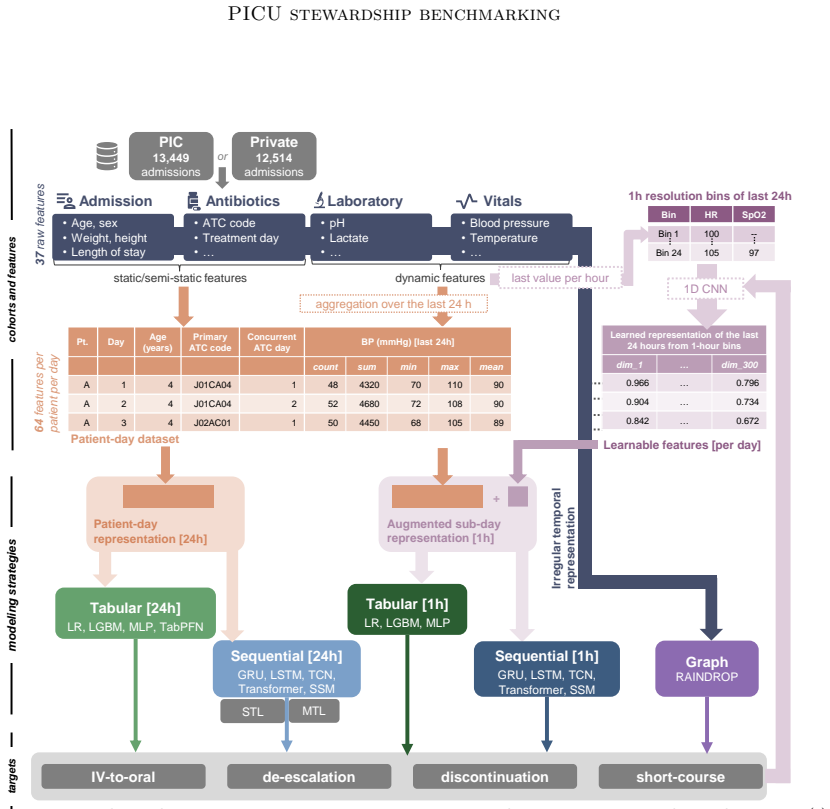
A unified benchmarking framework comparing tabular, sequence-based, and graph-based temporal models on four proxy targets for antibiotic exposure reduction: intravenous-to-oral switching, de-escalation, discontinuation, and short-course therapy.
If this is right
- Tabular models should be considered for applications where well-calibrated probabilities are essential for decision support.
- Efforts in developing AMS tools should prioritize defining clinically meaningful and prevalent targets over adopting complex model architectures.
- Coarse temporal resolutions like 24 hours may suffice for capturing useful patterns without the overhead of finer modeling.
- Multi-task approaches may not yield substantial benefits when stewardship tasks have distinct characteristics.
Where Pith is reading between the lines
- These findings may generalize to other clinical prediction tasks in imbalanced medical datasets where data quality outweighs algorithmic sophistication.
- Validating whether the proxy targets correspond to interventions that truly improve patient outcomes without increasing risks would strengthen the applicability of the results.
- Future work could explore richer graph structures incorporating more relational information from patient care to potentially enhance the graph-based models.
Load-bearing premise
The four proxy targets accurately reflect safe and effective stewardship interventions that can reduce antibiotic exposure in pediatric patients.
What would settle it
Observing substantial performance gains from complex sequence or graph models over tabular ones when target prevalence is matched across different datasets would falsify the primary finding on what drives performance.
Figures





read the original abstract
Antimicrobial stewardship (AMS) is critical in pediatric intensive care units (PICUs), where diagnostic uncertainty often drives broad-spectrum antibiotic use, increasing antimicrobial resistance and potential long-term harms. Machine learning offers a promising approach for identifying patient-level opportunities for stewardship interventions from electronic health record data, yet prior work has focused largely on adult populations and static tabular representations. We present a systematic benchmarking study of AMS intervention prediction in the PICU across a public dataset and a private institutional cohort. We define four clinically relevant proxy targets for reducing antibiotic exposure: intravenous-to-oral switching, de-escalation, discontinuation, and short-course therapy. Under a unified evaluation framework, we compare tabular, sequence-based, and graph-based temporal models at multiple temporal resolutions. We find that predictive performance is driven primarily by target prevalence and dataset characteristics rather than model complexity. Sequence models improve the precision-recall trade-off over tabular approaches at coarse (24-hour) resolution, while finer temporal modeling provides limited additional benefit. However, these gains come at the cost of poorer calibration, with simpler tabular models yielding more reliable probability estimates. Multi-task learning produces only marginal improvements, suggesting limited shared structure across stewardship targets. Our findings highlight the importance of target design, temporal representation, and calibration in clinical machine learning, and provide practical guidance for developing reliable decision support systems for pediatric AMS.
Editorial analysis
A structured set of objections, weighed in public.
Referee Report
Summary. The manuscript presents a benchmarking study comparing tabular, sequence-based, and graph-based machine learning models for predicting four proxy targets (intravenous-to-oral switching, de-escalation, discontinuation, and short-course therapy) as surrogates for antimicrobial stewardship interventions in pediatric ICUs. Evaluations are performed on a public dataset and a private institutional cohort at multiple temporal resolutions under a unified framework. The central claim is that predictive performance is driven primarily by target prevalence and dataset characteristics rather than model complexity, with sequence models improving the precision-recall trade-off over tabular baselines specifically at 24-hour resolution while finer temporal modeling yields limited additional benefit and tabular models provide superior calibration.
Significance. If the findings hold, the work is significant for clinical machine learning applications in antimicrobial stewardship. It supplies practical evidence that simpler models may be preferable due to calibration advantages and that target design and data characteristics merit more attention than architectural complexity. The use of both public and private cohorts and the focus on pediatric populations address gaps in prior adult-centric research.
major comments (1)
- [Methods] Methods section: Detailed information on data exclusion rules, exact label definitions for the four proxy targets, and the statistical tests used to compare performances across models and resolutions is absent. This omission prevents full verification that prevalence effects and dataset characteristics truly dominate over model complexity, as noted in the evaluation framework.
minor comments (1)
- [Abstract] Abstract: The description of the unified evaluation framework would benefit from explicitly naming the primary metrics (e.g., AUPRC, AUROC) and any cross-validation procedure to better support the comparative claims.
Simulated Author's Rebuttal
We thank the referee for their constructive review and recommendation for minor revision. We appreciate the recognition of the work's significance for clinical ML in pediatric antimicrobial stewardship, particularly the practical implications regarding model simplicity, calibration, and the role of target prevalence. We address the major comment below and will update the manuscript accordingly.
read point-by-point responses
-
Referee: [Methods] Methods section: Detailed information on data exclusion rules, exact label definitions for the four proxy targets, and the statistical tests used to compare performances across models and resolutions is absent. This omission prevents full verification that prevalence effects and dataset characteristics truly dominate over model complexity, as noted in the evaluation framework.
Authors: We agree that these details are necessary for full reproducibility and to strengthen verification of our central claims. In the revised manuscript, we will expand the Methods section to explicitly describe: (1) all data exclusion rules applied to the public dataset and the private institutional cohort (including any filtering for missing data, antibiotic exposure criteria, or patient eligibility); (2) precise label definitions and operationalization for each of the four proxy targets, including the exact temporal windows, EHR-derived criteria, and handling of multi-resolution labeling; and (3) the statistical tests used for model comparisons (e.g., paired Wilcoxon signed-rank tests with Bonferroni correction for multiple resolutions and architectures). These additions will directly support the finding that performance is driven primarily by target prevalence and dataset traits rather than architectural complexity. revision: yes
Circularity Check
No significant circularity detected in empirical benchmarking
full rationale
The paper is a standard empirical benchmarking study that defines four proxy targets for antimicrobial stewardship, trains and evaluates tabular, sequence, and graph models on held-out test sets from distinct public and institutional cohorts, and reports performance metrics such as precision-recall and calibration. The central claim that performance depends primarily on target prevalence and dataset characteristics rather than model complexity follows directly from cross-model comparisons at multiple temporal resolutions; these comparisons are statistically independent of the model parameters once the held-out evaluation is performed. No equations, fitted parameters, or self-citations are invoked in a load-bearing way that reduces the reported findings to the inputs by construction. The results remain falsifiable against external data and do not rely on any self-referential derivation chain.
Axiom & Free-Parameter Ledger
free parameters (1)
- temporal resolution
axioms (1)
- domain assumption Proxy targets accurately capture stewardship opportunities without introducing selection bias
Lean theorems connected to this paper
-
IndisputableMonolith/Foundation/RealityFromDistinction.leanreality_from_one_distinction unclear?
unclearRelation between the paper passage and the cited Recognition theorem.
We find that predictive performance is driven primarily by target prevalence and dataset characteristics rather than model complexity. Sequence models improve the precision-recall trade-off over tabular approaches at coarse (24-hour) resolution...
-
IndisputableMonolith/Cost/FunctionalEquation.leanwashburn_uniqueness_aczel unclear?
unclearRelation between the paper passage and the cited Recognition theorem.
We define four clinically relevant proxy targets for reducing antibiotic exposure: intravenous-to-oral switching, de-escalation, discontinuation, and short-course therapy.
What do these tags mean?
- matches
- The paper's claim is directly supported by a theorem in the formal canon.
- supports
- The theorem supports part of the paper's argument, but the paper may add assumptions or extra steps.
- extends
- The paper goes beyond the formal theorem; the theorem is a base layer rather than the whole result.
- uses
- The paper appears to rely on the theorem as machinery.
- contradicts
- The paper's claim conflicts with a theorem or certificate in the canon.
- unclear
- Pith found a possible connection, but the passage is too broad, indirect, or ambiguous to say the theorem truly supports the claim.
Reference graph
Works this paper leans on
-
[1]
International Journal of Medical Informatics , volume =
Development of machine learning algorithms for scaling-up antibiotic stewardship , author =. International Journal of Medical Informatics , volume =. 2024 , publisher =
work page 2024
-
[2]
Clinical Infectious Diseases , volume =
Implementing an antibiotic stewardship program: guidelines by the Infectious Diseases Society of America and the Society for Healthcare Epidemiology of America , author =. Clinical Infectious Diseases , volume =. 2016 , publisher =
work page 2016
-
[3]
Atlanta, GA: US Department of Health and Human Services, CDC , year =
Core elements of hospital antibiotic stewardship programs , author =. Atlanta, GA: US Department of Health and Human Services, CDC , year =
-
[4]
FEMS Microbiology Reviews , volume =
Antibiotics in early life: dysbiosis and the damage done , author =. FEMS Microbiology Reviews , volume =. 2018 , doi =
work page 2018
-
[5]
Variation in antibiotic resistance patterns for children and adults treated at 166 non-affiliated
Sivasankar, Shivani and Goldman, Jennifer L and Hoffman, Mark A , journal =. Variation in antibiotic resistance patterns for children and adults treated at 166 non-affiliated. 2023 , doi =
work page 2023
-
[6]
Advances in Neural Information Processing Systems , volume =
A unified approach to interpreting model predictions , author =. Advances in Neural Information Processing Systems , volume =
-
[7]
An Empirical Evaluation of Generic Convolutional and Recurrent Networks for Sequence Modeling
An empirical evaluation of generic convolutional and recurrent networks for sequence modeling , author =. arXiv preprint arXiv:1803.01271 , year =
work page internal anchor Pith review Pith/arXiv arXiv
-
[8]
Advances in Neural Information Processing Systems , volume =
Attention Is All You Need , author =. Advances in Neural Information Processing Systems , volume =
-
[9]
Learning Phrase Representations using
Cho, Kyunghyun and van Merri. Learning Phrase Representations using. Proceedings of the 2014 Conference on Empirical Methods in Natural Language Processing (. 2014 , doi =
work page 2014
-
[10]
Long Short-Term Memory , author =. Neural Computation , volume =. 1997 , doi =
work page 1997
-
[11]
Advances in Neural Information Processing Systems , volume =
LightGBM: A Highly Efficient Gradient Boosting Decision Tree , author =. Advances in Neural Information Processing Systems , volume =
-
[12]
Proceedings of the IEEE/CVF Conference on Computer Vision and Pattern Recognition , pages =
Multi-Task Learning Using Uncertainty to Weigh Losses for Scene Geometry and Semantics , author =. Proceedings of the IEEE/CVF Conference on Computer Vision and Pattern Recognition , pages =. 2018 , doi =
work page 2018
-
[13]
Modeling Task Relationships in Multi-task Learning with Multi-gate Mixture-of-Experts , author =. Proceedings of the 24th ACM SIGKDD International Conference on Knowledge Discovery & Data Mining , series =. 2018 , month = jul, publisher =. doi:10.1145/3219819.3220007 , isbn =
-
[14]
Advances in Neural Information Processing Systems , volume =
Gradient Surgery for Multi-Task Learning , author =. Advances in Neural Information Processing Systems , volume =
-
[15]
Antibiotic Resistance in Pediatric Infections: Global Emerging Threats, Predicting the Near Future , author =. Antibiotics , volume =. 2021 , doi =
work page 2021
-
[16]
The Role of Artificial Intelligence and Machine Learning Models in Antimicrobial Stewardship in Public Health: A Narrative Review , author =. Antibiotics , volume =. 2025 , doi =
work page 2025
-
[17]
Journal of Antimicrobial Chemotherapy , volume =
Artificial Intelligence for Improving Decision-Making in Bacterial Infection Management: A Narrative Review , author =. Journal of Antimicrobial Chemotherapy , volume =. 2026 , doi =
work page 2026
-
[18]
Nature Communications , volume =
Personalising Intravenous to Oral Antibiotic Switch Decision Making through Fair Interpretable Machine Learning , author =. Nature Communications , volume =. 2024 , doi =
work page 2024
-
[19]
The Lancet Digital Health , volume =
The Impact of Artificial Intelligence-Driven Decision Support on Uncertain Antimicrobial Prescribing: A Randomised, Multimethod Study , author =. The Lancet Digital Health , volume =. 2025 , doi =
work page 2025
-
[20]
Open Forum Infectious Diseases , volume =
Real-World Antimicrobial Stewardship Experience in a Large Academic Medical Center: Using Statistical and Machine Learning Approaches to Identify Intervention ``Hotspots'' in an Antibiotic Audit and Feedback Program , author =. Open Forum Infectious Diseases , volume =. 2022 , doi =
work page 2022
-
[21]
Infection Control & Hospital Epidemiology , volume =
Machine Learning for the Prediction of Antimicrobial Stewardship Intervention in Hospitalized Patients Receiving Broad-Spectrum Agents , author =. Infection Control & Hospital Epidemiology , volume =. 2020 , doi =
work page 2020
-
[22]
Clinical Therapeutics , volume =
Explainable and Interpretable Machine Learning for Antimicrobial Stewardship: Opportunities and Challenges , author =. Clinical Therapeutics , volume =. 2024 , doi =
work page 2024
-
[23]
Global Action Plan on Antimicrobial Resistance , year =
-
[24]
An Antimicrobial Prescription Surveillance System That Learns from Experience , author =. AI Magazine , volume =. 2014 , doi =
work page 2014
-
[25]
Artificial Intelligence in Medicine , volume =
Artificial Intelligence-Driven Approaches in Antibiotic Stewardship Programs and Optimizing Prescription Practices: A Systematic Review , author =. Artificial Intelligence in Medicine , volume =. 2025 , doi =
work page 2025
-
[26]
Clinical Infectious Diseases , volume =
Antibiotic Indications and Appropriateness in the Pediatric Intensive Care Unit: A 10-Center Point Prevalence Study , author =. Clinical Infectious Diseases , volume =. 2022 , doi =
work page 2022
-
[27]
Indian Journal of Critical Care Medicine , volume =
Evaluation of Antibiotic Use in Pediatric Intensive Care Unit of a Developing Country , author =. Indian Journal of Critical Care Medicine , volume =. 2016 , doi =
work page 2016
-
[28]
Renk, Hanna and Sarmisak, Eva and Spott, Corinna and Kumpf, Matthias and Hofbeck, Michael and H. Antibiotic Stewardship in the. Scientific Reports , volume =. 2020 , doi =
work page 2020
-
[29]
Zeng, Xian and Yu, Gang and Lu, Yang and Tan, Linhua and Wu, Xiujing and Shi, Shanshan and Duan, Huilong and Shu, Qiang and Li, Haomin , journal =. 2020 , doi =
work page 2020
-
[30]
Pediatric Critical Care Medicine , volume =
Suboptimal Beta-Lactam Therapy in Critically Ill Children: Risk Factors and Outcome , author =. Pediatric Critical Care Medicine , volume =. 2022 , doi =
work page 2022
-
[31]
The Lancet Infectious Diseases , volume =
Antibiotic duration and timing of the switch from intravenous to oral route for bacterial infections in children: systematic review and guidelines , author =. The Lancet Infectious Diseases , volume =. 2016 , doi =
work page 2016
-
[32]
The Lancet Child & Adolescent Health , volume =
Oral versus intravenous empirical antibiotics in children and adolescents with uncomplicated bone and joint infections: a nationwide, randomised, controlled, non-inferiority trial in Denmark , author =. The Lancet Child & Adolescent Health , volume =. 2024 , doi =
work page 2024
-
[33]
Frontiers in Digital Health , volume =
Machine Learning and Synthetic Outcome Estimation for Individualised Antimicrobial Cessation , author =. Frontiers in Digital Health , volume =. 2022 , doi =
work page 2022
-
[34]
Antimicrobial Stewardship Programmes in Health-Care Facilities in Low- and Middle-Income Countries: A Practical Toolkit , year =
-
[35]
Infection Control & Hospital Epidemiology , volume =
Development and Application of an Antibiotic Spectrum Index for Benchmarking Antibiotic Selection Patterns Across Hospitals , author =. Infection Control & Hospital Epidemiology , volume =. 2017 , doi =
work page 2017
-
[36]
2024 , howpublished =
work page 2024
- [37]
-
[38]
The Relationship Between Precision-Recall and
Davis, Jesse and Goadrich, Mark , booktitle =. The Relationship Between Precision-Recall and
-
[39]
Information Retrieval , author =
-
[40]
Biochimica et Biophysica Acta (BBA)---Protein Structure , volume =
Comparison of the Predicted and Observed Secondary Structure of T4 Phage Lysozyme , author =. Biochimica et Biophysica Acta (BBA)---Protein Structure , volume =. 1975 , doi =
work page 1975
-
[41]
Proceedings of the 14th International Conference on Machine Learning , pages =
Multitask Learning , author =. Proceedings of the 14th International Conference on Machine Learning , pages =. 1997 , publisher =
work page 1997
-
[42]
Willems, Jef and Hermans, Eline and Schelstraete, Petra and Depuydt, Pieter and De Cock, Pieter , year = 2021, journal =. Optimizing the. doi:10.1007/s40272-020-00426-y , urldate =
-
[43]
Liang, Danni and Wallace, Sowdhamini S. and Money, Nathan M. , year = 2024, month = may, journal =. Transitioning to. doi:10.1542/hpeds.2024-007812 , urldate =
-
[44]
Hanley, James A. and McNeil, Barbara J. , journal =. The meaning and use of the area under a receiver operating characteristic (. 1982 , doi =
work page 1982
-
[45]
Davis, Jesse and Goadrich, Mark , booktitle =. The relationship between. 2006 , doi =
work page 2006
-
[46]
Matthews, Brian W. , journal =. Comparison of the predicted and observed secondary structure of. 1975 , doi =
work page 1975
-
[47]
Li, Haomin and Zeng, Xian and Yu, Gang , title =. 2020 , month = nov, note =. doi:10.13026/32x9-wv38 , url =
-
[48]
Goldberger, A. L. and Amaral, L. A. N. and Glass, L. and Hausdorff, J. M. and Ivanov, P. Ch. and Mark, R. G. and Mietus, J. E. and Moody, G. B. and Peng, C.-K. and Stanley, H. E. PhysioBank, PhysioToolkit, and PhysioNet : Components of a New Research Resource for Complex Physiologic Signals. Circulation. 2000 (June 13)
work page 2000
-
[49]
Accurate predictions on small data with a tab- ular foundation model.Nature, 637(8045):319–326, 2025
Accurate predictions on small data with a tabular foundation model , author=. Nature , year=. doi:10.1038/s41586-024-08328-6 , publisher=
-
[50]
Nagendran, Myura and Festor, Paul and Komorowski, Matthieu and Gordon, Anthony C. and Faisal, Aldo A. , year = 2023, month = nov, journal =. Quantifying the Impact of. doi:10.1038/s41746-023-00955-z , urldate =
-
[51]
Pedregosa, F. and Varoquaux, G. and Gramfort, A. and Michel, V. and Thirion, B. and Grisel, O. and Blondel, M. and Prettenhofer, P. and Weiss, R. and Dubourg, V. and Vanderplas, J. and Passos, A. and Cournapeau, D. and Brucher, M. and Perrot, M. and Duchesnay, E. , journal=. Scikit-learn: Machine Learning in
-
[52]
International Conference on Learning Representations, ICLR , year =
Graph-Guided Network For Irregularly Sampled Multivariate Time Series , author =. International Conference on Learning Representations, ICLR , year =
-
[53]
Multitask Learning and Benchmarking with Clinical Time Series Data , author =. Scientific Data , volume =. doi:10.1038/s41597-019-0103-9 , abstract =
-
[54]
Laka, Mah and Milazzo, Adriana and Merlin, Tracy , year = 2021, month = jan, journal =. Factors. doi:10.3390/ijerph18041901 , urldate =
-
[55]
The Use of Machine Learning and Artificial Intelligence within Pediatric Critical Care , author =. Pediatric Research , volume =. doi:10.1038/s41390-022-02380-6 , urldate =
-
[56]
Archives of Disease in Childhood , volume=
Future of machine learning in paediatrics , author=. Archives of Disease in Childhood , volume=. 2022 , publisher=
work page 2022
-
[57]
Factors of acute respiratory infection among under-five children across sub-Saharan African countries using machine learning approaches , author=. Scientific Reports , volume=. 2024 , publisher=
work page 2024
-
[58]
Development and validation of machine learning-driven prediction model for serious bacterial infection among febrile children in emergency departments , author=. PLoS One , volume=. 2022 , publisher=
work page 2022
-
[59]
Machine learning approach to predicting absence of serious bacterial infection at PICU admission , author=. Hospital pediatrics , volume=. 2022 , publisher=
work page 2022
-
[60]
Intensive Care Medicine , volume =
Surviving Sepsis Campaign International Guidelines for the Management of Septic Shock and Sepsis-Associated Organ Dysfunction in Children , author =. Intensive Care Medicine , volume =. doi:10.1007/s00134-019-05878-6 , urldate =
-
[61]
Evans, Idris V. R. and Phillips, Gary S. and Alpern, Elizabeth R. and Angus, Derek C. and Friedrich, Marcus E. and Kissoon, Niranjan and Lemeshow, Stanley and Levy, Mitchell M. and Parker, Margaret M. and Terry, Kathleen M. and Watson, R. Scott and Weiss, Scott L. and Zimmerman, Jerry and Seymour, Christopher W. , year = 2018, month = jul, journal =. Asso...
-
[62]
and Srinivasan, Arjun , year = 2014, month = oct, journal =
Pollack, Loria A. and Srinivasan, Arjun , year = 2014, month = oct, journal =. Core. doi:10.1093/cid/ciu542 , urldate =
-
[63]
Khdour, Maher R. and Hallak, Hussein O. and Aldeyab, Mamoon A. and Nasif, Mowaffaq A. and Khalili, Aliaa M. and Dallashi, Ahamad A. and Khofash, Mohammad B. and Scott, Michael G. , year = 2018, journal =. Impact of Antimicrobial Stewardship Programme on Hospitalized Patients at the Intensive Care Unit: A Prospective Audit and Feedback Study , shorttitle =...
-
[64]
Deresinski, Stan , year = 2007, month = sep, journal =. Principles of. doi:10.1086/519472 , urldate =
-
[65]
Fanelli, Umberto and Chin. Improving the. Frontiers in Pharmacology , volume =. doi:10.3389/fphar.2020.00745 , urldate =
-
[66]
Fanelli, Umberto and Pappalardo, Marco and Chin. Role of. Antibiotics , volume =. doi:10.3390/antibiotics9110767 , urldate =
-
[67]
, year = 2018, month = oct, journal =
Oonsivilai, Mathupanee and Mo, Yin and Luangasanatip, Nantasit and Lubell, Yoel and Miliya, Thyl and Tan, Pisey and Loeuk, Lorn and Turner, Paul and Cooper, Ben S. , year = 2018, month = oct, journal =. Using Machine Learning to Guide Targeted and Locally-Tailored Empiric Antibiotic Prescribing in a Children's Hospital in. doi:10.12688/wellcomeopenres.148...
-
[68]
Early Prediction of Antibiotic Need and Bacteremia Risk in Non-Immunocompromised Pediatric Emergency Patients Using Machine Learning , author =. Pediatric Research , pages =. doi:10.1038/s41390-025-04656-z , urldate =
-
[69]
Zou, Zhuan and Tang, Fajuan and Qiao, Lina and Wang, Sisi and Zhang, Haiyang , year = 2025, month = mar, journal =. Integrating Sequencing Methods with Machine Learning for Antimicrobial Susceptibility Testing in Pediatric Infections: Current Advances and Future Insights , shorttitle =. doi:10.3389/fmicb.2025.1528696 , urldate =
-
[70]
IJCAI-99 workshop on machine learning for information filtering , volume=
Using maximum entropy for text classification , author=. IJCAI-99 workshop on machine learning for information filtering , volume=. 1999 , organization=
work page 1999
-
[71]
Wang, Jiaqi and Luo, Junyu and Ye, Muchao and Wang, Xiaochen and Zhong, Yuan and Chang, Aofei and Huang, Guanjie and Yin, Ziyi and Xiao, Cao and Sun, Jimeng and Ma, Fenglong , year = 2024, month = aug, journal =. Recent. doi:10.24963/ijcai.2024/914 , urldate =
-
[72]
Gu, Albert and Dao, Tri , year = 2024, month = may, number =. Mamba:. doi:10.48550/arXiv.2312.00752 , urldate =. arXiv , keywords =:2312.00752 , primaryclass =
work page internal anchor Pith review Pith/arXiv arXiv doi:10.48550/arxiv.2312.00752 2024
-
[73]
Damien Ernst, Pierre Geurts, and Louis Wehenkel
Caruana, Rich , year = 1997, month = jul, journal =. Multitask. doi:10.1023/A:1007379606734 , urldate =
- [74]
-
[75]
Journal of Paediatrics and Child Health , volume=
Antimicrobial stewardship in children: Where to from here? , author=. Journal of Paediatrics and Child Health , volume=. 2020 , publisher=
work page 2020
-
[76]
Archives de Pediatrie: Organe Officiel de la Societe Francaise de Pediatrie , volume=
Antibiotic treatment of appendicular peritonitis in children: is the oral route done? , author=. Archives de Pediatrie: Organe Officiel de la Societe Francaise de Pediatrie , volume=
-
[77]
Adam: A Method for Stochastic Optimization
Kingma, Diederik P. and Ba, Jimmy , year = 2017, month = jan, number =. Adam:. doi:10.48550/arXiv.1412.6980 , urldate =. arXiv , keywords =:1412.6980 , primaryclass =
work page internal anchor Pith review Pith/arXiv arXiv doi:10.48550/arxiv.1412.6980 2017
-
[78]
, year = 2020, month = dec, journal =
Chiotos, Kathleen and Tamma, Pranita D. , year = 2020, month = dec, journal =. Antibiotics: How Can We Make It as Easy to Stop as It Is to Start? , shorttitle =. doi:10.1016/j.cmi.2020.08.029 , urldate =
-
[79]
Johnson, Alistair E. W. and Bulgarelli, Lucas and Shen, Lu and Gayles, Alvin and Shammout, Ayad and Horng, Steven and Pollard, Tom J. and Hao, Sicheng and Moody, Benjamin and Gow, Brian and Lehman, Li-wei H. and Celi, Leo A. and Mark, Roger G. , year = 2023, month = jan, journal =. doi:10.1038/s41597-022-01899-x , urldate =
-
[80]
Pollard, Tom J. and Johnson, Alistair E. W. and Raffa, Jesse D. and Celi, Leo A. and Mark, Roger G. and Badawi, Omar , year = 2018, month = sep, journal =. The. doi:10.1038/sdata.2018.178 , urldate =
discussion (0)
Sign in with ORCID, Apple, or X to comment. Anyone can read and Pith papers without signing in.