A Local Probe Mass Spectrometer for Localized and Sensitive Product Detection in Environmental Electron Microscopy
Pith reviewed 2026-06-30 16:07 UTC · model grok-4.3
The pith
A micro-capillary probe samples reaction products locally during atomic-resolution ETEM imaging of catalysts.
A machine-rendered reading of the paper's core claim, the machinery that carries it, and where it could break.
Core claim
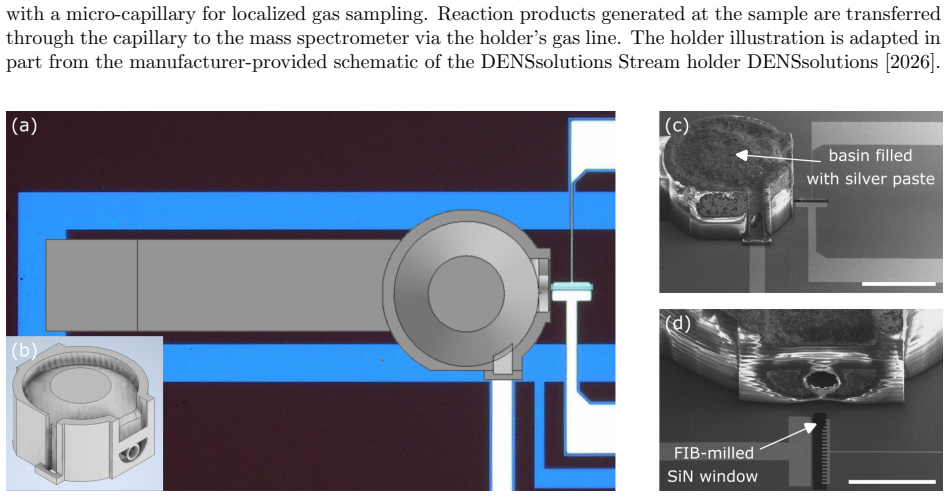
The LPMS setup combines a DENSsolution Stream holder with a mass spectrometer. Both top and bottom SiN membranes of the MEMS chip are removed to preserve spatial resolution while the gas environment is maintained via the ETEM chamber. Reaction products are sampled locally via a micro-capillary positioned near the catalyst and connected to a holder gas line that delivers the gas to the MS. Co3O4 nanoplates are placed at the reaction site with precise orientation using a novel micro-shuttle transfer strategy.
What carries the argument
The micro-capillary positioned near the catalyst, which samples reaction products locally and routes them through the holder gas line to the mass spectrometer.
If this is right
- Simultaneous spatially resolved detection of reaction products and atomic-scale structural dynamics becomes possible.
- Quantitative structure-reactivity correlations can be established for catalytic processes.
- Electron-transparent nanoplates can be studied without FIB lamella preparation and ion-beam damage.
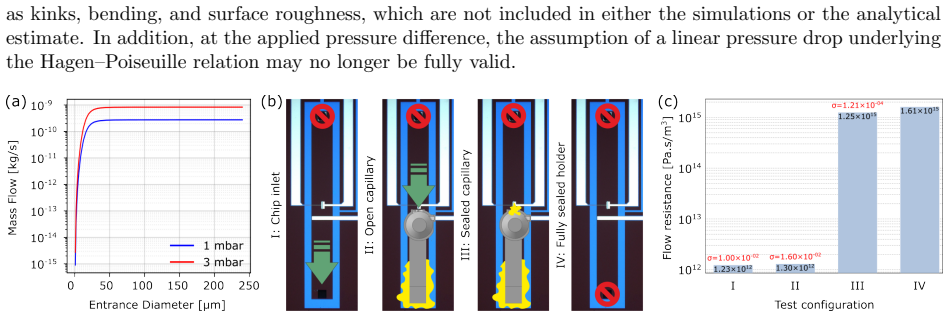
- Controlled gas delivery to the mass spectrometer is confirmed in environmental SEM tests.
Where Pith is reading between the lines
- The approach could extend to other gas-solid catalytic systems where local product mapping is needed.
- Time-resolved measurements might link specific structural events observed in ETEM to changes in product formation rates.
- Site-specific reactivity variations across a single nanoplate surface could become measurable with refined capillary positioning.
Load-bearing premise
The micro-capillary positioned near the catalyst samples products locally without significant dilution, interference with gas flow, or degradation of the atomic-resolution imaging conditions inside the ETEM chamber.
What would settle it
If placing the micro-capillary near an active catalyst under reaction conditions produces no detectable increase in product signal at the mass spectrometer, or if atomic resolution cannot be maintained with the capillary in position, the central claim would be falsified.
Figures



read the original abstract
Aberration-corrected environmental transmission electron microscopy (ETEM) enables atomic-resolution imaging of dynamic catalytic processes. Correlating atomic-scale structural changes with reaction products detected by mass spectrometry offers a powerful route to uncover catalytic mechanisms. However, current approaches face fundamental limitations: closed-cell ETEM setups suffer from diffuse scattering by SiN windows, degrading spatial resolution and sensitivity, while open-cell configurations enable high-resolution imaging and maintain high sensitivity but suffer from significant dilution of reaction products during transport to the mass spectrometer (MS). To overcome these challenges, we develop a Local Probe Mass Spectrometer (LPMS) integrated with aberration-corrected ETEM. The setup combines a DENSsolution Stream holder with a MS. To preserve spatial resolution, both top and bottom SiN membranes of the MEMS chip are removed, while the gas environment is maintained via the ETEM chamber. Reaction products are sampled locally via a micro-capillary positioned near the catalyst and connected to a holder gas line that delivers the gas to the MS. Initial validation in environmental SEM confirmed controlled gas delivery to the MS. Co3O4 nanoplates serve as a model catalyst due to their inherent electron transparency, enabling atomic-resolution imaging without FIB lamella preparation and associated ion-beam damage. A novel micro-shuttle transfer strategy enables controlled placement of a defined number of nanoplates at the reaction site with precise crystallographic orientation. This establishes the foundation for quantitative structure reactivity correlation by enabling simultaneous, spatially resolved detection of reaction products and atomic-scale structural dynamics.
Editorial analysis
A structured set of objections, weighed in public.
Referee Report
Summary. The manuscript describes the design of a Local Probe Mass Spectrometer (LPMS) integrated with aberration-corrected ETEM. It modifies a DENSsolution Stream holder and MEMS chip (removing both SiN membranes), routes reaction products via a micro-capillary positioned near the catalyst to a mass spectrometer, and uses a micro-shuttle transfer to place a controlled number of Co3O4 nanoplates at the reaction site. Initial validation is reported only in environmental SEM for controlled gas delivery; the setup is presented as enabling simultaneous, spatially resolved product detection alongside atomic-resolution imaging for catalytic mechanism studies.
Significance. If the local-sampling performance can be quantitatively demonstrated, the approach would address a recognized limitation of open-cell ETEM-MS (product dilution) while preserving the high spatial resolution available in open-cell configurations. The choice of electron-transparent Co3O4 nanoplates and the micro-shuttle transfer method are practical strengths that avoid FIB damage. The work is instrumentation-focused and could provide a useful platform for structure-reactivity studies if the key performance metrics are supplied.
major comments (1)
- [Abstract] Abstract (final sentence) and the description of the micro-capillary sampling: the central claim that the LPMS 'establishes the foundation for quantitative structure reactivity correlation by enabling simultaneous, spatially resolved detection' is not supported by any measured data on dilution factor, capillary-to-sample distance dependence of the MS signal, spatial selectivity, or before/after atomic-resolution metrics inside the ETEM chamber with the capillary present. These quantities are load-bearing for the asserted capability.
minor comments (1)
- The manuscript would benefit from a dedicated methods or results subsection that reports the SEM validation data (gas delivery rates, MS signal stability, etc.) even if ETEM data are reserved for a follow-up.
Simulated Author's Rebuttal
We thank the referee for the constructive feedback. We agree that the abstract overstates the current experimental support for quantitative performance and will revise the manuscript to align claims with demonstrated results from the environmental SEM validation. Point-by-point response follows.
read point-by-point responses
-
Referee: [Abstract] Abstract (final sentence) and the description of the micro-capillary sampling: the central claim that the LPMS 'establishes the foundation for quantitative structure reactivity correlation by enabling simultaneous, spatially resolved detection' is not supported by any measured data on dilution factor, capillary-to-sample distance dependence of the MS signal, spatial selectivity, or before/after atomic-resolution metrics inside the ETEM chamber with the capillary present. These quantities are load-bearing for the asserted capability.
Authors: We agree that the final sentence of the abstract asserts a capability not yet supported by the quantitative metrics listed. The manuscript reports design of the LPMS and initial validation of controlled gas delivery in an environmental SEM; no dilution factor, distance dependence, spatial selectivity, or ETEM atomic-resolution data with the capillary installed are presented. In revision we will replace the final abstract sentence with a more precise statement limited to the demonstrated local sampling approach and its design intent. The micro-capillary description will be updated to emphasize the SEM results and note that full quantitative characterization in the ETEM remains future work. These textual changes will be implemented. revision: yes
Circularity Check
No circularity: experimental instrumentation paper with no derivations or self-referential predictions
full rationale
The manuscript presents an experimental apparatus development (LPMS integrated with ETEM) without any equations, fitted parameters, predictions, or derivation chains. Claims rest on hardware description, MEMS modification, micro-shuttle transfer, and SEM validation of gas delivery. No load-bearing steps reduce to self-definition, fitted inputs renamed as predictions, or self-citation chains. The central assertion of spatially resolved product detection is presented as an enabled capability from the setup, not derived from prior results by construction. This matches the default expectation of no circularity for non-theoretical work.
Axiom & Free-Parameter Ledger
invented entities (1)
-
Local Probe Mass Spectrometer (LPMS)
no independent evidence
Reference graph
Works this paper leans on
-
[1]
doi: https://doi.org/10.1016/j.ultramic.2026.114328
ISSN 0304-3991. doi: https://doi.org/10.1016/j.ultramic.2026.114328. ED Boyes and PL Gai. Environmental high resolution electron microscopy and applications to chemical science.Ultramicroscopy, 67(1-4):219–232,
-
[2]
doi: https://doi.org/10.1016/S0304-3991(96)00099-X. COMSOL AB. Comsol multiphysics®v. 5.4.www.comsol.com,
-
[3]
JF Creemer, S Helveg, GH Hoveling, S Ullmann, AM Molenbroek, PM Sarro, and HW Zandbergen
doi: 10.1109/JMEMS.2010.2041190. JF Creemer, S Helveg, GH Hoveling, S Ullmann, AM Molenbroek, PM Sarro, and HW Zandbergen. Atomic- scale electron microscopy at ambient pressure.Ultramicroscopy, 108(9):993–998,
-
[4]
org/10.1016/j.ultramic.2008.04.014
doi: https://doi. org/10.1016/j.ultramic.2008.04.014. DENSsolutions,
-
[5]
Accessed: 2026-04-07
URLhttps://denssolutions.com/. Accessed: 2026-04-07. Patrick Gono and Alfredo Pasquarello. Oxygen evolution reaction: Bifunctional mechanism breaking the linear scaling relationship.The Journal of chemical physics, 152(10),
2026
-
[6]
doi: https://doi.org/10.1126/science.1064399. Hans Gunther Heide. Electron microscopic observation of specimens under controlled gas pressure.The Journal of cell biology, 13(1):147–152,
-
[7]
doi: https://doi.org/10.1083/jcb.13.1.147. Stig Helveg, Carlos L´ opez-Cartes, Jens Sehested, Poul L Hansen, Bjerne S Clausen, Jens R Rostrup-Nielsen, Frank Abild-Pedersen, and Jens K Nørskov. Atomic-scale imaging of carbon nanofibre growth.Nature, 427(6973):426–429,
-
[8]
Sooyeon Hwang, Xiaobo Chen, Guangwen Zhou, and Dong Su
doi: https://doi.org/10.1038/nature02278. Sooyeon Hwang, Xiaobo Chen, Guangwen Zhou, and Dong Su. In situ transmission electron microscopy on energy-related catalysis.Advanced Energy Materials, 10(11):1902105,
-
[9]
doi: https://doi.org/10.1016/j.micron.2012.01.006. Lev I Krishtalik. Energetics of multielectron reactions. photosynthetic oxygen evolution.Biochimica et Biophysica Acta (BBA)-Bioenergetics, 849(1):162–171,
-
[10]
doi: https://doi.org/10.1016/0005-2728(86) 90107-6. J. Lindner, U. Ross, V. Roddatis, and Ch. Jooss. Langmuir analysis of electron beam induced plasma in environmental tem.Ultramicroscopy, 243:113629,
-
[12]
doi: https: //doi.org/10.1038/s43246-020-00070-6. Isabela C Man, Hai-Yan Su, Federico Calle-Vallejo, Heine A Hansen, Jos´ e I Mart´ ınez, Nilay G Inoglu, John Kitchin, Thomas F Jaramillo, Jens K Nørskov, and Jan Rossmeisl. Universality in oxygen evolution electrocatalysis on oxide surfaces.ChemCatChem, 3(7):1159–1165,
-
[13]
doi: https://doi.org/10.1364/OL.22. 000132. Stephanie Mildner, Marco Beleggia, Daniel Mierwaldt, Thomas W Hansen, Jakob B Wagner, Sadegh Yazdi, Takeshi Kasama, Jim Ciston, Yimei Zhu, and Christian Jooss. Environmental tem study of electron beam induced electrochemistry of pr0. 64ca0. 36mno3 catalysts for oxygen evolution.The Journal of Physical Chemistry ...
-
[14]
doi: https://doi.org/10.1021/jp511628c. 10 Shunsuke Muto, Shigeo Arai, Tetsuo Higuchi, Koji Orita, Shigemasa Ohta, Hiromochi Tanaka, Takuya Suganuma, Masaya Ibe, and Hirohito Hirata. Environmental high-voltage s/tem combined with a quadrupole mass spectrometer for concurrent in situ structural characterization and detection of prod- uct gas molecules asso...
-
[15]
doi: https: //doi.org/10.1093/jmicro/dfy141. Milivoj Plodinec, Hannah C Nerl, Ramzi Farra, Marc G Willinger, Eugen Stotz, Robert Schl¨ ogl, and Thomas Lunkenbein. Versatile homebuilt gas feed and analysis system for operando tem of catalysts at work. Microscopy and Microanalysis, 26(2):220–228,
-
[16]
doi: https://doi.org/10.1017/S143192762000015X. Stephanie Raabe, Daniel Mierwaldt, Jim Ciston, Matth´ e Uijttewaal, Helge Stein, J¨ org Hoffmann, Yimei Zhu, Peter Bl¨ ochl, and Christian Jooss. In situ electrochemical electron microscopy study of oxygen evolution activity of doped manganite perovskites.Advanced Functional Materials, 22(16):3378–3388,
-
[17]
doi: https://doi.org/10.1002/adfm.201103173. Emanuel Ronge, Jonas Lindner, Ulrich Ross, Jens Melder, Jonas Ohms, Vladimir Roddatis, Philipp Kurz, and Christian Jooss. Atom surface dynamics of manganese oxide under oxygen evolution reaction-like conditions studied by in situ environmental transmission electron microscopy.The Journal of Physical Chemistry C...
-
[18]
Jan Rossmeisl, Z-W Qu, H Zhu, G-J Kroes, and Jens Kehlet Nørskov
doi: https://doi.org/10.1021/acs.jpcc.0c09806. Jan Rossmeisl, Z-W Qu, H Zhu, G-J Kroes, and Jens Kehlet Nørskov. Electrolysis of water on oxide surfaces.Journal of Electroanalytical Chemistry, 607(1-2):83–89,
-
[19]
doi: https://doi.org/10.1016/j. jelechem.2006.11.008. S Saddeler, U Hagemann, and S Schulz. Effect of the size and shape on the electrocatalytic activity of co3o4 nanoparticles in the oxygen evolution reaction.Inorganic chemistry, 59(14):10013–10024,
work page doi:10.1016/j 2006
-
[20]
Mrinmoy Kumar Sarmah, Tej Pratap Singh, Pankaj Kalita, and Anupam Dewan
doi: https://doi.org/10.1021/acs.inorgchem.0c01180. Mrinmoy Kumar Sarmah, Tej Pratap Singh, Pankaj Kalita, and Anupam Dewan. Sustainable hydrogen generation and storage–a review.RSC advances, 13(36):25253–25275,
-
[21]
doi: https://doi.org/10.1021/acsnano. 1c02340. Fang Song, Michael M Busch, Benedikt Lassalle-Kaiser, Chia-Shuo Hsu, Elitsa Petkucheva, Micha¨ el Bensi- mon, Hao Ming Chen, Clemence Corminboeuf, and Xile Hu. An unconventional iron nickel catalyst for the oxygen evolution reaction.ACS central science, 5(3):558–568,
-
[22]
doi: https://doi.org/10.1038/nmat4033. Jong Min Yuk, Jungwon Park, Peter Ercius, Kwanpyo Kim, Daniel J Hellebusch, Michael F Crommie, Jeong Yong Lee, A Zettl, and A Paul Alivisatos. High-resolution em of colloidal nanocrystal growth using graphene liquid cells.Science, 336(6077):61–64,
-
[23]
doi: https://doi.org/10.1126/science.1217654. 11
discussion (0)
Sign in with ORCID, Apple, or X to comment. Anyone can read and Pith papers without signing in.