Towards precision cosmology with Void x CMB correlations (II): Impact of mock catalogs on the Void x CMB lensing signal
Pith reviewed 2026-05-22 03:18 UTC · model grok-4.3
The pith
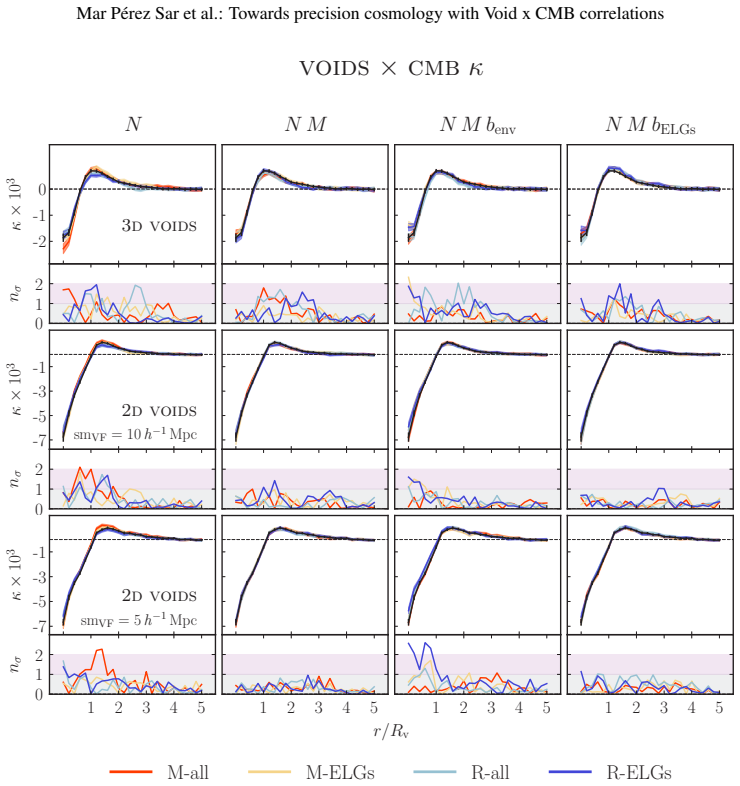
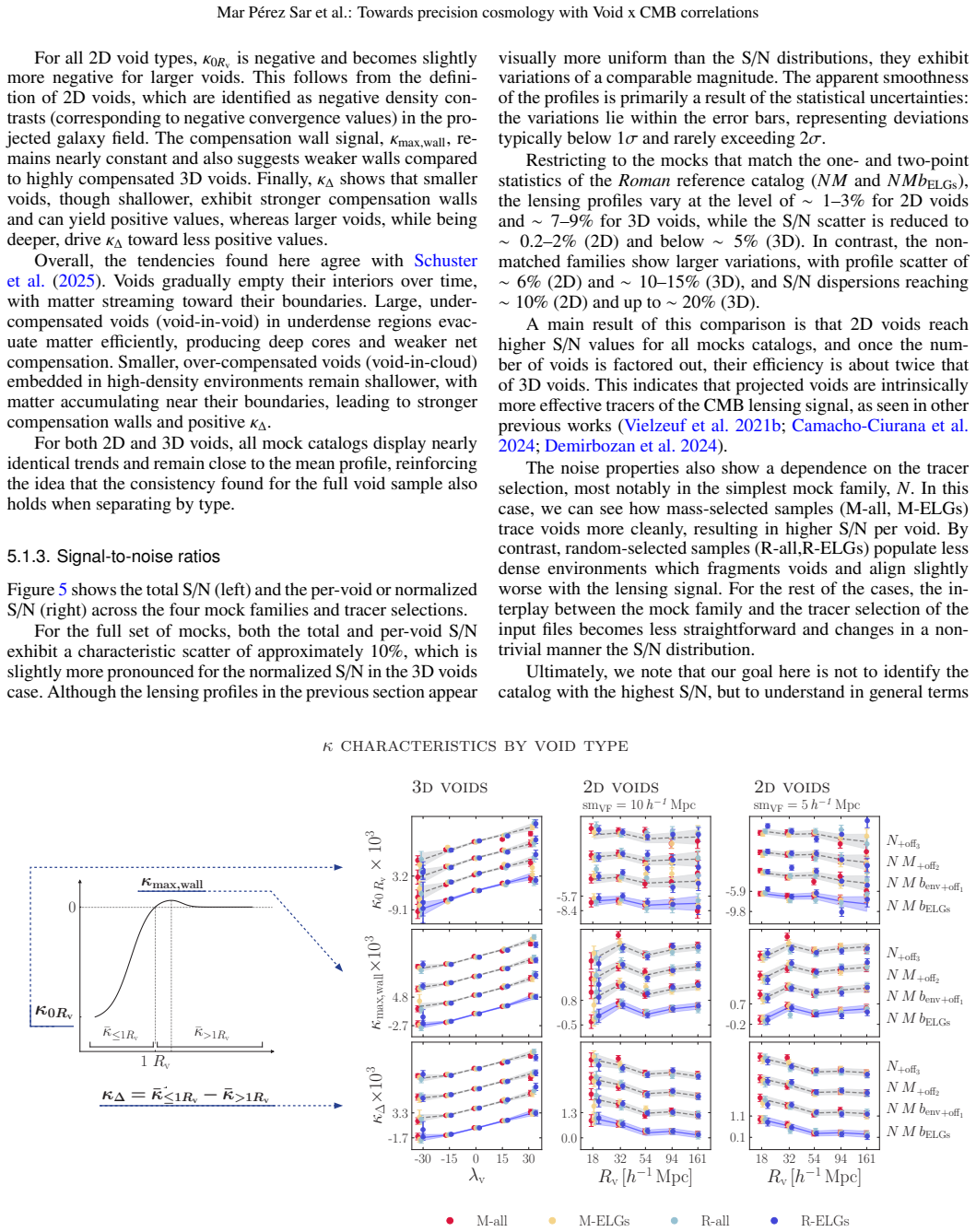
The Void x CMB lensing signal from Roman mock catalogs shows low sensitivity to catalog construction choices and supports high-S/N forecasts with future CMB data.
A machine-rendered reading of the paper's core claim, the machinery that carries it, and where it could break.
Core claim
Using a set of validated Roman mock catalogs, the analysis demonstrates that the Void x CMB lensing cross-correlation is less sensitive to mock construction details than galaxy or void statistics. Two-dimensional voids with rescaled profiles yield the highest signal-to-noise. Projected detections reach approximately 13 sigma for 2D (8 sigma for 3D) voids with Planck, rising to 22 sigma (13 sigma) for the Simons Observatory and 31 sigma (18 sigma) for CMB-S4-like surveys.
What carries the argument
Cross-correlation of 2D and 3D voids identified in Roman mock catalogs with filtered CMB lensing convergence maps, evaluated through rescaled versus non-rescaled stacking.
If this is right
- Future tensions between Void x CMB lensing measurements and theory are unlikely to originate primarily from inaccuracies in mock catalogs.
- Two-dimensional voids with rescaled profiles deliver the highest signal-to-noise ratios among the tested configurations.
- Combining Roman voids with Planck data yields projected detections around 13 sigma for 2D voids.
- The signal-to-noise improves substantially to 22 sigma with Simons Observatory and 31 sigma with CMB-S4-like experiments.
Where Pith is reading between the lines
- The reported robustness could allow void lensing to serve as a cleaner complement to other large-scale structure probes when testing cosmological models.
- Applying the same analysis pipeline directly to upcoming Roman observations would provide an immediate check on whether the mock-based forecasts hold in real data.
- Similar cross-correlation forecasts could be performed for other upcoming photometric or spectroscopic surveys to broaden the range of void lensing constraints.
Load-bearing premise
The validated Roman mock catalogs faithfully reproduce the statistical properties, selection effects, and void-finding behavior expected in actual Roman observations and corresponding lensing maps.
What would settle it
A measurement of the Void x CMB lensing signal in real Roman survey data that deviates significantly from the forecasted signal-to-noise values would test the robustness conclusions.
Figures




read the original abstract
Gravitational lensing by large-scale structure imprints secondary anisotropies on the Cosmic Microwave Background (CMB) that can be exploited to probe cosmology. In particular, cosmic voids produce a characteristic lensing signature detectable through Void x CMB cross-correlations. This signal has been robustly measured in the past but its cosmological constraining power remains limited by the incomplete knowledge of how methodological choices affect its measurement and by its uncertain dependence on cosmological parameters. Using a set of validated Roman mock catalogs, we first quantify how mock construction impacts the measured signal and then forecast the capabilities of Roman, in combination with current and upcoming CMB surveys such as Planck, SO and CMB-S4-like experiments. We analyze the signal-to-noise ratio (S/N) for different void definitions (2D and 3D), stacking approaches (rescaled versus non-rescaled profiles), CMB map filtering schemes and noise levels. In contrast to galaxy and void statistics, we find that the Void x CMB lensing signal is less sensitive to the choice of mock catalog, indicating that future tensions with data are unlikely to stem from mock inaccuracies alone. The highest S/N is achieved for 2D voids with rescaled profiles. We forecast S/N ~13$\sigma$ (8$\sigma$) for 2D (3D) Roman voids combined with Planck, increasing to 22$\sigma$ (13$\sigma$) for SO and 31$\sigma$ (18$\sigma$) for CMB-S4-like surveys. While the cosmological dependence of this observable remains to be quantified, Roman together with next-generation of LSS and CMB surveys opens a path toward the first direct cosmological constraints from Void x CMB lensing.
Editorial analysis
A structured set of objections, weighed in public.
Referee Report
Summary. The manuscript uses validated Roman mock catalogs to quantify the sensitivity of the Void x CMB lensing signal to mock construction choices, in contrast to galaxy and void statistics. It reports that the signal is relatively robust to these choices, identifies the highest S/N for 2D voids with rescaled profiles, and provides forecasts of S/N ~13σ (8σ) for 2D (3D) Roman voids with Planck, rising to 22σ (13σ) for SO and 31σ (18σ) for CMB-S4-like experiments, while noting that cosmological parameter dependence remains to be quantified.
Significance. If the results hold, the work demonstrates that mock inaccuracies are unlikely to drive future tensions in Void x CMB lensing measurements, thereby strengthening the case for this observable as a robust probe. The high forecasted S/N values indicate strong detection potential with Roman combined with next-generation CMB surveys, supporting a path toward direct cosmological constraints. Credit is due for the use of validated mocks and standard stacking/filtering techniques, which lend credibility to the robustness and forecast claims.
major comments (1)
- [§5] §5 (Forecasts): The S/N forecasts (e.g., 31σ for 2D voids with CMB-S4) rest on the assumption that the validated Roman mocks fully capture real-data selection effects and void identification biases in both the galaxy catalogs and lensing convergence maps; without an explicit sensitivity test to plausible residual mismatches, the quoted significance levels could be overstated.
minor comments (3)
- [Abstract] Abstract: The statement that the signal 'is less sensitive to the choice of mock catalog' would be strengthened by a quantitative metric (e.g., fractional variation in amplitude or S/N across mocks) and a brief pointer to the corresponding figure or table.
- [§3] §3 (Methodology): The distinction between rescaled and non-rescaled stacking profiles is central to the highest-S/N claim but is not defined in the abstract; a one-sentence recap or reference to the prior paper in the series would improve accessibility.
- [Figures] Figure captions: Ensure all panels comparing 2D vs. 3D voids and different mock realizations are labeled with the exact void finder parameters and filtering scheme used.
Simulated Author's Rebuttal
We thank the referee for their constructive review and recommendation for minor revision. We address the major comment below.
read point-by-point responses
-
Referee: [§5] §5 (Forecasts): The S/N forecasts (e.g., 31σ for 2D voids with CMB-S4) rest on the assumption that the validated Roman mocks fully capture real-data selection effects and void identification biases in both the galaxy catalogs and lensing convergence maps; without an explicit sensitivity test to plausible residual mismatches, the quoted significance levels could be overstated.
Authors: We thank the referee for this comment. The manuscript demonstrates that the Void x CMB lensing signal is robust to variations in mock catalog construction choices, including different galaxy selection and void identification methods, in contrast to galaxy and void statistics. This robustness is quantified directly from the validated mocks. Nevertheless, we agree that the S/N forecasts rely on the assumption that these mocks adequately capture the relevant selection effects and biases in real data. As Roman is a future survey, exhaustive tests against actual observations are not possible at present. We will revise §5 to explicitly state this assumption, note the robustness findings, and indicate that future real-data comparisons will be required to validate the forecasts. This addition will present the quoted significances with appropriate context. revision: partial
Circularity Check
No significant circularity; derivation relies on external mocks and direct S/N calculations
full rationale
The paper quantifies the Void x CMB lensing signal using validated Roman mock catalogs and computes S/N forecasts for different void definitions, stacking methods, and CMB surveys (Planck, SO, CMB-S4-like) by direct comparison of measured signals against noise levels. No load-bearing step reduces by construction to a fitted parameter renamed as prediction, a self-definition, or a self-citation chain that imports the target result. The robustness claim (lower sensitivity to mock choice than galaxy/void statistics) follows from explicit cross-comparisons across mock variants, and the quoted S/N values (~13σ for 2D Roman+Planck, scaling to 31σ for CMB-S4) are computed outputs rather than inputs. The analysis is self-contained against the provided mocks and standard lensing techniques.
Axiom & Free-Parameter Ledger
axioms (1)
- domain assumption Standard assumptions in cosmological simulations for void identification and CMB lensing convergence hold for the Roman survey specifications.
Lean theorems connected to this paper
-
IndisputableMonolith/Foundation/RealityFromDistinction.leanreality_from_one_distinction unclear?
unclearRelation between the paper passage and the cited Recognition theorem.
Using a set of validated Roman mock catalogs, we first quantify how mock construction impacts the measured signal and then forecast the capabilities of Roman, in combination with current and upcoming CMB surveys such as Planck, SO and CMB-S4-like experiments.
What do these tags mean?
- matches
- The paper's claim is directly supported by a theorem in the formal canon.
- supports
- The theorem supports part of the paper's argument, but the paper may add assumptions or extra steps.
- extends
- The paper goes beyond the formal theorem; the theorem is a base layer rather than the whole result.
- uses
- The paper appears to rely on the theorem as machinery.
- contradicts
- The paper's claim conflicts with a theorem or certificate in the canon.
- unclear
- Pith found a possible connection, but the passage is too broad, indirect, or ambiguous to say the theorem truly supports the claim.
Reference graph
Works this paper leans on
-
[1]
Abazajian, K. N., Adelman-McCarthy, J. K., Agüeros, M. A., et al. 2009, ApJS, 182, 543, doi:10.1088/0067-0049/182/2/543
work page internal anchor Pith review doi:10.1088/0067-0049/182/2/543 2009
-
[2]
CMB-S4 Science Book, First Edition
Abazajian, K. N., Adshead, P., Ahmed, Z., et al. 2016, arXiv e-prints, arXiv:1610.02743, doi:10.48550/arXiv.1610.02743
work page internal anchor Pith review Pith/arXiv arXiv doi:10.48550/arxiv.1610.02743 2016
-
[3]
Abbott, T. M. C., Aguena, M., Alarcon, A., et al. 2022, Phys. Rev. D, 105, 023520, doi:10.1103/PhysRevD.105.023520 Abdul Karim, M., Aguilar, J., Ahlen, S., et al. 2025, Phys. Rev. D, 112, 083515, doi:10.1103/tr6y-kpc6
-
[4]
Ade, P., Aguirre, J., Ahmed, Z., et al. 2019, J. Cosmology Astropart. Phys., 2019, 056, doi:10.1088/1475-7516/2019/02/056
-
[5]
Aiola, S., Kosowsky, A., & Wang, B. 2015, Phys. Rev. D, 91, 043510, doi:10. 1103/PhysRevD.91.043510
work page 2015
-
[6]
1979, Nature, 281, 358, doi:10.1038/281358a0
Alcock, C., & Paczynski, B. 1979, Nature, 281, 358, doi:10.1038/281358a0
-
[7]
Alpher, R. A., Bethe, H., & Gamow, G. 1948, Physical Review, 73, 803, doi:10. 1103/PhysRev.73.803
work page 1948
-
[8]
Alpher, R. A., & Herman, R. 1948, Nature, 162, 774, doi:10.1038/162774b0
-
[9]
Arcari, S., Pinetti, E., & Fornengo, N. 2022, J. Cosmology Astropart. Phys., 2022, 011, doi:10.1088/1475-7516/2022/11/011
-
[10]
2022, MNRAS, 513, 186, doi:10.1093/mnras/stac828 Balaguera-Antolínez, A., Montero-Dorta, A
Aubert, M., Cousinou, M.-C., Escoffier, S., et al. 2022, MNRAS, 513, 186, doi:10.1093/mnras/stac828
-
[11]
2018, MNRAS, 473, 3226, doi:10.1093/ mnras/stx2594
Baldi, M., & Villaescusa-Navarro, F. 2018, MNRAS, 473, 3226, doi:10.1093/ mnras/stx2594
work page 2018
-
[12]
Barreira, A., Cautun, M., Li, B., Baugh, C. M., & Pascoli, S. 2015, J. Cosmology Astropart. Phys., 2015, 028, doi:10.1088/1475-7516/2015/08/028
-
[13]
Basu, K., Hernández-Monteagudo, C., & Sunyaev, R. A. 2004, A&A, 416, 447, doi:10.1051/0004-6361:20034298
-
[14]
Bayer, A. E., Zhong, Y ., Li, Z., et al. 2025, J. Cosmology Astropart. Phys., 2025, 016, doi:10.1088/1475-7516/2025/05/016
-
[15]
E., Villaescusa-Navarro, F., Massara, E., et al
Bayer, A. E., Villaescusa-Navarro, F., Massara, E., et al. 2021, ApJ, 919, 24, doi:10.3847/1538-4357/ac0e91
-
[16]
Bennett, C. L., Boggess, N. W., Cheng, E. S., et al. 1993, Advances in Space Research, 13, 409, doi:10.1016/0273-1177(93)90150-A
-
[17]
Bennett, C. L., Hill, R. S., Hinshaw, G., et al. 2003, ApJS, 148, 97, doi:10. 1086/377252
work page 2003
-
[18]
2003, MNRAS, 344, 1000, doi: 10.1046/j.1365-8711.2003.06897.x
Benson, A. J., Hoyle, F., Torres, F., & V ogeley, M. S. 2003, MNRAS, 340, 160, doi:10.1046/j.1365-8711.2003.06281.x
-
[19]
Besuner, R., Dey, A., Drlica-Wagner, A., et al. 2025, arXiv e-prints, arXiv:2503.07923, doi:10.48550/arXiv.2503.07923
-
[20]
Biswas, R., Alizadeh, E., & Wandelt, B. D. 2010, Phys. Rev. D, 82, 023002, doi:10.1103/PhysRevD.82.023002
-
[21]
Bos, E. G. P., van de Weygaert, R., Dolag, K., & Pettorino, V . 2012, MNRAS, 426, 440, doi:10.1111/j.1365-2966.2012.21478.x
-
[22]
2017a, MNRAS, 466, 3364, doi:10
Cai, Y .-C., Neyrinck, M., Mao, Q., et al. 2017a, MNRAS, 466, 3364, doi:10. 1093/mnras/stw3299 —. 2017b, MNRAS, 466, 3364, doi:10.1093/mnras/stw3299
-
[23]
2015, MNRAS, 451, 1036, doi:10.1093/ mnras/stv777
Cai, Y .-C., Padilla, N., & Li, B. 2015, MNRAS, 451, 1036, doi:10.1093/ mnras/stv777
work page 2015
-
[24]
2024, A&A, 689, A171, doi:10.1051/0004-6361/202348970
Camacho-Ciurana, G., Lee, P., Arsenov, N., et al. 2024, A&A, 689, A171, doi:10.1051/0004-6361/202348970
-
[25]
Carbone, C., Petkova, M., & Dolag, K. 2016, J. Cosmology Astropart. Phys., 2016, 034, doi:10.1088/1475-7516/2016/07/034
-
[26]
Castorina, E., Carbone, C., Bel, J., Sefusatti, E., & Dolag, K. 2015, J. Cosmology Astropart. Phys., 2015, 043, doi:10.1088/1475-7516/2015/07/043
-
[27]
2018, MNRAS, 476, 3195, doi:10
Cautun, M., Paillas, E., Cai, Y .-C., et al. 2018, MNRAS, 476, 3195, doi:10. 1093/mnras/sty463
work page 2018
-
[28]
Chantavat, T., Sawangwit, U., Sutter, P. M., & Wandelt, B. D. 2016, Phys. Rev. D, 93, 043523, doi:10.1103/PhysRevD.93.043523
-
[29]
Chantavat, T., Sawangwit, U., & Wandelt, B. D. 2017, ApJ, 836, 156, doi:10. 3847/1538-4357/836/2/156
work page 2017
-
[30]
2013, MNRAS, 428, 1498, doi:10
Comparat, J., Kneib, J.-P., Escoffier, S., et al. 2013, MNRAS, 428, 1498, doi:10. 1093/mnras/sts127
work page 2013
-
[31]
2023, ApJ, 953, 46, doi:10.3847/ 1538-4357/acde54
Contarini, S., Pisani, A., Hamaus, N., et al. 2023, ApJ, 953, 46, doi:10.3847/ 1538-4357/acde54
work page 2023
-
[32]
2019, MNRAS, 488, 3526, doi:10
Contarini, S., Ronconi, T., Marulli, F., et al. 2019, MNRAS, 488, 3526, doi:10. 1093/mnras/stz1989
work page 2019
-
[33]
Correa, C. M., Paz, D. J., Padilla, N. D., et al. 2022, MNRAS, 509, 1871, doi:10. 1093/mnras/stab3070 Dark Energy Survey Collaboration, Abbott, T., Abdalla, F. B., et al. 2016, MN- RAS, 460, 1270, doi:10.1093/mnras/stw641
-
[34]
Das, S., Sherwin, B. D., Aguirre, P., et al. 2011, Phys. Rev. Lett., 107, 021301, doi:10.1103/PhysRevLett.107.021301
-
[35]
Dawson, K. S., Schlegel, D. J., Ahn, C. P., et al. 2013, AJ, 145, 10, doi:10. 1088/0004-6256/145/1/10
work page 2013
-
[36]
2025, arXiv e-prints, arXiv:2509.08884, doi:10.48550/arXiv.2509.08884
Degni, G., Sarpa, E., Aubert, M., et al. 2025, arXiv e-prints, arXiv:2509.08884, doi:10.48550/arXiv.2509.08884
-
[37]
The DESI Experiment Part I: Science,Targeting, and Survey Design
Demirbozan, U., Nadathur, S., Ferrero, I., et al. 2024, MNRAS, 534, 2328, doi:10.1093/mnras/stae2206 DESI Collaboration, Aghamousa, A., Aguilar, J., et al. 2016, arXiv e-prints, arXiv:1611.00036, doi:10.48550/arXiv.1611.00036
work page internal anchor Pith review Pith/arXiv arXiv doi:10.1093/mnras/stae2206 2024
-
[38]
2003, in American Institute of Physics Conference Series, V ol
Dodelson, S. 2003, in American Institute of Physics Conference Series, V ol. 689,
work page 2003
-
[39]
Neutrinos, Flavor Physics, and Precision Cosmology, ed. J. F. Nieves & R. R. V olkas, 184–196, doi:10.1063/1.1627736
-
[40]
Cosmology with the SPHEREX All-Sky Spectral Survey
Dong, F., Yu, Y ., Zhang, J., Yang, X., & Zhang, P. 2021, MNRAS, 500, 3838, doi:10.1093/mnras/staa3194 Doré, O., Bock, J., Ashby, M., et al. 2014, arXiv e-prints, arXiv:1412.4872, doi:10.48550/arXiv.1412.4872
work page internal anchor Pith review Pith/arXiv arXiv doi:10.1093/mnras/staa3194 2021
-
[41]
Drinkwater, M. J., Jurek, R. J., Blake, C., et al. 2010, MNRAS, 401, 1429, doi:10.1111/j.1365-2966.2009.15754.x
-
[42]
2021, MNRAS, 507, 1514, doi:10.1093/ mnras/stab533
Eifler, T., Simet, M., Krause, E., et al. 2021, MNRAS, 507, 1514, doi:10.1093/ mnras/stab533
work page 2021
-
[43]
2024, arXiv e-prints, arXiv:2411.04088, doi:10.48550/arXiv.2411.04088
Eifler, T., Fang, X., Krause, E., et al. 2024, arXiv e-prints, arXiv:2411.04088, doi:10.48550/arXiv.2411.04088
-
[44]
2016, MNRAS, 461, 3421, doi:10
Favole, G., Comparat, J., Prada, F., et al. 2016, MNRAS, 461, 3421, doi:10. 1093/mnras/stw1483 Fernández-García, E., Betancort-Rijo, J. E., Prada, F., et al. 2025, A&A, 695, A19, doi:10.1051/0004-6361/202451264
-
[45]
2005, International Journal of Modern Physics A, 20, 3121, doi:10
Flaugher, B. 2005, International Journal of Modern Physics A, 20, 3121, doi:10. 1142/S0217751X05025917
work page 2005
-
[46]
Flender, S., Hotchkiss, S., & Nadathur, S. 2013, J. Cosmology Astropart. Phys., 2013, 013, doi:10.1088/1475-7516/2013/02/013
-
[47]
Furlanetto, S. R., & Piran, T. 2006, MNRAS, 366, 467, doi:10.1111/j. 1365-2966.2005.09862.x
work page doi:10.1111/j 2006
-
[48]
1946, Physical Review, 70, 572, doi:10.1103/PhysRev.70.572.2 —
Gamow, G. 1946, Physical Review, 70, 572, doi:10.1103/PhysRev.70.572.2 —. 1948, Physical Review, 74, 505, doi:10.1103/PhysRev.74.505.2
-
[49]
Gonzalez-Perez, V ., Cui, W., Contreras, S., et al. 2020, MNRAS, 498, 1852, doi:10.1093/mnras/staa2504 Górski, K. M., Hivon, E., Banday, A. J., et al. 2005, ApJ, 622, 759, doi:10. 1086/427976
-
[50]
Granett, B. R., Kovács, A., & Hawken, A. J. 2015, MNRAS, 454, 2804, doi:10. 1093/mnras/stv2110
work page 2015
-
[51]
Granett, B. R., Neyrinck, M. C., & Szapudi, I. 2008, ApJ, 683, L99, doi:10. 1086/591670
work page 2008
-
[52]
Gregory, S. A., & Thompson, L. A. 1978, ApJ, 222, 784, doi:10.1086/156198
-
[53]
Guzzo, L., Scodeggio, M., Garilli, B., et al. 2014, A&A, 566, A108, doi:10. 1051/0004-6361/201321489
work page 2014
-
[54]
Habouzit, M., Pisani, A., Goulding, A., et al. 2020, MNRAS, 493, 899, doi:10. 1093/mnras/staa219 Article number, page 14 of 23 Mar Pérez Sar et al.: Towards precision cosmology with V oid x CMB correlations
work page 2020
-
[55]
Hadzhiyska, B., Bose, S., Eisenstein, D., Hernquist, L., & Spergel, D. N. 2020, MNRAS, 493, 5506, doi:10.1093/mnras/staa623
-
[56]
Hamaus, N., Sutter, P. M., Lavaux, G., & Wandelt, B. D. 2015, J. Cosmology Astropart. Phys., 2015, 036, doi:10.1088/1475-7516/2015/11/036
-
[57]
2022, A&A, 658, A20, doi:10.1051/ 0004-6361/202142073
Hamaus, N., Aubert, M., Pisani, A., et al. 2022, A&A, 658, A20, doi:10.1051/ 0004-6361/202142073
work page 2022
-
[58]
Hang, Q., Alam, S., Cai, Y .-C., & Peacock, J. A. 2021a, MNRAS, 507, 510, doi:10.1093/mnras/stab2184 —. 2021b, MNRAS, 507, 510, doi:10.1093/mnras/stab2184
-
[59]
K., Garcia Lambas, D., Ruiz, A
Hansen, F. K., Garcia Lambas, D., Ruiz, A. N., Toscano, F., & Pereyra, L. A. 2025, arXiv e-prints, arXiv:2506.08832, doi:10.48550/arXiv.2506. 08832
-
[60]
Hartlap, J., Simon, P., & Schneider, P. 2007, A&A, 464, 399, doi:10.1051/ 0004-6361:20066170 Hernández-Monteagudo, C., Rubiño-Martín, J. A., & Sunyaev, R. A. 2007, MN- RAS, 380, 1656, doi:10.1111/j.1365-2966.2007.12218.x Hernández-Monteagudo, C., & Smith, R. E. 2013, MNRAS, 435, 1094, doi:10. 1093/mnras/stt1322 Hernández-Monteagudo, C., Verde, L., & Jimen...
-
[61]
2015, MNRAS, 446, 1321, doi:10.1093/mnras/stu2072 Ili´c, S., Langer, M., & Douspis, M
Hotchkiss, S., Nadathur, S., Gottlöber, S., et al. 2015, MNRAS, 446, 1321, doi:10.1093/mnras/stu2072 Ili´c, S., Langer, M., & Douspis, M. 2013, A&A, 556, A51, doi:10.1051/ 0004-6361/201321150 Ivezi´c, Ž., Kahn, S. M., Tyson, J. A., et al. 2019, ApJ, 873, 111, doi:10.3847/ 1538-4357/ab042c Jõeveer, M., Einasto, J., & Tago, E. 1978, MNRAS, 185, 357, doi:10....
-
[62]
2025, MNRAS, 536, 1303, doi:10
Jeffrey, N., Whiteway, L., Gatti, M., et al. 2025, MNRAS, 536, 1303, doi:10. 1093/mnras/stae2629
work page 2025
-
[63]
Jennings, E., Li, Y ., & Hu, W. 2013, MNRAS, 434, 2167, doi:10.1093/mnras/ stt1169
-
[64]
1987, MNRAS, 227, 1, doi:10.1093/mnras/227.1.1
Kaiser, N. 1987, MNRAS, 227, 1, doi:10.1093/mnras/227.1.1
-
[65]
Kaiser, N., Tonry, J. L., & Luppino, G. A. 2000, PASP, 112, 768, doi:10.1086/ 316578 Kovács, A. 2018, MNRAS, 475, 1777, doi:10.1093/mnras/stx3213 Kovács, A., Beck, R., Szapudi, I., et al. 2020, MNRAS, 499, 320, doi:10.1093/ mnras/staa2631 Kovács, A., Sánchez, C., García-Bellido, J., et al. 2019, MNRAS, 484, 5267, doi:10.1093/mnras/stz341 Kovács, A., Vielz...
-
[66]
Krause, E., Chang, T.-C., Doré, O., & Umetsu, K. 2013, ApJ, 762, L20, doi:10. 1088/2041-8205/762/2/L20
work page 2013
- [67]
-
[68]
D., Pisani, A., Carbone, C., et al
Kreisch, C. D., Pisani, A., Carbone, C., et al. 2019, MNRAS, 488, 4413, doi:10. 1093/mnras/stz1944
work page 2019
-
[69]
Euclid Definition Study Report
Laureijs, R., Amiaux, J., Arduini, S., et al. 2011, arXiv e-prints, arXiv:1110.3193, doi:10.48550/arXiv.1110.3193
work page internal anchor Pith review Pith/arXiv arXiv doi:10.48550/arxiv.1110.3193 2011
-
[70]
Lavaux, G., & Wandelt, B. D. 2012, ApJ, 754, 109, doi:10.1088/0004-637X/ 754/2/109
-
[71]
Lewis, A. 2013, J. Cosmology Astropart. Phys., 2013, 053, doi:10.1088/ 1475-7516/2013/08/053
work page 2013
-
[72]
Lewis, A., & Challinor, A. 2006, Phys. Rep., 429, 1, doi:10.1016/j.physrep. 2006.03.002
-
[73]
Mainieri, V ., Anderson, R. I., Brinchmann, J., et al. 2024, arXiv e-prints, arXiv:2403.05398, doi:10.48550/arXiv.2403.05398
-
[74]
Massara, E., Villaescusa-Navarro, F., Viel, M., & Sutter, P. M. 2015, J. Cosmol- ogy Astropart. Phys., 2015, 018, doi:10.1088/1475-7516/2015/11/018
-
[75]
Nadathur, S., Carter, P. M., Percival, W. J., Winther, H. A., & Bautista, J. E. 2019, Phys. Rev. D, 100, 023504, doi:10.1103/PhysRevD.100.023504
-
[76]
2016, ApJ, 830, L19, doi:10.3847/2041-8205/ 830/1/L19
Nadathur, S., & Crittenden, R. 2016, ApJ, 830, L19, doi:10.3847/2041-8205/ 830/1/L19
-
[77]
2017, MNRAS, 467, 4067, doi:10
Nadathur, S., Hotchkiss, S., & Crittenden, R. 2017, MNRAS, 467, 4067, doi:10. 1093/mnras/stx336
work page 2017
-
[78]
Nadathur, S., Hotchkiss, S., & Sarkar, S. 2012, J. Cosmology Astropart. Phys., 2012, 042, doi:10.1088/1475-7516/2012/06/042
-
[79]
Neyrinck, M. C. 2008, MNRAS, 386, 2101, doi:10.1111/j.1365-2966. 2008.13180.x Observations Time Allocation Committee, R., & Community Survey Defini- tion Committees, C. 2025, arXiv e-prints, arXiv:2505.10574, doi:10.48550/ arXiv.2505.10574
-
[80]
2024, MNRAS, 530, 5030, doi:10.1093/mnras/stae1031
Omori, Y . 2024, MNRAS, 530, 5030, doi:10.1093/mnras/stae1031
discussion (0)
Sign in with ORCID, Apple, or X to comment. Anyone can read and Pith papers without signing in.