Posterior Collapse as Automatic Spectral Pruning
Pith reviewed 2026-05-22 07:52 UTC · model grok-4.3
The pith
Posterior collapse in β-VAEs implements automatic spectral pruning of latent modes.
A machine-rendered reading of the paper's core claim, the machinery that carries it, and where it could break.
Core claim
We show that posterior collapse in β-VAEs implements automatic spectral pruning. A latent mode collapses if its contribution to reconstruction is below the cutoff set by β. Equilibrium solutions with different β thus reveal a cascade of collapses as latent modes decouple from least to most useful. We derive this as a consequence of the loss via a Landau stability analysis. We define a latent-rescaling-invariant order parameter that ranks active latent modes and whose collapse thresholds identify which effective variables to inspect first. In the linear Gaussian case, the collapse spectrum, utility spectrum, and normalized PCA spectrum coincide, and each collapse follows a mean-field law.
What carries the argument
Landau stability analysis of the β-VAE loss, which identifies collapse thresholds for each latent mode according to its reconstruction contribution relative to β.
If this is right
- Equilibrium solutions at successive β values produce a cascade of collapses ordered from least to most useful latent modes.
- In the linear Gaussian case the collapse spectrum coincides with the normalized PCA spectrum.
- Each individual collapse obeys a mean-field law when the model is linear and Gaussian.
- The latent-rescaling-invariant order parameter ranks active modes and flags which variables to examine first.
Where Pith is reading between the lines
- Tuning β alone could serve as a direct control for the effective latent dimensionality.
- The same stability approach might predict analogous pruning behavior in other variational models whose losses admit equilibrium analysis.
- Nonlinear extensions of the derivation would test whether utility-based collapse generalizes beyond the linear Gaussian setting.
- Repeating the WorldClim experiment on other high-dimensional datasets would check how broadly the PCA alignment holds.
Load-bearing premise
Equilibrium solutions exist for different values of β and the Landau stability analysis of the VAE loss directly supplies the collapse thresholds without further fitting or adjustments.
What would settle it
Sweeping β in a linear Gaussian VAE trained on the WorldClim dataset and checking whether the observed order of collapsing modes matches the order of the normalized PCA eigenvalues would confirm or refute the claimed spectral coincidence.
Figures


read the original abstract
We show that posterior collapse in $\beta$-VAEs implements automatic spectral pruning. A latent mode collapses if its contribution to reconstruction is below the cutoff set by $\beta$. Equilibrium solutions with different $\beta$ thus reveal a cascade of collapses as latent modes decouple from least to most useful. We derive this as a consequence of the loss via a Landau stability analysis. We define a latent-rescaling-invariant order parameter that ranks active latent modes and whose collapse thresholds identify which effective variables to inspect first. In the linear Gaussian case, the collapse spectrum, utility spectrum, and normalized PCA spectrum coincide, and each collapse follows a mean-field law. We test these predictions on the WorldClim dataset.
Editorial analysis
A structured set of objections, weighed in public.
Referee Report
Summary. The paper claims that posterior collapse in β-VAEs implements automatic spectral pruning: a latent mode collapses when its contribution to reconstruction falls below a cutoff determined by β. Equilibrium solutions for varying β produce a cascade of collapses ordered from least to most useful modes. This is derived as a direct consequence of the β-VAE loss via Landau stability analysis around a latent-rescaling-invariant order parameter that ranks active modes. In the linear Gaussian case the collapse spectrum, utility spectrum, and normalized PCA spectrum coincide and each collapse obeys a mean-field law; the predictions are tested on the WorldClim dataset.
Significance. If the derivation is sound, the work supplies a principled, loss-derived account of posterior collapse as a feature that automatically performs spectral pruning, rather than a pathology. The explicit link to PCA in the linear case and the mean-field collapse law would be a notable theoretical contribution, offering both explanatory power and a potential route to predict useful latent dimensionality without post-hoc inspection. The WorldClim experiment provides an initial empirical check, but broader validation across architectures would be needed to establish the result's scope.
major comments (2)
- [§3] §3 (Landau stability analysis): the derivation of collapse thresholds from the sign of the quadratic term in the order-parameter expansion presupposes that stable equilibria exist near the claimed β values and that SGD trajectories reach or are governed by these local equilibria; the manuscript does not demonstrate that non-perturbative training paths cannot bypass the predicted thresholds, which is load-bearing for the claim that the cascade follows directly from the loss.
- [§4] §4 (extension beyond linear Gaussian): while the linear case permits explicit diagonalization and shows coincidence with PCA, the argument that the same Landau analysis yields automatic spectral pruning for general VAEs lacks an explicit statement of the additional assumptions required (e.g., on the decoder or posterior family) and does not contain a counter-example or robustness check when those assumptions are relaxed.
minor comments (2)
- [§2] The definition of the latent-rescaling-invariant order parameter should be stated explicitly with its invariance property shown in an equation, rather than described only in prose.
- [§6] Figure captions for the WorldClim results should include the precise β schedule and number of independent runs so that the observed cascade can be reproduced.
Simulated Author's Rebuttal
We thank the referee for the detailed and constructive report. We address the two major comments point by point below, clarifying the scope of the local stability analysis and the assumptions underlying the generalization. We plan revisions that strengthen the presentation without altering the core claims.
read point-by-point responses
-
Referee: [§3] §3 (Landau stability analysis): the derivation of collapse thresholds from the sign of the quadratic term in the order-parameter expansion presupposes that stable equilibria exist near the claimed β values and that SGD trajectories reach or are governed by these local equilibria; the manuscript does not demonstrate that non-perturbative training paths cannot bypass the predicted thresholds, which is load-bearing for the claim that the cascade follows directly from the loss.
Authors: We agree that the Landau analysis is a local perturbative expansion around candidate equilibria and therefore identifies critical β values at which a mode loses stability. In the linear-Gaussian case the loss is quadratic, the equilibria are global, and the predicted thresholds coincide exactly with the normalized PCA spectrum, so the cascade is loss-derived without reference to optimizer path. For the general case we acknowledge that the argument assumes training reaches a neighborhood of the relevant equilibria. We will revise §3 to state this locality explicitly and add a short discussion of why the observed ordering on WorldClim (and in additional runs we will report) is consistent with the loss landscape rather than an artifact of initialization. We do not claim a global convergence theorem; the contribution is the loss-derived ordering of collapse thresholds. revision: partial
-
Referee: [§4] §4 (extension beyond linear Gaussian): while the linear case permits explicit diagonalization and shows coincidence with PCA, the argument that the same Landau analysis yields automatic spectral pruning for general VAEs lacks an explicit statement of the additional assumptions required (e.g., on the decoder or posterior family) and does not contain a counter-example or robustness check when those assumptions are relaxed.
Authors: We accept the need for a clearer statement of assumptions. The analysis requires (i) a differentiable decoder, (ii) a variational posterior family that admits a latent-rescaling-invariant order parameter (satisfied by diagonal-Gaussian posteriors), and (iii) sufficient smoothness for the quadratic expansion to be meaningful. We will insert an explicit list of these assumptions at the start of §4. The WorldClim experiment already employs a non-linear neural decoder and reproduces the predicted cascade; we will add a brief robustness check by repeating the experiment with a shallower decoder. A systematic counter-example lies outside the present scope but will be noted as a limitation for future work. revision: yes
Circularity Check
Derivation via Landau stability analysis remains self-contained
full rationale
The paper derives posterior collapse thresholds as a direct consequence of the β-VAE loss through Landau stability analysis and introduces a latent-rescaling-invariant order parameter to rank modes. In the linear Gaussian case the collapse, utility, and normalized PCA spectra are shown to coincide, supplying an independent external benchmark rather than a tautology. No equations or definitions in the provided text reduce the claimed thresholds or spectral pruning interpretation to a fitted parameter, self-citation chain, or input by construction; the stability analysis is presented as yielding the cascade from the loss itself, with dataset testing providing further separation from the inputs.
Axiom & Free-Parameter Ledger
free parameters (1)
- beta
axioms (1)
- domain assumption Equilibrium solutions of the beta-VAE loss exist and can be analyzed for stability with respect to latent-mode perturbations.
Reference graph
Works this paper leans on
-
[1]
Fig. 1 displays the raw posterior mean-square 𝜇𝑘(𝑥)2, the scale-invariant signal fraction 𝑀 2 𝑘 (𝑇 ), and the posterior log-variance log 𝜎𝑘(𝑥)2 on a com- mon scan axis. The collapse thresholds are ex- tracted from the fixed-exponent fits in the 𝑀 2 𝑘 panel
-
[2]
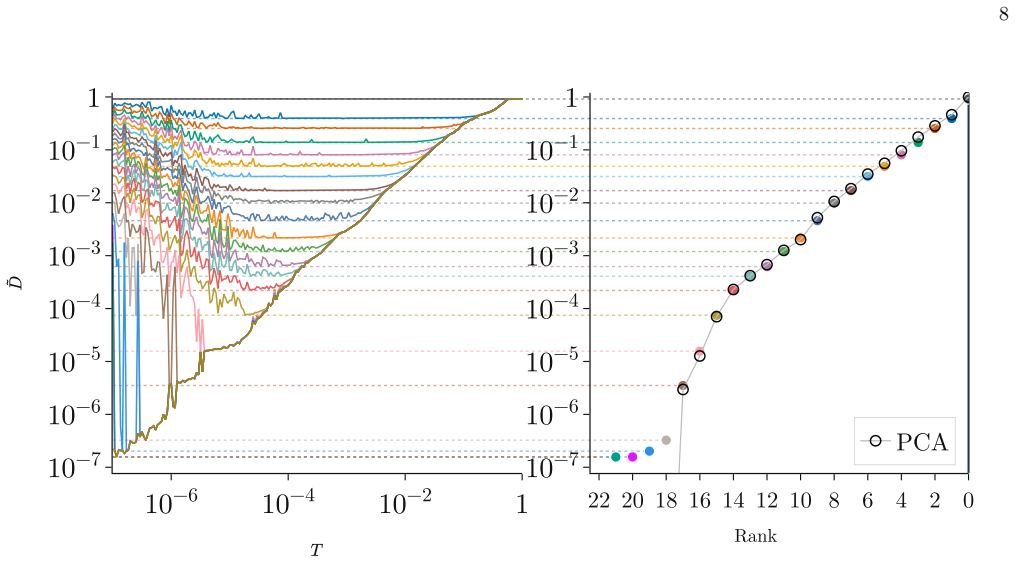
Fig. 2 displays the truncated normalized distortion (using posterior means to remove sampling noise) as a function of the scan coordinate and as a function of retained rank, with the PCA reference included in the rank plot. 7
-
[3]
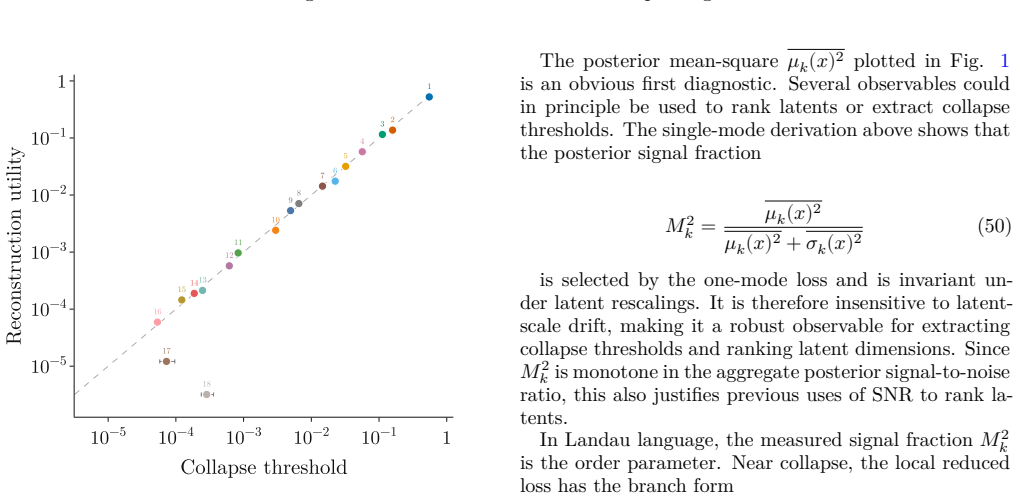
Fig. 3 displays reconstruction utility against the corresponding collapse thresholds, testing the utility–threshold duality itself
-
[4]
prune first, ask questions later
Fig. 4 in Appendix C diagnoses the behavior of the posterior scale 𝐴2 𝑘(𝑇 )and the posterior-variance Jensen gap 𝐽𝑘(𝑇 ). Unless otherwise noted, points and curves in these fig- ures are colored by ranked mode. 0 0.5 1 1.5 2 0 0.2 0.4 0.6 0.8 1 10 −7 10 −6 10 −5 10 −4 10 −3 10 −2 10 −1 1 −12 −10 −8 −6 −4 −2 0 Figure 1: Order-parameter collapse scan. The co...
work page 1952
-
[5]
D. P. Kingma and M. Welling, Auto-encoding variational bayes, in 2nd International Conference on Learning Rep- resentations (ICLR) (2014)
work page 2014
-
[6]
D. P. Kingma and M. Welling, An introduction to vari- ational autoencoders, Foundations and Trends® in Ma- chine Learning 12, 307 (2019)
work page 2019
-
[7]
I. Higgins, L. Matthey, A. Pal, C. P. Burgess, X. Glorot, M. M. Botvinick, S. Mohamed, and A. Lerchner, beta- vae: Learning basic visual concepts with a constrained variational framework, in 5th International Conference on Learning Representations (ICLR) (OpenReview.net, 2017)
work page 2017
-
[8]
C. P. Burgess, I. Higgins, A. Pal, L. Matthey, N. Watters, G. Desjardins, and A. Lerchner, Understanding disentan- gling in 𝑏𝑒𝑡𝑎-vae, arXiv preprint (2018), arXiv:1804.03599
work page internal anchor Pith review Pith/arXiv arXiv 2018
-
[9]
S. R. Bowman, L. Vilnis, O. Vinyals, A. Dai, R. Jozefow- icz, and S. Bengio, Generating sentences from a contin- uous space, in Proceedings of The 20th SIGNLL Confer- ence on Computational Natural Language Learning (2016) pp. 10–21
work page 2016
-
[10]
A. A. Alemi, B. Poole, I. Fischer, J. V. Dillon, R. A. Saurous, and K. Murphy, Fixing a broken elbo , arXiv preprint (2018), arXiv:1711.00464
work page internal anchor Pith review Pith/arXiv arXiv 2018
-
[11]
J. He, D. Spokoyny, G. Neubig, and T. Berg-Kirkpatrick, Lagging inference networks and posterior collapse in vari- ational autoencoders, in 7th International Conference on Learning Representations (ICLR) (OpenReview.net, 2019)
work page 2019
-
[12]
B. Dai, Z. Wang, and D. Wipf, The usual suspects? re- assessing blame for V AE posterior collapse, in Proceed- ings of the 37th International Conference on Machine Learning, Proceedings of Machine Learning Research, Vol. 119 (PMLR, 2020) pp. 2313–2322
work page 2020
- [13]
- [14]
-
[15]
Y. Ichikawa and K. Hukushima, Learning dynamics in lin- ear vae: Posterior collapse threshold, superfluous latent space pitfalls, and speedup with kl annealing, in Proceed- ings of The 27th International Conference on Artificial Intelligence and Statistics (PMLR, 2024) pp. 1936–1944
work page 2024
-
[16]
Y. Ichikawa and K. Hukushima, High-dimensional asymptotics of vaes: Threshold of posterior collapse and dataset-size dependence of rate-distortion curve, Journal of Statistical Mechanics: Theory and Experiment 2025, 073402 (2025)
work page 2025
-
[17]
The information bottleneck method
N. Tishby, F. C. Pereira, and W. Bialek, The in- formation bottleneck method , arXiv preprint (2000), arXiv:physics/0004057
work page internal anchor Pith review Pith/arXiv arXiv 2000
-
[18]
G. Chechik, A. Globerson, N. Tishby, and Y. Weiss, In- formation bottleneck for gaussian variables, Journal of Machine Learning Research 6, 165 (2005)
work page 2005
-
[19]
G. Barenboim, L. Del Debbio, J. Hirn, and V. Sanz, Exploring how a generative AI interprets music, Neural Computing and Applications 36, 17007 (2024) . 12 0 0.2 0.4 0.6 0.8 1 1.2 1.4 1.6 10 −6 10 −4 10 −2 1 0 0.0002 0.0004 0.0006 0.0008 0.001 Figure 4: WorldClim posterior-scale and Jensen-gap diagnostic for ranked latent modes
work page 2024
-
[20]
Sanz, Learning symmetries in datasets, Applied Sci- ences 16, 1930 (2026)
V. Sanz, Learning symmetries in datasets, Applied Sci- ences 16, 1930 (2026)
work page 1930
-
[21]
V. Sanz, Artificial intelligence and symmetries: Learn- ing, encoding, and discovering structure in physical data , arXiv preprint (2026), arXiv:2602.02351
-
[22]
Z. Li, F. Zhang, Z. Zhang, and Y. Chen, Posterior col- lapse as a phase transition in variational autoencoders, Physica A: Statistical Mechanics and its Applications 683, 131228 (2026)
work page 2026
discussion (0)
Sign in with ORCID, Apple, or X to comment. Anyone can read and Pith papers without signing in.