REVIEW 2 major objections 1 minor 43 references
GFSR calibrates lane confidence with geometric quality via LaneIoU and adds gated point refinement to handle complex curves.
Reviewed by Pith at T0; open to challenge. T0 means a machine referee read the full paper against a public rubric. the ladder, T0–T4 →
2026-06-30 16:11 UTC pith:26VUYUH7
load-bearing objection GFSR pairs LaneIoU calibration with gated point refinement to target confidence-geometry mismatch and weak inter-point links, but the abstract supplies no ablations or checks to confirm the mechanisms work as described. the 2 major comments →
GFSR: Geometric Fidelity and Spatial Refinement for Reliable Lane Detection
The pith
A machine-rendered reading of the paper's core claim, the machinery that carries it, and where it could break.
Core claim
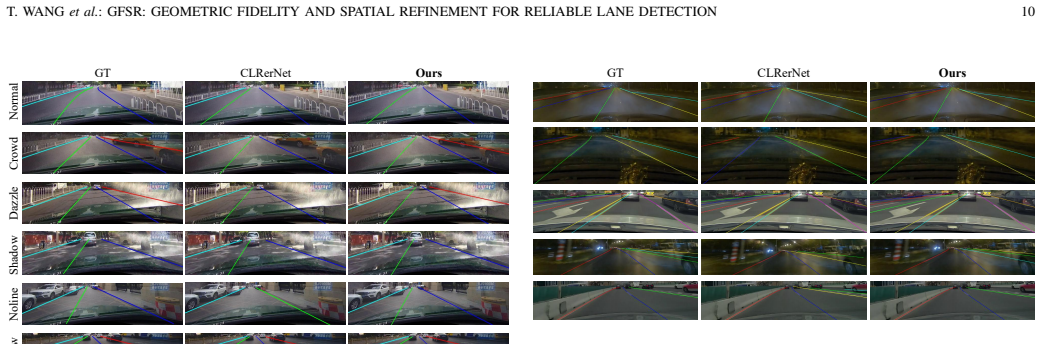
By treating LaneIoU as soft supervision to score geometric fidelity and fusing it with classification confidence into the Collaborative Reliability Index, lane priors with superior shape are retained; the Adaptive Gated Location Refinement module then predicts sampling-point lateral offsets and gates correction magnitude to strengthen inter-point correlations, yielding state-of-the-art F1_50 of 81.46 percent and F1_75 of 65.01 percent on CULane plus 87.35 percent F1_50 on CurveLanes.
What carries the argument
LaneIoU-guided Confidence Calibration that produces the Collaborative Reliability Index for filtering, paired with Adaptive Gated Location Refinement that regulates lateral-offset corrections across refinement stages.
Load-bearing premise
LaneIoU gives a reliable measure of geometric quality whose fusion with classification confidence will correctly keep better-shaped lanes over merely high-confidence ones.
What would settle it
If replacing the Collaborative Reliability Index with plain classification-confidence filtering produces identical or higher F1 scores on CULane and CurveLanes, the benefit of geometric calibration is refuted.
If this is right
- Filtering now keeps lanes whose shape matches ground truth even when their initial classification score is moderate.
- Refinement stages become more effective on distant, high-curvature, and topologically complex lanes.
- The model shows increased robustness when lane appearance varies or is partially occluded.
- Overall detection reliability rises for downstream planning modules that rely on accurate lane geometry.
Where Pith is reading between the lines
- The same separation of quality scoring from classification could apply to other structured prediction tasks such as road-boundary or curb detection.
- Adding explicit geometric losses during training might further amplify the gains from the calibration step.
- Measuring inference latency on embedded hardware would reveal whether the extra modules remain practical for real-time driving.
Editorial analysis
A structured set of objections, weighed in public.
Referee Report
Summary. The manuscript proposes the GFSR framework for lane detection, comprising LaneIoU-guided Confidence Calibration (LCC) that fuses LaneIoU-based geometric fidelity estimates with classification confidence into a Collaborative Reliability Index (CRI) for prior filtering, and Adaptive Gated Location Refinement (AGLR) that predicts lateral offsets with a gating mechanism to strengthen inter-point correlations. It reports state-of-the-art F1_50 of 81.46% and F1_75 of 65.01% on CULane plus 87.35% F1_50 on CurveLanes, attributing gains to better retention of geometrically high-quality lanes and improved refinement in complex scenarios.
Significance. If the mechanisms are shown to operate as described, the work could meaningfully advance reliable lane detection in autonomous driving by explicitly decoupling geometric quality from classification scores and adaptively refining point correlations, addressing documented failure modes in high-curvature and occluded cases.
major comments (2)
- [Abstract] Abstract: the central claim that LCC's LaneIoU soft supervision produces a CRI that 'correctly prioritizes lanes with superior geometry over those with only high classification confidence' lacks any supporting quantitative evidence (e.g., correlation between LaneIoU and point-wise geometric error, or ablation statistics on geometry of retained vs. discarded priors under occlusion or curvature).
- [Abstract] Abstract: the reported SOTA F1 scores are presented without reference to experimental protocol, ablation studies isolating LCC versus AGLR, baseline comparisons, or error analysis, making it impossible to determine whether the gains are attributable to the proposed components or to other factors.
minor comments (1)
- Notation for LaneIoU, CRI, and the gating mechanism should be introduced with explicit equations rather than descriptive prose alone.
Simulated Author's Rebuttal
We thank the referee for the constructive feedback on the abstract. We will revise the abstract to better reference the supporting evidence from the full manuscript while maintaining its conciseness. Point-by-point responses to the major comments are provided below.
read point-by-point responses
-
Referee: [Abstract] Abstract: the central claim that LCC's LaneIoU soft supervision produces a CRI that 'correctly prioritizes lanes with superior geometry over those with only high classification confidence' lacks any supporting quantitative evidence (e.g., correlation between LaneIoU and point-wise geometric error, or ablation statistics on geometry of retained vs. discarded priors under occlusion or curvature).
Authors: We agree the abstract itself does not embed the requested quantitative details, as it serves as a high-level summary. The full manuscript contains ablation studies and performance breakdowns under occlusion and curvature that support the prioritization effect of CRI. We will revise the abstract to add a brief clause referencing these experimental validations. revision: yes
-
Referee: [Abstract] Abstract: the reported SOTA F1 scores are presented without reference to experimental protocol, ablation studies isolating LCC versus AGLR, baseline comparisons, or error analysis, making it impossible to determine whether the gains are attributable to the proposed components or to other factors.
Authors: Abstracts are intentionally concise and do not replicate full experimental details. The manuscript specifies the standard CULane and CurveLanes protocols in Section 4, provides LCC/AGLR ablations in Section 4.3, baseline tables, and error analysis. To improve self-containment, we will revise the abstract to include a short qualifier indicating the results stem from component ablations and benchmark comparisons. revision: yes
- The manuscript does not include the specific correlation analysis between LaneIoU and point-wise geometric error suggested as an example; our ablations use aggregate F1 and qualitative retention metrics instead.
Circularity Check
No derivation chain present; empirical engineering contribution with no circularity
full rationale
The paper presents GFSR as an empirical framework consisting of LCC (using LaneIoU for soft supervision fused into CRI) and AGLR (gated refinement), with performance claims resting entirely on benchmark results (F1 scores on CULane and CurveLanes). No equations, derivations, fitted parameters renamed as predictions, or self-citation chains appear in the text. The central claims do not reduce to inputs by construction; they are externally falsifiable via standard lane detection metrics. This matches the default expectation of no significant circularity for non-derivational work.
Axiom & Free-Parameter Ledger
free parameters (1)
- model hyperparameters and training settings
axioms (2)
- domain assumption LaneIoU serves as a valid proxy for geometric fidelity of lane priors
- domain assumption Existing regression modules weaken inter-point correlations in complex lanes
Cite this review
Pith. "Pith review of GFSR: Geometric Fidelity and Spatial Refinement for Reliable Lane Detection." pith.science (2026). https://pith.science/paper/26VUYUH7
@misc{pith2026260523327,
  author       = {Pith},
  title        = {Pith review of: GFSR: Geometric Fidelity and Spatial Refinement for Reliable Lane Detection},
  year         = {2026},
  howpublished = {\url{https://pith.science/paper/26VUYUH7}},
  note         = {Machine review of arXiv:2605.23327}
}
read the original abstract
Lane detection stands as a crucial perception task in autonomous driving and advanced driver assistance systems. However, existing methods still degrade in complex real scenarios due to two major limitations. First, classification confidence only characterizes the categorical existence of lane priors and has no strong correlation with geometric quality. If threshold filtering and NMS are conducted merely based on this confidence, the model tends to retain lane priors with high confidence while eliminating those with lower confidence but superior geometric representation. Secondly, the regression modules in existing methods weaken correlations among sampling points, hindering fine-grained optimization of distant, high-curvature and complex-topology lanes and causing underfitting. To address these issues, we propose Geometric Fidelity and Spatial Refinement (GFSR), a framework consisting of LaneIoU-guided Confidence Calibration (LCC) and Adaptive Gated Location Refinement (AGLR). Specifically, LCC adopts LaneIoU as soft supervision to explicitly estimate the geometric fidelity of lane priors, which is further fused with classification confidence to construct the Collaborative Reliability Index (CRI). This index guides lane prior filtering, effectively retaining those with high classification confidence and favorable geometric quality. Meanwhile, cooperating with regression heads in each refinement stage, AGLR predicts sampling point lateral offsets and adopts a gating mechanism to adaptively regulate correction magnitude, strengthen inter-point correlations and boost model adaptability as well as robustness toward complex lane scenarios. Extensive experiments on CULane and CurveLanes demonstrate that our GFSR achieves state-of-the-art performance on CULane, with F1_50 and F1_75 scores of 81.46% and 65.01%, and reaches 87.35% F1_50 on CurveLanes.
Figures




Reference graph
Works this paper leans on
-
[1]
Comprehensive review of traffic modeling: towards autonomous vehicles,
Ł . Łach and D. Svyetlichnyy, “Comprehensive review of traffic modeling: towards autonomous vehicles,”Applied Sciences, vol. 14, no. 18, p. 8456, 2024
work page 2024
-
[2]
X. Luo, Y . Huang, J. Cui, and K. Zheng, “Deep learning-based lane detection for intelligent driving: A comprehensive survey of methods, datasets, challenges and outlooks,”Neurocomputing, vol. 650, p. 130795, 2025. T. W ANGet al.: GFSR: GEOMETRIC FIDELITY AND SPATIAL REFINEMENT FOR RELIABLE LANE DETECTION 12
work page 2025
-
[3]
Robust lane-mark extraction for autonomous driving under complex real conditions,
H. Xuan, H. Liu, J. Yuan, and Q. Li, “Robust lane-mark extraction for autonomous driving under complex real conditions,”IEEE Access, vol. 6, pp. 5749–5765, 2017
work page 2017
-
[4]
Real time detection of lane markers in urban streets,
M. Aly, “Real time detection of lane markers in urban streets,” in2008 IEEE intelligent vehicles symposium. IEEE, 2008, pp. 7–12
work page 2008
-
[5]
Lane detection and tracking using b-snake,
Y . Wang, E. K. Teoh, and D. Shen, “Lane detection and tracking using b-snake,”Image and Vision computing, vol. 22, no. 4, pp. 269–280, 2004
work page 2004
-
[6]
Hierarchical additive hough transform for lane detection,
R. K. Satzoda, S. Sathyanarayana, T. Srikanthan, and S. Sathyanarayana, “Hierarchical additive hough transform for lane detection,”IEEE Embed- ded Systems Letters, vol. 2, no. 2, pp. 23–26, 2010
work page 2010
-
[7]
Simultaneous detection of lane and pavement boundaries using model-based multisensor fusion,
B. Ma, S. Lakshmanan, and A. O. Hero, “Simultaneous detection of lane and pavement boundaries using model-based multisensor fusion,” IEEE Transactions on Intelligent Transportation Systems, vol. 1, no. 3, pp. 135–147, 2002
work page 2002
-
[8]
J. Bi, Y . Song, Y . Jiang, L. Sun, X. Wang, Z. Liu, J. Xu, S. Quan, Z. Dai, and W. Yan, “Lane detection for autonomous driving: Comprehensive reviews, current challenges, and future predictions,”IEEE Transactions on Intelligent Transportation Systems, vol. 26, no. 5, pp. 5710–5746, 2025
work page 2025
-
[9]
Towards end-to-end lane detection: an instance segmenta- tion approach,
D. Neven, B. De Brabandere, S. Georgoulis, M. Proesmans, and L. Van Gool, “Towards end-to-end lane detection: an instance segmenta- tion approach,” in2018 IEEE intelligent vehicles symposium (IV). IEEE, 2018, pp. 286–291
work page 2018
-
[10]
Spatial as deep: Spatial cnn for traffic scene understanding,
X. Pan, J. Shi, P. Luo, X. Wang, and X. Tang, “Spatial as deep: Spatial cnn for traffic scene understanding,” inProceedings of the AAAI conference on artificial intelligence, vol. 32, no. 1, 2018
work page 2018
-
[11]
Learning lightweight lane detection cnns by self attention distillation,
Y . Hou, Z. Ma, C. Liu, and C. C. Loy, “Learning lightweight lane detection cnns by self attention distillation,” inProceedings of the IEEE/CVF international conference on computer vision, 2019, pp. 1013– 1021
work page 2019
-
[12]
Resa: Recurrent feature-shift aggregator for lane detection,
T. Zheng, H. Fang, Y . Zhang, W. Tang, Z. Yang, H. Liu, and D. Cai, “Resa: Recurrent feature-shift aggregator for lane detection,” inProceedings of the AAAI conference on artificial intelligence, vol. 35, no. 4, 2021, pp. 3547–3554
work page 2021
-
[13]
Polylanenet: Lane estimation via deep polynomial regression,
L. Tabelini, R. Berriel, T. M. Paixao, C. Badue, A. F. De Souza, and T. Oliveira-Santos, “Polylanenet: Lane estimation via deep polynomial regression,” in2020 25th international conference on pattern recognition (ICPR). IEEE, 2021, pp. 6150–6156
work page 2021
-
[14]
End-to-end lane shape prediction with transformers,
R. Liu, Z. Yuan, T. Liu, and Z. Xiong, “End-to-end lane shape prediction with transformers,” inProceedings of the IEEE/CVF winter conference on applications of computer vision, 2021, pp. 3694–3702
work page 2021
-
[15]
Rethinking efficient lane detection via curve modeling,
Z. Feng, S. Guo, X. Tan, K. Xu, M. Wang, and L. Ma, “Rethinking efficient lane detection via curve modeling,” inProceedings of the IEEE/CVF conference on computer vision and pattern recognition, 2022, pp. 17 062–17 070
work page 2022
-
[16]
BSNet: Lane Detection via Draw B-spline Curves Nearby
H. Chen, M. Wang, and Y . Liu, “Bsnet: Lane detection via draw b-spline curves nearby,”arXiv preprint arXiv:2301.06910, 2023
work page Pith review arXiv 2023
-
[17]
Ultra fast structure-aware deep lane detection,
Z. Qin, H. Wang, and X. Li, “Ultra fast structure-aware deep lane detection,” inEuropean conference on computer vision. Springer, 2020, pp. 276–291
work page 2020
-
[18]
Condlanenet: a top-to-down lane detection framework based on conditional convolution,
L. Liu, X. Chen, S. Zhu, and P. Tan, “Condlanenet: a top-to-down lane detection framework based on conditional convolution,” inProceedings of the IEEE/CVF international conference on computer vision, 2021, pp. 3773–3782
work page 2021
-
[19]
Ultra fast deep lane detection with hybrid anchor driven ordinal classification,
Z. Qin, P. Zhang, and X. Li, “Ultra fast deep lane detection with hybrid anchor driven ordinal classification,”IEEE transactions on pattern analysis and machine intelligence, vol. 46, no. 5, pp. 2555–2568, 2022
work page 2022
-
[20]
Line-cnn: End-to-end traffic line detection with line proposal unit,
X. Li, J. Li, X. Hu, and J. Yang, “Line-cnn: End-to-end traffic line detection with line proposal unit,”IEEE Transactions on Intelligent Transportation Systems, vol. 21, no. 1, pp. 248–258, 2019
work page 2019
-
[21]
Keep your eyes on the lane: Real-time attention- guided lane detection,
L. Tabelini, R. Berriel, T. M. Paixao, C. Badue, A. F. De Souza, and T. Oliveira-Santos, “Keep your eyes on the lane: Real-time attention- guided lane detection,” inProceedings of the IEEE/CVF conference on computer vision and pattern recognition, 2021, pp. 294–302
work page 2021
-
[22]
Clrnet: Cross layer refinement network for lane detection,
T. Zheng, Y . Huang, Y . Liu, W. Tang, Z. Yang, D. Cai, and X. He, “Clrnet: Cross layer refinement network for lane detection,” inProceedings of the IEEE/CVF conference on computer vision and pattern recognition, 2022, pp. 898–907
work page 2022
-
[23]
Clrernet: improving confidence of lane detection with laneiou,
H. Honda and Y . Uchida, “Clrernet: improving confidence of lane detection with laneiou,” inProceedings of the IEEE/CVF winter conference on applications of computer vision, 2024, pp. 1176–1185
work page 2024
-
[24]
Ldtr: Transformer-based lane detection with anchor-chain representation,
Z. Yang, C. Shen, W. Shao, T. Xing, R. Hu, P. Xu, H. Chai, and R. Xue, “Ldtr: Transformer-based lane detection with anchor-chain representation,” Computational Visual Media, vol. 10, no. 4, pp. 753–769, 2024
work page 2024
-
[25]
Pointlanenet: Efficient end-to-end cnns for accurate real-time lane detection,
Z. Chen, Q. Liu, and C. Lian, “Pointlanenet: Efficient end-to-end cnns for accurate real-time lane detection,” in2019 IEEE intelligent vehicles symposium (IV). IEEE, 2019, pp. 2563–2568
work page 2019
-
[26]
Focus on local: Detecting lane marker from bottom up via key point,
Z. Qu, H. Jin, Y . Zhou, Z. Yang, and W. Zhang, “Focus on local: Detecting lane marker from bottom up via key point,” inProceedings of the IEEE/CVF conference on computer vision and pattern recognition, 2021, pp. 14 122–14 130
work page 2021
-
[27]
A keypoint-based global association network for lane detection,
J. Wang, Y . Ma, S. Huang, T. Hui, F. Wang, C. Qian, and T. Zhang, “A keypoint-based global association network for lane detection,” in Proceedings of the IEEE/CVF conference on computer vision and pattern recognition, 2022, pp. 1392–1401
work page 2022
-
[28]
Monocular lane detection based on deep learning: A survey,
X. He, H. Guo, K. Zhu, B. Zhu, X. Zhao, J. Fang, and J. Wang, “Monocular lane detection based on deep learning: A survey,”arXiv preprint arXiv:2411.16316, 2024
-
[29]
Asymmetric strip transformer with position vectors embedding for lane detection,
J. Zhang, Y . Le, S. Zhang, and Y . Li, “Asymmetric strip transformer with position vectors embedding for lane detection,”IEEE Transactions on Intelligent Transportation Systems, vol. 27, no. 1, pp. 1093–1104, 2025
work page 2025
-
[30]
End-to-end lane marker detection via row-wise classification,
S. Yoo, H. S. Lee, H. Myeong, S. Yun, H. Park, J. Cho, and D. H. Kim, “End-to-end lane marker detection via row-wise classification,” in Proceedings of the IEEE/CVF conference on computer vision and pattern recognition workshops, 2020, pp. 1006–1007
work page 2020
-
[31]
Feature pyramid networks for object detection,
T.-Y . Lin, P. Dollar, R. Girshick, K. He, B. Hariharan, and S. Belongie, “Feature pyramid networks for object detection,” inProceedings of the IEEE conference on computer vision and pattern recognition, 2017
work page 2017
-
[32]
A comprehensive review on yolo versions for object detection,
A. A. Murat and M. S. Kiran, “A comprehensive review on yolo versions for object detection,”Engineering Science and Technology, an International Journal, vol. 70, p. 102161, 2025
work page 2025
-
[33]
T. S. Ferguson,Mathematical statistics: A decision theoretic approach. Academic press, 2014, vol. 1
work page 2014
-
[34]
Curvelane-nas: Unifying lane-sensitive architecture search and adaptive point blending,
H. Xu, S. Wang, X. Cai, W. Zhang, X. Liang, and Z. Li, “Curvelane-nas: Unifying lane-sensitive architecture search and adaptive point blending,” inECCV, 2020
work page 2020
-
[35]
Clrkdnet: Speeding up lane detection with knowledge distillation,
W. Qi, G. Zhao, F. Ma, L. Zheng, J. Ma, and M. Liu, “Clrkdnet: Speeding up lane detection with knowledge distillation,” in2024 IEEE 27th International Conference on Intelligent Transportation Systems (ITSC). IEEE, 2024, pp. 679–686
work page 2024
-
[36]
Generating dynamic kernels via transformers for lane detection,
Z. Chen, Y . Liu, M. Gong, B. Du, G. Qian, and K. Smith-Miles, “Generating dynamic kernels via transformers for lane detection,” in Proceedings of the IEEE/CVF international conference on computer vision, 2023, pp. 6835–6844
work page 2023
-
[37]
A siamese transformer with hierarchical refinement for lane detection,
Z. Lv, D. Han, W. Wang, and D. Z. Chen, “A siamese transformer with hierarchical refinement for lane detection,”Advances in Neural Information Processing Systems, vol. 37, pp. 40 892–40 912, 2024
work page 2024
-
[38]
Dlnet: Direction-aware feature integration for robust lane detection in complex environments,
Z. Lu, L. Liao, R. Li, F. Zou, S. Cai, and G. Han, “Dlnet: Direction-aware feature integration for robust lane detection in complex environments,” IEEE Transactions on Intelligent Transportation Systems, 2025
work page 2025
-
[39]
Unsupervised labeled lane markers using maps,
K. Behrendt and R. Soussan, “Unsupervised labeled lane markers using maps,” inProceedings of the IEEE/CVF international conference on computer vision workshops, 2019, pp. 0–0
work page 2019
-
[40]
Deep residual learning for image recognition,
K. He, X. Zhang, S. Ren, and J. Sun, “Deep residual learning for image recognition,” inProceedings of the IEEE conference on computer vision and pattern recognition, 2016, pp. 770–778
work page 2016
-
[41]
Repvit: Revisiting mobile cnn from vit perspective,
A. Wang, H. Chen, Z. Lin, J. Han, and G. Ding, “Repvit: Revisiting mobile cnn from vit perspective,” inProceedings of the IEEE/CVF conference on computer vision and pattern recognition, 2024, pp. 15 909– 15 920
work page 2024
-
[42]
F. Yu, D. Wang, E. Shelhamer, and T. Darrell, “Deep layer aggregation,” in 2018 IEEE/CVF Conference on Computer Vision and Pattern Recognition, 2018, pp. 2403–2412
work page 2018
-
[43]
CANet: Curved guide line network with adaptive decoder for lane detection,
Z. Yang, C. Shen, W. Shao, T. Xing, R. Hu, P. Xu, H. Chai, and R. Xue, “CANet: Curved guide line network with adaptive decoder for lane detection,” inICASSP. IEEE, 2023, pp. 1–5
work page 2023
This paper was first reviewed by grok-4.3 on June 30, 2026.
discussion (0)
Sign in with ORCID, Apple, or X to comment. Anyone can read and Pith papers without signing in.