General Expressions for Measurable Parameters in Curved Spacetime
Pith reviewed 2026-05-25 04:26 UTC · model grok-4.3
The pith
Covariant expressions for measurable angles, distances, velocities, and accelerations are derived for use in any curved spacetime.
A machine-rendered reading of the paper's core claim, the machinery that carries it, and where it could break.
Core claim
General covariant expressions for measurable angles, distances, velocities, and accelerations are provided in terms of fundamental parameters that can be applied in any setup. The relativistic aberration of light relationship is presented in full generality, which is applicable to any orientation of observers and light rays. An expansion for the geometrical exponential map is established and used to form an expression for the physical distance between an observer and a nearby object within its extended local frame. Curvature effects on measurable distances, velocities, and accelerations are made explicit and appear in general tensorial form. The concepts of Fermi frames on timelike worldlies
What carries the argument
The Fermi-Walker derivative along timelike worldlines, established from the physical requirement of relative stationarity between observers, which defines Fermi frames for expressing measurable quantities covariantly.
If this is right
- Curvature effects on measurable distances, velocities, and accelerations appear explicitly in general tensorial form.
- The reciprocity theorem relating angular diameter distance and luminosity distance is verified.
- A generalized geodesic deviation equation holds for cases of extreme relative motion between observers.
- Generalized covariant Taylor expansions apply to tensors of any rank.
- General forms are supplied for the optically based angular diameter distance and luminosity distance.
Where Pith is reading between the lines
- These expressions would allow direct computation of observable effects in strong-gravity regions while remaining fully tensorial and free of coordinate choices.
- The same machinery could be inserted into numerical simulations of ray tracing or observer trajectories in arbitrary metrics to extract measurable outputs without intermediate frame transformations.
Load-bearing premise
The Fermi-Walker derivative can be established from first principles through physically meaningful consideration of relative stationarity between timelike observers without additional unstated assumptions about the spacetime or the observers' worldlines.
What would settle it
Direct reduction of the general aberration formula and distance expressions to their known special-relativistic forms in flat Minkowski spacetime, or an explicit mismatch in that limit, would settle whether the covariant expressions are correct.
Figures


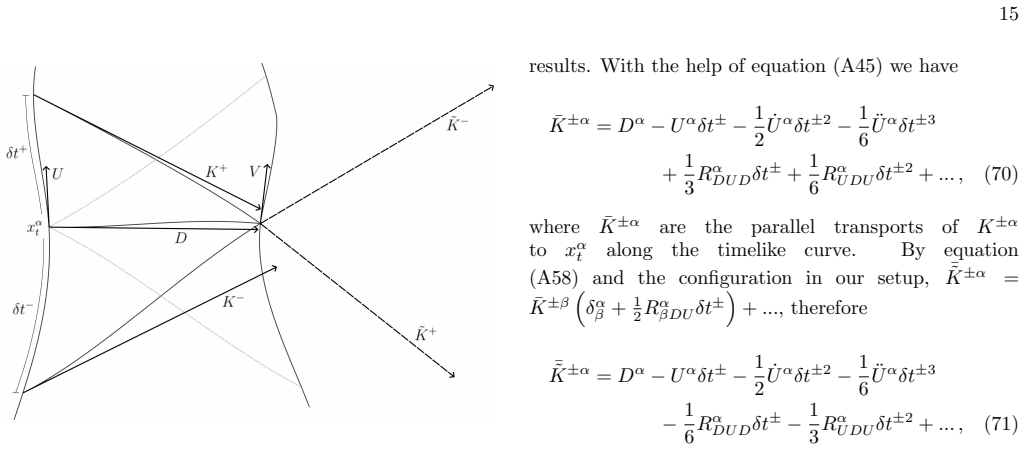


read the original abstract
General covariant expressions for measurable angles, distances, velocities, and accelerations are provided in terms of fundamental parameters that can be applied in any setup. The relativistic aberration of light relationship is presented in full generality, which is applicable to any orientation of observers and light rays. An expansion for the geometrical exponential map is established and used to form an expression for the physical distance between an observer and a nearby object within its extended local frame. Curvature effects on measurable distances, velocities, and accelerations are made explicit and appear in general tensorial form. The concepts of Fermi frames on timelike worldlines and the Fermi-Walker derivative are discussed in detail and used throughout; and in examining the meaning of relative stationarity between timelike observers, the Fermi-Walker derivative is established from first principles through physically meaningful consideration. A generalized type of Taylor expansion is provided for tensors of any rank in a covariant form. Expressions for the optically based angular diameter distance and luminosity distance are provided in general forms, and the reciprocity theorem is discussed and verified. A generalized version of the geodesic deviation equation, applicable to extreme relative motion, is provided as well.
Editorial analysis
A structured set of objections, weighed in public.
Referee Report
Summary. The manuscript claims to derive general covariant expressions for measurable quantities in curved spacetime, including angles, distances, velocities, and accelerations in terms of fundamental parameters applicable to any setup. It presents the relativistic aberration of light in full generality, an expansion of the geometrical exponential map for physical distance in an extended local frame, explicit curvature effects in tensorial form, a first-principles establishment of the Fermi-Walker derivative via relative stationarity of timelike observers, a generalized covariant Taylor expansion for tensors of any rank, general expressions for angular diameter and luminosity distances with verification of the reciprocity theorem, and a generalized geodesic deviation equation applicable to extreme relative motion.
Significance. If the central derivations hold without hidden assumptions or circularity, the work could provide a useful unified framework for observables in general relativity, with potential applications in strong-field regimes. The first-principles physical motivation for the Fermi-Walker derivative and the generality of the expressions represent strengths, as does the explicit inclusion of curvature effects and the verification of the reciprocity theorem. However, the absence of visible derivations, error checks, or verification steps limits assessment of whether these claims deliver parameter-free or falsifiable results.
major comments (1)
- [Abstract] The central claim that the Fermi-Walker derivative is established from first principles through physically meaningful consideration of relative stationarity between timelike observers (as stated in the abstract) is load-bearing for the entire framework; without access to the explicit steps or any check against standard definitions, it is not possible to confirm independence from unstated assumptions about worldlines or spacetime.
Simulated Author's Rebuttal
We thank the referee for their report and the opportunity to address the concern regarding the first-principles derivation of the Fermi-Walker derivative. The manuscript grounds this construction in the physical notion of relative stationarity, and we clarify the steps below while remaining open to expanding explicit intermediate calculations if the referee finds them insufficiently detailed.
read point-by-point responses
-
Referee: [Abstract] The central claim that the Fermi-Walker derivative is established from first principles through physically meaningful consideration of relative stationarity between timelike observers (as stated in the abstract) is load-bearing for the entire framework; without access to the explicit steps or any check against standard definitions, it is not possible to confirm independence from unstated assumptions about worldlines or spacetime.
Authors: The derivation appears in the dedicated section on Fermi frames. We begin with the operational definition that two nearby timelike observers are relatively stationary when the spatial components of each four-velocity vanish in the instantaneous rest frame of the other, with no relative acceleration measured by Fermi-Walker transported vectors. Imposing consistency of this condition along both worldlines yields the transport law for the four-velocity and connecting vectors without presupposing the Fermi-Walker formula. Equivalence to the conventional expression is then verified by direct substitution once the standard form is recovered. The construction relies only on the existence of timelike worldlines and the local Minkowski structure; no additional assumptions about global properties or specific coordinate choices are introduced. Should the referee require further intermediate algebraic steps or an explicit comparison table, we will insert them in a revised version. revision: partial
Circularity Check
No significant circularity; derivations presented as independent first-principles constructions
full rationale
The paper's central claims rest on establishing the Fermi-Walker derivative from relative stationarity of timelike observers and deriving covariant expressions for measurable quantities via the exponential map and generalized expansions. No load-bearing step is shown to reduce by construction to a fitted parameter, self-citation, or renamed input; the abstract and described structure indicate self-contained tensorial derivations applicable in arbitrary spacetimes without invoking prior author-specific uniqueness theorems or ansatzes as the sole justification. External benchmarks (standard GR literature on Fermi frames) are not contradicted by the provided information, supporting a non-circular assessment.
Axiom & Free-Parameter Ledger
Lean theorems connected to this paper
-
IndisputableMonolith/Foundation/RealityFromDistinction.leanreality_from_one_distinction unclear?
unclearRelation between the paper passage and the cited Recognition theorem.
Fermi-Walker derivative established from first principles through physically meaningful consideration of relative stationarity between timelike observers
-
IndisputableMonolith/Cost/FunctionalEquation.leanwashburn_uniqueness_aczel unclear?
unclearRelation between the paper passage and the cited Recognition theorem.
General covariant expressions for measurable angles, distances, velocities, and accelerations
What do these tags mean?
- matches
- The paper's claim is directly supported by a theorem in the formal canon.
- supports
- The theorem supports part of the paper's argument, but the paper may add assumptions or extra steps.
- extends
- The paper goes beyond the formal theorem; the theorem is a base layer rather than the whole result.
- uses
- The paper appears to rely on the theorem as machinery.
- contradicts
- The paper's claim conflicts with a theorem or certificate in the canon.
- unclear
- Pith found a possible connection, but the passage is too broad, indirect, or ambiguous to say the theorem truly supports the claim.
Reference graph
Works this paper leans on
-
[1]
Relativistic Aberration for Small Angles For small anglesθ U andθ V (θU , θV ≪1) equation (13) reduces to θ2 V θ2 U = (U αKα)(U αWα) (V αKα)(V αWα) .(B1) Defining 1 +x= V αWα/V αKα U αWα/UαKα ,(B2) allows us to rewrite the above as θ2 V θ2 U = (U αKα)2 (V αKα)2(1 +x) , or (U αWα)2(1 +x) (V αWα)2 .(B3) It is immediately evident that for either zero relativ...
-
[2]
Neighboring Objects at Constant Distance In this section we derive an expression for the proper time lapseδτ ±, and for other related quantities needed in section III B 2, under the condition of constant distance. For the setup in Figure 4 and the expression forK ±α given by (58),δτ ± is set by the requirementK ±αK ± α = 0, 0 =D 2 −δτ ±2 + 2Dα ¯Vαδτ ± +D ...
-
[3]
Distance Between Neighboring Null Geodesics In what follows we establish an expression for δK αUα ωU from the conditionV αδα = 0 for section IV B 1, and set a condition onV α which ensures that δK αUα ωU ≪1. Working to the highest accuracy the current analysis allows, the conditionV αδα = 0 requiresδK α to satisfy equation (130). WithδK α given by (137) w...
-
[4]
Inverse of a Matrix In this section we derive an explicit expression for the inverse of a square matrix in terms of the matrix itself and Levi-Civita symbols. For a non-singular matrixM α β , the determinant is neatly captured by use of the Levi-Civita symbolϵ α1..αn 1..n (or ϵ1..n α1..αn), whereα 1..αn isα 1, α2, .., αn−1, αn, 1..nis 1,2, .., n−1, nandni...
-
[5]
Subvolume Transformations In this section we derive relationships between volumes within subspaces under linear transformations. Consider a transformationT α β from a point in anndimensional manifold with metricg αβ, to a point in a different manifold of the same dimension with metricg ′ αβ. Assume the transformation is non-singular and has a determinant ...
-
[6]
The Determinant of a Nearly Identity Matrix We derive an expansion of the determinant of a square matrix of the form M α β =δ α β +δM α β (C49) to second order in the small coefficients of the matrixδM α β (≪1). From the definition of the determinant and by basic counting, we find det(M(α) (β) ) =ϵ α1..αn 1..n M1 α1 ..M n αn =ϵ 1..n α1..αn M α1 1 ..M αn n...
-
[7]
Higher Order Derivatives of the Connecting Vector In this section we find higher order derivatives of the connecting vectorD α for neighboring timelike and null geodesics. For two neighboring timelike trajectories with 4-velocitiesU α andV α as described in section III A, consider the case where both are geodesics and at a given initial event the position...
-
[8]
W. Rindler and M. Ishak, Contribution of the cosmolog- ical constant to the relativistic bending of light revisited, Phys. Rev. D76, 043006 (2007)
work page 2007
-
[9]
Park, Rigorous approach to gravitational lensing, Phys
M. Park, Rigorous approach to gravitational lensing, Phys. Rev. D78, 023014 (2008)
work page 2008
-
[10]
D. Lebedev and K. Lake, On the influence of the cosmo- logical constant on trajectories of light and associated measurements in schwarzschild de sitter space (2013), arXiv:1308.4931 [gr-qc]
work page internal anchor Pith review Pith/arXiv arXiv 2013
-
[11]
Relativistic Aberration and the Cosmological Constant in Gravitational Lensing I: Introduction
D. Lebedev and K. Lake, Relativistic aberration and the cosmological constant in gravitational lensing i: Intro- duction (2016), arXiv:1609.05183 [gr-qc]
work page internal anchor Pith review Pith/arXiv arXiv 2016
-
[12]
M. Soffelet al., The IAU 2000 resolutions for astrome- try, celestial mechanics and metrology in the relativistic framework: explanatory supplement, Astron. J.126, 2687 (2003)
work page 2000
-
[13]
L. Lindegren and D. Dravins, The fundamental definition of ‘radial velocity’, Astron. Astrophys.401, 1185 (2003)
work page 2003
-
[14]
V. J. Bol´ os, Intrinsic definitions of “relative velocity” in general relativity, Commun. Math. Phys.273, 217 (2007)
work page 2007
-
[15]
V. J. Bol´ os and D. Klein, Relative velocities for ra- dial motion in expanding robertson-walker spacetimes, Gen. Rel. Grav.44, 1361 (2012)
work page 2012
-
[16]
V. J. Bol´ os, A note on the computation of geometri- cally defined relative velocities, Gen. Rel. Grav.44, 391 (2012)
work page 2012
-
[17]
V. J. Bol´ os, Relative velocities, geometry, and expansion of space (2012), arXiv:1210.3161 [gr-qc]
work page internal anchor Pith review Pith/arXiv arXiv 2012
-
[18]
D. Klein and E. Randles, Fermi coordinates, simultane- ity, and expanding space in robertson-walker cosmolo- gies, Ann. Henri Poincar´ e12, 303 (2011)
work page 2011
-
[19]
D. Klein and P. Collas, Recessional velocities and hub- ble’s law in schwarzschild-de sitter space, Phys. Rev. D 81, 063518 (2010)
work page 2010
-
[20]
Klein, Maximal fermi charts and geometry of infla- tionary universes, Ann
D. Klein, Maximal fermi charts and geometry of infla- tionary universes, Ann. Henri Poincar´ e14, 1525 (2013)
work page 2013
-
[21]
D. Klein and J. Reschke, Velocity addition formulas in robertson-walker spacetimes, J. Math. Phys.56, 072501 (2015)
work page 2015
-
[22]
J. L. Synge,Relativity: The General Theory(North- Holland Publishing Company, Amsterdam, 1960)
work page 1960
-
[23]
K. Pechenick, C. Ftaclas, and J. Cohen, Hot spots on neutron stars: The near-field gravitational lens, Astro- phys. J.274, 846 (1983)
work page 1983
-
[24]
P. Teyssandir and C. L. Poncin-Lafitte, Angular dis- tances in metric theories (2006), arXiv:0611078 [gr-qc]
work page 2006
-
[25]
F. de Felice, M. Lattanzi, A. Vecchiato, and P. Bernacca, General relativistic satellite astrometry: I. a non- perturbative approach to data reduction, Astron. Astro- phys.332, 1133 (1998)
work page 1998
-
[26]
F. de Felice, P. Bernacca, M. Lattanzi, and A. Vecchiato, 60 General relativistic satellite astrometry: Ii. modeling par- allax and proper motion, Astron. Astrophys.373, 336 (2001)
work page 2001
-
[27]
O’Neill,Semi-Riemannian Geometry With Applica- tions to Relativity(Academic Press, 1983)
B. O’Neill,Semi-Riemannian Geometry With Applica- tions to Relativity(Academic Press, 1983)
work page 1983
-
[28]
Kriele,Spacetime: Foundations of General Relativity and Differential Geometry(Springer, 2001)
M. Kriele,Spacetime: Foundations of General Relativity and Differential Geometry(Springer, 2001)
work page 2001
-
[29]
G. F. R. Ellis, Republication of: Relativistic cosmology, Gen. Relativ. Gravit.41, 581 (2009)
work page 2009
-
[30]
C. Ftaclas and J. Cohen, Generalized radial observers and the reissner-nordstr¨ om field, Phys. Rev. D21, 8 (1980)
work page 1980
-
[31]
Ehlers, Contributions to the relativistic mechanics of continuous media, Gen
J. Ehlers, Contributions to the relativistic mechanics of continuous media, Gen. Rel. Grav.25, 1225 (1993)
work page 1993
-
[32]
Rindler,Relativity: Special, General, and Cosmolog- ical(Oxford University Press, New York, 2006)
W. Rindler,Relativity: Special, General, and Cosmolog- ical(Oxford University Press, New York, 2006)
work page 2006
-
[33]
G. W. Gibbons, Part I special relativity, Cambridge Uni- versity (2008)
work page 2008
-
[34]
P. Schneider, J. Ehlers, and E. Falco,Gravitational Lenses(Springer, 2009)
work page 2009
-
[35]
S. W. Hawking and G. F. R. Ellis,The large Scale Struc- ture of Space-Time(Cambridge University Press, 1973)
work page 1973
-
[36]
V. J. Bol´ os, An algorithm for computing geometric rel- ative velocities through fermi and observational coordi- nates, Gen. Rel. Grav.46, 1623 (2014)
work page 2014
-
[37]
Poisson,A Relativist’s Toolkit(Cambridge University Press, 2004)
E. Poisson,A Relativist’s Toolkit(Cambridge University Press, 2004)
work page 2004
-
[38]
E. Fermi, Sopra i fenomeni che avvengono in vici- nanza di una linea oraria (on the phenomena which happen near a world line), Atti. Accad. Naz. Lincei Cl. Sci. Fis. Mat. and Nat.31, 21 (1922)
work page 1922
-
[39]
A. G. Walker, Relative coordinates, Proc. Roy. Soc. Ed- inburgh52, 345 (1932)
work page 1932
-
[40]
D. Bini and R. T. Jantzen, Circular holonomy, clock ef- fects and gravitoelectromagnetism: Still going around in circles after all these years (2002), arXiv:0202085 [gr-qc]
work page 2002
-
[41]
V. J. Bol´ os, Lightlike simultaneity, comoving observers and distances in general relativity, J. Geom. Phys.56, 813 (2006)
work page 2006
-
[42]
W. O. Kermack, W. H. McCrea, and E. T. Whittacker, On properties of null geodesics and their application to the theory of radiation, Proc. Roy. Soc. Edinburgh53, 31 (1932)
work page 1932
-
[43]
G. F. R. Ellis, S. D. Nel, R. Maartens, W. R. Stoeger, and A. P. Whitman, Ideal observational cosmology, Phys. Rep.124, 5 (1985)
work page 1985
-
[44]
Sachs, Gravitational waves in general relativity
R. Sachs, Gravitational waves in general relativity. vi. the outgoing radiation condition, Proc. Roy. Soc. A264, 1318 (1961)
work page 1961
-
[45]
I. M. H. Etherington, On the Definition of Distance in General Relativity., Phil. Mag. ser. 715, 761 (1933)
work page 1933
-
[46]
J. L. Synge and A. Schild,Tensor Calculus(University of Toronto Press, Toronto, 1949)
work page 1949
-
[47]
Nordstr¨ omet al., COMMISSION 30: Radial Veloci- ties, Reports on Astronomy1, T26 (2007)
B. Nordstr¨ omet al., COMMISSION 30: Radial Veloci- ties, Reports on Astronomy1, T26 (2007)
work page 2007
-
[48]
G. Ter-Kazarian, On the kinetic recession velocities of as- tronomical objects, Gravitation and Cosmology28, 186 (2022)
work page 2022
-
[49]
G. Ter-Kazarian, Coordinate-independent definition of relative velocity in pseudo-riemannian space-time: Im- plications for special cases, Gravitation and Cosmology 29, 62 (2023)
work page 2023
-
[50]
A. G. Butkevich and L. Lindegren, Rigorous treatment of barycentric stellar motion. perspective and light-time ef- fects in astrometric and radial velocity data, Astron. As- trophys.570, A62 (2014)
work page 2014
-
[51]
Zhang, Geometrization of light bending and its ap- plication to sdsw spacetime, Class
Z. Zhang, Geometrization of light bending and its ap- plication to sdsw spacetime, Class. Quantum Grav.39, 015003 (2022)
work page 2022
-
[52]
C. M. Ho and S. D. H. Hsu, Astrophysical constraints on dark energy, Astropart. Phys.74, 47 (2016)
work page 2016
-
[53]
F. K. Manasse and C. W. Misner, Fermi normal coordi- nates and some basic concepts in differential geometry, J. Math. Phys.4, 735 (1963)
work page 1963
- [54]
-
[55]
W. Q. Li and W. T. Ni, Coupled inertial and gravitational effects in the proper reference frame of an accelerated, rotating observer, J. Math. Phys.20, 1473 (1979)
work page 1979
discussion (0)
Sign in with ORCID, Apple, or X to comment. Anyone can read and Pith papers without signing in.