Cosmological constraints from neighbor-density-weighted marked correlation functions
Pith reviewed 2026-05-25 03:23 UTC · model grok-4.3
The pith
Neighbor-density-weighted marked correlation functions improve cosmological constraints by factors of 1.7-2.5 over the standard two-point correlation function.
A machine-rendered reading of the paper's core claim, the machinery that carries it, and where it could break.
Core claim
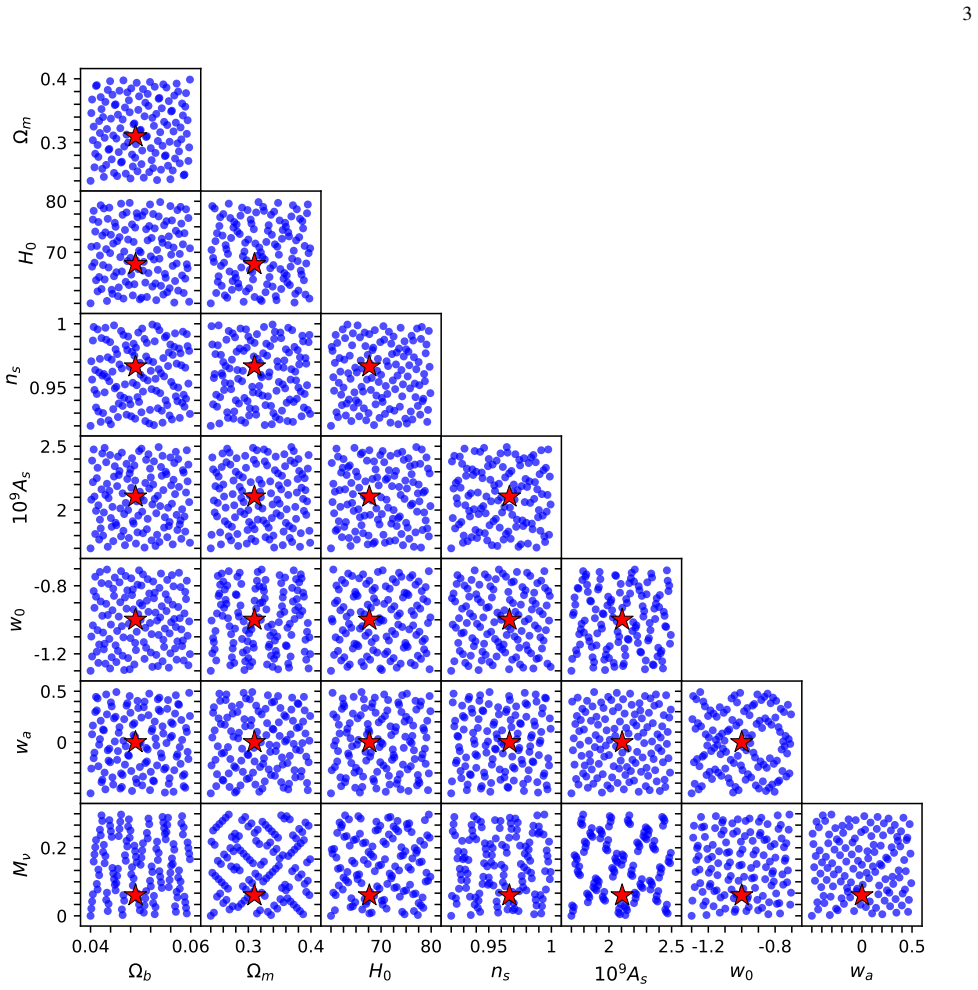
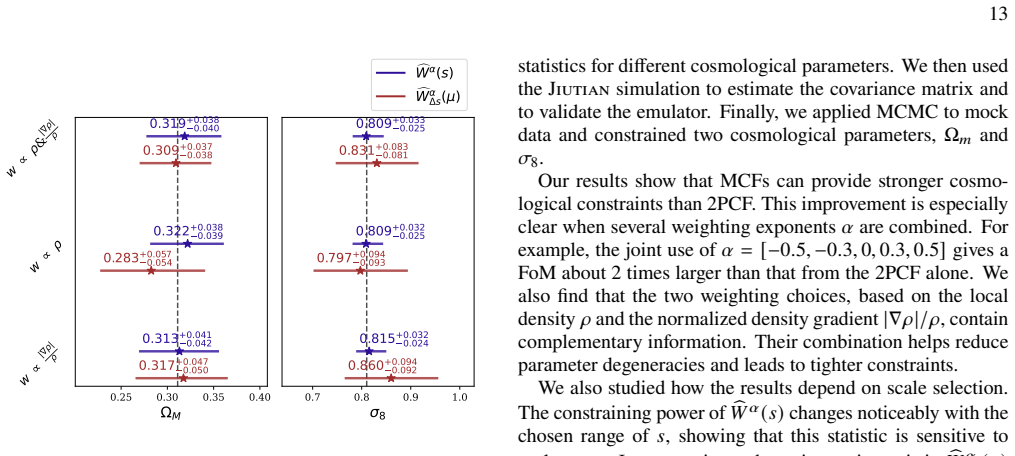
Using the Kun suite of 129 w0waCDM+sum m_nu simulations in 1 h^-1 Gpc boxes, the work builds emulators for the normalized scale statistic W^alpha(s) and the angular statistic W^alpha_Delta s(mu), then demonstrates that joint analyses with multiple mark parameters alpha raise the FoM in the Omega_m-sigma_8 plane by factors of 1.7-2.5 relative to the unmarked 2PCF, while density and normalized-gradient marks are nearly redundant for isotropic statistics but complementary for angular statistics, improving the FoM by up to 43 percent.
What carries the argument
Neighbor-density-weighted marked correlation functions (MCFs) with variable mark parameter alpha, emulated by Gaussian processes on the Kun-suite simulations.
If this is right
- Three-mark combinations raise the FoM by 1.7-2.5 depending on the statistic and mark definition.
- Five-mark combinations produce comparable gains of 1.9-2.4.
- Density and normalized-gradient marks are nearly redundant for isotropic statistics but complementary for angular statistics, adding up to 43 percent extra FoM.
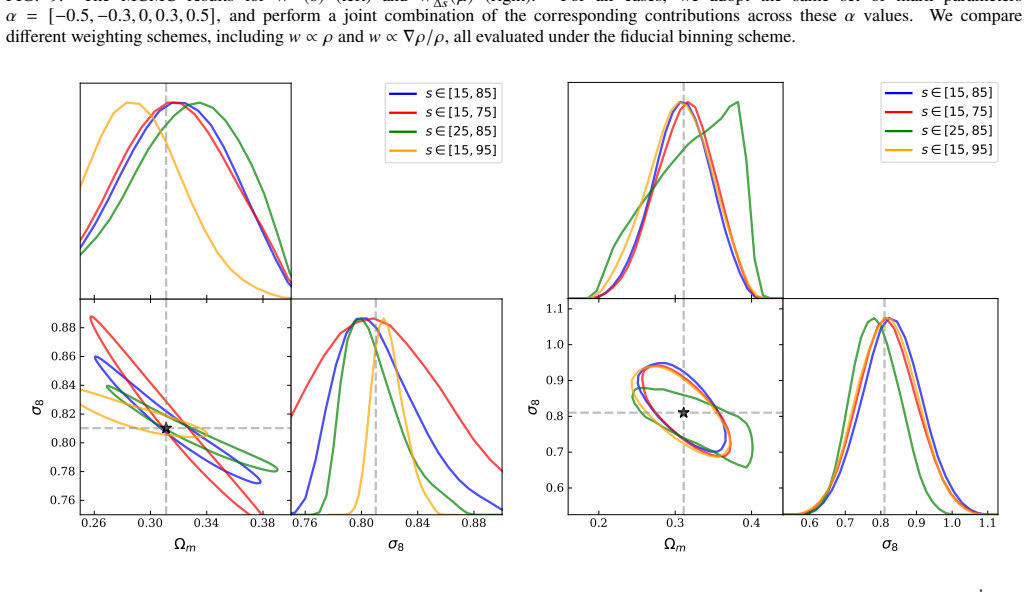
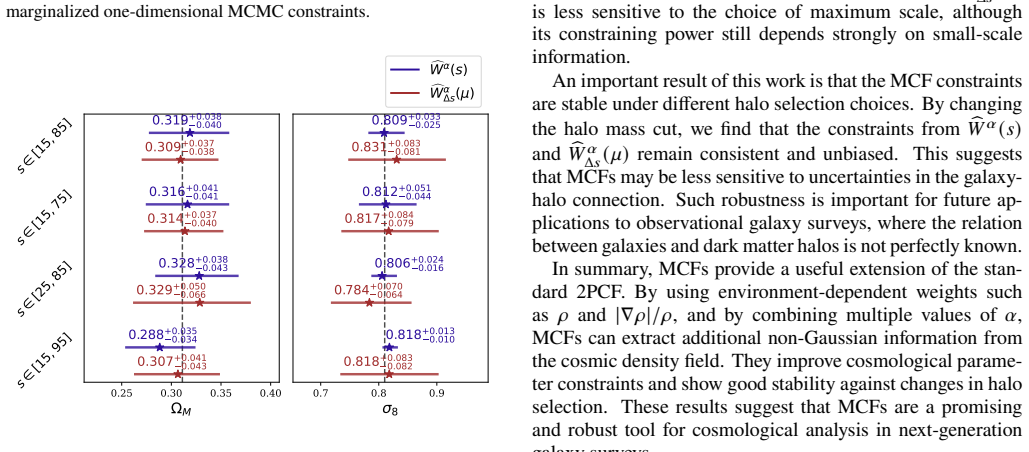
- The marked statistics remain robust when the analysis scale range or halo selection is changed.
- The angular statistic retains extra cosmological information that is less sensitive to tracer selection.
Where Pith is reading between the lines
- Applying the same multi-mark analysis to real catalogs from DESI or Euclid could tighten neutrino-mass bounds without requiring larger survey volumes.
- The observed complementarity between mark types suggests that a joint density-plus-gradient mark might yield still larger gains in full three-dimensional analyses.
- If the emulator accuracy holds when the simulation volume is increased, the method should scale directly to the data volumes expected from next-generation surveys.
- Comparing the marked statistics against alternative higher-order probes such as three-point functions on the same simulations would clarify whether the gains are unique or overlapping.
Load-bearing premise
The Gaussian-process emulators trained on the 129 simulations accurately reproduce the marked statistics across the full parameter space with negligible interpolation error.
What would settle it
Repeating the full FoM comparison on an independent simulation suite or on mock catalogs that include realistic observational systematics would falsify the claimed improvement if the gain shrinks below 1.2.
Figures



read the original abstract
We investigate whether neighbor-density-weighted marked correlation functions (MCFs) can extract cosmological information beyond the standard redshift-space two-point correlation function (2PCF). Using the Kun suite of 129 $w_0w_a$CDM$+\sum m_\nu$ simulations in $1~h^{-1}{\rm Gpc}$ boxes, we construct Gaussian-process emulators for the normalized scale statistic $\widehat{W}^{\alpha}(s)$ and the angular statistic $\widehat{W}^{\alpha}_{\Delta s}(\mu)$. We perform joint analyses combining multiple mark parameters $\alpha$ and quantify the information gain using the FoM in the $\Omega_m$--$\sigma_8$ plane. Relative to the 2PCF case, three-mark combinations improve the FoM by factors of $1.7$--$2.5$, while five-mark combinations increase the gain to $1.9$--$2.4$, depending on the statistic and mark definition. We further compare density and normalized-gradient marks, finding that they are nearly redundant for isotropic statistics but complementary for angular statistics, where their combination improves the FoM by up to $43\%$. Tests of scale range and halo selection show that the marked statistics remain robust under changes in analysis choices, with the angular statistic retaining additional cosmological information that is less sensitive to tracer selection. Our results demonstrate that MCFs substantially enhance cosmological constraints beyond the standard 2PCF and provide a robust probe for next-generation galaxy surveys.
Editorial analysis
A structured set of objections, weighed in public.
Referee Report
Summary. The manuscript investigates whether neighbor-density-weighted marked correlation functions (MCFs) extract additional cosmological information beyond the redshift-space 2PCF. Using the Kun suite of 129 w0waCDM+∑mν simulations, the authors train Gaussian-process emulators for the normalized scale statistic Ŵ^α(s) and angular statistic Ŵ^α_Δs(μ), then quantify information gain via FoM in the Ωm–σ8 plane for multi-mark combinations (three-mark: 1.7–2.5× improvement; five-mark: 1.9–2.4×). They also compare density vs. normalized-gradient marks and test robustness to scale range and halo selection.
Significance. If the emulator-based results hold, the work would be significant for next-generation surveys by showing that MCFs can deliver substantial FoM gains over the 2PCF with modest additional computational cost. The use of independent N-body simulations rather than parameter-fitting circularity is a methodological strength, and the reported complementarity between mark types for angular statistics is a concrete, testable finding.
major comments (2)
- [Abstract / emulator section] Abstract and emulator construction section: the headline FoM gains (1.7–2.5× for three-mark combinations) rest on the assumption that the GP emulators for Ŵ^α(s) and Ŵ^α_Δs(μ) reproduce the true dependence on the full ≥6-dimensional parameter vector (Ωm, σ8, w0, wa, ∑mν, plus h, ns) with negligible interpolation error. Only 129 training points are used for statistics that weight small-scale neighbor densities and are therefore more nonlinear than the plain 2PCF; no cross-validation, held-out error, or covariance-inflation metrics are reported. This directly undermines the quantitative central claim.
- [Results / joint analyses] Results section on joint analyses: the claim that five-mark combinations increase the gain to 1.9–2.4× and that density + gradient marks improve angular FoM by up to 43% is presented without any demonstration that the emulator error budget has been propagated into the reported contours or FoM values. If emulator variance is comparable to the reported gains, the improvements could be artifacts of sparse sampling in parameter space.
minor comments (2)
- [Methods] The precise definition of the normalized statistics Ŵ^α(s) and Ŵ^α_Δs(μ) (including how the mark weighting is applied and normalized) should be stated explicitly in the main text rather than deferred entirely to appendices.
- [Figures] Figure captions for the FoM comparison plots should include the exact mark parameter values α used in each combination and the covariance estimation method.
Simulated Author's Rebuttal
We thank the referee for their thorough review and for highlighting the importance of emulator validation to support the quantitative claims. We address each major comment below and will revise the manuscript to incorporate the requested checks.
read point-by-point responses
-
Referee: [Abstract / emulator section] Abstract and emulator construction section: the headline FoM gains (1.7–2.5× for three-mark combinations) rest on the assumption that the GP emulators for Ŵ^α(s) and Ŵ^α_Δs(μ) reproduce the true dependence on the full ≥6-dimensional parameter vector (Ωm, σ8, w0, wa, ∑mν, plus h, ns) with negligible interpolation error. Only 129 training points are used for statistics that weight small-scale neighbor densities and are therefore more nonlinear than the plain 2PCF; no cross-validation, held-out error, or covariance-inflation metrics are reported. This directly undermines the quantitative central claim.
Authors: We agree that the absence of reported cross-validation or held-out error metrics leaves the emulator accuracy unquantified and weakens the central claims. The original manuscript describes the GP construction but does not include these diagnostics. In the revision we will add a new subsection presenting leave-one-out cross-validation results, mean absolute percentage errors on held-out simulations, and an assessment of whether interpolation errors remain subdominant to the covariance used in the FoM calculation. revision: yes
-
Referee: [Results / joint analyses] Results section on joint analyses: the claim that five-mark combinations increase the gain to 1.9–2.4× and that density + gradient marks improve angular FoM by up to 43% is presented without any demonstration that the emulator error budget has been propagated into the reported contours or FoM values. If emulator variance is comparable to the reported gains, the improvements could be artifacts of sparse sampling in parameter space.
Authors: We acknowledge that emulator uncertainties were not propagated into the reported FoM values or contours. In the revised manuscript we will add explicit tests that either (i) inflate the data covariance by the measured emulator variance or (ii) recompute the FoM after adding a diagonal emulator-error term, and we will report the resulting changes to the quoted improvement factors. This will either confirm the robustness of the gains or qualify them appropriately. revision: yes
Circularity Check
No circularity; derivation relies on external simulations and standard emulation
full rationale
The paper measures marked correlation functions directly on the independent Kun suite of 129 N-body simulations, trains Gaussian-process emulators on those measurements, and then compares FoM values between the 2PCF and various MCF combinations. No step equates a reported prediction or constraint to a fitted input by construction, invokes a self-citation as the sole justification for a uniqueness claim, or renames an input quantity as an output. The emulator step is a standard interpolation whose accuracy is an external assumption rather than a definitional identity, and the FoM gains are computed from the same simulation measurements for all statistics.
Axiom & Free-Parameter Ledger
axioms (1)
- domain assumption Standard flat w0waCDM cosmology with massive neutrinos governs the simulated large-scale structure.
Reference graph
Works this paper leans on
-
[1]
Choice of marks Weusetwoenvironmentalmarksinthelikelihoodanalysis. The first is the adaptive local density itself, 𝑤=𝜌 𝑛NB .(4) This mark directly upweights halos in dense environments. It is therefore sensitive to the clustering of halos in compact overdense structures. The second mark is the normalized density gradient, 𝑤= |∇𝜌 𝑛NB | 𝜌𝑛NB .(5) This quant...
-
[2]
Marked two-point statistic We now incorporate the environmental marks into a two- point statistic. For a given mark𝑤and mark power𝛼, we define the marked correlation function as 𝑊 𝛼 (r)= ⟨𝛿(x)𝑤 𝛼 (x)𝛿(x+r)𝑤 𝛼 (x+r) ⟩ .(6) Here𝛿is the tracer overdensity field, and the exponent𝛼 controls how strongly the mark affects the pair weighting. Forcomparison,theord...
-
[3]
To build a compact data vector, we compress it in two comple- mentary ways
Scale and angular compression The full two-dimensional statistic𝑊𝛼 (𝑠, 𝜇)contains both scale dependence and line-of-sight angular dependence. To build a compact data vector, we compress it in two comple- mentary ways. First, to isolate the scale dependence, we integrate over the angular range, 𝑊 𝛼 (𝑠)= ∫ 𝜇max 𝜇min 𝑊 𝛼 (𝑠, 𝜇)𝑑𝜇.(9) This statistic measures ...
-
[4]
Normalized marked correlation functions Forlikelihoodinference,wefocusontheshapeinformation rather than the overall integral of each marked statistic. We therefore define the normalized scale-dependent statistic as b𝑊 𝛼 (𝑠)= 𝑊 𝛼 (𝑠)∫ 𝑠max 𝑠min 𝑊 𝛼 (𝑠 ′)𝑑𝑠 ′ .(11) 5 FIG.2: Environmentalquantitiesina500×500(ℎ −1Mpc)2 sliceofaKunhalocatalog. Left: thelocal-d...
-
[5]
The full simulation is divided into 𝑁sub =5 3 =125subsamples, each with volume𝑉 sub = (400ℎ −1Mpc)3
Data covariance We estimate the data covariance from subvolumes of the Jiutiansimulation. The full simulation is divided into 𝑁sub =5 3 =125subsamples, each with volume𝑉 sub = (400ℎ −1Mpc)3. Lety 𝑘 be the data vector measured from the𝑘-th subvolume, and let ¯y= 1 𝑁sub 𝑁sub∑︁ 𝑘=1 y𝑘 (29) be the mean over all subvolumes. The covariance for an ob- served vol...
-
[6]
We estimate this term using the leave-one-out validation de- scribed in the previous section
Emulator covariance The emulator covariance quantifies the uncertainty intro- duced by interpolation across cosmological parameter space. We estimate this term using the leave-one-out validation de- scribed in the previous section. For the𝑗-th training cosmol- ogy, the emulator is trained on all other cosmologies and then evaluated at the omitted point. T...
-
[7]
Correction for fixed initial phases TheKuntraining simulations are generated with fixed ini- tial phases. While this suppresses sample variance and im- proves emulator training, it can introduce a systematic offset between the emulator prediction and the ensemble-averaged statistic from independent realizations. Following the ratio- based correction [84],...
-
[8]
We correct this bias using the Hartlap factor [85]
Inverse covariance correction Because the covariance matrix is estimated from a finite number of subvolumes, its inverse is biased. We correct this bias using the Hartlap factor [85]. The debiased inverse co- variance is bC−1 = 𝑁sub −𝑁 𝑑 −2 𝑁sub −1 C−1,(36) 9 31 46 62 77w 31 46 62 77 w 31 46 62 77w / 31 46 62 77 w / 0.00 0.01 0.02 0.03 0.04 W(s) 0.2 0.4 0...
work page 2021
-
[9]
M. Colless, B. A. Peterson, C. Jackson, J. A. Peacock, S. Cole, P. Norberg, I. K. Baldry, C. M. Baugh, J. Bland-Hawthorn, T. Bridges, et al., arXiv Astrophysics e-prints (2003), astro- 14 0.26 0.30 0.34 0.38 m 0.76 0.78 0.80 0.82 0.84 0.86 0.88 8 0.76 0.80 0.84 0.88 8 Mcut = 3.85 × 10¹² M Mcut = 3.15 × 10¹² M Mcut = 1.65 × 10¹² M 0.2 0.3 0.4 m 0.6 0.7 0.8...
-
[10]
The 6dF Galaxy Survey: z \approx 0 measurement of the growth rate and sigma_8
F. Beutler, C. Blake, M. Colless, D. H. Jones, L. Staveley- Smith, G. B. Poole, L. Campbell, Q. Parker, W. Saunders, and F. Watson, mnras423, 3430 (2012), 1204.4725
work page internal anchor Pith review Pith/arXiv arXiv 2012
- [14]
-
[15]
W. J. Percival, S. Cole, D. J. Eisenstein, R. C. Nichol, J. A. Peacock,A.C.Pope,andA.S.Szalay,mnras381,1053(2007), 0705.3323
work page internal anchor Pith review Pith/arXiv arXiv 2007
-
[16]
L. Anderson, E. Aubourg, S. Bailey, D. Bizyaev, M. Blanton, A. S. Bolton, J. Brinkmann, J. R. Brownstein, A. Burden, A. J. Cuesta, et al., mnras427, 3435 (2012), 1203.6594
work page internal anchor Pith review Pith/arXiv arXiv 2012
-
[17]
S.Alam,M.Ata,S.Bailey,F.Beutler,D.Bizyaev,J.A.Blazek, A.S.Bolton,J.R.Brownstein,A.Burden,C.-H.Chuang,etal., mnras470, 2617 (2017), 1607.03155
work page internal anchor Pith review Pith/arXiv arXiv 2017
-
[18]
Kaiser, Monthly Notices of the Royal Astronomical Society 227, 1 (1987)
N. Kaiser, Monthly Notices of the Royal Astronomical Society 227, 1 (1987)
work page 1987
-
[19]
W. E. Ballinger, J. A. Peacock, and A. F. Heavens, Monthly Notices of the Royal Astronomical Society282, 877 (1996), astro-ph/9605017
work page internal anchor Pith review Pith/arXiv arXiv 1996
-
[20]
D.J.EisensteinandW.Hu,TheAstrophysicalJournal496,605 (1998), astro-ph/9709112
work page internal anchor Pith review Pith/arXiv arXiv 1998
-
[21]
Probing dark energy using baryonic oscillations in the galaxy power spectrum as a cosmological ruler
C. Blake and K. Glazebrook, The Astrophysical Journal594, 665 (2003), astro-ph/0301632
work page internal anchor Pith review Pith/arXiv arXiv 2003
-
[22]
Probing Dark Energy with Baryonic Acoustic Oscillations from Future Large Galaxy Redshift Surveys
H.-J. Seo and D. J. Eisenstein, The Astrophysical Journal598, 720 (2003), astro-ph/0307460
work page internal anchor Pith review Pith/arXiv arXiv 2003
-
[23]
M. Colless, B. A. Peterson, C. Jackson, J. A. Peacock, S. Cole, P. Norberg, I. K. Baldry, C. M. Baugh, J. Bland-Hawthorn, T.Bridges,etal.,arXive-printsastro-ph/0306581(2003),astro- ph/0306581
-
[24]
F. Beutler, C. Blake, M. Colless, D. H. Jones, L. Staveley-Smith, G. B. Poole, L. Campbell, Q. Parker, W. Saunders, and F. Watson, Monthly Notices of the Royal Astronomical Society423, 3430 (2012), ISSN 0035-8711, https://academic.oup.com/mnras/article- pdf/423/4/3430/4903419/mnras0423-3430.pdf, URLhttps: //doi.org/10.1111/j.1365-2966.2012.21136.x
-
[25]
C. Blake, K. Glazebrook, T. M. Davis, S. Brough, M. Colless, C.Contreras,W.Couch,S.Croom,M.J.Drinkwater,K.Forster, et al., Monthly Notices of the Royal Astronomical Society418, 1725 (2011), 1108.2637
work page internal anchor Pith review Pith/arXiv arXiv 2011
-
[26]
The WiggleZ Dark Energy Survey: the growth rate of cosmic structure since redshift z=0.9
C. Blake, S. Brough, M. Colless, C. Contreras, W. Couch, S. Croom, T. Davis, M. J. Drinkwater, K. Forster, D. Gilbank, et al., Monthly Notices of the Royal Astronomical Society415, 2876 (2011), 1104.2948
work page internal anchor Pith review Pith/arXiv arXiv 2011
-
[27]
D. G. York, J. Adelman, J. Anderson, John E., S. F. Anderson, J.Annis,N.A.Bahcall,J.A.Bakken,R.Barkhouser,S.Bastian, E. Berman, et al., The Astronomical Journal120, 1579 (2000), astro-ph/0006396
work page internal anchor Pith review Pith/arXiv arXiv 2000
-
[28]
A.G.Sánchez,C.G.Scóccola,A.J.Ross,W.Percival,M.Man- era, F. Montesano, X. Mazzalay, A. J. Cuesta, D. J. Eisenstein, E. Kazin, et al., Monthly Notices of the Royal Astronomical Society425, 415 (2012), 1203.6616
work page internal anchor Pith review Pith/arXiv arXiv 2012
-
[29]
A. G. Sánchez, E. A. Kazin, F. Beutler, C.-H. Chuang, A. J. Cuesta,D.J.Eisenstein,M.Manera,F.Montesano,R.C.Nichol, N. Padmanabhan, et al., Monthly Notices of the Royal Astro- nomical Society433, 1202 (2013), 1303.4396. 15
work page internal anchor Pith review Pith/arXiv arXiv 2013
-
[30]
L. Anderson, É. Aubourg, S. Bailey, F. Beutler, V. Bhardwaj, M. Blanton, A. S. Bolton, J. Brinkmann, J. R. Brownstein, A. Burden, et al., Monthly Notices of the Royal Astronomical Society441, 24 (2014), 1312.4877
work page internal anchor Pith review Pith/arXiv arXiv 2014
-
[31]
L.Samushia,B.A.Reid,M.White,W.J.Percival,A.J.Cuesta, G.-B. Zhao, A. J. Ross, M. Manera, É. Aubourg, F. Beutler, et al., Monthly Notices of the Royal Astronomical Society439, 3504 (2014), 1312.4899
work page internal anchor Pith review Pith/arXiv arXiv 2014
-
[32]
A. J. Ross, L. Samushia, C. Howlett, W. J. Percival, A. Burden, and M. Manera, Monthly Notices of the Royal Astronomical Society449, 835 (2015), 1409.3242
work page internal anchor Pith review Pith/arXiv arXiv 2015
-
[33]
F. Beutler, H.-J. Seo, A. J. Ross, P. McDonald, S. Saito, A. S. Bolton, J. R. Brownstein, C.-H. Chuang, A. J. Cuesta, D. J. Eisenstein, et al., Monthly Notices of the Royal Astronomical Society464, 3409 (2017), 1607.03149
work page internal anchor Pith review Pith/arXiv arXiv 2017
-
[34]
A. G. Sánchez, J. N. Grieb, S. Salazar-Albornoz, S. Alam, F. Beutler, A. J. Ross, J. R. Brownstein, C.-H. Chuang, A. J. Cuesta, D. J. Eisenstein, et al., Monthly Notices of the Royal Astronomical Society464, 1493 (2017), 1607.03146
work page internal anchor Pith review Pith/arXiv arXiv 2017
-
[35]
C.-H.Chuang,F.-S.Kitaura,Y.Liang,A.Font-Ribera,C.Zhao, P.McDonald,andC.Tao,PhysicalReviewD95,063528(2017), 1605.05352
work page internal anchor Pith review Pith/arXiv arXiv 2017
-
[36]
The DESI Experiment Part I: Science,Targeting, and Survey Design
DESI Collaboration, A. Aghamousa, J. Aguilar, S. Ahlen, S. Alam, L. E. Allen, C. Allende Prieto, J. Annis, S. Bai- ley, C. Balland, et al., arXiv e-prints arXiv:1611.00036 (2016), 1611.00036
work page internal anchor Pith review Pith/arXiv arXiv 2016
-
[37]
LSST Science Collaboration, P. A. Abell, J. Allison, S. F. An- derson, J. R. Andrew, J. R. P. Angel, L. Armus, D. Arnett, S. J. Asztalos, T. S. Axelrod, et al., arXiv e-prints arXiv:0912.0201 (2009), 0912.0201
work page internal anchor Pith review Pith/arXiv arXiv 2009
-
[38]
Euclid Definition Study Report
R. Laureijs, J. Amiaux, S. Arduini, J. L. Auguères, J. Brinch- mann,R.Cole,M.Cropper,C.Dabin,L.Duvet,A.Ealet,etal., arXiv e-prints arXiv:1110.3193 (2011), 1110.3193
work page internal anchor Pith review Pith/arXiv arXiv 2011
-
[39]
Euclid Collaboration, Y. Mellier, Abdurro’uf, J. A. Acevedo Barroso, A. Achúcarro, J. Adamek, R. Adam, G. E. Ad- dison, N. Aghanim, M. Aguena, et al., arXiv e-prints arXiv:2405.13491 (2024), 2405.13491
-
[40]
O.Dore,C.Hirata,Y.Wang,D.Weinberg,T.Eifler,R.J.Foley, C. H. Heinrich, E. Krause, S. Perlmutter, A. Pisani, et al., Bull. Amer. Astron. Soc.51, 341 (2019), 1904.01174
work page internal anchor Pith review Pith/arXiv arXiv 2019
- [41]
-
[42]
C. G. Sabiu, D. F. Mota, C. Llinares, and C. Park, Astronomy and Astrophysics592, A38 (2016), 1603.05750
work page internal anchor Pith review Pith/arXiv arXiv 2016
-
[43]
Z. Slepian, D. J. Eisenstein, J. R. Brownstein, C.-H. Chuang, H. Gil-Marín, S. Ho, F.-S. Kitaura, W. J. Percival, A. J. Ross, G. Rossi, et al., Monthly Notices of the Royal Astronomical Society469, 1738 (2017), 1607.06097
work page internal anchor Pith review Pith/arXiv arXiv 2017
-
[44]
C. G. Sabiu, B. Hoyle, J. Kim, and X.-D. Li, The Astrophysical Journals242, 29 (2019), 1901.00296
work page internal anchor Pith review Pith/arXiv arXiv 2019
- [45]
-
[46]
Precision cosmography with stacked voids
G. Lavaux and B. D. Wandelt, The Astrophysical Journal754, 109 (2012), 1110.0345
work page internal anchor Pith review Pith/arXiv arXiv 2012
-
[47]
Estimating Cosmological Parameters from the Dark Matter Distribution
S. Ravanbakhsh, J. Oliva, S. Fromenteau, L. C. Price, S. Ho, J.Schneider,andB.Poczos,arXive-prints(2017),1711.02033
work page internal anchor Pith review Pith/arXiv arXiv 2017
-
[48]
CosmoFlow: Using Deep Learning to Learn the Universe at Scale
A. Mathuriya, D. Bard, P. Mendygral, L. Meadows, J. Arne- mann, L. Shao, S. He, T. Karna, D. Moise, S. J. Pennycook, et al., arXiv e-prints (2018), 1808.04728
work page internal anchor Pith review Pith/arXiv arXiv 2018
-
[49]
S. Pan, M. Liu, J. Forero-Romero, C. G. Sabiu, Z. Li, H. Miao, and X.-D. Li, Science China Physics, Mechanics & Astronomy 63, 110412 (2020)
work page 2020
-
[50]
Luminosity- and morphology-dependent clustering of galaxies
C. Beisbart and M. Kerscher, The Astrophysical Journal545, 6 (2000), astro-ph/0003358
work page internal anchor Pith review Pith/arXiv arXiv 2000
- [51]
-
[52]
Spatial distribution of galactic halos and their merger histories
S. Gottlöber, M. Kerscher, A. V. Kravtsov, A. Faltenbacher, A. Klypin, and V. Müller, Astronomy and Astrophysics387, 778 (2002), astro-ph/0203148
work page internal anchor Pith review Pith/arXiv arXiv 2002
-
[53]
R. K. Sheth and G. Tormen, Monthly Notices of the Royal Astronomical Society350, 1385 (2004), astro-ph/0402237
work page internal anchor Pith review Pith/arXiv arXiv 2004
- [54]
- [55]
-
[56]
Breaking Halo Occupation Degeneracies with Marked Statistics
M. White and N. Padmanabhan, Monthly Notices of the Royal Astronomical Society395, 2381 (2009), 0812.4288
work page internal anchor Pith review Pith/arXiv arXiv 2009
-
[57]
A marked correlation function for constraining modified gravity models
M. White, JCAP2016, 057 (2016), 1609.08632
work page internal anchor Pith review Pith/arXiv arXiv 2016
-
[58]
S.Satpathy,R.ACCroft,S.Ho,andB.Li,MonthlyNoticesof theRoyalAstronomicalSociety484,2148(2019),1901.01447
work page internal anchor Pith review Pith/arXiv arXiv 2019
-
[59]
E. Massara, F. Villaescusa-Navarro, S. Ho, N. Dalal, and D. N. Spergel, Physical Review Letters126, 011301 (2021)
work page 2021
- [60]
- [61]
-
[62]
X. Xiao, Y. Yang, X. Luo, J. Ding, Z. Huang, X. Wang, Y. Zheng, C. G. Sabiu, J. Forero-Romero, H. Miao, et al., Monthly Notices of the Royal Astronomical Society513, 595–603 (2022), ISSN 1365-2966, URLhttp://dx.doi. org/10.1093/mnras/stac879
-
[63]
L. Lai, J. Ding, X. Luo, Y. Yang, Z. Wang, K. Liu, G. Liu, X. Wang, Y. Zheng, Z. Li, et al., Science China Physics, Me- chanics & Astronomy67(2024), ISSN 1869-1927, URL http://dx.doi.org/10.1007/s11433-023-2384-4
-
[64]
K. Heitmann, D. Higdon, M. White, S. Habib, B. J. Williams, E. Lawrence, and C. Wagner, Astrophys. J.705, 156 (2009), 0902.0429
work page internal anchor Pith review Pith/arXiv arXiv 2009
-
[65]
The Coyote Universe I: Precision Determination of the Nonlinear Matter Power Spectrum
K. Heitmann, M. White, C. Wagner, S. Habib, and D. Higdon, Astrophys. J.715, 104 (2010), 0812.1052
work page internal anchor Pith review Pith/arXiv arXiv 2010
-
[66]
E. Lawrence, K. Heitmann, M. White, D. Higdon, C. Wagner, S. Habib, and B. Williams, Astrophys. J.713, 1322 (2010), 0912.4490
work page internal anchor Pith review Pith/arXiv arXiv 2010
-
[67]
The Coyote Universe Extended: Precision Emulation of the Matter Power Spectrum
K. Heitmann, E. Lawrence, J. Kwan, S. Habib, and D. Higdon, Astrophys. J.780, 111 (2014), 1304.7849
work page internal anchor Pith review Pith/arXiv arXiv 2014
-
[68]
The Mira-Titan Universe II: Matter Power Spectrum Emulation
E. Lawrence, K. Heitmann, J. Kwan, A. Upadhye, D. Bingham, S. Habib, D. Higdon, A. Pope, H. Finkel, and N. Frontiere, Astrophys. J.847, 50 (2017), 1705.03388
work page internal anchor Pith review Pith/arXiv arXiv 2017
-
[69]
S. Bocquet, K. Heitmann, S. Habib, E. Lawrence, T. Uram, N. Frontiere, A. Pope, and H. Finkel, arXiv e-prints (2020), 2003.12116
-
[70]
J.Kwan,K.Heitmann,S.Habib,N.Padmanabhan,E.Lawrence, H.Finkel,N.Frontiere,andA.Pope,TheAstrophysicalJournal 810, 35 (2015)
work page 2015
-
[71]
B. D. Wibking, D. H. Weinberg, A. N. Salcedo, H.-Y. Wu, S. Singh, S. Rodríguez-Torres, L. H. Garrison, and D. J. Eisenstein, Monthly Notices of the Royal Astronomical So- ciety492, 2872–2896 (2019), ISSN 1365-2966, URLhttp: //dx.doi.org/10.1093/mnras/stz3423
-
[72]
J. Kwan, S. Bhattacharya, K. Heitmann, and S. Habib, The Astrophysical Journal768, 123 (2013), ISSN 1538-4357, URL http://dx.doi.org/10.1088/0004-637X/768/2/123
-
[73]
Nishimichi et al., The Astrophysical Journal884, 29 (2019), ISSN 1538-4357, URLhttp://dx.doi.org/10
T. Nishimichi et al., The Astrophysical Journal884, 29 (2019), ISSN 1538-4357, URLhttp://dx.doi.org/10. 3847/1538-4357/ab3719. 16
work page 2019
-
[74]
Y. Kobayashi, T. Nishimichi, M. Takada, R. Takahashi, and K.Osato,arXive-printsarXiv:2005.06122(2020),2005.06122
- [75]
-
[76]
K.R.Moran,K.Heitmann,E.Lawrence,S.Habib,D.Bingham, A. Upadhye, J. Kwan, D. Higdon, and R. Payne, Mon. Not. R. Astron. Soc.520, 3443 (2023), 2207.12345
-
[77]
K. Cranmer, J. Brehmer, and G. Louppe, Proceedings of the National Academy of Sciences117, 30055–30062 (2020), ISSN 1091-6490, URLhttp://dx.doi.org/10. 1073/pnas.1912789117
work page 2020
- [78]
-
[79]
V. Springel, R. Pakmor, O. Zier, and M. Reinecke, Monthly Notices of the Royal Astronomical Society506, 2871–2949 (2021), ISSN 1365-2966, URLhttp://dx.doi.org/10. 1093/mnras/stab1855
work page 2021
- [80]
- [81]
-
[82]
Planck 2018 results. VI. Cosmological parameters
Planck Collaboration, N. Aghanim, Y. Akrami, M. Ashdown, J. Aumont, C. Baccigalupi, M. Ballardini, A. J. Banday, R. B. Barreiro, N. Bartolo, et al., Astron. Astrophys.641, A6 (2020), 1807.06209
work page internal anchor Pith review Pith/arXiv arXiv 2020
-
[83]
R. E. Angulo and A. Pontzen, Mon. Not. R. Astron. Soc.462, L1 (2016), 1603.05253
work page internal anchor Pith review Pith/arXiv arXiv 2016
discussion (0)
Sign in with ORCID, Apple, or X to comment. Anyone can read and Pith papers without signing in.