Lowest order Carleman linearization for low Reynolds long-term behaviour of fluid flow simulations
Pith reviewed 2026-05-25 04:22 UTC · model grok-4.3
The pith
The second-order truncation of Carleman linearization for the fluid equations recovers the steady-state solution.
A machine-rendered reading of the paper's core claim, the machinery that carries it, and where it could break.
Core claim
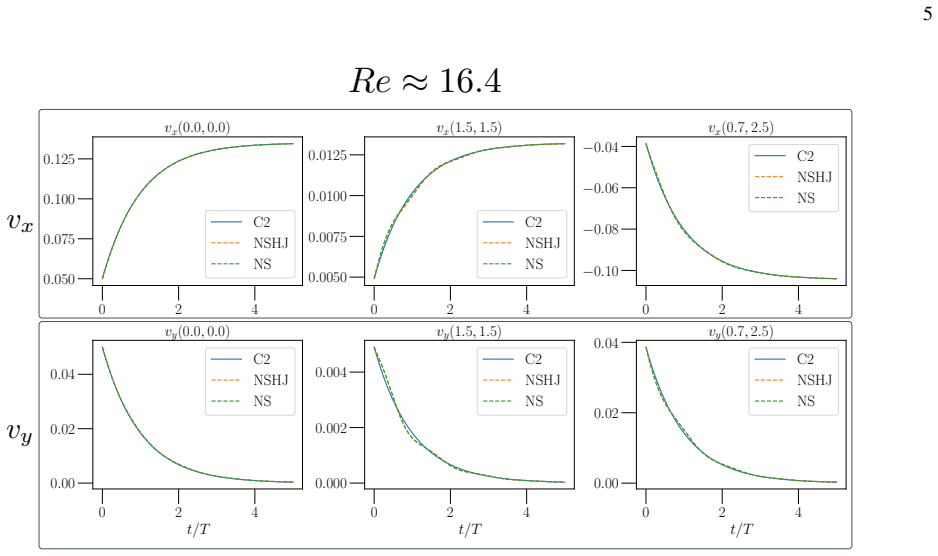
It is shown that the lowest (second) order truncation of the Carleman linearization of the fluid equations (C2) recovers not only the initial transient of the time evolution but also its late stage, namely the steady-state solution. This asymptotic property is first proved analytically for the decaying logistic with external forcing and then shown to hold to a significant degree of accuracy also for the fairly more complex case of two-dimensional fluid flows at moderate Reynolds number.
What carries the argument
The second-order Carleman linearization (C2), which replaces the nonlinear fluid equations with a larger linear system by discarding all terms beyond quadratic order in the expansion.
If this is right
- The steady state satisfies the truncated linear system exactly, so it can be obtained by solving a linear problem rather than integrating the nonlinear equations in time.
- The property holds analytically for the forced logistic equation and numerically for two-dimensional flows at moderate Reynolds number.
- Linear-system methods become applicable to steady fluid problems that were previously treated as nonlinear initial-value problems.
Where Pith is reading between the lines
- The same truncation might preserve fixed points in other nonlinear systems whose Carleman expansion has a similar structure.
- Quantum linear solvers could be applied directly to the C2 system to obtain steady fluid solutions without classical time marching.
- Higher-dimensional or higher-Reynolds cases can be checked by repeating the numerical comparison performed for the two-dimensional moderate-Re flows.
Load-bearing premise
The error from discarding terms beyond second order does not move or destabilize the fixed point that the full fluid equations approach at late times.
What would settle it
Solve the steady Navier-Stokes equations and the C2-truncated linear system for the same two-dimensional domain, boundary conditions, and moderate Reynolds number; the velocity fields must differ by more than numerical tolerance if the claim is false.
Figures




read the original abstract
It is shown that the lowest (second) order truncation of the Carleman linearization of the fluid equations (C2) recovers the late stage of the evolution, namely the steady-state solution, although to a decreasing degree of accuracy at increasing Reynolds number. This asymptotic property is first proved analytically for the decaying logistic with external forcing and then shown to hold to a significant degree of accuracy also for the more complex case of two-dimensional Kolmogorov-like fluid flow at low Reynolds numbers, below $Re \sim 10$. This time-asymptotic property may open interesting prospects for the quantum simulation of low-Reynolds steady-state fluid flows.
Editorial analysis
A structured set of objections, weighed in public.
Referee Report
Summary. The manuscript claims that the lowest (second) order truncation of the Carleman linearization of the fluid equations (denoted C2) recovers not only the initial transient but also the late-time steady-state solution. An analytic proof is provided for the forced logistic equation; for two-dimensional Navier-Stokes flows at moderate Reynolds number the property is asserted to hold to a significant degree of accuracy on the basis of numerical experiments. The result is presented as enabling quantum-computer simulation of steady fluid states.
Significance. If the fixed-point preservation property extends rigorously beyond the logistic case, the work would supply a concrete route for quantum linear-system solvers to reach steady fluid solutions without requiring the full nonlinear Carleman embedding or long-time integration. The analytic demonstration for the logistic equation is a clear strength; the numerical fluid evidence, however, remains preliminary.
major comments (2)
- [fluid-flow numerical section (implicit in abstract and introduction)] The central claim for the Navier-Stokes equations—that C2 leaves the steady-state fixed point unchanged (up to discretization error)—rests on numerical observation rather than derivation. No section demonstrates that the quadratic truncation terms vanish identically when the time derivative is set to zero, nor that the resulting algebraic system for the fixed point coincides with the original steady NS equations.
- [numerical results for 2D flows] The fluid-flow evidence is described only as holding 'to a significant degree of accuracy' with no error metrics, mesh details, Reynolds-number values, or comparison baselines supplied. This is insufficient to confirm that the truncation error does not alter the location or stability of the asymptotic fixed point.
minor comments (1)
- [abstract] The abstract and introduction should explicitly state the Reynolds-number range and the quantitative tolerance used to declare agreement with the reference steady solution.
Simulated Author's Rebuttal
We thank the referee for the detailed and constructive report. We address the two major comments point by point below, indicating planned revisions where appropriate. The manuscript's central claim for the Navier-Stokes equations is presented as a numerical observation rather than a general theorem, consistent with the analytic proof being limited to the logistic case.
read point-by-point responses
-
Referee: The central claim for the Navier-Stokes equations—that C2 leaves the steady-state fixed point unchanged (up to discretization error)—rests on numerical observation rather than derivation. No section demonstrates that the quadratic truncation terms vanish identically when the time derivative is set to zero, nor that the resulting algebraic system for the fixed point coincides with the original steady NS equations.
Authors: We agree that no general derivation is provided for the Navier-Stokes equations; the analytic fixed-point preservation is proved only for the forced logistic equation. For the fluid case the manuscript relies on numerical evidence that the C2 truncation recovers the steady state to a significant degree of accuracy. We will revise the text to state this distinction more explicitly in the abstract, introduction, and conclusions, and we will add a short paragraph discussing the structural reason why quadratic truncation can be expected to preserve the fixed point (the time-derivative term vanishes and the remaining algebraic system is closed at second order), while acknowledging that a rigorous proof for NS remains open. revision: partial
-
Referee: The fluid-flow evidence is described only as holding 'to a significant degree of accuracy' with no error metrics, mesh details, Reynolds-number values, or comparison baselines supplied. This is insufficient to confirm that the truncation error does not alter the location or stability of the asymptotic fixed point.
Authors: We acknowledge the lack of quantitative details in the numerical section. In the revised manuscript we will expand the fluid-flow results to report: (i) specific Reynolds numbers and mesh resolutions used, (ii) quantitative error norms (L2 and L-infinity) between the C2 steady-state solution and the reference steady Navier-Stokes solution obtained by direct nonlinear iteration, (iii) comparison against a standard baseline solver, and (iv) a brief assessment of stability of the recovered fixed point. These additions will allow readers to evaluate the truncation error more precisely. revision: yes
- A rigorous analytic demonstration that the second-order Carleman truncation preserves the steady-state fixed point for the full Navier-Stokes equations (beyond the logistic case) is not currently available and would require substantial additional theoretical development.
Circularity Check
No circularity; analytic logistic proof independent of fluid numerics
full rationale
The paper derives the time-asymptotic fixed-point property analytically for the forced logistic equation and reports separate numerical checks for 2D Navier-Stokes at moderate Re. No equation or claim reduces the fluid result to the logistic result by construction, and no self-citation is invoked as load-bearing justification for the fluid case. The fluid evidence is presented explicitly as numerical agreement rather than an identity or forced prediction.
Axiom & Free-Parameter Ledger
axioms (2)
- domain assumption The second-order truncation of the Carleman embedding preserves the location of the asymptotic fixed point for the forced logistic equation.
- domain assumption The same truncation order remains accurate for the steady state of the two-dimensional Navier-Stokes equations at moderate Reynolds number.
discussion (0)
Sign in with ORCID, Apple, or X to comment. Anyone can read and Pith papers without signing in.