On the Gravitational Angular Momentum of Axial Perturbations of a Regular Black Hole
Pith reviewed 2026-05-25 04:10 UTC · model grok-4.3
The pith
Axial perturbations of the Bardeen black hole transport angular momentum only for even multipoles.
A machine-rendered reading of the paper's core claim, the machinery that carries it, and where it could break.
Core claim
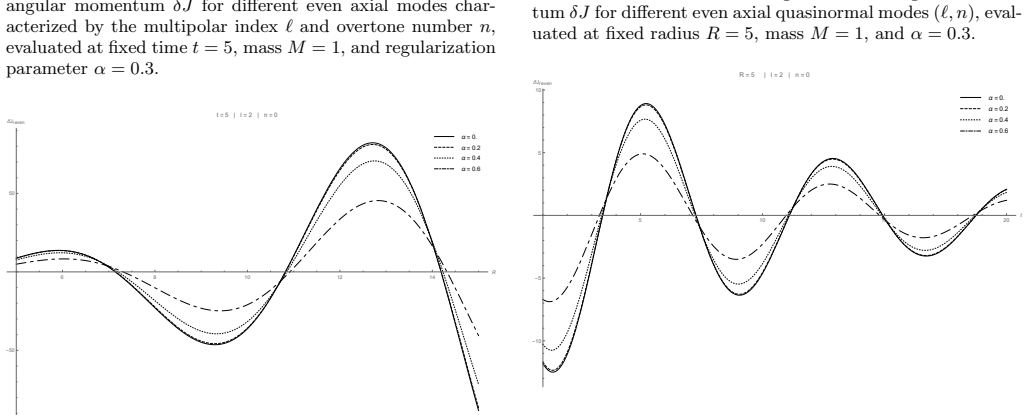
Using the Hamiltonian definition of conserved quantities in TEGR, we derive a closed expression for the perturbative angular momentum δJ in terms of the axial perturbation function h0(r,t). The result exhibits a sharp multipolar selection rule: δJ vanishes for odd values of the multipole index ℓ, while even-ℓ modes yield a nonzero contribution. The radial and temporal behavior of δJ is illustrated using the known axial quasinormal modes of the Bardeen spacetime.
What carries the argument
The Hamiltonian definition of conserved quantities in TEGR, which produces the closed expression for δJ from the axial perturbation function h0(r,t).
If this is right
- Axial perturbations with odd multipole index ℓ contribute zero to the gravitational angular momentum.
- Even multipole modes produce a nonzero δJ whose value depends on the specific form of h0(r,t).
- The time and radial dependence of this angular momentum follows the quasinormal mode ringing of the black hole.
Where Pith is reading between the lines
- The selection rule could be checked in other regular black hole solutions beyond the Bardeen metric.
- It suggests that parity of the perturbation mode controls angular momentum transport in teleparallel descriptions of black hole dynamics.
- Numerical evolution of even versus odd axial perturbations might reveal measurable differences in total angular momentum.
Load-bearing premise
The Hamiltonian definition of conserved quantities in TEGR can be directly applied to linear axial perturbations of the Bardeen spacetime to yield a physically meaningful δJ.
What would settle it
Explicit evaluation of the derived expression for δJ at an odd value of ℓ that gives a nonzero result would falsify the claimed selection rule.
Figures

read the original abstract
This Letter deals with the gravitational angular momentum carried by axial (odd-parity) perturbations of the Bardeen regular black hole within the teleparallel equivalent of general relativity (TEGR). Using the Hamiltonian definition of conserved quantities in TEGR, we derive a closed expression for the perturbative angular momentum $\delta J$ in terms of the axial perturbation function $h_0(r,t)$. The result exhibits a sharp multipolar selection rule: $\delta J$ vanishes for odd values of the multipole index $\ell$, while even-$\ell$ modes yield a nonzero contribution. The radial and temporal behavior of $\delta J$ is illustrated using the known axial quasinormal modes of the Bardeen spacetime.
Editorial analysis
A structured set of objections, weighed in public.
Referee Report
Summary. The paper derives a closed-form expression for the perturbative gravitational angular momentum δJ carried by axial (odd-parity) perturbations of the Bardeen regular black hole in teleparallel equivalent of general relativity (TEGR). Starting from the Hamiltonian definition of conserved quantities, the authors obtain δJ explicitly in terms of the axial perturbation function h_0(r,t). The derivation yields a multipolar selection rule in which δJ vanishes identically for odd values of the multipole index ℓ while remaining nonzero for even ℓ; the radial and temporal dependence is illustrated using known axial quasinormal modes of the Bardeen spacetime.
Significance. If the derivation is correct, the work supplies a parameter-free, closed expression for a conserved quantity in the linearized axial sector of a regular black-hole background within TEGR. The explicit multipolar selection rule, arising directly from parity properties under the spherical-harmonic decomposition of the Hamiltonian surface term, constitutes a sharp, falsifiable prediction. The use of known quasinormal modes to illustrate the result further strengthens the utility of the expression for concrete calculations.
minor comments (3)
- [§2.2, Eq. (8)] §2.2, Eq. (8): the surface term that defines the Hamiltonian conserved quantity is written with an implicit integration over the sphere; an explicit statement of the angular integration measure and the resulting factor of 4π would improve reproducibility of the selection rule.
- [§3] §3, paragraph following Eq. (12): the statement that the expression for δJ is 'closed' would be clearer if the authors explicitly note that no further integration by parts or use of the background field equations is required after substitution of h_0.
- [Figure 1] Figure 1 caption: the plotted quantity is labeled δJ(r) but the time dependence is not indicated; adding '(at fixed t = t_0)' or showing a sequence of snapshots would remove ambiguity.
Simulated Author's Rebuttal
We thank the referee for their positive assessment of the manuscript and the recommendation for minor revision. No specific major comments were listed in the report.
Circularity Check
No significant circularity in derivation chain
full rationale
The central derivation applies the standard Hamiltonian definition of conserved quantities from TEGR to linear axial perturbations of the Bardeen background, yielding an explicit expression for δJ in terms of h0(r,t) together with a parity-based multipolar selection rule. No self-definitional steps, fitted parameters renamed as predictions, or load-bearing self-citations are present in the provided abstract or described derivation. The result is parameter-free once the TEGR Hamiltonian surface term is evaluated on the linearized metric, and the selection rule follows directly from the spherical-harmonic decomposition without additional assumptions imported from prior author work. This is a standard, non-circular application of an external framework.
Axiom & Free-Parameter Ledger
axioms (1)
- domain assumption Hamiltonian definition of conserved quantities applies to linear axial perturbations in TEGR
Reference graph
Works this paper leans on
-
[1]
First M87 Event Horizon Telescope Results. I. The Shadow of the Super- massive Black Hole,
Event Horizon Telescope Collaboration, “First M87 Event Horizon Telescope Results. I. The Shadow of the Super- massive Black Hole,”Astrophys. J. Lett.875, L1 (2019)
work page 2019
-
[2]
Event Horizon Telescope Collaboration, “First Sagittarius A* Event Horizon Telescope Results. I. The Shadow of the Supermassive Black Hole in the Center of the Milky Way,” Astrophys. J. Lett.930, L12 (2022)
work page 2022
-
[3]
Non-singular general-relativistic gravita- tional collapse,
J. M. Bardeen, “Non-singular general-relativistic gravita- tional collapse,” inProceedings of International Confer- ence GR5, Tbilisi, Georgia (1968)
work page 1968
-
[4]
On the Quasinormal Modes for Gravita- tional Perturbations of the Bardeen Black Hole,
S. C. Ulhoa, “On the Quasinormal Modes for Gravita- tional Perturbations of the Bardeen Black Hole,”Braz. J. Phys.44, 380 (2014)
work page 2014
-
[5]
The teleparallel equivalent of general rela- tivity,
J. W. Maluf, “The teleparallel equivalent of general rela- tivity,”Ann. Phys. (Berlin)525, 339 (2013)
work page 2013
-
[6]
J. W. Maluf, S. C. Ulhoa, F. L. Carneiro, and K. H. C. Castello Branco, “Perturbations of the Grav- itational Energy in the Teleparallel Equivalent of Gen- eral Relativity: Quasinormal Modes of the Schwarzschild Black Hole,”Universe7, 100 (2021)
work page 2021
-
[7]
Testing black hole mimickers with the Event Horizon Telescope image of Sagittarius A ∗,
R. Shaikh, “Testing black hole mimickers with the Event Horizon Telescope image of Sagittarius A ∗,” Mon. Not. Roy. Astron. Soc.523, 375–384 (2023), arXiv:2208.01995 [gr-qc]
-
[8]
Black Hole Spectroscopy and Tests of General Relativity with GW250114,
A. G. Abacet al.(LIGO Scientific, Virgo, and KAGRA Collaborations), “Black Hole Spectroscopy and Tests of General Relativity with GW250114,” Phys. Rev. Lett. 136, 041403 (2026)
work page 2026
discussion (0)
Sign in with ORCID, Apple, or X to comment. Anyone can read and Pith papers without signing in.