Integral field spectroscopy with no IFUs: combining wide-field rotational slitless spectroscopy with tomographic reconstruction
Pith reviewed 2026-05-25 02:39 UTC · model grok-4.3
The pith
ROSSINI reconstructs full integral field spectroscopy datacubes from a series of rotated slitless images via tomographic inversion.
A machine-rendered reading of the paper's core claim, the machinery that carries it, and where it could break.
Core claim
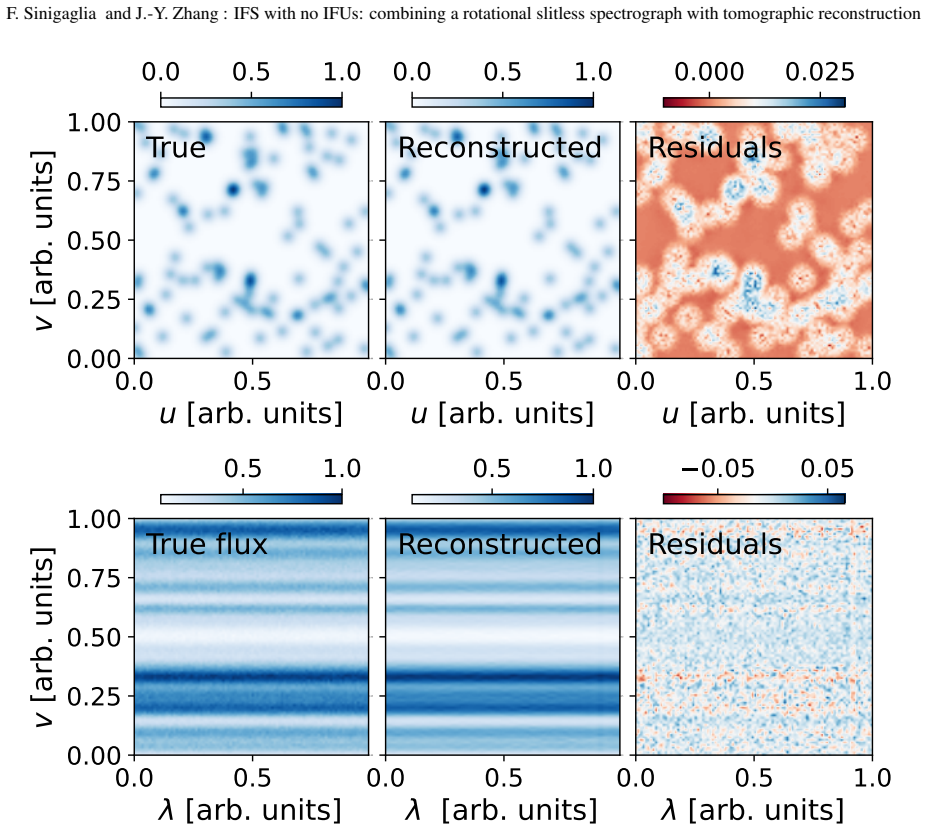
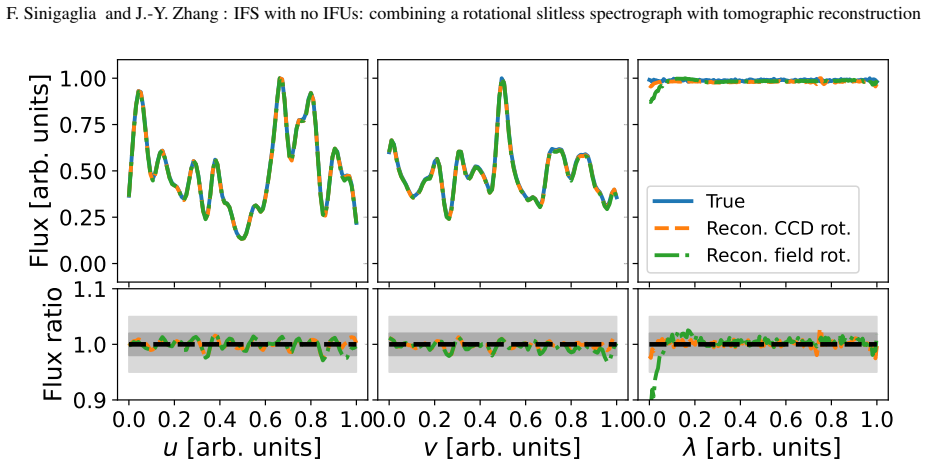
ROSSINI generates independent detector images of the same field by rotating the telescope or the dispersion direction of the optical element and then applies a tomographic reconstruction algorithm to produce a full IFS datacube with arbitrary angular and spectral pixelization. The problem is formulated as a linear matrix inversion that can be solved iteratively; numerical experiments show that benchmark datacubes are recovered to percent accuracy in a few hundred iterations using negligible computational resources.
What carries the argument
The iterative tomographic reconstruction algorithm that inverts the linear mapping from the unknown datacube to the set of rotated slitless detector images.
If this is right
- The number of rotations needed is set by the relative pixelization of the datacube and the detector pixel count.
- Reconstruction reaches percent-level accuracy on the tested benchmark datacubes.
- Only a few hundred iterations are required for convergence.
- The method relies on existing slitless spectrograph technologies rather than custom IFU hardware.
Where Pith is reading between the lines
- Existing slitless spectrographs could be adapted for this rotational mode without major hardware changes.
- Real observations will require separate calibration of rotation angles and optical distortions before the inversion can be applied.
- The same rotational-projection approach might be tested on archival slitless data to check consistency with known IFU observations of the same fields.
Load-bearing premise
The tomographic algorithm recovers the true datacube from the rotated slitless images when there is no unmodeled noise, optical aberrations, or detector effects.
What would settle it
Run the reconstruction on simulated detector images that include realistic levels of noise, aberrations, and detector artifacts, then measure the residual difference from the known input datacube.
Figures


read the original abstract
Among spectroscopic techniques, Integral Field Spectroscopy (IFS) is regarded as one of the most versatile and powerful, but it is limited by small FoVs, complex designs, and high costs. We hereby present ROSSINI: the ROtational Slitless Spectrograph for INtegral field spectroscopy and Imager, a novel spectrograph design aimed at performing IFS without IFUs but in a slitless fashion instead. The device relies on generating a series of independent detector images of the same field by rotating the whole telescope and/or the dispersion direction of the optical element, and on a postprocessing tomographic reconstruction algorithm, yielding a full IFS datacube with arbitrary angular and spectral pixelization defined by the user. We first develop the mathematical formulation of the problem and derive the solution as a linear matrix inversion. Then, we provide an interpretation of ROSSINI as a particular application of tomography and leverage this to propose a practical numerical solution based on iterative reconstruction. We test this novel conception through a series of numerical experiments: we first generate toy datacubes on the sky, then simulate the spectrograph and the corresponding detector images, and finally apply tomographic reconstruction, recovering the input datacube. The number of needed rotations can be easily computed from the relative pixelization of the datacube and the pixel number of the detector. From the numerical experiments, ROSSINI turns out to be able to reconstruct the benchmark datacubes with percent accuracy and in just a few hundred iterations, using negligible computational resources. ROSSINI is a promising way forward for future spectroscopic facilities, as it allows us to perform wide-field IFS in an efficient and cheap fashion by relying mostly on existing slitless spectrograph technologies.
Editorial analysis
A structured set of objections, weighed in public.
Referee Report
Summary. The paper claims to introduce ROSSINI, a rotational slitless spectrograph for integral field spectroscopy without IFUs. It derives a linear matrix inversion for the problem and provides a tomographic interpretation leading to an iterative reconstruction algorithm. Numerical experiments with toy datacubes show reconstruction of the input datacube with percent accuracy in a few hundred iterations using negligible computational resources, positioning it as a promising, efficient, and cheap method for wide-field IFS.
Significance. If the reconstruction accuracy holds under realistic observational conditions, this method could enable cost-effective wide-field integral field spectroscopy by building on existing slitless technologies, potentially reducing the complexity and cost of future spectroscopic facilities. The paper provides a clear mathematical formulation and tomographic view, which are strengths. No machine-checked proofs or reproducible code are mentioned, but the conceptual approach is novel in this context.
major comments (2)
- [Numerical experiments (abstract and main text)] The numerical experiments generate detector images using the same linear forward operator that is subsequently inverted by the matrix or iterative tomographic algorithm. This demonstrates solvability of the idealized discrete problem by construction but provides no evidence on stability when the real optical model deviates (e.g., wavelength-dependent aberrations, finite slitless PSF, or detector non-linearities). No condition numbers, singular-value spectra, or controlled model-mismatch tests are reported, which is load-bearing for the central claim of percent-level accuracy in the abstract and numerical experiments section.
- [Abstract and numerical experiments section] The claim that ROSSINI reconstructs benchmark datacubes 'with percent accuracy' and 'in just a few hundred iterations' lacks supporting quantitative details such as per-voxel error maps, convergence criteria, or noise models; the high-level statement alone does not substantiate the accuracy under the idealized conditions described.
minor comments (1)
- [Abstract] The abstract states that 'the number of needed rotations can be easily computed from the relative pixelization of the datacube and the pixel number of the detector' but does not provide or reference the explicit formula or derivation in the main text.
Simulated Author's Rebuttal
We thank the referee for the constructive and detailed report. The comments correctly identify that the current numerical experiments are idealized. We address each major point below and will revise the manuscript to improve clarity and quantitative support while preserving the paper's focus on the conceptual framework and mathematical formulation.
read point-by-point responses
-
Referee: [Numerical experiments (abstract and main text)] The numerical experiments generate detector images using the same linear forward operator that is subsequently inverted by the matrix or iterative tomographic algorithm. This demonstrates solvability of the idealized discrete problem by construction but provides no evidence on stability when the real optical model deviates (e.g., wavelength-dependent aberrations, finite slitless PSF, or detector non-linearities). No condition numbers, singular-value spectra, or controlled model-mismatch tests are reported, which is load-bearing for the central claim of percent-level accuracy in the abstract and numerical experiments section.
Authors: We agree that the experiments validate the method only under the assumption of an exact forward model and do not yet address robustness to realistic mismatches. This is a genuine limitation of the current work. In revision we will (i) explicitly state the idealized nature of the tests in the abstract and numerical section, (ii) add a short discussion of the system matrix condition number for the toy cases, and (iii) outline planned future work on including wavelength-dependent aberrations and finite PSF effects. Full mismatch experiments lie beyond the scope of this conceptual paper but will be noted as necessary next steps. revision: partial
-
Referee: [Abstract and numerical experiments section] The claim that ROSSINI reconstructs benchmark datacubes 'with percent accuracy' and 'in just a few hundred iterations' lacks supporting quantitative details such as per-voxel error maps, convergence criteria, or noise models; the high-level statement alone does not substantiate the accuracy under the idealized conditions described.
Authors: We will revise both the abstract and the numerical experiments section to include explicit quantitative metrics (mean and maximum relative error per voxel, iteration count at convergence defined by a relative residual threshold, and confirmation that the simulations are noise-free). A convergence plot and a representative per-voxel error map will be added as a new figure or panel. These changes will make the accuracy claims directly traceable to the reported experiments. revision: yes
Circularity Check
Mathematical derivation of linear inversion and tomography is independent; numerical tests are standard consistency checks
full rationale
The paper derives the linear matrix inversion directly from the forward model of rotated slitless spectroscopy and interprets the problem as tomography to motivate an iterative solver. The numerical experiments generate toy datacubes, apply the forward operator to produce detector images, and recover the input via the derived inverse; this recovers the input by the algebraic properties of the exact inverse under idealized conditions, which is a routine validation of implementation correctness rather than a self-referential definition or fitted prediction. No equations reduce to their inputs by construction in a load-bearing way, no self-citations are invoked for uniqueness or ansatzes, and the central claim rests on the first-principles formulation itself. The work is self-contained against its stated mathematical benchmarks.
Axiom & Free-Parameter Ledger
Reference graph
Works this paper leans on
-
[1]
A Review of Tomographic Reconstruction Techniques for Computed Tomography
A Review of Tomographic Reconstruction Techniques for Computed Tomography. arXiv e-prints , keywords =. doi:10.48550/arXiv.1808.09172 , archivePrefix =. 1808.09172 , primaryClass =
work page internal anchor Pith review Pith/arXiv arXiv doi:10.48550/arxiv.1808.09172
-
[2]
Ground-based and Airborne Instrumentation for Astronomy III , year = 2010, editor =
The MUSE second-generation VLT instrument. Ground-based and Airborne Instrumentation for Astronomy III , year = 2010, editor =. doi:10.1117/12.856027 , archivePrefix =. 2211.16795 , primaryClass =
-
[3]
Optimized filter functions for filtered back projection reconstructions. arXiv e-prints , keywords =. doi:10.48550/arXiv.2408.06471 , archivePrefix =. 2408.06471 , primaryClass =
-
[4]
Optical and IR Telescope Instrumentation and Detectors , volume=
OSIRIS tunable imager and spectrograph , author=. Optical and IR Telescope Instrumentation and Detectors , volume=. 2000 , organization=
2000
-
[5]
The Near Infrared Imager and Slitless Spectrograph for the James Webb Space Telescope. I. Instrument Overview and In-flight Performance. , keywords =. doi:10.1088/1538-3873/acd41b , archivePrefix =. 2306.03277 , primaryClass =
-
[6]
Euclid: III. The NISP Instrument. , keywords =. doi:10.1051/0004-6361/202450786 , archivePrefix =. 2405.13493 , primaryClass =
-
[7]
The Enigmatic Brown Dwarf WISEA J153429.75-104303.3 (a.k.a. ``The Accident''). , keywords =. doi:10.3847/2041-8213/ac0437 , archivePrefix =. 2106.13408 , primaryClass =
-
[8]
The Slitless Spectroscopy Data Extraction Software aXe
The Slitless Spectroscopy Data Extraction Software aXe. , keywords =. doi:10.1086/596715 , archivePrefix =. 0812.1434 , primaryClass =
work page internal anchor Pith review Pith/arXiv arXiv doi:10.1086/596715
-
[9]
Forward modeling of galaxy kinematics in slitless spectroscopy. , keywords =. doi:10.1051/0004-6361/201936318 , archivePrefix =. 1910.07803 , primaryClass =
-
[10]
XIV.0 Scientific Meeting (virtual) of the Spanish Astronomical Society , year = 2020, month = jul, eid =
The SVO Filter Profile Service. XIV.0 Scientific Meeting (virtual) of the Spanish Astronomical Society , year = 2020, month = jul, eid =
2020
-
[11]
Fingering convection and cloudless models for cool brown dwarf atmospheres
Fingering Convection and Cloudless Models for Cool Brown Dwarf Atmospheres. , keywords =. doi:10.1088/2041-8205/804/1/L17 , archivePrefix =. 1504.03334 , primaryClass =
work page internal anchor Pith review Pith/arXiv arXiv doi:10.1088/2041-8205/804/1/l17 2041
-
[12]
Advection of Potential Temperature in the Atmosphere of Irradiated Exoplanets: A Robust Mechanism to Explain Radius Inflation. , keywords =. doi:10.3847/1538-4357/aa6e57 , archivePrefix =. 1704.05440 , primaryClass =
work page internal anchor Pith review Pith/arXiv arXiv doi:10.3847/1538-4357/aa6e57
-
[13]
A new set of atmosphere and evolution models for cool T-Y brown dwarfs and giant exoplanets. , keywords =. doi:10.1051/0004-6361/201937381 , archivePrefix =. 2003.13717 , primaryClass =
-
[14]
Ross 19B: An Extremely Cold Companion Discovered via the Backyard Worlds: Planet 9 Citizen Science Project. , keywords =. doi:10.3847/1538-4357/ac1c75 , archivePrefix =. 2108.05321 , primaryClass =
-
[15]
Chemical Equilibrium Abundances in Brown Dwarf and Extrasolar Giant Planet Atmospheres
Chemical Equilibrium Abundances in Brown Dwarf and Extrasolar Giant Planet Atmospheres. , keywords =. doi:10.1086/306811 , archivePrefix =. astro-ph/9807055 , primaryClass =
work page internal anchor Pith review Pith/arXiv arXiv doi:10.1086/306811
-
[16]
Theoretical profiles of light alkali resonance lines for brown dwarf atmosphere conditions. , keywords =. doi:10.1051/0004-6361:20053162 , adsurl =
-
[17]
doi:10.5281/zenodo.10381250 , url =
Mukherjee, Sagnick and Fortney, Jonathan and Morley, Caroline and Batalha, Natasha and Marley, Mark and Karalidi, Theodora and Visscher, Channon and Lupu, Roxana and Freedman, Richard and Gharib-Nezhad, Ehsan , title =. doi:10.5281/zenodo.10381250 , url =
-
[18]
doi:10.5281/zenodo.10385821 , url =
Mukherjee, Sagnick and Fortney, Jonathan and Morley, Caroline and Batalha, Natasha and Marley, Mark and Karalidi, Theodora and Visscher, Channon and Lupu, Roxana and Freedman, Richard and Gharib-Nezhad, Ehsan , title =. doi:10.5281/zenodo.10385821 , url =
-
[19]
doi:10.5281/zenodo.10385987 , url =
Mukherjee, Sagnick and Fortney, Jonathan and Morley, Caroline and Batalha, Natasha and Marley, Mark and Karalidi, Theodora and Visscher, Channon and Lupu, Roxana and Freedman, Richard and Gharib-Nezhad, Ehsan , title =. doi:10.5281/zenodo.10385987 , url =
-
[20]
The JPL Planetary and Lunar Ephemerides DE440 and DE441. , keywords =. doi:10.3847/1538-3881/abd414 , adsurl =
-
[21]
DAOPHOT: A Computer Program for Crowded-Field Stellar Photometry. , keywords =. doi:10.1086/131977 , adsurl =
-
[22]
K-H _ 2 line shapes for the spectra of cool brown dwarfs. , keywords =. doi:10.1051/0004-6361/201628270 , adsurl =
-
[23]
Calculations of the Far-Wing Line Profiles of Sodium and Potassium in the Atmospheres of Substellar-Mass Objects. , keywords =. doi:10.1086/345412 , archivePrefix =. astro-ph/0210086 , primaryClass =
work page internal anchor Pith review Pith/arXiv arXiv doi:10.1086/345412
-
[24]
Discovery of a Possible Early-T Thick-Disk Subdwarf from the AllWISE2 Motion Survey
Discovery of a Possible Early-T Thick-disk Subdwarf from the AllWISE2 Motion Survey. , keywords =. doi:10.3847/1538-3881/aaa3f2 , archivePrefix =. 1712.08658 , primaryClass =
work page internal anchor Pith review Pith/arXiv arXiv doi:10.3847/1538-3881/aaa3f2
-
[25]
Alkali Element Chemistry in Cool Dwarf Atmospheres. , keywords =. doi:10.1086/307387 , adsurl =
-
[26]
Astronomy Reports , year = 2007, month = apr, volume =
Resonance potassium and sodium lines in the spectra of ultracool dwarfs. Astronomy Reports , year = 2007, month = apr, volume =. doi:10.1134/S106377290704004X , adsurl =
-
[27]
The Sonora Brown Dwarf Atmosphere and Evolution Models. I. Model Description and Application to Cloudless Atmospheres in Rainout Chemical Equilibrium. , keywords =. doi:10.3847/1538-4357/ac141d , archivePrefix =. 2107.07434 , primaryClass =
-
[28]
Measuring and Replicating the 1-20 m Energy Distributions of the Coldest Brown Dwarfs: Rotating, Turbulent, and Nonadiabatic Atmospheres. , keywords =. doi:10.3847/1538-4357/ac0cfe , archivePrefix =. 2107.00696 , primaryClass =
-
[29]
Ultracool dwarfs in deep extragalactic surveys using the virtual observatory: ALHAMBRA and COSMOS. , keywords =. doi:10.1093/mnras/staa3423 , archivePrefix =. 2010.16392 , primaryClass =
-
[30]
VizieR Online Data Catalog: AllWISE Data Release (Cutri+ 2013)
2013
-
[31]
doi:10.5479/ADS/bib/2012ivoa.rept.1015R , adsurl =
SVO Filter Profile Service Version 1.0. doi:10.5479/ADS/bib/2012ivoa.rept.1015R , adsurl =
-
[32]
Two Extraordinary Substellar Binaries at the T/Y Transition and the Y-band Fluxes of the Coolest Brown Dwarfs. , keywords =. doi:10.1088/0004-637X/758/1/57 , archivePrefix =. 1206.4044 , primaryClass =
work page internal anchor Pith review Pith/arXiv arXiv doi:10.1088/0004-637x/758/1/57
-
[33]
Optical and IR Telescope Instrumentation and Detectors , year = 2000, editor =
Achieving a wide-field near-infrared camera for the Calar Alto 3.5-m telescope. Optical and IR Telescope Instrumentation and Detectors , year = 2000, editor =. doi:10.1117/12.395447 , archivePrefix =. astro-ph/0003072 , primaryClass =
-
[34]
The Messenger , keywords =
Successful commissioning of FORS1 - the first optical instrument on the VLT. The Messenger , keywords =
-
[35]
New theoretical study of potassium perturbed by He and a comparison to laboratory spectra. , keywords =. doi:10.1051/0004-6361/202348711 , archivePrefix =. 2403.03059 , primaryClass =
-
[36]
Deep DECam Y-band Follow-up of WISEA J153429.75-104303.3 (a.k.a. ``The Accident''). Research Notes of the American Astronomical Society , keywords =. doi:10.3847/2515-5172/acc033 , adsurl =
-
[37]
Revised Metallicity Classes for Low-Mass Stars: Dwarfs (dM), Subdwarfs (sdM), Extreme Subdwarfs (esdM), and Ultrasubdwarfs (usdM). , keywords =. doi:10.1086/521614 , archivePrefix =. 0707.2993 , primaryClass =
work page internal anchor Pith review Pith/arXiv arXiv doi:10.1086/521614
-
[38]
Temperature and density dependence of line profiles of sodium perturbed by helium. , keywords =. doi:10.1051/0004-6361/202346215 , archivePrefix =. 2305.06079 , primaryClass =
-
[39]
A new model for brown dwarf spectra including accurate unified line shape theory for the Na I and K I resonance line profiles. , keywords =. doi:10.1051/0004-6361:20031299 , adsurl =
-
[40]
Cryogenic engineering for OMEGA2000: design and performance. Instrument Design and Performance for Optical/Infrared Ground-based Telescopes , year = 2003, editor =. doi:10.1117/12.461003 , adsurl =
-
[41]
Optical and Infrared Detectors for Astronomy , year = 2004, editor =
Characterization, testing, and operation of Omega2000 wide-field infrared camera. Optical and Infrared Detectors for Astronomy , year = 2004, editor =. doi:10.1117/12.551194 , adsurl =
-
[42]
Initial Performance of the NEOWISE Reactivation Mission
Initial Performance of the NEOWISE Reactivation Mission. , keywords =. doi:10.1088/0004-637X/792/1/30 , archivePrefix =. 1406.6025 , primaryClass =
work page internal anchor Pith review Pith/arXiv arXiv doi:10.1088/0004-637x/792/1/30
-
[43]
Characterization of High Proper Motion Objects from the Wide-field Infrared Survey Explorer
Characterization of High Proper Motion Objects from the Wide-field Infrared Survey Explorer. , keywords =. doi:10.1088/0004-637X/787/2/126 , archivePrefix =. 1404.6505 , primaryClass =
work page internal anchor Pith review Pith/arXiv arXiv doi:10.1088/0004-637x/787/2/126
-
[44]
Astronomical Data Analysis Software and Systems II , year = 1993, editor =
IRAF in the Nineties. Astronomical Data Analysis Software and Systems II , year = 1993, editor =
1993
-
[45]
Expanding the Y Dwarf Census with Spitzer Follow-up of the Coldest CatWISE Solar Neighborhood Discoveries. , keywords =. doi:10.3847/1538-4357/ab6215 , archivePrefix =. 1911.12372 , primaryClass =
-
[46]
The Exemplar T8 Subdwarf Companion of Wolf 1130
The Exemplar T8 Subdwarf Companion of Wolf 1130. , keywords =. doi:10.1088/0004-637X/777/1/36 , archivePrefix =. 1309.1500 , primaryClass =
work page internal anchor Pith review Pith/arXiv arXiv doi:10.1088/0004-637x/777/1/36
-
[47]
Wolf 1130: A Nearby Triple System Containing a Cool, Ultramassive White Dwarf
Wolf 1130: A Nearby Triple System Containing a Cool, Ultramassive White Dwarf. , keywords =. doi:10.3847/1538-4357/aaa8dd , archivePrefix =. 1802.04803 , primaryClass =
work page internal anchor Pith review Pith/arXiv arXiv doi:10.3847/1538-4357/aaa8dd
-
[48]
SkyMapper Southern Survey: Data Release 4. arXiv e-prints , keywords =. doi:10.48550/arXiv.2402.02015 , archivePrefix =. 2402.02015 , primaryClass =
-
[49]
New determination of the hydrogen burning limit
Impact of a new H/He equation of state on the evolution of massive brown dwarfs. New determination of the hydrogen burning limit. , keywords =. doi:10.1051/0004-6361/202243832 , archivePrefix =. 2212.07153 , primaryClass =
-
[50]
Optical properties of metal-poor T dwarf candidates. , keywords =. doi:10.1051/0004-6361/202346923 , archivePrefix =. 2308.10617 , primaryClass =
-
[51]
HiPERCAM: a quintuple-beam, high-speed optical imager on the 10.4-m Gran Telescopio Canarias. , keywords =. doi:10.1093/mnras/stab2130 , archivePrefix =. 2107.10124 , primaryClass =
-
[52]
Cool Zero-Metallicity Stellar Atmospheres. , keywords =. doi:10.1086/173892 , adsurl =
-
[53]
, author=
The structure of stars of very low mass. , author=. The Astrophysical Journal , volume=
-
[54]
The Astrophysical Journal , volume=
New evolutionary tracks for very low mass stars , author=. The Astrophysical Journal , volume=
-
[55]
Annual Review of Astronomy and Astrophysics , volume=
The search for brown dwarfs , author=. Annual Review of Astronomy and Astrophysics , volume=
-
[56]
The Astrophysical Journal , volume=
Spectroscopy of a brown dwarf candidate in the Alpha Persei open cluster , author=. The Astrophysical Journal , volume=
-
[57]
The Astrophysical Journal , volume=
Lithium in brown dwarf candidates: the mass and age of the faintest Pleiades stars , author=. The Astrophysical Journal , volume=
-
[58]
Annual Review of Astronomy and Astrophysics , volume=
Theory of low-mass stars and substellar objects , author=. Annual Review of Astronomy and Astrophysics , volume=. 2000 , publisher=
2000
-
[59]
The Astrophysical Journal , volume=
Deuterium burning in substellar objects , author=. The Astrophysical Journal , volume=. 2000 , publisher=
2000
-
[60]
Reviews of Modern Physics , volume=
The science of brown dwarfs , author=. Reviews of Modern Physics , volume=. 1993 , publisher=
1993
-
[61]
Nature , volume=
Discovery of a brown dwarf in the Pleiades star cluster , author=. Nature , volume=. 1995 , publisher=
1995
-
[62]
nature , volume=
Discovery of a cool brown dwarf , author=. nature , volume=. 1995 , publisher=
1995
-
[63]
The messenger , volume=
Successful commissioning of FORS1-the first optical instrument on the VLT , author=. The messenger , volume=
-
[64]
VizieR Online Data Catalog , pages=
VizieR Online Data Catalog: Discoveries from the NEOWISE proper motion survey (Greco+, 2019) , author=. VizieR Online Data Catalog , pages=
2019
-
[65]
Spectroscopic Follow-up of Discoveries from the NEOWISE Proper Motion Survey. , keywords =. doi:10.3847/1538-3881/ab3ebe , archivePrefix =. 1908.10988 , primaryClass =
-
[66]
Publications of the Astronomical Society of the Pacific , volume=
SpeX: a medium-resolution 0.8--5.5 micron spectrograph and imager for the NASA infrared telescope facility , author=. Publications of the Astronomical Society of the Pacific , volume=. 2003 , publisher=
2003
-
[67]
New Candidate Extreme T Subdwarfs from the Backyard Worlds: Planet 9 Citizen Science Project. , keywords =. doi:10.3847/1538-4357/ac013c , archivePrefix =. 2106.01387 , primaryClass =
-
[68]
Spitzer Follow-up of Extremely Cold Brown Dwarfs Discovered by the Backyard Worlds: Planet 9 Citizen Science Project. , keywords =. doi:10.3847/1538-4357/aba633 , archivePrefix =. 2008.06396 , primaryClass =
-
[69]
The discovery of a T6.5 subdwarf
The discovery of a T6.5 subdwarf. , keywords =. doi:10.1093/mnras/stu184 , archivePrefix =. 1401.5982 , primaryClass =
work page internal anchor Pith review Pith/arXiv arXiv doi:10.1093/mnras/stu184
-
[70]
Blue not brown: UKIRT Infrared Deep Sky Survey T dwarfs with suppressed K-band flux. , keywords =. doi:10.1111/j.1365-2966.2011.18424.x , archivePrefix =. 1101.4881 , primaryClass =
-
[71]
Spectroscopic Classification of Late-M and L Field Dwarfs. , keywords =. doi:10.1086/301107 , adsurl =
-
[72]
Discovery of CWISE J052306.42-015355.4, an Extreme T Subdwarf Candidate. , keywords =. doi:10.3847/1538-3881/ac3a0a , archivePrefix =. 2111.08182 , primaryClass =
-
[73]
J. Xavier Prochaska and Joseph F. Hennawi and Kyle B. Westfall and Ryan J. Cooke and Feige Wang and Tiffany Hsyu and Frederick B. Davies and Emanuele Paolo Farina and Debora Pelliccia , title =. 2020 , publisher =. doi:10.21105/joss.02308 , url =
-
[74]
doi:10.5281/zenodo.3743493 , version =
pypeit/PypeIt: Release 1.0.0. doi:10.5281/zenodo.3743493 , version =
-
[75]
Astrometry.net: Blind astrometric calibration of arbitrary astronomical images
Astrometry.net: Blind Astrometric Calibration of Arbitrary Astronomical Images. , keywords =. doi:10.1088/0004-6256/139/5/1782 , archivePrefix =. 0910.2233 , primaryClass =
work page internal anchor Pith review Pith/arXiv arXiv doi:10.1088/0004-6256/139/5/1782
-
[76]
A deep WISE search for very late type objects and the discovery of two halo/thick-disc T dwarfs: WISE 0013+0634 and WISE 0833+0052. , keywords =. doi:10.1093/mnras/stt1437 , archivePrefix =. 1308.0495 , primaryClass =
work page internal anchor Pith review Pith/arXiv arXiv doi:10.1093/mnras/stt1437
-
[77]
Explanatory Supplement to the WISE All-Sky Data Release Products
-
[78]
The UKIRT Infrared Deep Sky Survey (UKIDSS). , keywords =. doi:10.1111/j.1365-2966.2007.12040.x , archivePrefix =. astro-ph/0604426 , primaryClass =
-
[79]
The CatWISE2020 Catalog. , keywords =. doi:10.3847/1538-4365/abd805 , archivePrefix =. 2012.13084 , primaryClass =
-
[80]
Chambers K.C. et al. , title =. 2017 , publisher =
2017
discussion (0)
Sign in with ORCID, Apple, or X to comment. Anyone can read and Pith papers without signing in.