Quantum Quenches that Resemble Operator Growth
Pith reviewed 2026-05-25 04:02 UTC · model grok-4.3
The pith
Growth quenches map formally to Heisenberg operator evolution, yielding Krylov localization for |ν| > 2α and a Lyapunov bound saturated in large-q SYK models.
A machine-rendered reading of the paper's core claim, the machinery that carries it, and where it could break.
Core claim
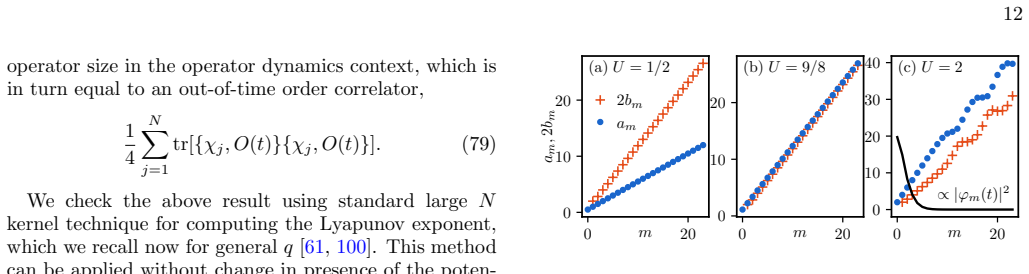
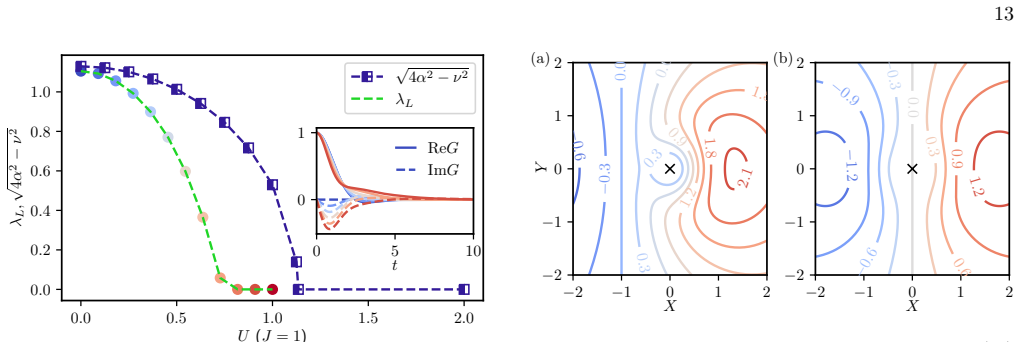
By treating a growth quench as the analogue of operator growth, the dynamics in Krylov space is governed by linear Lanczos sequences a_m ~ ν m and b_m ~ α m; the state remains localized in both Krylov and Fock space when |ν| > 2α, while for |ν| < 2α the growth-quench Lyapunov exponent satisfies λ_L ≤ sqrt(4α² - ν²), with equality achieved in the large-q SYK growth quench.
What carries the argument
The formal analogy between growth-quench evolution and Heisenberg-picture operator dynamics, which transfers Krylov-space localization criteria and Lyapunov bounds without extra lattice corrections.
If this is right
- When |ν| > 2α the quench dynamics localizes in both Krylov and Fock space.
- An explicit upper bound holds on the growth-quench Lyapunov exponent for |ν| < 2α.
- The bound is saturated in large-q SYK-inspired growth quenches.
- In the 1D East-West model, Fock-space cage states correspond to a conserved charge that supports ballistic transport.
- Fine-tuned hopping amplitudes induce partial localization through flat-band formation.
Where Pith is reading between the lines
- The same mapping may let existing operator-growth bounds be repurposed to predict quench-induced coherent phenomena in other constrained systems.
- The conserved-charge interpretation in the East model suggests that growth quenches can be engineered to protect or transport specific quantum information.
- Saturation of the Lyapunov bound in the SYK case hints that growth quenches could serve as a lattice proxy for studying scrambling without requiring all-to-all interactions.
Load-bearing premise
The analogy between growth quenches and local operator dynamics is faithful enough that Krylov localization criteria and bounds transfer directly.
What would settle it
Numerical or experimental measurement of the quenched-state support in Fock space for a family of models with tunable ν and α, checking whether the localization transition occurs precisely at |ν| = 2α.
Figures




read the original abstract
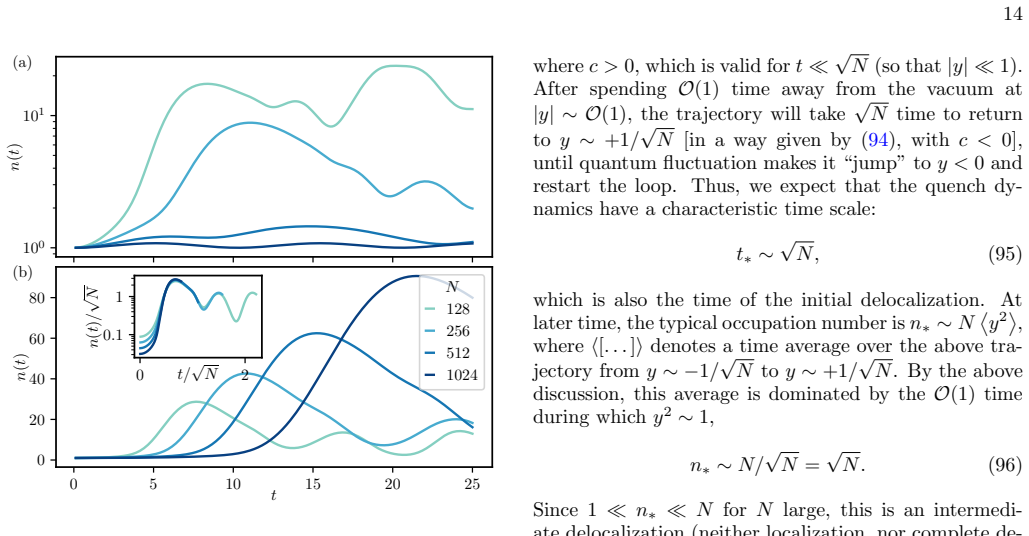
We study growth quenches, which are local quenches that may gradually destabilize a false vacuum in certain kinetic constrained quantum lattice models, such as the East-West model. We point out a formal analogy with the dynamics of a local operator in the Heisenberg picture. Exploiting this analogy, we obtain several results on growth quenches by adapting operator-dynamics concepts and methods. First, applying the Krylov approach (recursion method), we conjecture the linear growth of Lanzcos coefficients in generic quenches, $a_m \sim \nu m$ (diagonal), and $b_m \sim \alpha m$ (off-diagonal), extending an operator growth hypothesis. We show that the growth quench dynamics is localized in both Krylov and Fock spaces when $|\nu| > 2 \alpha$, and derive a bound for the growth quench analogue of Lyapunov exponent $\lambda_L \le \sqrt{4 \alpha^2 - \nu^2}$ when $|\nu| < 2 \alpha$. Second, we realize the Fock localization in large $N$ solvable growth quenches inspired by Sachdev-Ye-Kitaev (SYK) models. The bound on Lyapunov exponent is saturated in large-$q$ SYK grow quench. By contrast, the growth quench is almost always Fock localized in a nonrandom all-to-all growth quench amenable to semiclassics. Finally, in the 1D East-West model, we interpret Fock space cage states as the existence of a conserved charge. We show that the latter has ballistic transport due to current conservation. Moreover, adding hopping with a fine-tuned amplitude induces a partial localization due to a flat band. Our work suggest growth quenches as a promising approach to realize non-equilibrium coherent phenomena in many-body systems.
Editorial analysis
A structured set of objections, weighed in public.
Referee Report
Summary. The manuscript introduces growth quenches in kinetic-constrained lattice models (e.g., East-West) that can destabilize a false vacuum. It identifies a formal analogy with Heisenberg-picture operator dynamics, conjectures linear Lanczos coefficients a_m ∼ ν m (diagonal) and b_m ∼ α m (off-diagonal) by extending the operator-growth hypothesis, and uses this to establish Krylov- and Fock-space localization when |ν| > 2α together with the bound λ_L ≤ √(4α² − ν²) when |ν| < 2α. The bound is shown to saturate in large-q SYK-inspired growth quenches; Fock localization is also realized in an all-to-all semiclassical case. In the 1D East-West model the authors interpret Fock-space cage states as a conserved charge that produces ballistic transport, with partial localization induced by fine-tuned hopping.
Significance. If the conjecture and analogy hold without significant corrections, the work supplies a concrete bridge between quench dynamics and Krylov/operator-growth methods, yielding explicit, falsifiable localization criteria and a Lyapunov bound that is exactly saturated in a solvable large-q SYK limit. The conserved-charge interpretation and transport results in the East-West model add a lattice-model illustration. These elements constitute a genuine strength when the supporting assumptions are made rigorous.
major comments (3)
- [Abstract / conjecture statement] Abstract and the paragraph introducing the conjecture: the localization condition |ν| > 2α and the Lyapunov bound λ_L ≤ √(4α² − ν²) are obtained by direct substitution of the assumed linear forms a_m ∼ ν m, b_m ∼ α m into the three-term Lanczos recurrence; no independent derivation or error estimate of these coefficients from the growth-quench Hamiltonian is supplied, rendering the central claims dependent on an imported assumption whose validity is not verified within the manuscript.
- [Analogy and Krylov analysis] The section presenting the formal analogy: the transfer of Krylov-space localization and Lyapunov bounds from the operator case assumes that the growth-quench generator produces an identical three-term recurrence without additional diagonal shifts or higher-order terms induced by lattice constraints or Fock-space projections; no explicit mapping of the quench operator onto the Heisenberg generator nor any estimate of such corrections is provided, which is load-bearing for the claim that the |ν| > 2α criterion carries over unchanged.
- [East-West model section] The East-West model discussion: the interpretation of cage states as a conserved charge and the subsequent claim of ballistic transport rely on the same linear-Lanczos assumption; it is unclear whether the fine-tuned hopping that produces a flat band preserves the linear coefficient structure or introduces deviations that would alter the localization threshold.
minor comments (3)
- [Abstract] Abstract contains the typographical error 'Lanzcos' (should be 'Lanczos') and the phrase 'grow quench' (should be 'growth quench').
- [Results on Lyapunov bound] Notation for the Lyapunov bound is introduced without an explicit equation number; cross-referencing would improve readability.
- [Numerical/SYK section] The manuscript would benefit from a short table or paragraph comparing the effective ν and α extracted from the SYK and East-West examples.
Simulated Author's Rebuttal
We thank the referee for the constructive report. We address each major comment below, clarifying the conjectural status of the linear Lanczos assumption and noting where the manuscript will be revised for greater precision.
read point-by-point responses
-
Referee: [Abstract / conjecture statement] Abstract and the paragraph introducing the conjecture: the localization condition |ν| > 2α and the Lyapunov bound λ_L ≤ √(4α² − ν²) are obtained by direct substitution of the assumed linear forms a_m ∼ ν m, b_m ∼ α m into the three-term Lanczos recurrence; no independent derivation or error estimate of these coefficients from the growth-quench Hamiltonian is supplied, rendering the central claims dependent on an imported assumption whose validity is not verified within the manuscript.
Authors: We agree that the linear forms a_m ∼ ν m and b_m ∼ α m are introduced as a conjecture extending the operator-growth hypothesis rather than derived from the growth-quench Hamiltonian. The localization criteria and Lyapunov bound then follow by substitution into the recurrence. The manuscript supports the conjecture via explicit saturation in large-q SYK-inspired models and realization in the East-West model, but does not supply a general derivation or error estimate. We will revise the abstract and introduction to label the linear coefficients explicitly as conjectural and to state that the criteria are conditional on this assumption, with supporting evidence from the solvable cases. revision: partial
-
Referee: [Analogy and Krylov analysis] The section presenting the formal analogy: the transfer of Krylov-space localization and Lyapunov bounds from the operator case assumes that the growth-quench generator produces an identical three-term recurrence without additional diagonal shifts or higher-order terms induced by lattice constraints or Fock-space projections; no explicit mapping of the quench operator onto the Heisenberg generator nor any estimate of such corrections is provided, which is load-bearing for the claim that the |ν| > 2α criterion carries over unchanged.
Authors: The analogy is formal and rests on the growth quench generating a Krylov recurrence whose leading coefficients follow the linear form. We do not claim an exact isomorphism free of corrections for arbitrary lattice constraints; the results are presented as holding under the conjectured linear structure. No general estimate of higher-order terms is given. We will add a paragraph in the analogy section acknowledging possible corrections from constraints and emphasizing that the |ν| > 2α criterion is conjectural, to be verified model-by-model. revision: partial
-
Referee: [East-West model section] The East-West model discussion: the interpretation of cage states as a conserved charge and the subsequent claim of ballistic transport rely on the same linear-Lanczos assumption; it is unclear whether the fine-tuned hopping that produces a flat band preserves the linear coefficient structure or introduces deviations that would alter the localization threshold.
Authors: In the East-West analysis the cage states are identified as a conserved charge whose current conservation implies ballistic transport; the fine-tuned hopping is shown to produce a flat band and partial localization. The linear Lanczos form is assumed throughout. While our explicit diagonalization in this model is consistent with the assumed structure, we do not demonstrate that the fine-tuned hopping leaves the coefficients exactly linear to all orders. We will add a remark in that section noting that the localization threshold remains conditional on the linear assumption and that deviations could shift the threshold. revision: partial
Circularity Check
No significant circularity; derivation applies standard recurrence consequences to an explicit conjecture
full rationale
The paper states a formal analogy to Heisenberg-picture operator dynamics, then explicitly conjectures linear Lanczos coefficients a_m ∼ ν m and b_m ∼ α m as an extension of the operator growth hypothesis. It next applies the known mathematical properties of the three-term recurrence with these linear coefficients to obtain Krylov/Fock localization for |ν| > 2α and the bound λ_L ≤ √(4α² − ν²) for |ν| < 2α. These consequences follow directly from the recurrence relation once the linear form is assumed; they are not redefined or fitted from the quench observables themselves. No load-bearing self-citation, uniqueness theorem, or ansatz is invoked to force the central results, and the SYK saturation and East-West interpretations are presented as separate realizations. The chain is therefore self-contained.
Axiom & Free-Parameter Ledger
free parameters (2)
- ν
- α
axioms (2)
- domain assumption A formal analogy exists between growth-quench evolution and Heisenberg-picture operator dynamics that permits direct transfer of Krylov-space concepts.
- ad hoc to paper Lanczos coefficients grow linearly, a_m ~ ν m and b_m ~ α m, in generic growth quenches.
discussion (0)
Sign in with ORCID, Apple, or X to comment. Anyone can read and Pith papers without signing in.