Digital twins for compact hybrid quantum classical learning in FMCW radar detection
Pith reviewed 2026-06-30 15:40 UTC · model grok-4.3
The pith
Digital twins of FMCW radar let a quantum support vector classifier reach 0.941 accuracy on UAV detection from four principal components onward, beating the classical 0.880 baseline.
A machine-rendered reading of the paper's core claim, the machinery that carries it, and where it could break.
Core claim
The central claim is that physics-informed digital twins generate representative synthetic benchmarks for frequency-modulated continuous-wave radar, allowing a quantum support vector classifier to outperform the classical radial basis function baseline on unmanned aerial vehicle classification from four principal components onward while both methods remain robust to added Gaussian noise.
What carries the argument
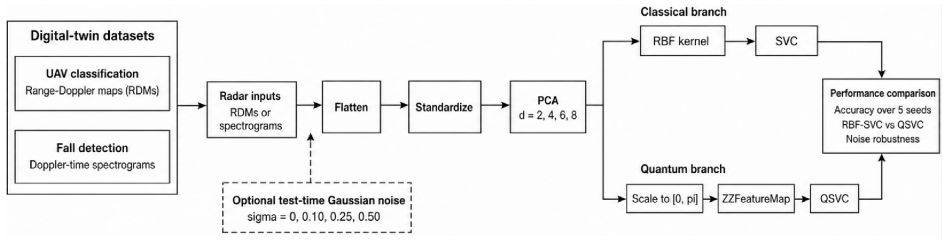
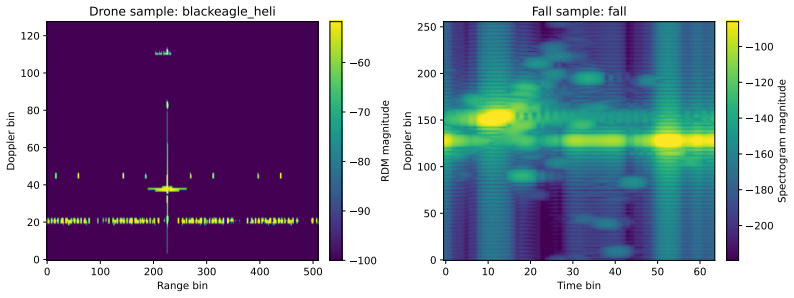
Physics-informed digital twins that produce labeled synthetic range-Doppler maps and Doppler-time spectrograms for principal-component analysis followed by quantum or classical support vector classification.
If this is right
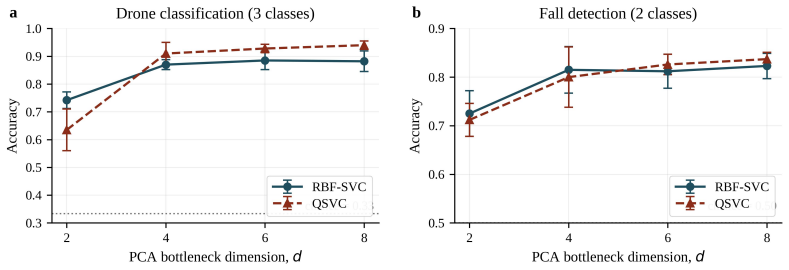
- The quantum support vector classifier improves UAV classification accuracy from four principal components onward, reaching 0.941 plus or minus 0.012 at eight components.
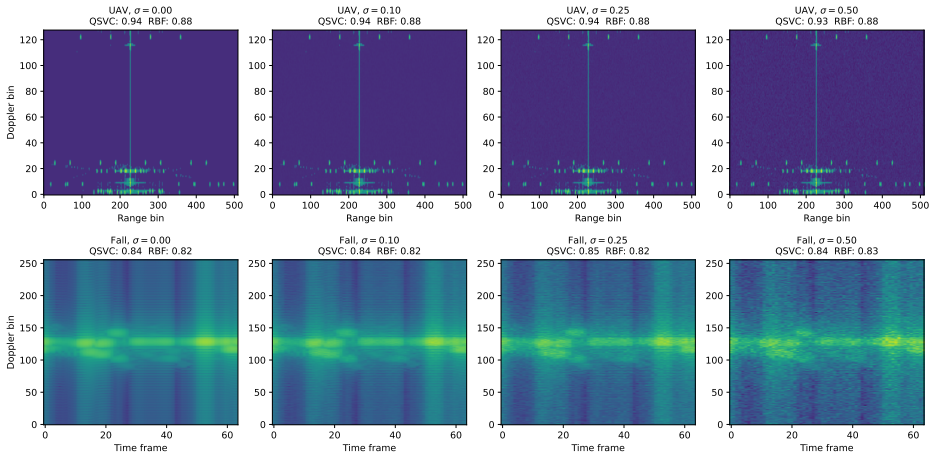
- Both classifiers show limited degradation under added Gaussian noise while the UAV quantum-kernel gain is preserved.
- On the human fall detection task the quantum and classical methods perform similarly, with only a small quantum-kernel improvement at higher feature dimensions.
- Digital twins provide controlled environments for radar quantum machine learning benchmarking prior to measured-data validation and hardware execution.
Where Pith is reading between the lines
- If the digital-twin data proves sufficiently realistic, the approach could lower the barrier to testing quantum kernels on other radar or sensing tasks where collecting large labeled sets is expensive.
- The same twin-based workflow might be applied to benchmark hybrid quantum-classical methods in related domains such as medical Doppler ultrasound or automotive radar.
- Hardware execution on actual quantum devices would be needed to determine whether the simulated kernel advantages survive realistic noise and decoherence.
- Extending the benchmarks to include more complex radar scenes or multi-class problems could reveal whether the observed quantum-classical separation grows with task difficulty.
Load-bearing premise
The synthetic radar data produced by the digital twins is representative enough of real frequency-modulated continuous-wave measurements that performance differences seen in simulation will appear in practice.
What would settle it
Running the same principal-component-reduced classifiers on a collection of actual measured FMCW radar data for UAV classification and fall detection and checking whether the accuracy gap between quantum and classical kernels remains.
Figures
read the original abstract
Frequency-modulated continuous-wave radar sensing often relies on labeled measurements that are costly, restricted, or difficult to collect at scale. This work evaluates physics-informed digital twins as controlled testbeds for early-stage quantum-classical radar learning. Two synthetic radar benchmarks are considered: unmanned aerial vehicle classification from range-Doppler maps and human fall detection from Doppler-time spectrograms. For both tasks, inputs are standardized, reduced using principal component analysis, and classified using either a radial basis function support vector classifier or a quantum support vector classifier. All quantum-kernel results are obtained using noiseless classical simulation; no quantum hardware is used, and no quantum-advantage claim is made. Across five random seeds, the quantum support vector classifier improves the UAV benchmark from four principal components onward, reaching an accuracy of 0.941 +/- 0.012 at eight components, compared with 0.880 +/- 0.029 for the classical baseline. On the fall-detection benchmark, both classifiers perform similarly, with a small quantum-kernel improvement at higher feature dimensions. A Gaussian-noise robustness study shows limited performance degradation across the tested noise levels, while preserving the UAV quantum-kernel gain. These results support digital twins as useful, controlled environments for radar-QML benchmarking prior to measured-data validation and hardware execution.
Editorial analysis
A structured set of objections, weighed in public.
Referee Report
Summary. The manuscript evaluates physics-informed digital twins as controlled testbeds for early-stage hybrid quantum-classical machine learning in FMCW radar detection. It considers two synthetic benchmarks—UAV classification from range-Doppler maps and human fall detection from Doppler-time spectrograms—where inputs are standardized, PCA-reduced, and classified via RBF support vector classifier versus quantum support vector classifier (noiseless classical simulation of the quantum kernel). Across five seeds the quantum method improves UAV accuracy from four principal components onward, reaching 0.941 ± 0.012 at eight components versus 0.880 ± 0.029 for the classical baseline; fall-detection performance is comparable with a small quantum gain at higher dimensions. A Gaussian-noise robustness check is also reported.
Significance. If the central empirical comparisons hold, the work supplies concrete, seed-averaged evidence that quantum kernels can yield measurable gains on certain synthetic radar tasks and illustrates the utility of digital twins for controlled QML benchmarking before hardware or real-data stages. The multi-seed reporting and noise-robustness experiment are positive features that enhance reproducibility of the observed trends.
major comments (2)
- [Abstract / Results] The claim that digital twins constitute useful controlled environments for radar-QML benchmarking rests on the premise that performance differences observed on the synthetic data will be informative for real FMCW measurements. No quantitative fidelity assessment (statistical distance, feature-distribution comparison, or transfer of the same classifiers to a real-data hold-out) is supplied anywhere in the manuscript; without it the reported 0.061 accuracy gap on the UAV task at eight components cannot be distinguished from an artifact of the twin model itself.
- [Abstract] The abstract states that inputs are standardized and PCA-reduced, yet provides no description of the digital-twin generation procedure, the precise quantum-kernel circuit or feature map, or the exact preprocessing pipeline. These omissions are load-bearing for assessing whether the quoted accuracies (0.941 ± 0.012 vs. 0.880 ± 0.029) genuinely support the benchmarking utility asserted in the conclusion.
minor comments (1)
- [Abstract] The noise-robustness study is mentioned only at the level of “limited performance degradation”; a table or figure quantifying accuracy versus noise variance for both classifiers would strengthen the presentation.
Simulated Author's Rebuttal
We thank the referee for the constructive and detailed review. The comments highlight important aspects of scope and presentation that we address point by point below. We propose targeted revisions to clarify the manuscript's positioning without overstating its claims.
read point-by-point responses
-
Referee: [Abstract / Results] The claim that digital twins constitute useful controlled environments for radar-QML benchmarking rests on the premise that performance differences observed on the synthetic data will be informative for real FMCW measurements. No quantitative fidelity assessment (statistical distance, feature-distribution comparison, or transfer of the same classifiers to a real-data hold-out) is supplied anywhere in the manuscript; without it the reported 0.061 accuracy gap on the UAV task at eight components cannot be distinguished from an artifact of the twin model itself.
Authors: We agree that the absence of a quantitative fidelity assessment (e.g., statistical distances or real-data transfer experiments) means the specific numerical gap cannot be shown to transfer directly to measured FMCW data. The manuscript positions the digital twins explicitly as physics-informed controlled testbeds for early-stage benchmarking, where known ground truth and controllable factors (including the reported Gaussian-noise study) enable reproducible isolation of classifier behavior prior to real-data stages. This controlled setting has independent value for QML method development when real labeled radar data is scarce. We will revise the abstract, results, and conclusion to state this scope more explicitly and add a limitations paragraph acknowledging that twin-specific artifacts cannot be ruled out without future real-data validation. revision: yes
-
Referee: [Abstract] The abstract states that inputs are standardized and PCA-reduced, yet provides no description of the digital-twin generation procedure, the precise quantum-kernel circuit or feature map, or the exact preprocessing pipeline. These omissions are load-bearing for assessing whether the quoted accuracies (0.941 ± 0.012 vs. 0.880 ± 0.029) genuinely support the benchmarking utility asserted in the conclusion.
Authors: The full manuscript body details the digital-twin generation (physics-informed FMCW signal simulation for UAV range-Doppler and human Doppler-time cases), the quantum-kernel feature map and circuit (angle embedding in noiseless QSVC simulation), and the exact pipeline (standardization then PCA). The abstract is intentionally concise. To address the concern, we will expand the abstract with brief, self-contained references to these elements while remaining within length limits. revision: yes
Circularity Check
No circularity: empirical accuracy comparisons on synthetic data
full rationale
The manuscript reports direct empirical results from applying PCA and two SVC variants (RBF and quantum kernel) to synthetic range-Doppler and spectrogram data generated by physics-informed digital twins. No derivation chain, fitted-parameter prediction, self-citation load-bearing premise, or ansatz is present; the reported accuracies (0.941 vs 0.880 at 8 components) are measured outputs, not quantities forced by the paper's own equations. The work explicitly disclaims quantum-advantage claims and hardware execution.
Axiom & Free-Parameter Ledger
Reference graph
Works this paper leans on
-
[1]
The Institution of Engineering and Technology, 2021
Carmine Clemente, Francesco Fioranelli, Fabiola Colone, and Fabiola Gang Li.Radar Coun- termeasures for Unmanned Aerial Vehicles. The Institution of Engineering and Technology, 2021
2021
-
[2]
The Institution of Engineering and Technology, 2020
Francesco Fioranelli, Hugh Griffiths, Matthew Ritchie, and Alessio Balleri.Micro-Doppler Radar and Its Applications. The Institution of Engineering and Technology, 2020
2020
-
[3]
Falls.https://www.who.int/news-room/fact-sheets/detail/ falls, 2021
World Health Organization. Falls.https://www.who.int/news-room/fact-sheets/detail/ falls, 2021. Accessed: 2026-04-28
2021
-
[4]
Older adult falls data.https://www.cdc.gov/ falls/data-research/index.html, 2024
Centers for Disease Control and Prevention. Older adult falls data.https://www.cdc.gov/ falls/data-research/index.html, 2024. Accessed: 2026-04-28
2024
-
[5]
Severity of fall detection using digital twin for radar systems
Abdelrahman Elbadrawy, Hajar Abedi, Omar Ramahi, and George Shaker. Severity of fall detection using digital twin for radar systems. In2023 IEEE Microwaves, Antennas, and Propagation Conference (MAPCON), pages 1–3, 2023
2023
-
[6]
Sayed, Abdelrahman Elbadrawy, Arien Sligar, and George Shaker
Sebastian Ratto V., Huy Trinh, Ahmed N. Sayed, Abdelrahman Elbadrawy, Arien Sligar, and George Shaker. Radar-based fall detection for assisted living: A digital-twin representation case study.arXiv preprint arXiv:2601.11938, 2026
-
[7]
Caris, W
M. Caris, W. Johannes, S. Sieger, V. Port, and S. Stanko. Detection of small uas with w-band radar. In2017 18th International Radar Symposium (IRS), pages 1–6, 2017
2017
-
[8]
Sayed, Michael M
Ahmed N. Sayed, Michael M. Y. R. Riad, Ahmad Ansariyan, Laila Salman, Omar M. Ramahi, and George Shaker. Unmanned Aerial Vehicle Classification Using Neural Networks and Radar Digital Twins.IEEE Microwave Magazine, 25(11):30–42, 2024. 10
2024
-
[9]
Sayed, Omar M
Ahmed N. Sayed, Omar M. Ramahi, and George Shaker. In the Realm of Aerial Deception: UAV Classification via ISAR Images and Radar Digital Twins for Enhanced Security.IEEE Sensors Letters, 8(7):1–4, 2024. Art. no. 6007704
2024
-
[10]
Sayed, Omar M
Ahmed N. Sayed, Omar M. Ramahi, and George Shaker. Frequency-Modulated Continuous- Wave Radar Perspectives on Unmanned Aerial Vehicle Detection and Classification: A Primer for Researchers with Comprehensive Machine Learning Review and Emphasis on Full-Wave Electromagnetic Computer-Aided Design Tools.Drones, 8(8):370, 2024
2024
-
[11]
Sayed, Hajar Abedi, Omar M
Ahmed N. Sayed, Hajar Abedi, Omar M. Ramahi, and George Shaker. Enhanced UAV De- tection and Classification Using Machine Learning and MIMO Radars.IEEE Transactions on Microwave Theory and Techniques, 72(11):6716–6727, 2024
2024
-
[12]
Ahmed, Ahmed N
Taher S. Ahmed, Ahmed N. Sayed, Youssef Ahmed, George Shaker, and Magdy Elbahna- sawy. Assessing Noise Effects on UAV Classification Accuracy With Deep Learning and FPGA Real-Time Processing: A Study Utilizing Radar Digital Twins.IEEE Sensors Journal, 25(12):22850–22862, 2025
2025
-
[13]
Sayed, Abdelrahman Elbadrawy, Arien Sligar, Omar M
Sebastian Ratto, Ahmed N. Sayed, Abdelrahman Elbadrawy, Arien Sligar, Omar M. Ramahi, and George Shaker. Enhancing healthcare monitoring through a fully integrated radar digi- tal twin. In2025 International Applied Computational Electromagnetics Society Symposium (ACES), pages 1–1. IEEE, 2025
2025
-
[14]
Sayed, Abdelrahman Elbadrawy, Arien Sligar, Omar Ramahi, and George Shaker
Sebastian Ratto, Ahmed N. Sayed, Abdelrahman Elbadrawy, Arien Sligar, Omar Ramahi, and George Shaker. Digital twin-driven radar for human monitoring optimization. InInternational Conference on Extended Reality, pages 33–45, Cham, 2025. Springer Nature Switzerland
2025
-
[15]
Sayed, Abdelrahman Elbadrawy, Arien Sligar, Omar M
Sebastian Ratto, Ahmed N. Sayed, Abdelrahman Elbadrawy, Arien Sligar, Omar M. Ramahi, and George Shaker. Digital twin system for realistic radar optimization in healthcare mon- itoring. In2025 IEEE 20th International Symposium on Antenna Technology and Applied Electromagnetics (ANTEM), pages 182–185. IEEE, 2025
2025
-
[16]
Sayed, Arien Sligar, Omar M
Sebastian Ratto V., Ahmed N. Sayed, Arien Sligar, Omar M. Ramahi, and George Shaker. Radar-based people presence estimation using digital twin simulation framework. In2025 International Telecommunications Conference (ITC-Egypt), pages 164–166. IEEE, 2025
2025
-
[17]
Córcoles, Kristan Temme, Aram W
Vojtěch Havlíček, Antonio D. Córcoles, Kristan Temme, Aram W. Harrow, Abhinav Kandala, Jerry M. Chow, and Jay M. Gambetta. Supervised learning with quantum-enhanced feature spaces.Nature, 567(7747):209–212, 2019
2019
-
[18]
Quantum machine learning in feature hilbert spaces.Phys
Maria Schuld and Nathan Killoran. Quantum machine learning in feature hilbert spaces.Phys. Rev. Lett., 122:040504, Feb 2019
2019
-
[19]
On lines and planes of closest fit to systems of points in space.The London, Edinburgh, and Dublin Philosophical Magazine and Journal of Science, 2(11):559–572, 1901
Karl Pearson. On lines and planes of closest fit to systems of points in space.The London, Edinburgh, and Dublin Philosophical Magazine and Journal of Science, 2(11):559–572, 1901
1901
-
[20]
Scikit-learn: Machine learning in python.Journal of Machine Learning Research, 12:2825–2830, 2011
Fabian Pedregosa, Gael Varoquaux, Alexandre Gramfort, Vincent Michel, Bertrand Thirion, Olivier Grisel, Mathieu Blondel, Peter Prettenhofer, Ron Weiss, Vincent Dubourg, Jake Vanderplas, Alexandre Passos, David Cournapeau, Matthieu Brucher, Matthieu Perrot, and Edouard Duchesnay. Scikit-learn: Machine learning in python.Journal of Machine Learning Research...
2011
-
[21]
Qiskit: An open-source framework for quantum computing.https: //qiskit.org, 2025
Qiskit contributors. Qiskit: An open-source framework for quantum computing.https: //qiskit.org, 2025
2025
-
[22]
Huy Trinh, Sebastian Ratto V., Elliot Creager, and George Shaker. A physics-informed digital twin framework for calibrated sim-to-real FMCW radar occupancy estimation.arXiv preprint arXiv:2601.17871, 2026. 12
discussion (0)
Sign in with ORCID, Apple, or X to comment. Anyone can read and Pith papers without signing in.