Non-monotonic evolution of multipartite entanglement under the Unruh effect
Pith reviewed 2026-06-30 13:39 UTC · model grok-4.3
The pith
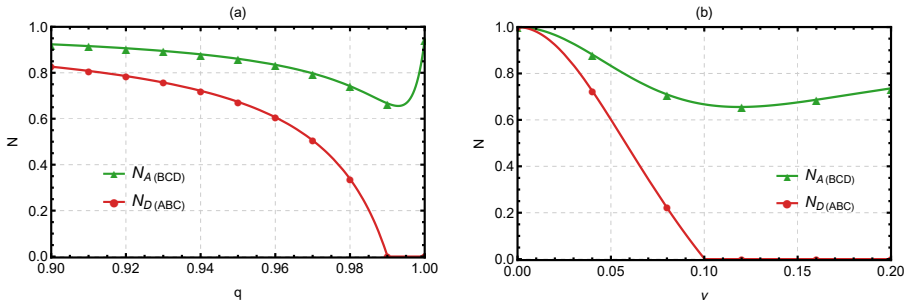
The Unruh effect causes tetrapartite entanglement in a four-qubit Dicke state to decrease then increase with rising acceleration.
A machine-rendered reading of the paper's core claim, the machinery that carries it, and where it could break.
Core claim
In the four-qubit Dicke state with one detector in uniform acceleration, the tetrapartite entanglement first decreases and then increases to a finite nonzero value as the acceleration parameter grows, revealing that the Unruh effect can enhance rather than solely degrade multipartite entanglement within a finite regime.
What carries the argument
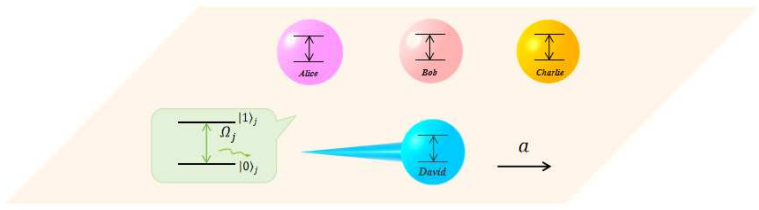
Unruh-DeWitt detector model applied to one accelerated qubit in a four-qubit Dicke state, tracking the evolution of a tetrapartite entanglement measure with acceleration.
If this is right
- Multipartite entanglement in Dicke states does not follow the conventional monotonic degradation under the Unruh effect.
- There exists a finite range of accelerations where increasing acceleration improves entanglement.
- Dicke states provide more robust resources for relativistic quantum information tasks than states subject only to degradation.
- The Unruh effect plays a dual role, both degrading and enhancing correlations depending on the acceleration regime.
Where Pith is reading between the lines
- Similar non-monotonic patterns may appear in other symmetric multipartite states when only one party accelerates.
- Relativistic quantum protocols could exploit the high-acceleration regime for entanglement generation rather than treating acceleration as pure noise.
- Extensions to curved spacetime or non-uniform acceleration might preserve or amplify this enhancement effect.
Load-bearing premise
The interaction between the accelerated detector and the field is fully captured by the Unruh-DeWitt model without extra decoherence or higher-order corrections.
What would settle it
Numerical computation or experiment showing the entanglement measure continues to decrease monotonically for all acceleration values instead of rising after an initial drop.
Figures

read the original abstract
We investigate the behavior of tetrapartite entanglement in a four-qubit Dicke state under relativistic motion by employing the Unruh-DeWitt detector model, where one detector undergoes uniform acceleration. We show that the entanglement exhibits a non-monotonic evolution: it first decreases and subsequently increases toward a finite value as the acceleration grows. In contrast to the conventional view that the Unruh effect leads to a monotonic degradation of multipartite entanglement, our results demonstrate that it can instead enhance multipartite entanglement within a finite parameter regime. This behavior reveals a dual role of the Unruh effect in multipartite systems. Our findings therefore provide a refined understanding of relativistic multipartite quantum correlations, indicating that Dicke states constitute more robust multipartite quantum resources against Unruh-induced decoherence and may offer advantages for relativistic quantum information processing tasks.
Editorial analysis
A structured set of objections, weighed in public.
Referee Report
Summary. The manuscript studies tetrapartite entanglement for a four-qubit Dicke state in which one detector undergoes uniform acceleration, modeled via the Unruh-DeWitt interaction with the Minkowski vacuum. It reports that a standard entanglement monotone first decreases and then increases toward a nonzero value with rising proper acceleration, indicating that the Unruh effect can enhance rather than only degrade multipartite correlations within a finite parameter window.
Significance. If the central numerical or analytic result survives scrutiny, the work supplies a concrete counter-example to the prevailing expectation of monotonic Unruh-induced degradation of multipartite entanglement. The finding that Dicke states can exhibit an upturn supplies a potentially useful distinction between bipartite and multipartite relativistic resources and may inform proposals for relativistic quantum communication.
major comments (2)
- [Results / entanglement calculation] The non-monotonic upturn is obtained from the reduced four-qubit density matrix computed to leading (first) order in the detector-field coupling λ. Because the Unruh temperature scales linearly with acceleration, the size of the neglected O(λ²) corrections to the transition amplitudes and induced field correlations also grows with a; it is therefore necessary to verify that the reported increase remains inside the perturbative window (see the parameter values used for the entanglement plots).
- [Introduction and Discussion] The claim that the behavior is 'in contrast to the conventional view' requires an explicit comparison, within the same model and state, to the monotonic degradation obtained for the corresponding two-qubit or three-qubit cases; without that benchmark the dual-role interpretation rests on an incomplete contrast.
minor comments (2)
- Notation for the four-qubit Dicke state and the precise definition of the entanglement monotone (e.g., which multipartite generalization of concurrence or negativity is employed) should be stated once in the main text rather than only in the abstract.
- The range of accelerations (or dimensionless parameter aσ) over which the non-monotonic regime occurs should be stated numerically in the text or caption, not only qualitatively as 'finite parameter regime'.
Simulated Author's Rebuttal
We thank the referee for the careful reading and constructive comments. We address each major point below and indicate the revisions we will make to strengthen the manuscript.
read point-by-point responses
-
Referee: [Results / entanglement calculation] The non-monotonic upturn is obtained from the reduced four-qubit density matrix computed to leading (first) order in the detector-field coupling λ. Because the Unruh temperature scales linearly with acceleration, the size of the neglected O(λ²) corrections to the transition amplitudes and induced field correlations also grows with a; it is therefore necessary to verify that the reported increase remains inside the perturbative window (see the parameter values used for the entanglement plots).
Authors: We agree that the perturbative regime must be explicitly verified. Our calculations employ a small fixed coupling λ (with values chosen such that λ remains well below unity across the plotted acceleration range), consistent with the standard first-order Unruh-DeWitt treatment. We will revise the manuscript to include a dedicated paragraph or appendix that bounds the O(λ²) error for the specific parameter values used in the entanglement plots, thereby confirming that the reported non-monotonic upturn lies inside the perturbative window. revision: yes
-
Referee: [Introduction and Discussion] The claim that the behavior is 'in contrast to the conventional view' requires an explicit comparison, within the same model and state, to the monotonic degradation obtained for the corresponding two-qubit or three-qubit cases; without that benchmark the dual-role interpretation rests on an incomplete contrast.
Authors: We accept that an explicit side-by-side comparison within the identical Unruh-DeWitt model would make the contrast more rigorous. While the conventional monotonic degradation is well-documented for bipartite cases, we will add a concise comparison (either in the main text or as a supplementary figure) showing the monotonic behavior for the corresponding two-qubit and three-qubit reductions or analogous states under the same accelerated-detector setup. This will directly support the dual-role claim for the tetrapartite Dicke state. revision: yes
Circularity Check
No circularity; standard perturbative calculation of reduced density matrix yields the reported non-monotonicity
full rationale
The derivation applies the Unruh-DeWitt detector model to a four-qubit Dicke state, computes the joint detector-field evolution to leading order in the coupling, traces out the field, and evaluates an entanglement monotone on the resulting reduced state. No equation is defined in terms of its own output, no fitted parameter is relabeled as a prediction, and no load-bearing step rests on a self-citation chain. The non-monotonic feature is an explicit consequence of the first-order transition amplitudes and the acceleration-dependent Unruh temperature within the model's stated regime; the calculation is self-contained against external benchmarks and does not reduce to its inputs by construction.
Axiom & Free-Parameter Ledger
Reference graph
Works this paper leans on
-
[1]
C. H. Bennett, Quantum information, Phys. Scr. 1998, 210 (1998)
1998
-
[2]
S. Zhou, P . Zhang, and Z. Y u, Environment-induced transitions in many-body quantum teleportation, Phys. Rev. Research 8, L012007 (2026). 13
2026
-
[3]
Y . Guo, X. Chen, H. Peng, and Q. Tian, Average correlation as a resource of quantum teleportation, Phys. Rev. A 112, 052403 (2025)
2025
-
[4]
Anil and R
A. Anil and R. Arun, Protecting fidelity of quantum telepo rtation by quantum interferences, Phys. Rev. A 113, 022408 (2026)
2026
-
[5]
K. Lee, F. Turro, and X. Y ao, Quantum computing for energy correlators, Phys. Rev. D 111, 054514 (2025)
2025
-
[6]
I. D. Smith, B. Klaver, H. P . Nautrup, W. Lechner, and H. J. Briegel, Minimally universal parity quantum computing, Phys. Rev. A 112, 032606 (2025)
2025
-
[7]
Bozzio, C
M. Bozzio, C. Cr´ epeau, P . Wallden, and P . Walther, Quantum cryptography beyond key distribution: Theory and experiment, Rev. Mod. Phys. 97, 045006 (2025)
2025
-
[8]
H. Y u, B. Crockett, N. Montaut, S. Sciara, M. Chemnitz, S. T. Chu, B. E. Little, D. J. Moss, Z. Wang et al, Exploiting Nonlocal Correlations for Dispersion-Re silient Quantum Communications, Phys. Rev. Lett. 134, 220801 (2025)
2025
-
[9]
Wang and L
Z. Wang and L. Jiang, Passive Environment-Assisted Quan tum Communication with GKP States, Phys. Rev. X 15, 021003 (2025)
2025
-
[10]
Gandotra, Z
A. Gandotra, Z. Wang, A. A. Clerk, and L. Jiang, Quantum c ommunication over bandwidth-and- time-limited channels, Phys. Rev. A 113, 032616 (2026)
2026
-
[11]
R. H. Dicke, Coherence in spontaneous radiation proces ses, Phys. Rev. 93, 99 (1954)
1954
-
[12]
G¨ uhne, F
O. G¨ uhne, F. Bodoky, and M. Blaauboer, Multiparticle entanglement under the influence of decoher- ence, Phys. Rev. A 78, 060301(R) (2008)
2008
-
[13]
T´ oth, W
G. T´ oth, W. Wieczorek, D. Gross, R. Krischek, C. Schwem mer, and H. Weinfurter, Permutationally Invariant Quantum Tomography, Phys. Rev. Lett. 105, 250403 (2010)
2010
-
[14]
Moroder, P
T. Moroder, P . Hyllus, G. T´ oth, C. Schwemmer, A. Niggeb aum, S. Gaile, O. G¨ uhne and H. Wein- furter, Permutationally invariant state reconstruction, New J. Phys. 14, 105001 (2012)
2012
-
[15]
T´ oth, Detection of multipartite entanglement in th e vicinity of symmetric Dicke states, J
G. T´ oth, Detection of multipartite entanglement in th e vicinity of symmetric Dicke states, J. Opt. Soc. Am. B 24, 275 (2007)
2007
-
[16]
T´ oth, W
G. T´ oth, W. Wieczorek, R. Krischek, N. Kiesel, P . Michelberger and H. Weinfurter, Practical methods for witnessing genuine multi-qubit entanglement in the vicinity of symmetric states, New J. Phys. 11, 083002 (2009)
2009
-
[17]
Huber, P
M. Huber, P . Erker, H. Schimpf, A. Gabriel, and B. Hiesma yr, Experimentally feasible set of cri- teria detecting genuine multipartite entanglement in n-qubit Dicke states and in higher-dimensional 14 systems, Phys. Rev. A 83, 040301(R) (2011)
2011
-
[18]
L. Novo, T. Moroder, and O. G¨ uhne, Genuine multiparticle entanglement of permutationally invariant states, Phys. Rev. A 88, 012305 (2013)
2013
-
[19]
Kiesel, C
N. Kiesel, C. Schmid, G. T´ oth, E. Solano, and H. Weinfur ter, Experimental Observation of Four- Photon Entangled Dicke State with High Fidelity, Phys. Rev. Lett. 98, 063604 (2007)
2007
-
[20]
Wieczorek, R
W. Wieczorek, R. Krischek, N. Kiesel, P . Michelberger, G. T´ oth, and H. Weinfurter, Experimental Entanglement of a Six-Photon Symmetric Dicke State, Phys. R ev. Lett. 103, 020504 (2009)
2009
-
[21]
Prevedel, G
R. Prevedel, G. Cronenberg, M. S. Tame, M. Paternostro, P . Walther, M. S. Kim, and A. Zeilinger, Experimental Realization of Dicke States of up to Six Qubits for Multiparty Quantum Networking, Phys. Rev. Lett. 103, 020503 (2009)
2009
-
[22]
H. Du, R. B. Mann, Fisher information as a probe of spacet ime structure: relativistic quantum metrol- ogy in (A)dS, J. High Energ. Phys. 2021, 112 (2021)
2021
-
[23]
J. P . Covey, I. Pikovski, J. Borregaard, Probing curved spacetime with a distributed atomic processor clock, PRX Quantum 6, 030310 (2025)
2025
-
[24]
Barman, I
S. Barman, I. Chakraborty, S. Mukherjee, Signatures of gravitational wave memory in the radiative process of entangled quantum probes, Phys. Rev. D 111, 025021 (2025)
2025
-
[25]
Z. Liu, R. Q. Y ang, H. Fan, J. Wang, Simulation of the mass less Dirac field in 1+1D curved space- time, Sci. China Phys. Mech. Astron. 68, 290411 (2025)
2025
-
[26]
Agullo, A
I. Agullo, A. Delhom, ´A. Parra-L´ opez, Toward the observation of entangled pairs in BEC analog expanding universes, Phys. Rev. D 110, 125023 (2024)
2024
-
[27]
J. Hu, L. Feng, Z. Zhang, C. Chin, Quantum simulation of U nruh radiation, Nat. Phys. 15, 785 (2019)
2019
-
[28]
T. Li, L. H. Liu, Cosmological complexity of the modified dispersion relation, Phys. Lett. B 854, 138728 (2024)
2024
-
[29]
H. T. Zheng, X. F. Zhou, G. C. Guo, Z. W. Zhou, Enhancing an alog Unruh effect via superradiance in a cylindrical cavity, Phys. Rev. Research 7, 013027 (2025)
2025
-
[30]
K. B. Tallent, D. E. Sheehy, Analog Unruh effect of inhom ogeneous one-dimensional Dirac fermions, Phys. Rev. B 112, 104306 (2025)
2025
-
[31]
T. Li, L. H. Liu, Inflationary Krylov complexity, J. High Energ. Phys. 2024, 123 (2024)
2024
-
[32]
Belgiorno, S
F. Belgiorno, S. L. Cacciatori, A. Farahat, and A. Vigan ` o, Analog Hawking effect: BEC and surface waves, Phys. Rev. D 102, 105004 (2020). 15
2020
-
[33]
J. Foo, C. S. Arabaci, M. Zych, R. B. Mann, Quantum Signat ures of Black Hole Mass Superpositions, Phys. Rev. Lett. 129, 181301 (2022)
2022
-
[34]
J. Foo, C. S. Arabaci, M. Zych, R. B. Mann, Quantum superp ositions of Minkowski spacetime, Phys. Rev. D 107, 045014 (2023)
2023
-
[35]
Y . Tang, W. Liu, J. Wang, Observational signature of Lorentz violation in acceleration radiation, Eur. Phys. J. C 85, 1108 (2025)
2025
-
[36]
W. Liu, C. Wen, J. Wang, Lorentz violation alleviates gr avitationally induced entanglement degrada- tion, J. High Energ. Phys. 2025, 184 (2025)
2025
-
[37]
S. Sen, A. Mukherjee and S. Gangopadhyay, Entanglement degradation as a tool to detect signatures of modified gravity, Phys. Rev. D 109, 046012 (2024)
2024
-
[38]
Fuentes-Schuller and R
I. Fuentes-Schuller and R. B. Mann, Alice falls into a bl ack hole: Entanglement in non-inertial frames, Phys. Rev. Lett. 95, 120404 (2005)
2005
-
[39]
Pan and J
Q. Pan and J. Jing, Hawking radiation, entanglement, an d teleportation in the background of an asymptotically flat static black hole, Phys. Rev. D 78, 065015 (2008)
2008
-
[40]
Mart´ ın-Mart´ ınez, L
E. Mart´ ın-Mart´ ınez, L. J. Garay and J. Le´ on, Unveiling quantum entanglement degradation near a Schwarzschild black hole, Phys. Rev. D 82, 064006 (2010)
2010
-
[41]
Wu and L
H. Wu and L. Chen, Orbital angular momentum entanglemen t in noninertial reference frame, Phys. Rev. D 107, 065006 (2023)
2023
-
[42]
P . M. Alsing, I. Fuentes-Schuller, R. B. Mann and T. E. Te ssier, Entanglement of Dirac fields in non-inertial frames, Phys. Rev. A 74, 032326 (2006)
2006
-
[43]
Elghaayda, A
S. Elghaayda, A. Ali, S. Al-Kuwari and M. Mansour, Physi cally accessible and inaccessible quantum correlations of Dirac fields in Schwarzschild spacetime, Ph ys. Lett. A 525, 129915 (2024)
2024
-
[44]
J. K. Basak, D. Giataganas, S. Mondal and W. Y . Wen, Reflec ted entropy and Markov gap in nonin- ertial frames, Phys. Rev. D 108, 125009 (2023)
2023
-
[45]
A. Ali, S. Al-Kuwari, M. Ghominejad, M. T. Rahim, D. Wang and S. Haddadi, Quantum character- istics near event horizons, Phys. Rev. D 110, 064001 (2024)
2024
-
[46]
Adesso, I
G. Adesso, I. Fuentes-Schuller and M. Ericsson, Contin uous-variable entanglement sharing in non- inertial frames, Phys. Rev. A 76, 062112 (2007)
2007
-
[47]
H. E. Camblong, A. Chakraborty, P . Lopez-Duque, C. R. Or d´ o˜ nez, Entanglement degradation in causal diamonds, Phys. Rev. D 109, 105003 (2024)
2024
-
[48]
Belfiglio, O
A. Belfiglio, O. Luongo, S. Mancini, Quantum entangleme nt in cosmology, Phys. Rep. 1146, 1 16 (2025)
2025
-
[49]
X. Liu, W. Liu, Z. Liu, J. Wang, Harvesting correlations from BTZ black hole coupled to a Lorentz- violating vector field, J. High Energ. Phys. 2025, 94 (2025)
2025
-
[50]
Izquierdo, J
W. Izquierdo, J. Beltran, E. Arias, Enhancement of harv esting vacuum entanglement in Cosmic String Spacetime, J. High Energ. Phys. 2025, 49 (2025)
2025
- [51]
-
[52]
Chakraborty, L
A. Chakraborty, L. Hackl, M. Zych, Entanglement harves ting in quantum superposed spacetime, Phys. Rev. D 111, 104052 (2025)
2025
-
[53]
X. Liu, Z. Tian, J. Jing, Entanglement dynamics in κ-deformed spacetime, Sci. China Phys. Mech. Astron. 67, 100411 (2024)
2024
-
[54]
J. Foo, R. B. Mann, M. Zych, Entanglement amplification b etween superposed detectors in flat and curved spacetimes, Phys. Rev. D 103, 065013 (2021)
2021
-
[55]
Y . Ji, J. Zhang and H. Y u, Entanglement harvesting in cos mic string spacetime, J. High Energ. Phys. 2024, 161 (2024)
2024
-
[56]
Z. Liu, J. Zhang and H. Y u, Harvesting correlations from vacuum quantum fields in the presence of a reflecting boundary, J. High Energ. Phys. 2023, 184 (2023)
2023
-
[57]
S. H. Li, S. H. Shang, S. M. Wu, Does acceleration always d egrade quantum entanglement for tetra- partite Unruh-DeWitt detectors?, J. High Energ. Phys. 2025, 214 (2025)
2025
-
[58]
Y . Tang, W. Liu, Z. Liu, J. Wang, Can the latent signature s of quantum superposition be detected through correlation harvesting?, J. High Energ. Phys. 2026, 45 (2026)
2026
-
[59]
Ciliberto, S
G. Ciliberto, S. Emig, N. Pavloff, M. Isoard, Violation of Bell inequalities in an analog black hole, Phys. Rev. A 109, 063325 (2024)
2024
-
[60]
Zhang, X
T. Zhang, X. Wang and S. M. Fei, Hawking effect can genera te physically inaccessible genuine tripartite nonlocality, Eur. Phys. J. C 83, 607 (2023)
2023
-
[61]
G. W. Mi, X. Huang, S. M. Fei, T. Zhang, Genuine four-part ite Bell nonlocality in the curved space- time, Eur. Phys. J. C 85, 354 (2025)
2025
-
[62]
S. M. Wu, R. D. Wang, X. L. Huang, Z. Wang, Does gravitatio nal wave assist vacuum steering and Bell nonlocality?, J. High Energ. Phys. 2024, 155 (2024)
2024
-
[63]
S. M. Wu, X. W. Teng, W. M. Li, Y . X. Wang, J. Lu, Nonseparab ility of multipartite systems in dilaton black hole, JCAP 09, 030 (2025). 17
2025
-
[64]
M. M. Du, H. W. Li, S. T. Shen, X. J. Y an, X. Y . Li, L. Zhou, W. Zhong and Y . B. Sheng, Maximal steered coherence in the background of Schwarzschild space -time, Eur. Phys. J. C 84, 450 (2024)
2024
-
[65]
C. Y . Liu, Z. W. Long and Q. L. He, Quantum coherence and qu antum Fisher information of Dirac particles in curved spacetime under decoherence, Phys. Let t. B 857, 138991 (2024)
2024
-
[66]
G. W. Mi, X. Huang, S. M. Fei, T. Zhang, Quantumness near t he Schwarzschild black hole based on W-state, Ann. Phys. (Berlin) 537, e00397 (2025)
2025
-
[67]
S. M. Wu, C. X. Wang, D. D. Liu, X. L. Huang, H. S. Zeng, Woul d quantum coherence be increased by curvature effect in de Sitter space?, J. High Energ. Phys. 2023, 115 (2023)
2023
-
[68]
X. Liu, Z. Tian, J. Wang, J. Jing, Protecting quantum coh erence of two-level atoms from vacuum fluctuations of electromagnetic field, Ann. Phys. 366, 102 (2016)
2016
-
[69]
M. M. Du, H. W. Li, Z. Tao, S. T. Shen, X. J. Y an, X. Y . Li, W. Z hong, Y . B. Sheng and L. Zhou, Basis-independent quantum coherence and its distribution under relativistic motion, Eur. Phys. J. C 84, 838 (2024)
2024
-
[70]
Q. Xiao, Y . Chen, T. Liu, Effects of Lorentz symmetry bre aking on quantum coherence in an expand- ing universe, Phys. Lett. B 872, 140133 (2026)
2026
-
[71]
X. Liu, C. Wen, J. Wang, Quantum coherence of continuous variables in the black hole quantum atmosphere, Phys. Lett. B 873, 140185 (2026)
2026
-
[72]
Shahbazi, S
F. Shahbazi, S. Haseli, H. Dolatkha, and S. Salimi, Entr opic uncertainty relation in Garfinkle- Horowitz-Strominger dilation black hole, JCAP 10, 047 (2020)
2020
-
[73]
L. J. Li, F. Ming, X. K. Song, L. Y e and D. Wang, Quantumnes s and entropic uncertainty in curved space-time, Eur. Phys. J. C 82, 726 (2022)
2022
-
[74]
T. Y . Wang and D. Wang, Entropic uncertainty relations i n Schwarzschild space-time, Phys. Lett. B 855, 138876 (2024)
2024
-
[75]
Y . K. Zhang, L. J. Li, X. K. Song, L. Y e and D. Wang, Entropi c uncertainty and quantum non- classicality of Unruh-Dewitt detectors in relativity, Phy s. Lett. B 858, 139063 (2024)
2024
-
[76]
F. Ming, Z. Q. Xu, T. T. Lu, L. Dong, B. L. Fang, X. Hu, Y . Y u, H. Y ang, D. Wang, Unveiling gravity-induced quantumness by three-measurement uncert ainty relations, Eur. Phys. J. C 86, 85 (2026)
2026
-
[77]
Gonzalez-Raya, S
T. Gonzalez-Raya, S. Pirandola and M. Sanz, Satellite- based entanglement distribution and quantum teleportation with continuous variables, Commun. Phys. 7, 126 (2024)
2024
-
[78]
S. M. Wu, X. W. Fan, R. D. Wang, H. Y . Wu, X. L. Huang and H. S. Zeng, Does Hawking effect 18 always degrade fidelity of quantum teleportation in Schwarz schild spacetime?, J. High Energ. Phys. 2023, 232 (2023)
2023
-
[79]
G. W. Mi, X. Huang, S. M. Fei, T. Zhang, Impact of the Hawki ng Effect on the fully entangled fraction of three-qubit states in Schwarzschild spacetime , Ann. Phys. (Berlin) 537, 2400308 (2024)
2024
-
[80]
Z. Liu, Y . Li, Z. Tian, J. Wang, Scrambling-Enhanced Qua ntum Battery Charging in Black Hole Analogues, Adv. Sci. 13, e20281 (2025)
2025
discussion (0)
Sign in with ORCID, Apple, or X to comment. Anyone can read and Pith papers without signing in.