Techno-economic Analysis of Light Isotope-enriched Elements for Lightweighting Applications
Pith reviewed 2026-06-30 13:10 UTC · model grok-4.3
The pith
Enriching light isotopes in nine elements can reduce aerospace vehicle mass at costs below the resulting savings.
A machine-rendered reading of the paper's core claim, the machinery that carries it, and where it could break.
Core claim
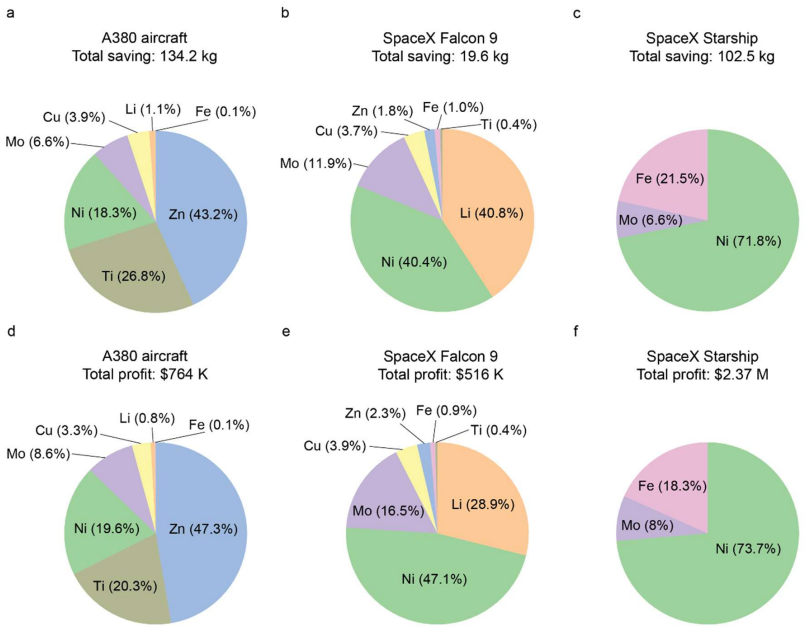
With optimized enrichment levels, nine elements including Li, B, Zn, Ni, Mo, and Sn yield positive economic returns for lightweighting, producing lifetime savings of approximately USD 700 K for an Airbus A380, USD 516 K for a SpaceX Falcon 9, and USD 2.37 million for a SpaceX Starship.
What carries the argument
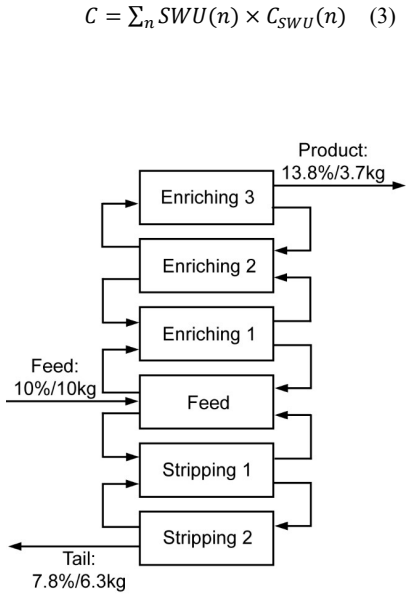
Techno-economic scaling of isotope enrichment costs from established large-scale processes, combined with calculation of economic gain from mass reduction in aerospace applications.
If this is right
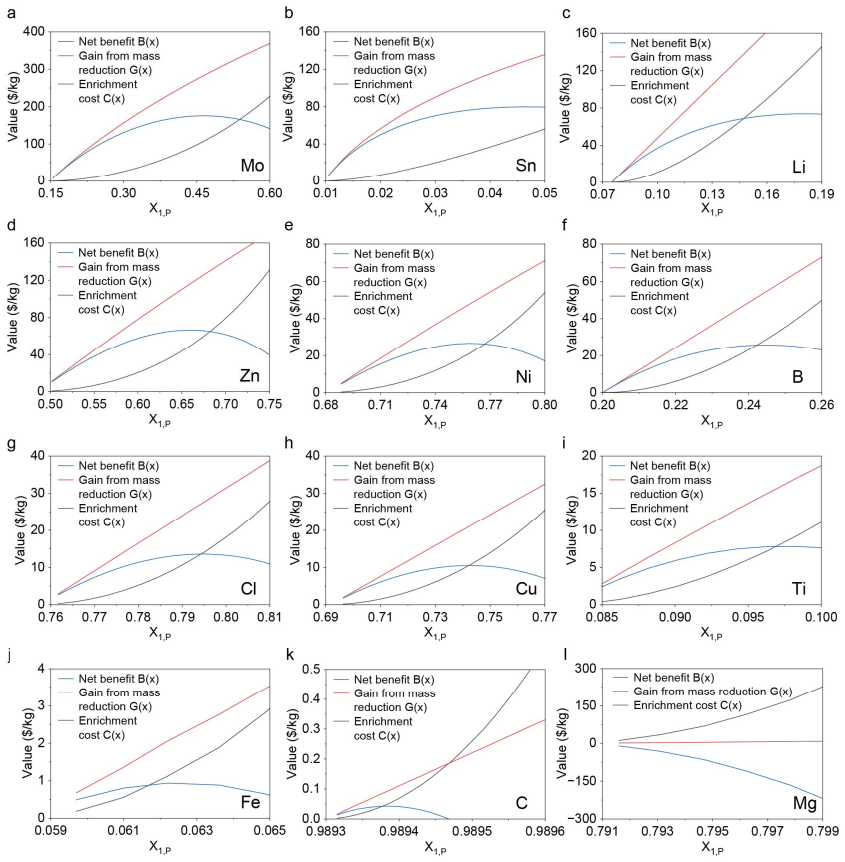
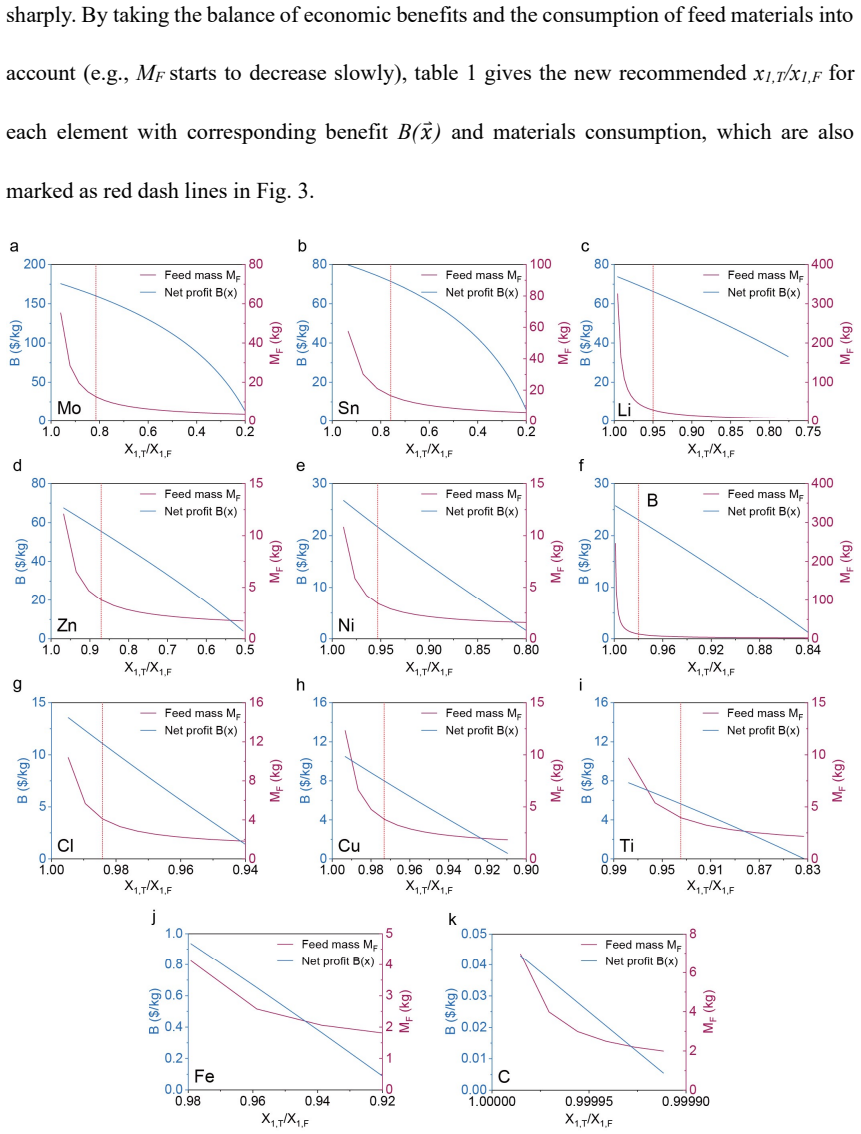
- Nine of the twelve elements show potentially attractive economic benefit at moderate enrichment levels.
- Carbon, magnesium, and iron provide little or no benefit under the same costing assumptions.
- The method is presented as leaving structural and chemical properties largely unchanged.
- Savings figures are derived from the difference between scaled enrichment cost and lifetime value of the mass reduction.
Where Pith is reading between the lines
- The scaled cost estimates should be replaced by actual quotes once enrichment plants are designed for the target volumes.
- The same cost-benefit logic could be applied to other mass-sensitive systems such as long-range electric aircraft or high-performance batteries.
- Experimental checks on whether mechanical or corrosion properties shift at the optimized enrichment fractions would tighten the model.
Load-bearing premise
Enrichment costs can be reliably estimated by scaling from existing large-scale isotope separation processes, and the enriched elements retain their structural and chemical properties.
What would settle it
A direct industrial cost quote or pilot-plant measurement for enriching one promising element such as lithium or zinc to the modeled level would confirm or refute whether the calculated net savings are real.
Figures
read the original abstract
Lightweighting is critical to mass-sensitive applications such as aircraft and space transportation. Conventional lightweight strategies often rely on new designs of materials and structures. An alternative approach is to enrich the lightest stable isotopes in an element to reduce the elements atomic mass while having little effect on structural and chemical properties. However, the economic feasibility of this concept remains unclear. Here we present a techno-economic analysis of light isotope-enriched elements for lightweighting applications by estimating isotope enrichment cost and the economic gain from mass reduction. The enrichment cost is scaled from established large-scale processes. Twelve common aerospace-relevant elements are considered, including Li, B, C, Mg, Cl, Ti, Ni, Fe, Cu, Zn, Mo, and Sn. We find that nine elements, especially Li, B, Zn, Ni, Mo, and Sn, show potentially attractive economic benefit at moderate enrichment levels, whereas C, Mg, and Fe provide little or no benefit. With the optimized enrichment levels, an Airbus A380 is expected to save approximately USD 700 K over a 30-year operational lifetime, a SpaceX Falcon 9 could save USD 516 K, and a SpaceX Starship is expected to save USD 2.37 million over its whole lifetime. While the exact enrichment cost needs to be further investigated, these results provide an initial screening of promising candidate elements and highlight isotopic mass reduction as a potential drop-in lightweighting strategy.
Editorial analysis
A structured set of objections, weighed in public.
Referee Report
Summary. The manuscript presents a techno-economic analysis of enriching the lightest stable isotopes of 12 aerospace-relevant elements (Li, B, C, Mg, Cl, Ti, Ni, Fe, Cu, Zn, Mo, Sn) to reduce atomic mass for lightweighting in aircraft and spacecraft. Enrichment costs are scaled from established large-scale industrial processes, economic gains are computed from the resulting mass reductions at post-hoc optimized enrichment levels, and net lifetime savings are projected as approximately USD 700 K for an Airbus A380, USD 516 K for a SpaceX Falcon 9, and USD 2.37 million for a SpaceX Starship.
Significance. If the scaled cost estimates and unchanged-properties assumption hold, the work would identify a potentially drop-in isotopic lightweighting route and screen promising elements (especially Li, B, Zn, Ni, Mo, Sn). The quantitative vehicle-level savings figures would be of direct interest to aerospace economics if accompanied by validated methodology.
major comments (3)
- [Abstract] Abstract (enrichment cost scaling paragraph): the net savings are obtained by subtracting scaled enrichment costs from monetized mass-reduction value at optimized levels. No first-principles energy or capital model, element-specific separation factors, or published benchmark costs for the target isotopes are provided to anchor the scaling; because the result is a difference of two large numbers, even a factor-of-2–3 underestimate in enrichment cost would eliminate or reverse the sign for marginal elements.
- [Abstract] Abstract (optimization paragraph): enrichment levels are optimized post-hoc to produce attractive benefits. This introduces selection effects that affect the reported savings figures; no pre-specified optimization criteria, sensitivity analysis across non-optimal levels, or raw data are supplied.
- [Abstract] Abstract (property assumption): the claim that enrichment has “little effect on structural and chemical properties” is stated without supporting data, references, or bounds on acceptable enrichment levels, yet it is required for the mass-reduction benefit to be realizable in actual components.
minor comments (1)
- [Abstract] Abstract: “elements atomic mass” should read “element’s atomic mass”.
Simulated Author's Rebuttal
We thank the referee for the constructive comments on our manuscript. We address each major comment point by point below, proposing revisions to improve clarity and robustness where the concerns are valid.
read point-by-point responses
-
Referee: [Abstract] Abstract (enrichment cost scaling paragraph): the net savings are obtained by subtracting scaled enrichment costs from monetized mass-reduction value at optimized levels. No first-principles energy or capital model, element-specific separation factors, or published benchmark costs for the target isotopes are provided to anchor the scaling; because the result is a difference of two large numbers, even a factor-of-2–3 underestimate in enrichment cost would eliminate or reverse the sign for marginal elements.
Authors: The cost estimates rely on scaling from established large-scale industrial isotope separation processes, which is appropriate for an initial screening study of this type. We agree that the net savings are sensitive to the underlying cost assumptions and that the absence of element-specific separation factors or direct benchmarks limits precision. In the revised manuscript we will add an explicit sensitivity analysis varying enrichment costs by factors of 2 and 3, demonstrating that the sign of the net benefit remains positive for the six most promising elements (Li, B, Zn, Ni, Mo, Sn) even under the higher-cost scenarios. revision: yes
-
Referee: [Abstract] Abstract (optimization paragraph): enrichment levels are optimized post-hoc to produce attractive benefits. This introduces selection effects that affect the reported savings figures; no pre-specified optimization criteria, sensitivity analysis across non-optimal levels, or raw data are supplied.
Authors: The optimization identifies enrichment levels that maximize net economic benefit for the purpose of screening candidate elements. To mitigate concerns about post-hoc selection, the revised version will include (i) a pre-specified optimization criterion (maximum net present value subject to a minimum enrichment level of 10 %), (ii) sensitivity results across fixed enrichment levels of 10 %, 50 %, and 90 % for all twelve elements, and (iii) the underlying raw mass-reduction and cost data in the supplementary information. revision: yes
-
Referee: [Abstract] Abstract (property assumption): the claim that enrichment has “little effect on structural and chemical properties” is stated without supporting data, references, or bounds on acceptable enrichment levels, yet it is required for the mass-reduction benefit to be realizable in actual components.
Authors: We accept that the manuscript would benefit from explicit support for this assumption. In the revision we will add references to the literature on isotopic effects in metals and compounds (showing that chemical bonding and crystal structure are essentially unchanged by isotopic substitution) and will qualify the claim by noting that the assumption applies to moderate enrichment levels (up to ~90 %) where no phase changes or significant alterations in mechanical properties have been reported. revision: yes
Circularity Check
No circularity detected; economic projections use external cost scalings and independent mass-reduction calculations.
full rationale
The paper derives savings by scaling enrichment costs from published figures on established industrial processes and subtracting those from the monetized value of mass reduction at chosen enrichment levels. No equations define a quantity in terms of itself, no fitted parameters are relabeled as predictions, and no load-bearing self-citations or ansatzes imported from prior author work appear. The central claims rest on external benchmarks and straightforward arithmetic, remaining self-contained.
Axiom & Free-Parameter Ledger
free parameters (2)
- optimized enrichment levels
- enrichment costs
axioms (1)
- domain assumption Enriching the lightest stable isotope reduces average atomic mass while having little effect on structural and chemical properties.
Reference graph
Works this paper leans on
-
[1]
Introduction Lightweighting is critical to mass-sensitive applications, such as aircraft and space transportation. Conventional lightweighting materials include low-density alloys1, 2, carbon fiber-based composites3, 4, and high-performance coatings5, which often require material substitution and redesign to meet harsh requirements in multiple dimensions ...
-
[2]
Modeling 4 2.1 The analysis framework The atomic percentage of different isotopes in an element E is denoted as 𝑥⃑ = [x1, x2, … xk], where 1 to k represent isotopes from the lowest to the highest atomic mass, and 𝑥⃑௧ correspond to the natural abundance. Then B(𝑥⃑), the benefit of using the light-isotope-enriched element E with a composition of 𝑥⃑, can b...
-
[3]
Results We analyzed 12 common elements that are used in aircraft which span over the entire periodic table, including Li, B, C, Mg, Cl, Ti, Ni, Fe, Cu, Zn, Mo, and Sn. We assume that Cl, Ti, Ni, Fe, Cu, Zn, Mo and Sn are enriched by gas centrifugation, and Li, B, C, and Mg are enriched by chemical exchange. This aligns with literature since α in chemical ...
-
[5]
(6) Davis, M
https://www.space.com/40582-elon-musk-explains-spacex-falcon-9-block-5 (accessed 2026 May 5). (6) Davis, M. The Starship revolution in space. The Strategist — Australian Strategic Policy Institute,
2026
-
[6]
https://www.aspistrategist.org.au/the-starship-revolution-in-space/ (accessed 2026 May 5). (7) SpaceX. Starship. SpaceX, https://www.spacex.com/vehicles/starship (accessed 2026 May 5). (8) (Sigma-Aldrich), M. Deuterium oxide, 99.8 atom % D (Product No. 756822 ). MilliporeSigma (Sigma-Aldrich), (accessed February 20, 2026). (9) Limited, U. 2018 Annual Resu...
-
[7]
Advanced materials & processes 2007, 165 (7). (17) Bhat, B. N. Aerospace Materials Characteristics; NASA/TP–2018–220077; NASA Marshall Space Flight Center, Huntsville, AL, 2018. (18) Lenczowski, B. New product vision for Aerospace by applying of lightweight Al-Li based alloys and Al-Mg-Sc material technologies. 2013, Vol. 24. 36 (19) Agency, E. U. A. S. T...
discussion (0)
Sign in with ORCID, Apple, or X to comment. Anyone can read and Pith papers without signing in.