Point-group symmetry analysis of many-electron wavefunctions on a quantum computer
Pith reviewed 2026-06-30 01:21 UTC · model grok-4.3
The pith
A hybrid quantum method computes point-group symmetry weights for many-electron states by applying orbital rotations from representation-matrix eigenvectors.
A machine-rendered reading of the paper's core claim, the machinery that carries it, and where it could break.
Core claim
For any prepared many-electron state the projection weight onto each irreducible representation is obtained by rotating the orbitals with the eigenvectors of the representation matrices and measuring the transformed state; the same rotations are used for both abelian and non-abelian groups and remain valid for arbitrary basis sets.
What carries the argument
Orbital rotations derived from the eigenvectors of the point-group representation matrices, which isolate the contribution of each irreducible representation when applied to the wavefunction.
If this is right
- Symmetry analysis of realistic molecular states becomes possible on near-term quantum hardware without extra ancilla qubits.
- The same rotation-based procedure applies equally to abelian and non-abelian point groups.
- Weights can be extracted for wavefunctions expressed in arbitrary basis sets.
- Error-mitigated runs on 32-qubit devices already recover the expected weights to within a few percent for benzene.
Where Pith is reading between the lines
- The extracted weights could serve as a diagnostic to verify that a prepared state lies in a desired symmetry sector before further computation.
- Symmetry-adapted state preparation might be combined with this projection step to reduce the effective Hilbert-space dimension explored by variational algorithms.
- The eigenvector-derived rotation technique could be ported to other discrete symmetry groups if their representation matrices can be diagonalized in the orbital basis.
Load-bearing premise
The wavefunction prepared on the quantum device must be close enough to the target state that the subsequent rotations and measurements reflect its true symmetry content rather than device noise or preparation error.
What would settle it
If the weights extracted on hardware after the prescribed rotations differ substantially from the weights obtained by applying the identical rotations to the same state on a classical simulator, the method's hardware viability is refuted.
Figures


read the original abstract
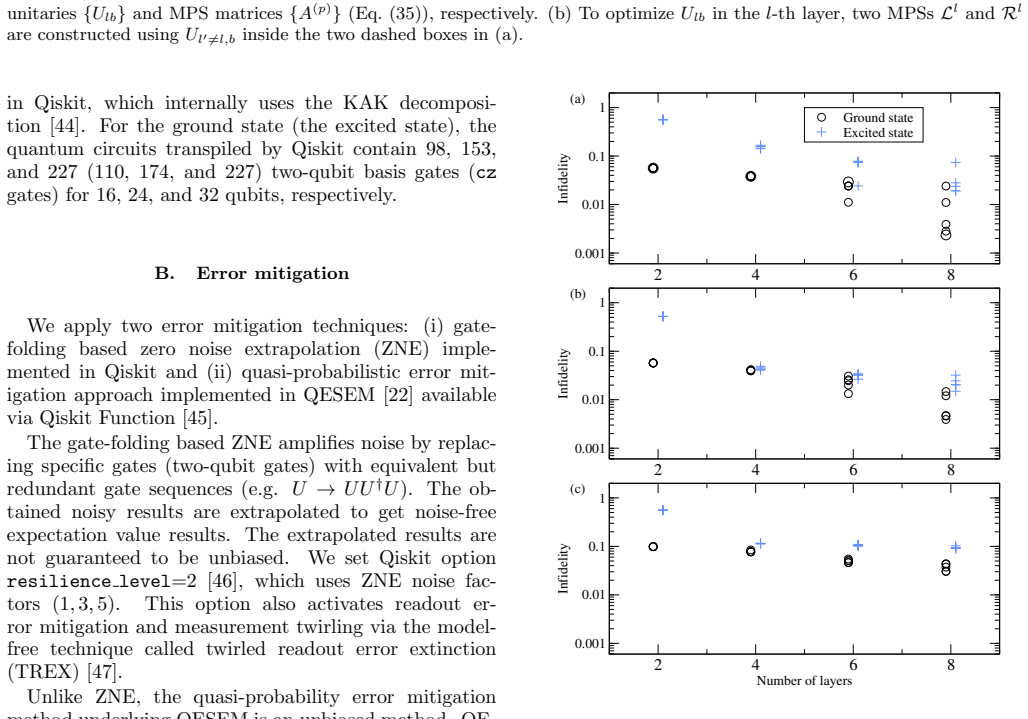
A point group is a set of spatial symmetry operations in molecular systems and is an indispensable tool for analyzing molecular orbitals and spectroscopy experiments in chemistry. Several quantum algorithms to exploit this symmetry have been proposed, but practical implementations of point-group symmetry operations and the detailed symmetry analysis of realistic many-electron wavefunctions are still missing. In this work, we propose an ancilla-free hybrid method to analyze point-group symmetries of many-electron states, which works for both abelian and non-abelian groups. For a given wavefunction, our method calculates the projection weights of point-group irreducible representations by applying orbital rotations derived from the eigenvectors of the representation matrices, making it applicable to arbitrary basis functions. The usefulness of our approach is demonstrated through numerical simulations of benzene and ferrocene molecules. Furthermore, we perform a hardware demonstration of the weight calculation of the ground state and the first excited state of benzene in $D_{2h}$ symmetry, using up to 32 qubits of IBM's ibm_kawasaki device. By combining a tensor-network based encoding scheme and error mitigation techniques, we find the weights of irreducible representations for both states are faithfully reproduced within a few percent error. Our results suggest that the proposed method serves as a practical tool for analyzing symmetry properties of many-electron wavefunctions in realistic material simulations on near-term and early fault-tolerant quantum computers.
Editorial analysis
A structured set of objections, weighed in public.
Referee Report
Summary. The paper claims to introduce an ancilla-free hybrid method for point-group symmetry analysis of many-electron wavefunctions on quantum computers. For a prepared state, the method extracts projection weights onto irreducible representations by applying orbital rotations obtained from the eigenvectors of the finite-group representation matrices; this is shown to work for both abelian and non-abelian groups and for arbitrary basis functions. Numerical demonstrations are given for benzene and ferrocene, and a hardware experiment on IBM ibm_kawasaki (up to 32 qubits, tensor-network encoding plus mitigation) reports that the D_{2h} ground- and excited-state weights are reproduced within a few percent.
Significance. If the central claim holds, the work supplies a practical, ancilla-free tool for symmetry analysis that can be run on the same circuit depth as state preparation itself. The explicit construction via representation-matrix eigenvectors and the hardware demonstration with tensor-network encoding and error mitigation are concrete strengths that could be useful for near-term quantum chemistry simulations where point-group symmetry is exploited.
major comments (1)
- [Hardware demonstration] Hardware demonstration (abstract and final experimental section): the claim that the weights are 'faithfully reproduced within a few percent error' is load-bearing for the practical-utility conclusion, yet the manuscript supplies neither quantitative error bars on the extracted projection weights nor any bound on how large a state-preparation or residual-noise deviation ||ψ − ψ_ideal|| can be before the reported weights deviate beyond that tolerance. Because the procedure is ancilla-free and re-uses the state-preparation circuit, any unmitigated error directly contaminates the symmetry content; the absence of such a sensitivity analysis leaves the hardware result without a clear error budget.
Simulated Author's Rebuttal
We thank the referee for the constructive comment on the hardware demonstration. We address the point below and will revise the manuscript accordingly.
read point-by-point responses
-
Referee: Hardware demonstration (abstract and final experimental section): the claim that the weights are 'faithfully reproduced within a few percent error' is load-bearing for the practical-utility conclusion, yet the manuscript supplies neither quantitative error bars on the extracted projection weights nor any bound on how large a state-preparation or residual-noise deviation ||ψ − ψ_ideal|| can be before the reported weights deviate beyond that tolerance. Because the procedure is ancilla-free and re-uses the state-preparation circuit, any unmitigated error directly contaminates the symmetry content; the absence of such a sensitivity analysis leaves the hardware result without a clear error budget.
Authors: We agree that the absence of quantitative error bars and a sensitivity analysis weakens the hardware claim. In the revised manuscript we will add (i) statistical error bars on the reported projection weights obtained from repeated hardware runs and (ii) a numerical sensitivity study that injects controlled state-preparation and readout errors into the ideal circuit and tracks the resulting deviation in the extracted weights. This will provide an explicit error budget for the few-percent agreement. revision: yes
Circularity Check
No circularity: derivation applies standard finite-group representation theory to quantum states
full rationale
The paper's core procedure (orbital rotations from eigenvectors of representation matrices to extract irrep projection weights) follows directly from textbook point-group theory applied to Slater determinants or general many-electron states. No equation reduces a reported weight to a fitted parameter inside the paper, no self-citation is invoked as a uniqueness theorem, and the hardware demonstration is presented as an empirical check rather than a derivation. The method is therefore self-contained against external group-theoretic benchmarks.
Axiom & Free-Parameter Ledger
axioms (1)
- standard math Point groups admit a complete set of irreducible representations whose projection operators can be realized by orbital rotations.
Reference graph
Works this paper leans on
-
[1]
the original Hartree-Fock ground state and one SE state
-
[2]
states obtained by applying the symmetry projec- tionP Γ to 1
-
[3]
We apply a step-function like filter with cutoff energy as Θ(H−E cutoff)|Ψ⟩, where Θ(E) = ( 1E <0 0E >0
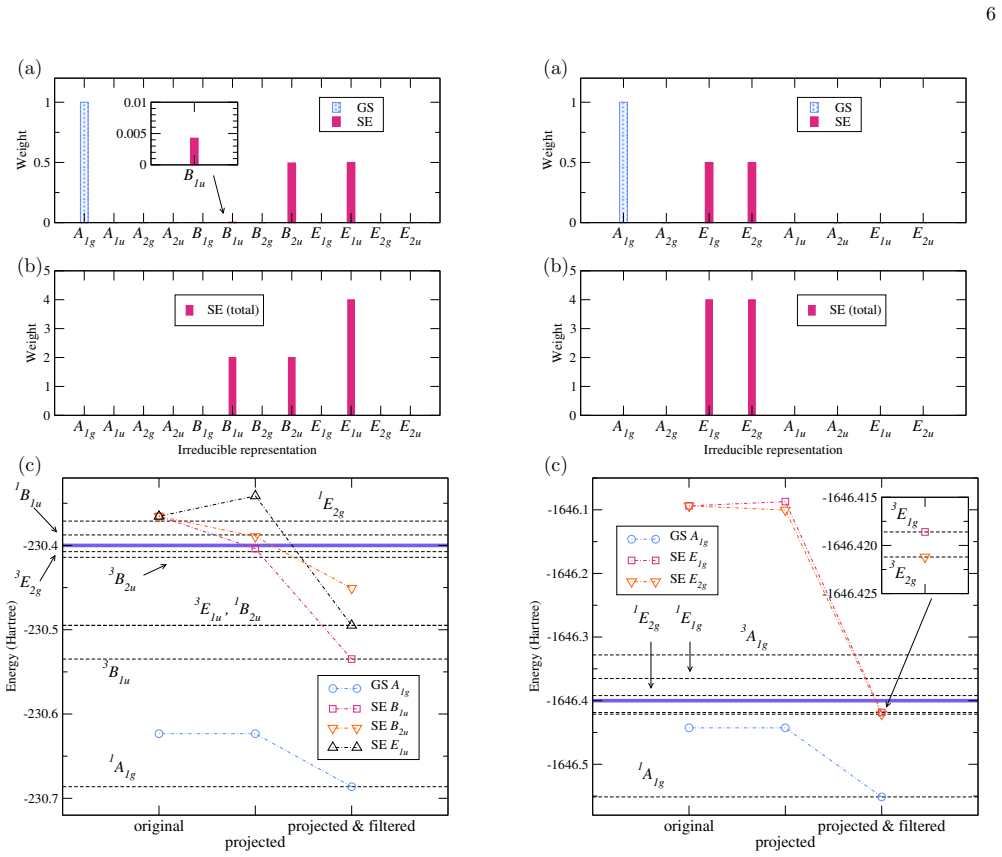
states obtained by applying an energy-based filter to 2. We apply a step-function like filter with cutoff energy as Θ(H−E cutoff)|Ψ⟩, where Θ(E) = ( 1E <0 0E >0. (28) This filter can be implemented, for example, with the quantum eigenvalue transformation of unitary matrices (QETU) [36]. In Fig. 3(c) and Fig. 4(c), the cutoff energy and the exact eigenstat...
2026
-
[4]
The corresponding QPU time for each mea- surement set ranges approximately from 400 to 600 sec- onds
In QESEM, the number of total shots for each mea- surement set, including calibration, noise characteriza- tion, and mitigation, with 32 qubits varies from 1.4×10 6 to 2.1×10 6. The corresponding QPU time for each mea- surement set ranges approximately from 400 to 600 sec- onds. C. Hardware results Figure 9 shows the hardware results executed on ibm kawas...
-
[5]
Singh, R
S. Singh, R. N. C. Pfeifer, and G. Vidal, Tensor network states and algorithms in the presence of a global U(1) symmetry, Phys. Rev. B83, 115125 (2011)
2011
-
[6]
B. T. Gard, L. Zhu, G. S. Barron, N. J. Mayhall, S. E. Economou, and E. Barnes, Efficient symmetry-preserving state preparation circuits for the variational quantum eigensolver algorithm, npj Quantum Information6, 10 (2020)
2020
-
[7]
S. Bravyi, J. M. Gambetta, A. Mezzacapo, and K. Temme, Tapering off qubits to simulate fermionic Hamiltonians (2017), arXiv:1701.08213 [quant-ph]
Pith/arXiv arXiv 2017
-
[8]
Bishop,Group Theory and Chemistry, Dover Books on Chemistry (Dover Publications, 2012)
D. Bishop,Group Theory and Chemistry, Dover Books on Chemistry (Dover Publications, 2012)
2012
-
[9]
H. A. Jahn and E. Teller, Stability of polyatomic molecules in degenerate electronic states - I—Orbital de- generacy, Proceedings of the Royal Society of London. A. Mathematical and Physical Sciences161, 220 (1937)
1937
-
[10]
H. A. Jahn, Stability of polyatomic molecules in degen- erate electronic states II-Spin degeneracy, Proceedings of the Royal Society of London. A. Mathematical and Phys- ical Sciences164, 117 (1938)
1938
-
[11]
Bersuker,The Jahn-Teller Effect(Cambridge Univer- sity Press, 2006)
I. Bersuker,The Jahn-Teller Effect(Cambridge Univer- sity Press, 2006)
2006
-
[12]
R. B. Woodward and R. Hoffmann, Stereochemistry of electrocyclic reactions, J. Am. Chem. Soc.87, 395 (1965)
1965
-
[13]
Setia, R
K. Setia, R. Chen, J. E. Rice, A. Mezzacapo, M. Pistoia, and J. D. Whitfield, Reducing qubit requirements for quantum simulations using molecular point group sym- metries, Journal of Chemical Theory and Computation 16, 6091 (2020)
2020
-
[14]
Picozzi and J
D. Picozzi and J. Tennyson, Symmetry-adapted encod- ings for qubit number reduction by point-group and other Boolean symmetries, Quantum Science and Technology 8, 035026 (2023)
2023
-
[15]
C. Cao, J. Hu, W. Zhang, X. Xu, D. Chen, F. Yu, J. Li, H.-S. Hu, D. Lv, and M.-H. Yung, Progress toward larger molecular simulation on a quantum computer: Simulat- ing a system with up to 28 qubits accelerated by point- group symmetry, Phys. Rev. A105, 062452 (2022)
2022
-
[16]
T.-C. Yen, R. A. Lang, and A. F. Izmaylov, Exact and ap- proximate symmetry projectors for the electronic struc- ture problem on a quantum computer, The Journal of Chemical Physics151, 164111 (2019)
2019
-
[17]
V. M. Bastidas, N. Fitzpatrick, K. J. Joven, Z. M. Rossi, S. Islam, T. Van Voorhis, I. L. Chuang, and Y. Liu, Uni- fication of finite symmetries in the simulation of many- body systems on quantum computers, Phys. Rev. A111, 052433 (2025)
2025
-
[18]
V. Khinevich and W. Mizukami, Symmetry-adapted state preparation for quantum chemistry on fault- tolerant quantum computers (2026), arXiv:2601.08533 [quant-ph]
arXiv 2026
-
[19]
Motta, K
M. Motta, K. J. Sung, K. B. Whaley, M. Head-Gordon, and J. Shee, Bridging physical intuition and hardware ef- ficiency for correlated electronic states: the local unitary cluster Jastrow ansatz for electronic structure, Chem. Sci.14, 11213 (2023)
2023
-
[20]
S. R. White, Density matrix formulation for quantum renormalization groups, Phys. Rev. Lett.69, 2863 (1992)
1992
-
[21]
Schollw¨ ock, The density-matrix renormalization group in the age of matrix product states, Annals of Physics 326, 96 (2011), january 2011 Special Issue
U. Schollw¨ ock, The density-matrix renormalization group in the age of matrix product states, Annals of Physics 326, 96 (2011), january 2011 Special Issue
2011
-
[22]
Kanno, K
S. Kanno, K. Sugisaki, H. Nakamura, H. Yamauchi, R. Sakuma, T. Kobayashi, Q. Gao, and N. Yamamoto, Tensor-based quantum phase difference estimation for large-scale demonstration, Proceedings of the National Academy of Sciences122, e2425026122 (2025)
2025
-
[23]
Temme, S
K. Temme, S. Bravyi, and J. M. Gambetta, Error mitiga- tion for short-depth quantum circuits, Phys. Rev. Lett. 119, 180509 (2017)
2017
-
[24]
A. Javadi-Abhari, M. Treinish, K. Krsulich, C. J. Wood, J. Lishman, J. Gacon, S. Martiel, P. D. Na- tion, L. S. Bishop, A. W. Cross, B. R. Johnson, and J. M. Gambetta, Quantum computing with qiskit (2024), arXiv:2405.08810 [quant-ph]
Pith/arXiv arXiv 2024
-
[25]
D. Aharonov, O. Alberton, I. Arad, Y. Atia, E. Bairey, Z. Brakerski, I. Cohen, O. Golan, I. Gurwich, O. Ken- neth, E. Leviatan, N. H. Lindner, R. A. Melcer, A. Meyer, G. Schul, and M. Shutman, On the importance of error mitigation for quantum computation (2025), arXiv:2503.17243 [quant-ph]
arXiv 2025
-
[26]
D. Aharonov, O. Alberton, I. Arad, Y. Atia, E. Bairey, M. B. Dov, A. Berkovitch, Z. Brakerski, I. Cohen, E. Fuchs, O. Golan, O. Golan, B. D. Gur, I. Gur- wich, A. Haber, R. Haber, D. Halbertal, Y. Itkin, B. A. Katzir, O. Kenneth, S. Kotler, R. Levi, E. Leviatan, Y. Y. Lifshitz, A. Ludmer, S. Matityahu, R. A. Melcer, A. Meyer, O. Ovdat, A. Panahi, G. Ron, ...
Pith/arXiv arXiv 2025
-
[27]
Moore, D
C. Moore, D. Rockmore, and A. Russell, Generic quan- tum fourier transforms, ACM Trans. Algorithms2, 707–723 (2006)
2006
-
[28]
Helgaker, P
T. Helgaker, P. Jørgensen, and J. Olsen,Molecular Electronic-Structure Theory(John Wiley & Sons, Ltd, 2000)
2000
-
[29]
Dreizler and E
R. Dreizler and E. Gross,Density Functional Theory: An Approach to the Quantum Many-Body Problem(Springer Berlin Heidelberg, 2012)
2012
-
[30]
Arute, K
F. Arute, K. Arya, R. Babbush, D. Bacon, J. C. Bardin, R. Barends, S. Boixo, M. Broughton, B. B. Buck- ley, D. A. Buell, B. Burkett, N. Bushnell, Y. Chen, Z. Chen, B. Chiaro, R. Collins, W. Courtney, S. Demura, A. Dunsworth, E. Farhi, A. Fowler, B. Foxen, C. Gid- ney, M. Giustina, R. Graff, S. Habegger, M. P. Harri- gan, A. Ho, S. Hong, T. Huang, W. J. Hu...
2020
-
[31]
Lacroix, E
D. Lacroix, E. A. Ruiz Guzman, and P. Siwach, Sym- metry breaking/symmetry preserving circuits and sym- metry restoration on quantum computers, The European Physical Journal A59, 3 (2023)
2023
-
[32]
Chakraborty, Implementing any Linear Combination of Unitaries on Intermediate-term Quantum Computers, Quantum8, 1496 (2024)
S. Chakraborty, Implementing any Linear Combination of Unitaries on Intermediate-term Quantum Computers, Quantum8, 1496 (2024)
2024
-
[33]
N. C. Rubin, R. Babbush, and J. McClean, Application of fermionic marginal constraints to hybrid quantum al- gorithms, New Journal of Physics20, 053020 (2018)
2018
-
[34]
Y. S. Sohn, D. N. Hendrickson, and H. B. Gray, Elec- tronic structure of metallocene, J. Am. Chem. Soc.93, 3603 (1971)
1971
-
[35]
Mohammadi, A
N. Mohammadi, A. Ganesan, C. T. Chantler, and F. Wang, Differentiation of ferrocene D5d and D5h con- formers using IR spectroscopy, Journal of Organometallic Chemistry713, 51 (2012)
2012
-
[36]
K. J. Sung, I. Choi, M. Amico, B. Andrews, E. Ayan- tuna, Y. Kawashima, W.-H. Lin, D. Omanovic, S. Pic- cinelli, J. R. Moreno, A. A. Saki, J. Shee, S. Shin, M. C. Tran, K. Ueda, H. Zhang, and M. Motta, ffsim: Faster simulation of fermionic quantum circuits (2026), arXiv:2605.03123 [quant-ph]
Pith/arXiv arXiv 2026
-
[37]
The ffsim developers, ffsim: Faster simulations of fermionic quantum circuits,https://github.com/ qiskit-community/ffsim
-
[38]
Q. Sun, X. Zhang, S. Banerjee, P. Bao, M. Barbry, N. S. Blunt, N. A. Bogdanov, G. H. Booth, J. Chen, Z.-H. Cui, J. J. Eriksen, Y. Gao, S. Guo, J. Hermann, M. R. Hermes, K. Koh, P. Koval, S. Lehtola, Z. Li, J. Liu, N. Mardirossian, J. D. McClain, M. Motta, B. Mussard, H. Q. Pham, A. Pulkin, W. Purwanto, P. J. Robin- son, E. Ronca, E. R. Sayfutyarova, M. Sc...
2020
-
[39]
R. L. Ellis and H. H. Jaffe, The symmetries and multiplic- ities of electronic states in polyatomic molecules, Journal of Chemical Education48, 92 (1971)
1971
-
[40]
Y. Dong, L. Lin, and Y. Tong, Ground-state prepara- tion and energy estimation on early fault-tolerant quan- tum computers via quantum eigenvalue transformation of unitary matrices, PRX Quantum3, 040305 (2022)
2022
-
[41]
A. Y. Kitaev, Quantum measurements and the abelian stabilizer problem (1995), arXiv:quant-ph/9511026 [quant-ph]
Pith/arXiv arXiv 1995
-
[42]
Robledo-Moreno, M
J. Robledo-Moreno, M. Motta, H. Haas, A. Javadi- Abhari, P. Jurcevic, W. Kirby, S. Martiel, K. Sharma, S. Sharma, T. Shirakawa, I. Sitdikov, R.-Y. Sun, K. J. Sung, M. Takita, M. C. Tran, S. Yunoki, and A. Mezza- capo, Chemistry beyond the scale of exact diagonaliza- tion on a quantum-centric supercomputer, Science Ad- vances11, eadu9991 (2025)
2025
-
[43]
W.-H. Lin, F. Liang, M. Motta, H. Zhang, K. M. M. Jr., and K. J. Sung, Improved parameter initialization for the (local) unitary cluster Jastrow ansatz (2025), arXiv:2511.22476 [quant-ph]
arXiv 2025
-
[44]
K. Kanno, M. Kohda, R. Imai, S. Koh, K. Mitarai, W. Mizukami, and Y. O. Nakagawa, Quantum-Selected Configuration Interaction: classical diagonalization of Hamiltonians in subspaces selected by quantum comput- ers (2023), arXiv:2302.11320 [quant-ph]
Pith/arXiv arXiv 2023
-
[45]
Y. Zhou, E. M. Stoudenmire, and X. Waintal, What lim- its the simulation of quantum computers?, Phys. Rev. X 10, 041038 (2020)
2020
-
[46]
Shirakawa, H
T. Shirakawa, H. Ueda, and S. Yunoki, Automatic quan- tum circuit encoding of a given arbitrary quantum state, Phys. Rev. Res.6, 043008 (2024)
2024
-
[47]
H. Zhai, H. R. Larsson, S. Lee, Z.-H. Cui, T. Zhu, C. Sun, L. Peng, R. Peng, K. Liao, J. T¨ olle, J. Yang, S. Li, and G. K.-L. Chan, Block2: A comprehensive open source framework to develop and apply state-of-the-art DMRG algorithms in electronic structure and beyond, The Jour- nal of Chemical Physics159, 234801 (2023)
2023
-
[48]
A. W. Cross, L. S. Bishop, S. Sheldon, P. D. Nation, and J. M. Gambetta, Validating quantum computers using randomized model circuits, Phys. Rev. A100, 032328 (2019)
2019
-
[49]
QESEM: A Qiskit Function by Qedma,https:// quantum.cloud.ibm.com/docs/en/guides/qedma-qesem (2026), accessed: 2026-04-15
2026
-
[50]
IBM Quantum, Configure error mitigation, https://quantum.cloud.ibm.com/docs/en/guides/ configure-error-mitigation(2026), accessed: 2026- 04-15
2026
-
[51]
van den Berg, Z
E. van den Berg, Z. K. Minev, and K. Temme, Model-free readout-error mitigation for quantum expectation values, Phys. Rev. A105, 032620 (2022)
2022
-
[52]
van den Berg, Z
E. van den Berg, Z. K. Minev, A. Kandala, and K. Temme, Probabilistic error cancellation with sparse Pauli–Lindblad models on noisy quantum processors, Na- ture Physics19, 1116 (2023)
2023
-
[53]
Momma and F
K. Momma and F. Izumi,VESTA3for three-dimensional visualization of crystal, volumetric and morphology data, Journal of Applied Crystallography44, 1272 (2011)
2011
discussion (0)
Sign in with ORCID, Apple, or X to comment. Anyone can read and Pith papers without signing in.