Subcritical bubble prehistory in weak first-order phase transition
Pith reviewed 2026-06-30 00:00 UTC · model grok-4.3
The pith
Weak first-order phase transitions can develop a mixed background from subcritical bubbles before the nucleation temperature.
A machine-rendered reading of the paper's core claim, the machinery that carries it, and where it could break.
Core claim
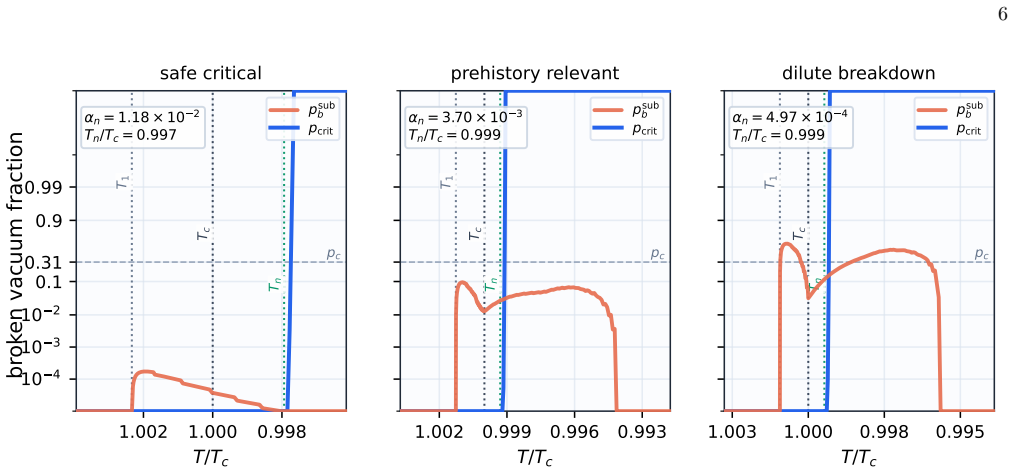
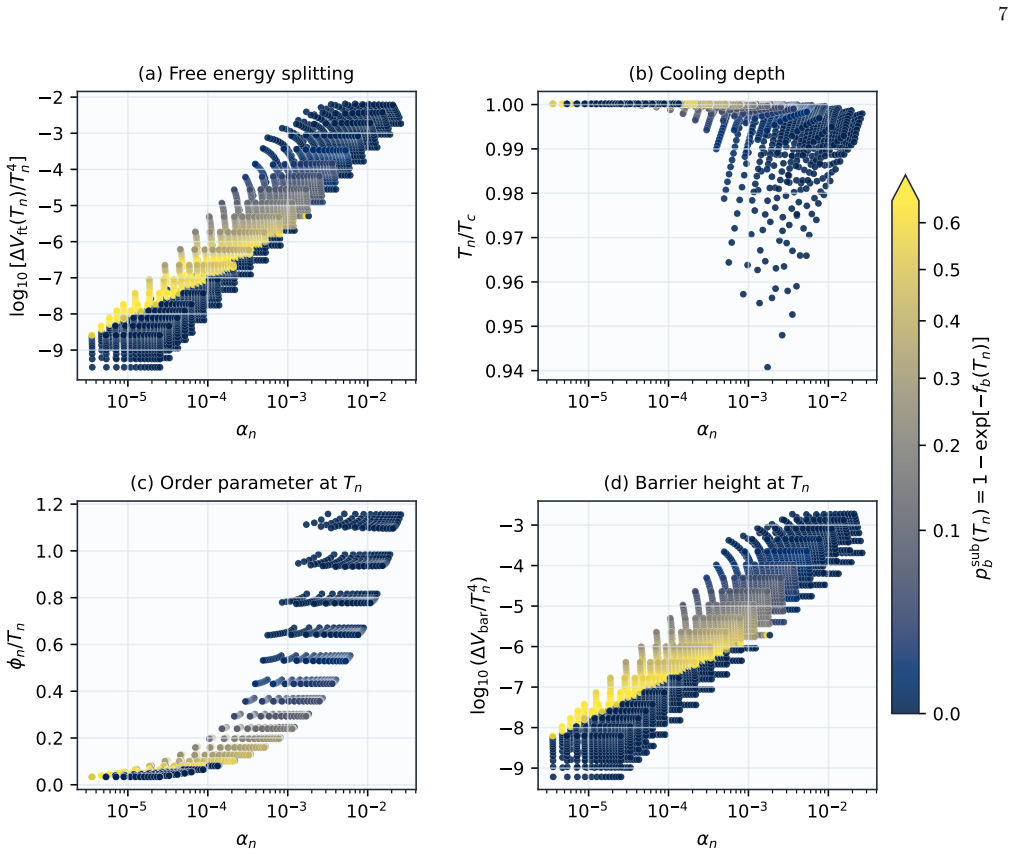
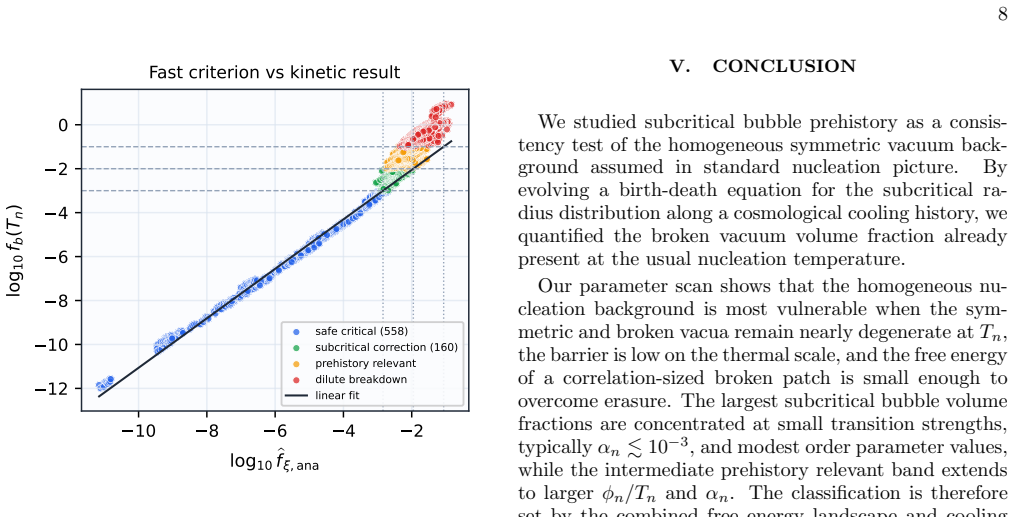
In weak first-order phase transitions, thermal fluctuations can produce a sizable population of subcritical bubbles before the critical nucleation temperature Tn is reached. When the symmetric and broken phases are nearly degenerate at Tn, the potential barrier is low, the free-energy difference is moderate, and the transition strength is weak, the subcritical volume fraction at Tn can reach the percent level. The analysis identifies a simple threshold, log10 of the subcritical bubble volume fraction at Tn approximately equal to -1.95, above which the background must be treated as mixed rather than homogeneous.
What carries the argument
The subcritical bubble population evolution that tracks volume fraction up to the nucleation temperature, compared against the critical bubble nucleation rate.
If this is right
- Regions with nearly degenerate phases and low barriers at Tn exhibit sizable subcritical fractions.
- A log10 f̂_ξ(Tn) value of about -1.95 marks the boundary for percent-level subcritical volume.
- Parameter points above this boundary require mixed-background treatment instead of homogeneous bounce calculations.
- The approximation of homogeneous nucleation is self-consistent only for stronger transitions or higher barriers.
Where Pith is reading between the lines
- Calculations of gravitational wave production from such transitions may need to account for the mixed prehistory.
- The criterion could be applied to scan models for electroweak phase transition to flag unreliable points.
- Extensions might include how this affects bubble wall dynamics or relic abundances.
Load-bearing premise
The subcritical bubble kinetics model accurately captures the evolution without additional damping or interaction effects that would change the volume fraction in the scanned space.
What would settle it
A calculation or simulation of the bubble population evolution that includes extra damping terms and shows the volume fraction at Tn remains below the percent level even above the proposed criterion.
Figures

read the original abstract
Standard calculations of cosmological first-order phase transitions usually assume critical bubbles to nucleate on a homogeneous symmetric vacuum background. However, this assumption can fail in weak transitions, where thermal fluctuations trigger subcritical bubbles before the standard nucleation temperature $T_n$. Motivated by this possibility, we systematically examine whether the homogeneous nucleation background approximation is self-consistent. By evolving the Gelmini-Gleiser subcritical bubble kinetics and comparing it with the standard critical bubble nucleation picture, we identify the parameter regions in which the background becomes apparently mixed. A detailed scan of these regions shows that sizable subcritical volume fractions arise when the two phases are nearly degenerate at $T_n$, the potential barrier is low, the difference of free energy between the symmetric and broken phases is moderate and the transition strength is weak. Our analysis further yields a simple criterion, $\log_{10}\hat f_\xi(T_n)\simeq -1.95$, for a percent level subcritical bubble volume fraction. Parameter points above this boundary should be treated as mixed background candidates rather than as ordinary homogeneous bounce points.
Editorial analysis
A structured set of objections, weighed in public.
Referee Report
Summary. The paper examines whether the standard assumption of a homogeneous symmetric vacuum background remains self-consistent in weak first-order cosmological phase transitions. Using the Gelmini-Gleiser subcritical bubble kinetics, it evolves the bubble population to the nucleation temperature Tn and compares against the critical-bubble picture. A parameter scan identifies regions of sizable subcritical volume fractions when phases are nearly degenerate at Tn, the barrier is low, the free-energy difference is moderate, and the transition is weak. The analysis produces an empirical criterion, log10 f̂_ξ(Tn) ≃ −1.95, marking the boundary for percent-level subcritical volume; points above this threshold are flagged as mixed-background candidates rather than standard homogeneous bounce points.
Significance. If the result holds, the work supplies a practical diagnostic for when conventional nucleation calculations lose validity in weak transitions, which is relevant for many BSM cosmological models. Credit is due for the systematic comparison of subcritical kinetics against the standard picture and for distilling the scan into a simple numerical threshold that can be checked without re-running full simulations.
major comments (2)
- [Abstract and results of the parameter scan] The threshold log10 f̂_ξ(Tn) ≃ −1.95 is determined by matching the 1 % volume-fraction contour within the same numerical scan that defines the mixed-background regions (see the scan description in the abstract). This makes the quoted value a post-hoc fit rather than an independent prediction, weakening the evidential support for the stated criterion.
- [Kinetics model and evolution to Tn] The central claim rests on evolving the subcritical population with the Gelmini-Gleiser rate equations, which treat bubbles as non-interacting and undamped. At volume fractions approaching a few percent in the weak-transition regime (nearly degenerate vacua, low barrier), coalescence, repulsion, or additional friction could alter the accumulated volume and shift the reported boundary; this modeling assumption is load-bearing for the criterion.
minor comments (2)
- The notation f̂_ξ is introduced without an explicit definition in the abstract; a one-sentence clarification of its physical meaning would improve readability for readers outside the immediate subfield.
- The abstract states that a 'detailed scan' was performed but does not list the sampled ranges, number of points, or convergence criteria; adding these details (even in a supplementary table) would strengthen reproducibility.
Simulated Author's Rebuttal
We thank the referee for the constructive comments, which help clarify the scope and limitations of our analysis. We respond to each major comment below and indicate the revisions we will make.
read point-by-point responses
-
Referee: [Abstract and results of the parameter scan] The threshold log10 f̂_ξ(Tn) ≃ −1.95 is determined by matching the 1 % volume-fraction contour within the same numerical scan that defines the mixed-background regions (see the scan description in the abstract). This makes the quoted value a post-hoc fit rather than an independent prediction, weakening the evidential support for the stated criterion.
Authors: The referee is correct that the numerical value log10 f̂_ξ(Tn) ≃ −1.95 is obtained by fitting the 1% contour directly from the parameter scan that also identifies the mixed-background regions. We present the threshold as an empirical diagnostic that emerges from the scan rather than as an a priori theoretical prediction. In the revised manuscript we will modify the abstract and the results section to state explicitly that the criterion is an empirical fit to the 1% volume-fraction contour within the same scan. This framing makes the practical utility of the diagnostic clearer without overstating its status as an independent result. revision: yes
-
Referee: [Kinetics model and evolution to Tn] The central claim rests on evolving the subcritical population with the Gelmini-Gleiser rate equations, which treat bubbles as non-interacting and undamped. At volume fractions approaching a few percent in the weak-transition regime (nearly degenerate vacua, low barrier), coalescence, repulsion, or additional friction could alter the accumulated volume and shift the reported boundary; this modeling assumption is load-bearing for the criterion.
Authors: The Gelmini-Gleiser rate equations are the standard framework used in the literature for subcritical bubble evolution and indeed assume non-interacting, undamped bubbles. We agree that, once volume fractions reach a few percent, coalescence or additional damping could in principle modify the accumulated volume and shift the precise location of the boundary. Our scan is performed within this established model, and the reported criterion therefore inherits its limitations. In the revised manuscript we will add a dedicated paragraph in the discussion section that explicitly acknowledges this modeling assumption, notes that the 1% threshold is intended as a conservative flag within the Gelmini-Gleiser approximation, and states that more complete simulations including bubble interactions would be required to refine the boundary. revision: partial
Circularity Check
No significant circularity; empirical criterion is output of external model scan
full rationale
The paper evolves the external Gelmini-Gleiser subcritical bubble kinetics model across a parameter space to locate regions where the homogeneous nucleation assumption fails, then reports an empirical boundary value log10 f̂_ξ(Tn) ≃ −1.95 as a compact summary of those numerical results. No step reduces a claimed prediction or first-principles result to its own inputs by construction, no self-citation chain bears the central claim, and the model equations themselves are not redefined in terms of the target volume fraction. The derivation therefore remains self-contained against the external kinetics framework.
Axiom & Free-Parameter Ledger
free parameters (1)
- log10 f̂_ξ threshold =
-1.95
axioms (1)
- domain assumption Gelmini-Gleiser subcritical bubble kinetics accurately describes the population evolution before Tn
Reference graph
Works this paper leans on
-
[1]
5 summarizes two checks on the solver
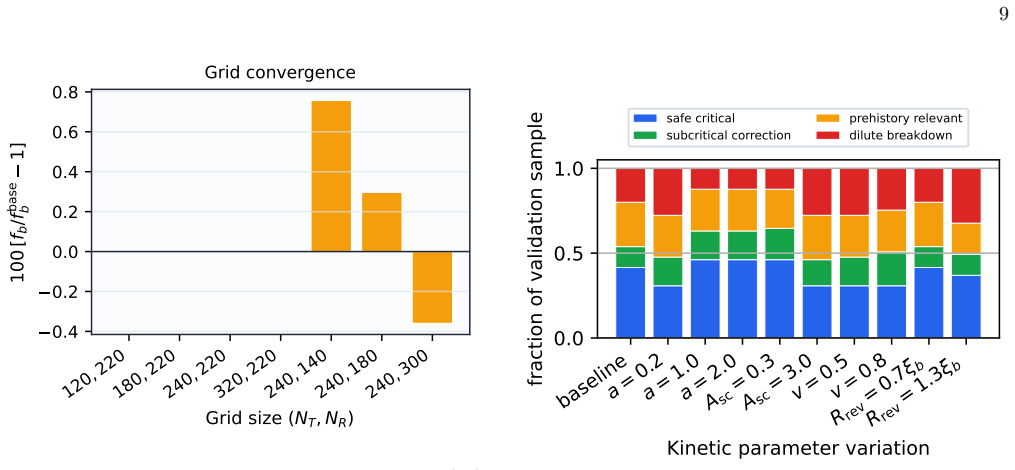
Grid convergence Fig. 5 summarizes two checks on the solver. For the benchmark point (D, λ, r c) = (0.35,0.21,0.40), vary- ing the cooling grid between 120 and 320 points leaves fb(Tn) unchanged at the precision shown. The radius grid is more demanding because the direct volume inte- gral weights the radius distribution byR 3: the coarsest radius grid shi...
-
[2]
Robustness of kinetic assumptions The baseline scan usesa= 0.5,A sc = 1,v= 1, and the reverse erasure cutR > ξ b. Fig. 6 tests the robustness baselinea=0.2 a=1.0 a=2.0 Asc=0.3 Asc=3.0 v=0.5 v=0.8 Rrev=0.7 b Rrev=1.3 b Kinetic parameter variation 0.0 0.5 1.0fraction of validation sample safe critical subcritical correction prehistory relevant dilute breakd...
-
[3]
A Non-Perturbative Analysis of the Finite T Phase Transition in SU(2)xU(1) Electroweak Theory
K. Kajantie, M. Laine, K. Rummukainen and M. E. Shaposhnikov,A Nonperturbative analysis of the finite T phase transition in SU(2) x U(1) electroweak theory, Nucl. Phys. B493(1997) 413–438, [hep-lat/9612006]
work page internal anchor Pith review Pith/arXiv arXiv 1997
-
[4]
H. Chen and Y. Jiang,A comprehensive framework for electroweak phase transitions: Thermal history and dynamics from bubble nucleation to percolation, 2503.00421
-
[5]
J. Du, Y. Jiang and W. Su,Probing the electroweak phase transition in the flipped two-higgs-doublet model at the lhc,2605.13939
work page internal anchor Pith review Pith/arXiv arXiv
- [6]
-
[7]
L. Wang,Inflation, electroweak phase transition, and Higgs searches at the LHC in the two-Higgs-doublet model,JHEP07(2022) 055, [2105.02143]
- [8]
- [9]
-
[10]
X.-F. Han, L. Wang and Y. Zhang,Dark matter, electroweak phase transition, and gravitational waves in the type ii two-higgs-doublet model with a singlet scalar field,Phys. Rev. D103(2021) 035012
2021
- [11]
-
[12]
J. Yang, R. Zhou and L. Bian,Gravitational waves and monopoles dark matter from first-order phase transition, Phys. Lett. B839(2023) 137822
2023
-
[13]
Vaskonen,Electroweak baryogenesis and gravitational waves from a real scalar singlet,Phys
V. Vaskonen,Electroweak baryogenesis and gravitational waves from a real scalar singlet,Phys. Rev. D95(2017) 123515
2017
-
[14]
A. Beniwal, M. Lewicki, M. White and A. G. Williams, Gravitational waves and electroweak baryogenesis in a global study of the extended scalar singlet model,JHEP 02(2019) 183, [1810.02380]
work page internal anchor Pith review Pith/arXiv arXiv 2019
-
[15]
Z. Kang, P. Ko and T. Matsui,Strong first order EWPT &strong gravitational waves in Z 3-symmetric singlet scalar extension,JHEP02(2018) 115, [1706.09721]
work page internal anchor Pith review Pith/arXiv arXiv 2018
-
[16]
Signals of the electroweak phase transition at colliders and gravitational wave observatories
M. Chala, C. Krause and G. Nardini,Signals of the electroweak phase transition at colliders and gravitational wave observatories,JHEP07(2018) 062, [1802.02168]
work page internal anchor Pith review Pith/arXiv arXiv 2018
- [17]
-
[18]
A. Alves, T. Ghosh, H.-K. Guo, K. Sinha and D. Vagie, Collider and Gravitational Wave Complementarity in Exploring the Singlet Extension of the Standard Model, JHEP04(2019) 052, [1812.09333]
work page internal anchor Pith review Pith/arXiv arXiv 2019
-
[19]
Gravitational Wave Signals of Electroweak Phase Transition Triggered by Dark Matter
W. Chao, H.-K. Guo and J. Shu,Gravitational Wave Signals of Electroweak Phase Transition Triggered by Dark Matter,JCAP09(2017) 009, [1702.02698]
work page internal anchor Pith review Pith/arXiv arXiv 2017
-
[20]
M. Trodden,Electroweak baryogenesis,Rev. Mod. Phys. 71(1999) 1463–1500, [hep-ph/9803479]
work page internal anchor Pith review Pith/arXiv arXiv 1999
-
[21]
J. M. Cline,Baryogenesis, inLes Houches Summer School - Session 86: Particle Physics and Cosmology: The Fabric of Spacetime, 9, 2006,hep-ph/0609145
work page internal anchor Pith review Pith/arXiv arXiv 2006
-
[22]
G. A. White,A Pedagogical Introduction to Electroweak Baryogenesis. 2053-2571. Morgan and Claypool Publishers, 2016, 10.1088/978-1-6817-4457-5
-
[23]
D. E. Morrissey and M. J. Ramsey-Musolf,Electroweak baryogenesis,New J. Phys.14(2012) 125003, [1206.2942]
work page internal anchor Pith review Pith/arXiv arXiv 2012
- [24]
- [25]
-
[26]
M. J. Baker, M. Breitbach, J. Kopp and L. Mittnacht, Dynamic Freeze-In: Impact of Thermal Masses and Cosmological Phase Transitions on Dark Matter Production,JHEP03(2018) 114, [1712.03962]
work page internal anchor Pith review Pith/arXiv arXiv 2018
-
[27]
S. W. Hawking, I. G. Moss and J. M. Stewart,Bubble Collisions in the Very Early Universe,Phys. Rev. D26 (1982) 2681
1982
-
[28]
B. Carr, K. Kohri, Y. Sendouda and J. Yokoyama, Constraints on primordial black holes,Rept. Prog. Phys. 84(2021) 116902, [2002.12778]
work page internal anchor Pith review Pith/arXiv arXiv 2021
- [29]
- [30]
-
[31]
A. D. Linde,Decay of the false vacuum at finite temperature,Nucl. Phys. B216(1983) 421–445
1983
-
[32]
S. R. Coleman,The Fate of the False Vacuum. 1. Semiclassical Theory,Phys. Rev. D15(1977) 2929–2936
1977
-
[33]
Gleiser, E
M. Gleiser, E. W. Kolb and R. Watkins,Phase Transitions with Subcritical Bubbles,Nucl. Phys. B364 (1991) 411–450
1991
-
[34]
Gleiser and E
M. Gleiser and E. W. Kolb,Fluctuation Driven Electroweak Phase Transition,Phys. Rev. Lett.69 (1992) 1304–1307
1992
-
[35]
G. W. Anderson,Collapsing subcritical bubbles,Phys. Lett. B295(1992) 32–36, [hep-ph/9209258]
work page internal anchor Pith review Pith/arXiv arXiv 1992
-
[36]
Kinetics of Sub-Critical Bubbles and the Electroweak Transition
G. Gelmini and M. Gleiser,Kinetics of subcritical bubbles and the electroweak transition,Nucl. Phys. B 419(1994) 129–146, [hep-ph/9211303]
work page internal anchor Pith review Pith/arXiv arXiv 1994
-
[37]
Dynamics of Subcritical Bubbles in First Order Phase Transition
T. Shiromizu, M. Morikawa and J. Yokoyama, Dynamics of subcritical bubbles in first order phase transition,Prog. Theor. Phys.94(1995) 805–822, [astro-ph/9509018]
work page internal anchor Pith review Pith/arXiv arXiv 1995
-
[38]
Modeling Thermal Fluctuations: Phase Mixing and Percolation
M. Gleiser, A. F. Heckler and E. W. Kolb,Modeling thermal fluctuations: Phase mixing and percolation, Phys. Lett. B405(1997) 121–125, [cond-mat/9512032]
work page internal anchor Pith review Pith/arXiv arXiv 1997
-
[39]
Thermal Phase Mixing During First Order Phase Transitions
J. Borrill and M. Gleiser,Thermal phase mixing during first order phase transitions,Phys. Rev. D51(1995) 4111–4121, [hep-ph/9410235]
work page internal anchor Pith review Pith/arXiv arXiv 1995
- [40]
-
[41]
Rubakov,Classical theory of gauge fields, inClassical Theory of Gauge Fields
V. Rubakov,Classical theory of gauge fields, inClassical Theory of Gauge Fields. Princeton University Press, 2009
2009
-
[42]
Quiros,Finite temperature field theory and phase transitions,Proceedings, Summer school in high-energy physics and cosmology: Trieste, Italy1999(1998) 187–259
M. Quiros,Finite temperature field theory and phase transitions,Proceedings, Summer school in high-energy physics and cosmology: Trieste, Italy1999(1998) 187–259
1998
-
[43]
A. Ekstedt, O. Gould and J. Hirvonen,BubbleDet: a Python package to compute functional determinants for bubble nucleation,JHEP12(2023) 056, [2308.15652]
-
[44]
C. L. Wainwright,CosmoTransitions: Computing Cosmological Phase Transition Temperatures and Bubble Profiles with Multiple Fields,Comput. Phys. Commun.183(2012) 2006–2013, [1109.4189]
work page internal anchor Pith review Pith/arXiv arXiv 2012
discussion (0)
Sign in with ORCID, Apple, or X to comment. Anyone can read and Pith papers without signing in.