Field Sources for Dark Matter Black Holes
Pith reviewed 2026-06-29 23:59 UTC · model grok-4.3
The pith
Dark matter halo density profiles can determine regular black hole geometries supported by nonlinear electrodynamics.
A machine-rendered reading of the paper's core claim, the machinery that carries it, and where it could break.
Core claim
Starting from a static spherically symmetric line element fixed by an input halo density ρ(r), the mass function is obtained by integration and the supporting nonlinear electrodynamics source is derived; in the magnetic sector the Lagrangian is recovered directly as L(F) = −ρ(r(F)), while the electric sector is obtained parametrically. The construction is applied to the Einasto, Dehnen, Burkert and pseudo-isothermal families, all of which produce regular geometries when the central density is finite.
What carries the argument
Reconstruction of the NED Lagrangian from the halo density profile ρ(r) via the mass function of a static spherically symmetric metric.
If this is right
- Halo profiles with finite central density yield de Sitter cores.
- The exterior is asymptotically Schwarzschild.
- A broad class of observed halo families admits an NED completion.
- The same formalism supplies a unified geometric and field-theoretic description of regular black holes sourced by dark matter.
Where Pith is reading between the lines
- The construction could be extended to rotating or axisymmetric halos by relaxing spherical symmetry while keeping the same density-to-Lagrangian map.
- If galactic-center observations ever constrain the central density of dark matter, they would directly constrain the allowed NED Lagrangians for the corresponding black holes.
- The magnetic-sector simplicity suggests that purely magnetic NED configurations may be the most natural realizations of these halo-sourced spacetimes.
Load-bearing premise
The geometry is assumed to be completely fixed by the input halo density profile and to admit a supporting nonlinear electrodynamics source that remains regular and obeys the energy conditions.
What would settle it
A halo profile with finite central density that produces a curvature singularity at the origin or violates the weak energy condition at some radius would falsify the claim for that profile.
Figures
read the original abstract
We investigate the field-theoretic realization of regular black holes sourced by dark matter halo profiles within nonlinear electrodynamics (NED) minimally coupled to gravity. Starting from a static, spherically symmetric geometry determined by a halo density profile $\rho(r)$, we reconstruct the associated mass function and derive the effective matter source supporting the spacetime. In the magnetic sector, the reconstruction is direct and yields a NED Lagrangian of the form $L(F)=-\rho(r(F))$, while in the electric sector the theory is obtained parametrically through the field equations. We analyze the admissibility and consistency of the reconstructed models by studying regularity at the origin, asymptotic behavior, and the relevant energy conditions. The formalism is applied to representative halo profiles, including the Einasto, Dehnen, Burkert, and pseudo-isothermal families. For halo distributions with finite central density, the resulting geometries naturally exhibit de Sitter cores and asymptotically Schwarzschild behavior, providing a controlled and physically transparent link between dark matter halo phenomenology and regular black-hole spacetimes. Our results show that a broad class of halo profiles admits an effective NED completion, offering a unified geometric and field-theoretic interpretation of regular black holes sourced by dark matter halos.
Editorial analysis
A structured set of objections, weighed in public.
Referee Report
Summary. The manuscript reconstructs nonlinear electrodynamics (NED) Lagrangians from static spherically symmetric geometries sourced by dark matter halo density profiles ρ(r). In the magnetic sector it obtains L(F) = −ρ(r(F)) directly from the input profile; the electric sector is obtained parametrically. The method is applied to Einasto, Dehnen, Burkert and pseudo-isothermal families, with claimed checks of regularity at the origin, asymptotic behavior and energy conditions. The central claim is that finite-central-density halos produce de Sitter cores and asymptotically Schwarzschild geometries, thereby linking DM halo phenomenology to regular black-hole spacetimes via minimally coupled NED.
Significance. If the reconstruction were independent and the asymptotics held for the full set of profiles, the work would supply an explicit dictionary between observed halo densities and NED sources for regular black holes. The direct construction in the magnetic sector, however, limits the independence of the derivation, and the claimed Schwarzschild asymptotics fail for at least two of the four representative profiles, reducing the scope of the proposed link.
major comments (3)
- [Abstract] Abstract: the statement that 'for halo distributions with finite central density, the resulting geometries naturally exhibit ... asymptotically Schwarzschild behavior' is contradicted by the Burkert (ρ ∼ r^{-3} at large r, M(r) ∼ log r) and pseudo-isothermal (ρ ∼ r^{-2}, M(r) ∼ r) profiles, both of which have divergent total mass and therefore cannot approach Schwarzschild asymptotics. This directly undermines the central claim for the full set of representative profiles listed.
- [Abstract] Abstract (magnetic-sector reconstruction): defining L(F) = −ρ(r(F)) makes the source term identical to the input density profile re-expressed in field variables. The resulting geometry is therefore supported by construction rather than derived from the Einstein-NED field equations independently; this renders the 'field-theoretic realization' a reparametrization whose physical content requires explicit justification.
- [Analysis of admissibility and consistency] Analysis of admissibility and consistency (as described in the abstract): the manuscript states that regularity, asymptotics and energy conditions are analyzed, yet provides no explicit derivations, inversion procedures for r(F), or verification that the reconstructed L(F) satisfies the field equations for the assumed metric without further assumptions.
minor comments (1)
- Add a table or dedicated subsection listing the large-r asymptotic form of M(r) and the resulting spacetime asymptotics for each profile.
Simulated Author's Rebuttal
We thank the referee for the careful reading and constructive criticism. The points raised highlight important qualifications needed in the abstract and the presentation of the reconstruction method. We address each major comment below, indicating where revisions will be made to strengthen the manuscript.
read point-by-point responses
-
Referee: [Abstract] Abstract: the statement that 'for halo distributions with finite central density, the resulting geometries naturally exhibit ... asymptotically Schwarzschild behavior' is contradicted by the Burkert (ρ ∼ r^{-3} at large r, M(r) ∼ log r) and pseudo-isothermal (ρ ∼ r^{-2}, M(r) ∼ r) profiles, both of which have divergent total mass and therefore cannot approach Schwarzschild asymptotics. This directly undermines the central claim for the full set of representative profiles listed.
Authors: We agree that the abstract statement is overly broad. Burkert and pseudo-isothermal profiles indeed yield divergent total mass at infinity, precluding Schwarzschild asymptotics, while Einasto and certain Dehnen profiles can have finite mass. We will revise the abstract to read 'for halo distributions with finite central density and finite total mass' and add a clarifying sentence noting the exceptions for the Burkert and pseudo-isothermal cases. This directly addresses the scope of the central claim. revision: yes
-
Referee: [Abstract] Abstract (magnetic-sector reconstruction): defining L(F) = −ρ(r(F)) makes the source term identical to the input density profile re-expressed in field variables. The resulting geometry is therefore supported by construction rather than derived from the Einstein-NED field equations independently; this renders the 'field-theoretic realization' a reparametrization whose physical content requires explicit justification.
Authors: The magnetic-sector reconstruction is indeed direct by construction, as L(F) is defined to reproduce the input density via the Einstein equations for the given metric. This is not an independent derivation from the field equations alone but an effective completion that maps observed halo profiles to explicit NED Lagrangians. The physical content resides in furnishing a concrete field-theoretic model for DM-sourced regular black holes that can be used for further analysis (e.g., stability, thermodynamics). We will add an explicit paragraph in the revised manuscript justifying this effective-theory approach and verifying consistency with the NED stress-energy tensor. revision: partial
-
Referee: [Analysis of admissibility and consistency] Analysis of admissibility and consistency (as described in the abstract): the manuscript states that regularity, asymptotics and energy conditions are analyzed, yet provides no explicit derivations, inversion procedures for r(F), or verification that the reconstructed L(F) satisfies the field equations for the assumed metric without further assumptions.
Authors: We acknowledge that the current manuscript presents the analysis at a summary level without sufficient explicit steps. In the revision we will add: (i) the explicit inversion r(F) for the magnetic sector, (ii) direct substitution of the reconstructed L(F) back into the NED field equations to confirm consistency with the assumed metric, and (iii) detailed derivations for regularity at the origin, asymptotic mass behavior, and energy-condition checks for each of the four profiles. These additions will make the admissibility analysis fully explicit. revision: yes
Circularity Check
NED Lagrangian defined directly as L(F) = −ρ(r(F)), making the source identical to the input halo profile by construction
specific steps
-
self definitional
[Abstract]
"in the magnetic sector, the reconstruction is direct and yields a NED Lagrangian of the form L(F)=- ho(r(F))"
The Lagrangian is explicitly constructed to equal the negative of the input density profile once the radial coordinate is traded for the field invariant F. Consequently the effective matter source supporting the spacetime is identical to the given halo profile ρ(r) by definition; the 'reconstruction' adds no new dynamical content or independent field-theoretic constraint.
full rationale
The paper's central construction starts from an arbitrary halo density ρ(r) that determines the metric, then sets the NED Lagrangian equal to that same density re-expressed in field variables. This step is load-bearing for the claimed 'field-theoretic realization' and 'unified geometric and field-theoretic interpretation,' yet reduces to a reparametrization. The geometry and source are not independently derived; the NED completion is tautological in the magnetic sector. No other circular patterns (self-citation chains, uniqueness theorems, or renamed empirical results) appear in the provided text.
Axiom & Free-Parameter Ledger
axioms (2)
- standard math Einstein field equations minimally coupled to nonlinear electrodynamics
- domain assumption Static spherically symmetric metric ansatz determined by halo density ρ(r)
Forward citations
Cited by 1 Pith paper
-
Regular Black Holes from Anisotropic Source with Hydrodynamic Equation of State
Regular black hole metrics are constructed from anisotropic fluids with P=P(ρ) equations of state, yielding known and new solutions while revealing sound-speed sign changes and a universal hierarchy in energy-conditio...
Reference graph
Works this paper leans on
-
[1]
the combination 5ρ′(r) +rρ ′′(r)≤0 (32) holds for allr >0
-
[2]
Then the corresponding magnetic reconstruction defines a nonlinear electrodynamics completion with the following properties:
asymptotically, the density decays sufficiently fast so that ρ(r)→0, m(r)→M <∞(33) asr→ ∞. Then the corresponding magnetic reconstruction defines a nonlinear electrodynamics completion with the following properties:
-
[3]
the spacetime possesses a regular de Sitter core at the center
-
[4]
the Lagrangian remains finite in the strong-field regime, L(F→ ∞)→ −ρ 0; (34)
-
[5]
the first derivative satisfies LF ≤0; (35)
-
[6]
Proof.Condition (1) implies Eq
the second derivative satisfies LF F ≥0.(36) Therefore,ρ(r)admits a well-defined effective nonlinear electrodynamics completion with regular ultraviolet behav- ior and controlled convexity properties. Proof.Condition (1) implies Eq. (28), which in turn gives the de Sitter-core behavior (29); hence the space- time is regular at the center. Condition (4) gu...
-
[7]
(7) holds
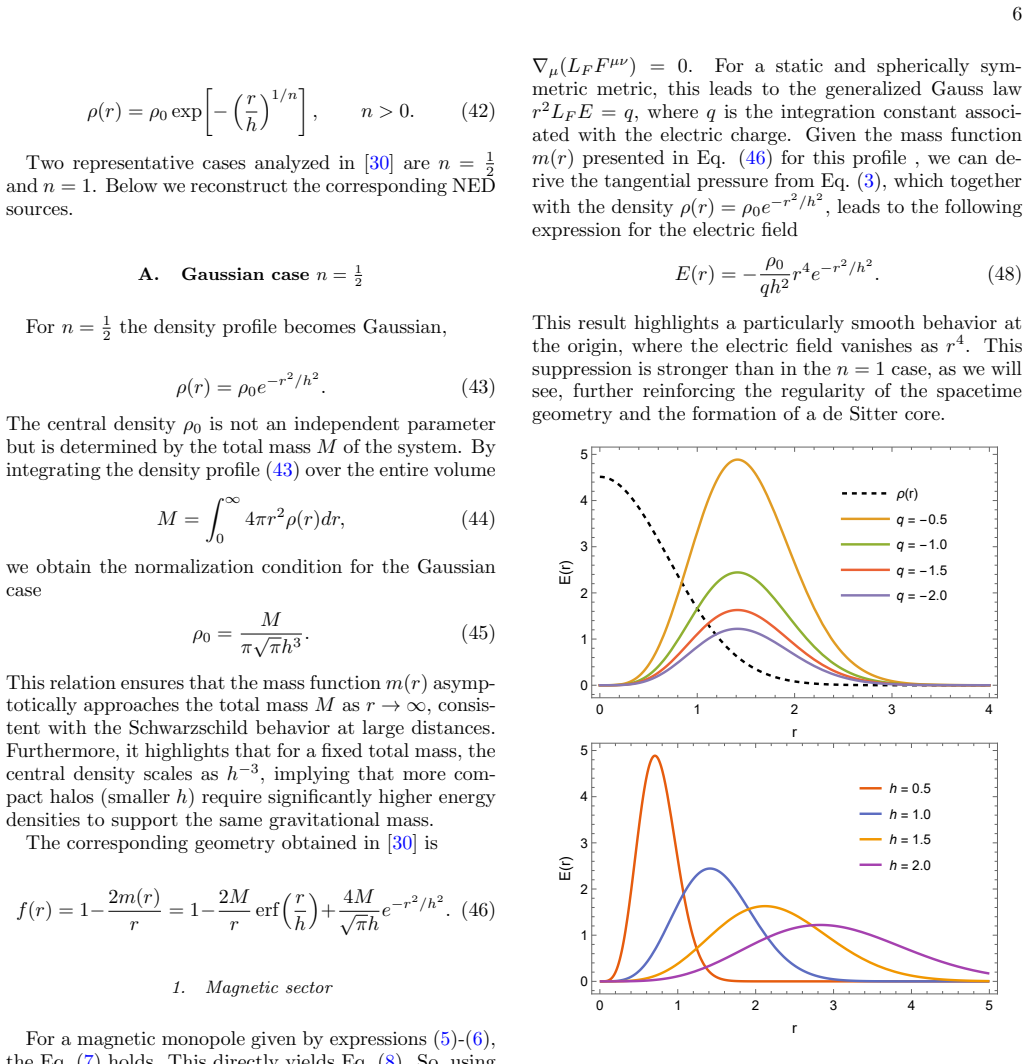
Magnetic sector For a magnetic monopole given by expressions (5)-(6), the Eq. (7) holds. This directly yields Eq. (8). So, using the right expression in Eq. (9) the nonlinear electrody- namics Lagrangian becomes L(F) =−ρ 0 exp " − 1 h2 g2 2F 1/2# .(47)
-
[8]
Furthermore, the electric field can be explic- itly determined by applying the generalized Gauss’s law ∇µ(LF F µν) = 0
Electric sector For a purely electric field, the electric NED source is determined parametrically from expressions (10)- (12). Furthermore, the electric field can be explic- itly determined by applying the generalized Gauss’s law ∇µ(LF F µν) = 0. For a static and spherically sym- metric metric, this leads to the generalized Gauss law r2LF E=q, whereqis th...
-
[9]
So that L(F) =−ρ 0 exp " − 1 h g2 2F 1/4# .(52) 8
Magnetic sector For a magnetic monopole the invariant is again given by expressions (9). So that L(F) =−ρ 0 exp " − 1 h g2 2F 1/4# .(52) 8
-
[10]
Therefore the electric NED source is again determined parametri- cally
Electric sector In the electric configuration the reconstruction equa- tion (12) becomes F LF = M 8h5 r(r+ 4h)e −r/h,(53) where we used the mass function found above. Therefore the electric NED source is again determined parametri- cally. To find the explicit form of the electric fieldE(r), we utilize the non-linear Maxwell equations∇ µ(LF F µν) = 0 once ...
-
[11]
How- ever, the Strong Energy Condition (SEC), defined also by the combinationρ+p r + 2pt, effectively reduces to 2pt = 2ρ(r/2h−1)
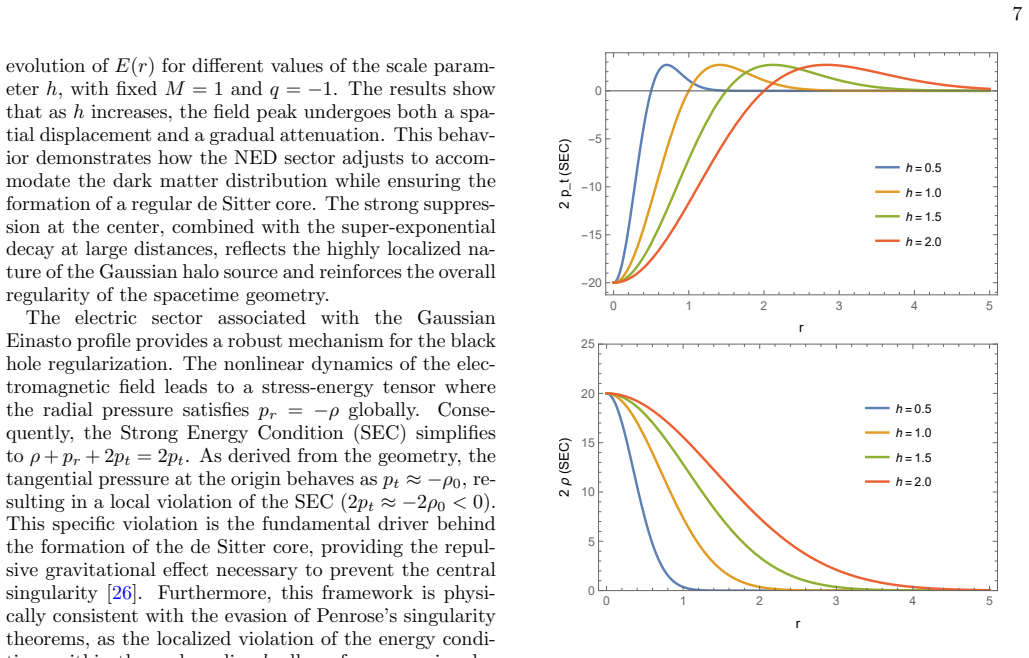
Simultaneously, the tangential NEC, expressed as ρ+p t =ρr/(2h), remains strictly non-negative through- out the domain, vanishing only at the origin. How- ever, the Strong Energy Condition (SEC), defined also by the combinationρ+p r + 2pt, effectively reduces to 2pt = 2ρ(r/2h−1). At the origin (r= 0), this expres- sion attains the value−2ρ 0, which, as in...
-
[12]
V. C. Rubin, W. K. Ford, Rotation of the andromeda nebula from a spectroscopic survey of emission regions, Astrophysical Journal 159 (1970) 379.doi:10.1086/ 150317
1970
-
[13]
Zwicky, Die rotverschiebung von extragalaktischen nebeln, Helvetica Physica Acta 6 (1933) 110–127
F. Zwicky, Die rotverschiebung von extragalaktischen nebeln, Helvetica Physica Acta 6 (1933) 110–127
1933
-
[14]
A direct empirical proof of the existence of dark matter
D. Clowe, M. Bradaˇ c, A. H. Gonzalez, M. Markevitch, S. W. Randall, C. Jones, D. Zaritsky, A direct em- pirical proof of the existence of dark matter, Astro- physical Journal Letters 648 (2006) L109–L113.arXiv: astro-ph/0608407,doi:10.1086/508162
work page internal anchor Pith review Pith/arXiv arXiv doi:10.1086/508162 2006
-
[15]
Planck 2018 results. VI. Cosmological parameters
P. Collaboration, Planck 2018 results. vi. cosmologi- cal parameters, Astronomy & Astrophysics 641 (2020) A6.arXiv:1807.06209,doi:10.1051/0004-6361/ 201833910
work page internal anchor Pith review Pith/arXiv arXiv doi:10.1051/0004-6361/ 2018
-
[16]
Particle Dark Matter: Evidence, Candidates and Constraints
G. Bertone, D. Hooper, J. Silk, Particle dark matter: Evidence, candidates and constraints, Phys. Rept. 405 (2005) 279–390.arXiv:hep-ph/0404175,doi:10.1016/ j.physrep.2004.08.031
work page internal anchor Pith review Pith/arXiv arXiv 2005
-
[17]
J. S. Bullock, M. Boylan-Kolchin, Small-scale challenges to the lambda cdm paradigm, Ann. Rev. Astron. As- trophys. 55 (2017) 343–387.arXiv:1707.04256,doi: 10.1146/annurev-astro-091916-055313
-
[18]
Salucci, The distribution of dark matter in galaxies, Astron
P. Salucci, The distribution of dark matter in galaxies, Astron. Astrophys. Rev. 27 (1) (2019) 2.arXiv:1811. 08843,doi:10.1007/s00159-018-0113-1
-
[19]
W. J. G. de Blok, The core-cusp problem, Adv. Astron. 2010 (2010) 789293.arXiv:0910.3538,doi:10.1155/ 2010/789293
work page internal anchor Pith review Pith/arXiv arXiv 2010
-
[20]
J. F. Navarro, C. S. Frenk, S. D. M. White, The struc- ture of cold dark matter halos, Astrophysical Journal 462 (1996) 563.arXiv:astro-ph/9508025,doi:10.1086/ 177173
work page internal anchor Pith review Pith/arXiv arXiv 1996
-
[21]
Einasto, On the construction of a composite model for the galaxy, Trudy Astrofizicheskogo Instituta Alma-Ata 5 (1965) 87–100
J. Einasto, On the construction of a composite model for the galaxy, Trudy Astrofizicheskogo Instituta Alma-Ata 5 (1965) 87–100
1965
-
[22]
W. Dehnen, A family of potential-density pairs for spher- ical galaxies and bulges, MNRAS 265 (1993) 250.doi: 10.1093/mnras/265.1.250
-
[23]
The Structure of Dark Matter Haloes in Dwarf Galaxies
A. Burkert, The structure of dark matter halos in dwarf galaxies, Astrophys. J. 447 (1995) L25–L28.arXiv: astro-ph/9504041,doi:10.1086/309560
work page internal anchor Pith review Pith/arXiv arXiv doi:10.1086/309560 1995
-
[24]
K. G. Begeman, A. H. Broeils, R. H. Sanders, Extended rotation curves of spiral galaxies, MNRAS 249 (1991) 523.doi:10.1093/mnras/249.3.523
-
[25]
J. M. Bardeen, Non-singular general-relativistic gravita- 13 tional collapse (1968)
1968
-
[26]
Dymnikova, Vacuum nonsingular black hole, Gen
I. Dymnikova, Vacuum nonsingular black hole, Gen. Rel- ativ. Gravit. 24 (1992) 235.doi:10.1007/BF00760226
-
[27]
S. A. Hayward, Formation and evaporation of nonsingu- lar black holes, Phys. Rev. Lett. 96 (2006) 031103.arXiv: gr-qc/0506126,doi:10.1103/PhysRevLett.96.031103
work page internal anchor Pith review Pith/arXiv arXiv doi:10.1103/physrevlett.96.031103 2006
-
[28]
E. Ay´ on-Beato, A. Garc´ ıa, Regular black hole in general relativity coupled to nonlinear electrodynamics, Phys. Rev. Lett. 80 (1998) 5056.doi:10.1103/PhysRevLett. 80.5056
-
[29]
New Regular Black Hole Solution from Nonlinear Electrodynamics
E. Ay´ on-Beato, A. Garc´ ıa, New regular black hole so- lution from nonlinear electrodynamics, Phys. Lett. B 464 (1999) 25.arXiv:hep-th/9911174,doi:10.1016/ S0370-2693(99)01038-2
work page internal anchor Pith review Pith/arXiv arXiv 1999
-
[30]
K. A. Bronnikov, Regular magnetic black holes from nonlinear electrodynamics, Phys. Rev. D 63 (2001) 044005.arXiv:gr-qc/0006014,doi:10.1103/PhysRevD. 63.044005
work page internal anchor Pith review Pith/arXiv arXiv doi:10.1103/physrevd 2001
-
[31]
Smarr's formula for black holes with non-linear electrodynamics
N. Bret´ on, Smarr’s formula for black holes with nonlinear electrodynamics (2004).arXiv:gr-qc/0405116
work page internal anchor Pith review Pith/arXiv arXiv 2004
-
[32]
Geometrical aspects of light propagation in nonlinear electrodynamics
M. Novello, V. A. De Lorenci, J. M. Salim, R. Klippert, Geometrical aspects of light propagation in nonlinear electrodynamics, Phys. Rev. D 61 (2000) 045001.arXiv: gr-qc/9911085,doi:10.1103/PhysRevD.61.045001
work page internal anchor Pith review Pith/arXiv arXiv doi:10.1103/physrevd.61.045001 2000
-
[33]
S. Ansoldi, Spherical black holes with regular center: A review of existing models including a recent realization with gaussian sources (2008).arXiv:0802.0330
work page internal anchor Pith review Pith/arXiv arXiv 2008
-
[34]
S. I. Kruglov, Nonlinear electrodynamics and magnetic black holes, Annals Phys. 353 (2015) 299–306.arXiv: 1410.0351,doi:10.1016/j.aop.2014.12.001
work page internal anchor Pith review Pith/arXiv arXiv doi:10.1016/j.aop.2014.12.001 2015
-
[35]
Stability properties of black holes in self-gravitating nonlinear electrodynamics
C. Moreno, O. Sarbach, Stability properties of black holes in self-gravitating nonlinear electrodynamics, Phys. Rev. D 67 (2003) 024028.arXiv:gr-qc/0208090,doi: 10.1103/PhysRevD.67.024028
work page internal anchor Pith review Pith/arXiv arXiv doi:10.1103/physrevd.67.024028 2003
-
[36]
S. G. Ghosh, A nonsingular rotating black hole, Eur. Phys. J. C 75 (2015) 532.arXiv:1408.5668,doi:10. 1140/epjc/s10052-015-3740-y
work page internal anchor Pith review Pith/arXiv arXiv 2015
-
[37]
O. B. Zaslavskii, Regular black holes and energy condi- tions, Phys. Lett. B 688 (2010) 278–280.arXiv:1004. 2362,doi:10.1016/j.physletb.2010.04.031
-
[38]
Regular black hole metrics and the weak energy condition
L. Balart, E. C. Vagenas, Regular black holes with a non- linear electrodynamics source, Phys. Lett. B 730 (2014) 14.arXiv:1401.2136,doi:10.1016/j.physletb.2014. 01.037
work page internal anchor Pith review Pith/arXiv arXiv doi:10.1016/j.physletb.2014 2014
-
[39]
Z.-Y. Fan, X. Wang, Construction of regular black holes, Phys. Rev. D 94 (2016) 124027.arXiv:1610.02636,doi: 10.1103/PhysRevD.94.124027
work page internal anchor Pith review Pith/arXiv arXiv doi:10.1103/physrevd.94.124027 2016
-
[40]
B. e. a. Toshmatov, Regular black hole solutions, Phys. Rev. D 96 (2017) 064028.arXiv:1707.06622,doi:10. 1103/PhysRevD.96.064028
work page internal anchor Pith review Pith/arXiv arXiv 2017
- [41]
-
[42]
Curiel, A primer on energy conditions, in: D
E. Curiel, A primer on energy conditions, in: D. Lehmkuhl, G. Schiemann, E. Scholz (Eds.), Towards a Theory of Spacetime Theories, Vol. 13 of Einstein Stud- ies, Birkh¨ auser, New York, 2017, pp. 43–104.arXiv: 1405.0403,doi:10.1007/978-1-4939-3210-8_3
-
[43]
Pleba´ nski, Lectures on non-linear electrodynamics (1970)
J. Pleba´ nski, Lectures on non-linear electrodynamics (1970)
1970
-
[44]
M. Born, L. Infeld, Foundations of the new field theory, Proceedings of the Royal Society A 144 (852) (1934) 425– 451.doi:10.1098/rspa.1934.0059
discussion (0)
Sign in with ORCID, Apple, or X to comment. Anyone can read and Pith papers without signing in.