Electromagnetic Signatures of Kinetic Alfv\'{e}n Wave Turbulence at Ion Inertial Scales in Earth's High-β Magnetosheath
Pith reviewed 2026-06-29 23:35 UTC · model grok-4.3
The pith
Four electromagnetic signatures identify kinetic Alfvén wave turbulence at the ion inertial scale in high-beta plasma.
A machine-rendered reading of the paper's core claim, the machinery that carries it, and where it could break.
Core claim
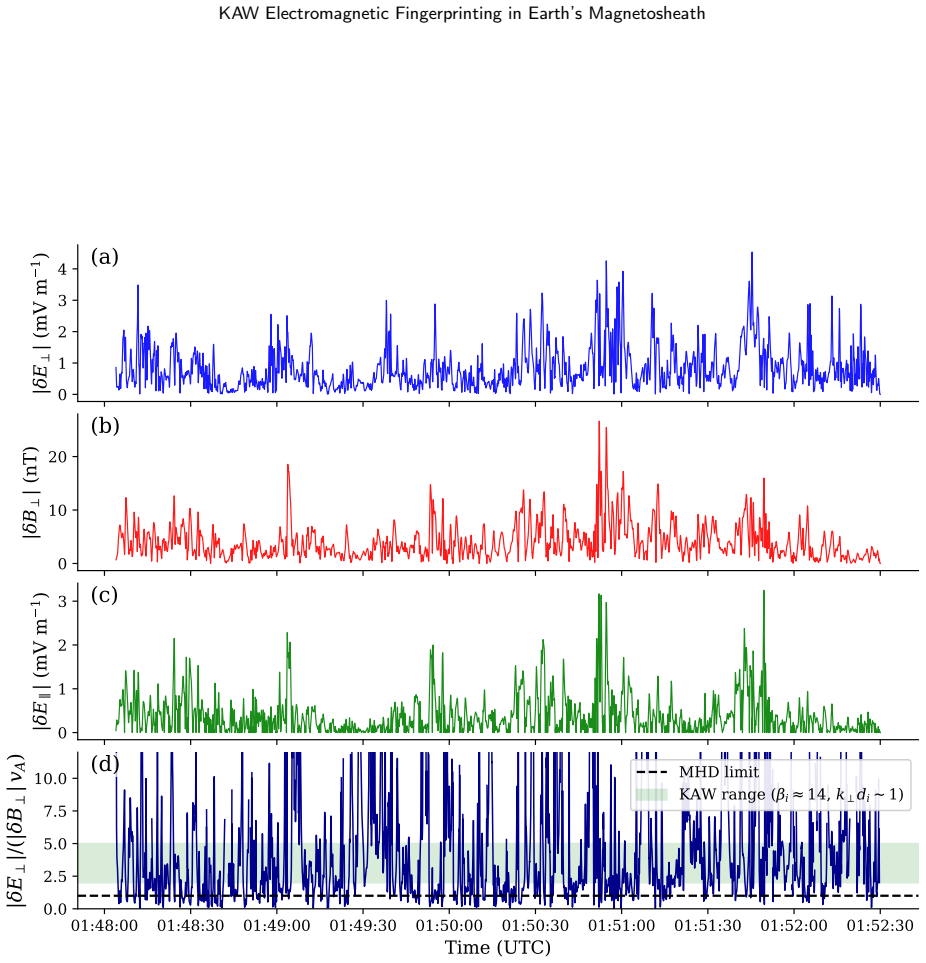
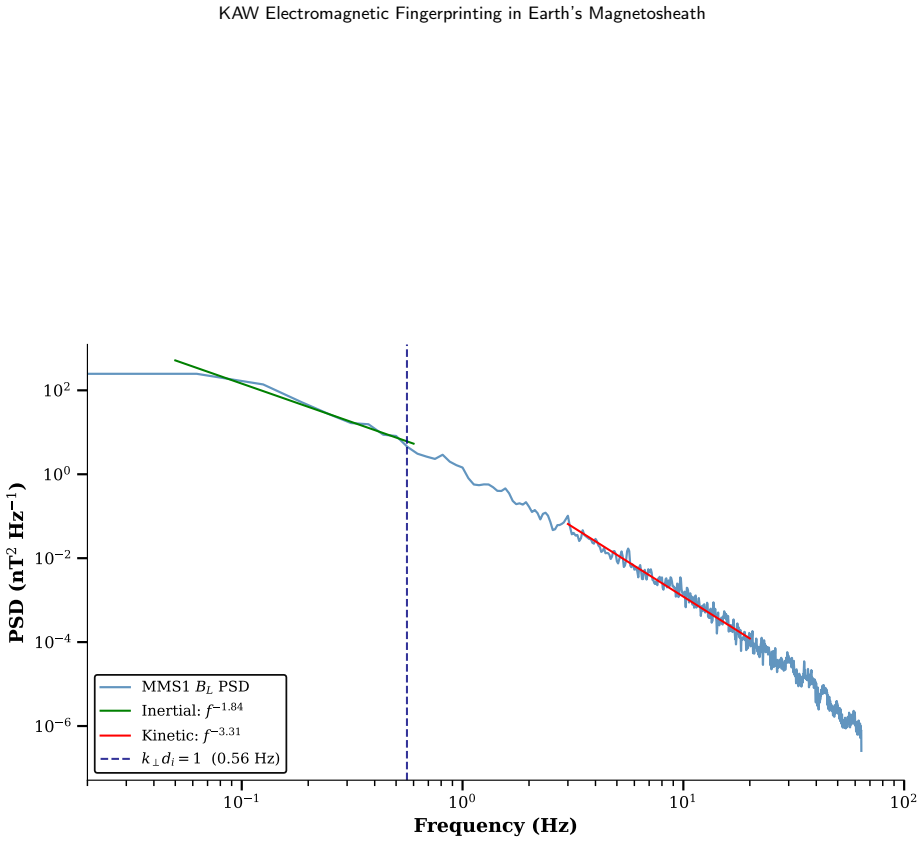
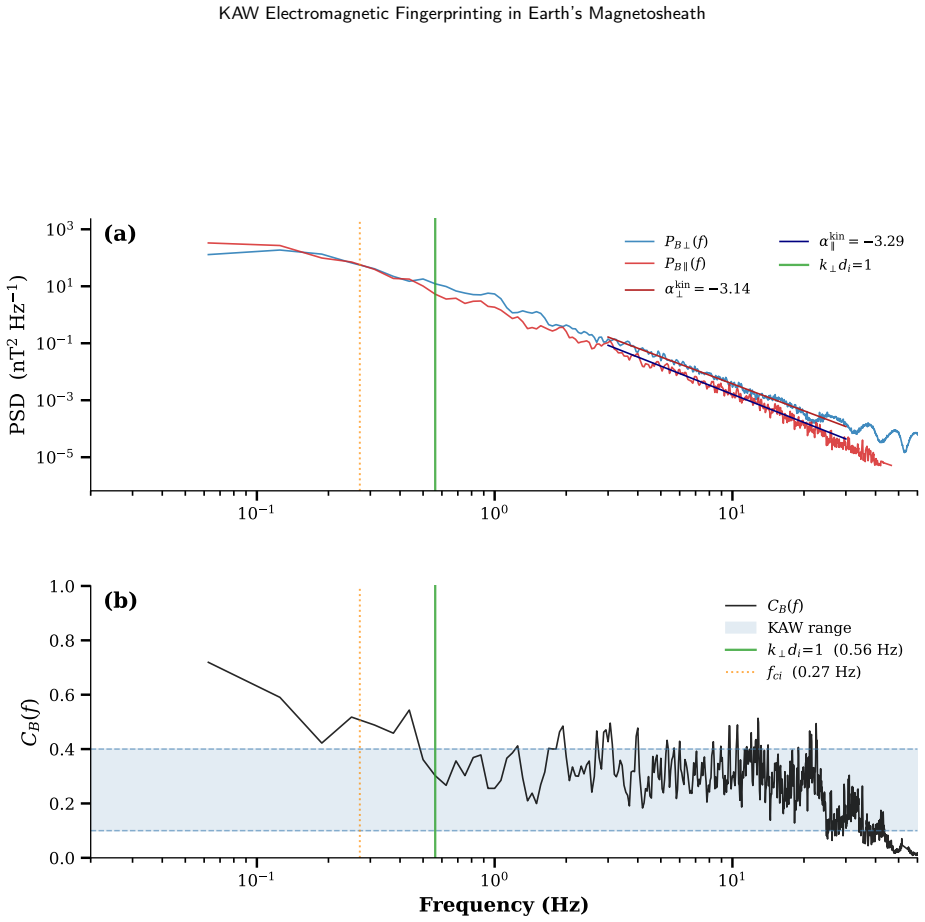
In the high-beta magnetosheath interval the four electromagnetic signatures are observed together: the normalized electric-to-magnetic field ratio exceeds the ideal MHD limit, a finite parallel electric field appears, the spectral break occurs at k_perp d_i approximately 1, and the kinetic-range magnetic compressibility falls inside the interval predicted for KAWs. This combination supplies an electromagnetic identification of KAW turbulence that does not require particle distribution measurements and establishes the ion inertial length, rather than the ion gyroradius, as the relevant break scale when beta_i is much greater than one.
What carries the argument
The set of four simultaneous electromagnetic criteria (normalized E_perp over B_perp ratio above the MHD limit, presence of finite E_parallel, spectral break at k_perp d_i equals 1, and magnetic compressibility between 0.10 and 0.40) that together identify KAW turbulence.
If this is right
- Electromagnetic measurements alone can identify KAW turbulence without particle distribution data.
- The spectral break occurs at the ion inertial length d_i when beta_i is much larger than one.
- The separation between d_i and the ion gyroradius becomes directly testable at high beta.
- Magnetic compressibility in the kinetic range matches the interval predicted for KAWs.
Where Pith is reading between the lines
- The same four-criterion test could be applied to field-only data from other high-beta space or astrophysical plasmas.
- Turbulence models should treat the inertial length as the transition scale in regimes where beta greatly exceeds one.
- Multi-diagnostic electromagnetic analysis may help separate KAWs from competing kinetic modes in future observations.
Load-bearing premise
The four electromagnetic signatures are both necessary and sufficient to identify KAW turbulence uniquely without contamination from other kinetic modes or data artifacts.
What would settle it
A high-beta interval in which the four electromagnetic signatures are all satisfied yet independent particle data show no KAW signatures, or in which the spectral break occurs at the ion gyroradius instead of the inertial length.
Figures
read the original abstract
We present a multi-diagnostic electromagnetic study of kinetic Alfv\'{e}n wave (KAW) activity in Earth's magnetosheath using burst-mode measurements from the Magnetospheric Multiscale (MMS) mission. We apply this analysis to a well-characterized dayside magnetosheath interval on 2015 December 28 at unusually high plasma $\beta_i \approx 14$. The identification relies on four simultaneous criteria: the normalized electric-to-magnetic field ratio $\dEperp / (\dBperp \vA)$ exceeding the ideal MHD limit (median 2.55), the presence of a finite parallel electric field $\dEpar$ (peak $3.2$~mV~m$^{-1}$), a spectral break at the ion inertial scale $\kperp d_i \approx 1$ (where $d_i = 45.0$~km is the ion inertial length, the theoretically expected transition scale at $\beta_i \gg 1$), and a kinetic-range magnetic compressibility $C_B = 0.31$ within the KAW-predicted range $[0.10, 0.40]$. All four criteria are satisfied in the same interval, providing a consistent electromagnetic identification of KAWs that does not require particle distribution measurements. A key result of this analysis is the clear identification of $d_i$ rather than the ion gyroradius $\rhoi = 170.4$~km as the relevant spectral break scale. At $\beta_i = 14.4$, the two scales differ by a factor of 3.79, making this distinction observationally testable in a way that is not possible at the more typical magnetosheath $\beta \sim 1$--$5$.
Editorial analysis
A structured set of objections, weighed in public.
Referee Report
Summary. The paper claims to identify kinetic Alfvén wave (KAW) turbulence in a high-β_i ≈14 dayside magnetosheath interval observed by MMS on 2015 December 28. Identification rests on four simultaneous electromagnetic signatures being satisfied in the same interval: normalized perpendicular electric-to-magnetic field ratio exceeding the ideal MHD limit (median 2.55), finite parallel electric field (peak 3.2 mV m^{-1}), spectral break at k_⊥ d_i ≈1 (d_i=45 km), and magnetic compressibility C_B=0.31 within the KAW range [0.10,0.40]. The analysis concludes that this provides an electromagnetic-only identification of KAWs and demonstrates that the ion inertial length d_i, rather than the gyroradius ρ_i=170.4 km, is the relevant spectral break scale at β_i≈14.4.
Significance. If the central identification holds, the result is significant for kinetic plasma turbulence studies because it supplies a purely electromagnetic diagnostic for KAW activity that does not require particle distribution measurements. The high-β regime allows an observational test that cleanly separates d_i and ρ_i, directly addressing a key prediction of KAW turbulence theory at ion inertial scales. The work also supplies concrete measured values (ratio 2.55, C_B=0.31, break location) that can be compared against theory and other datasets.
major comments (1)
- [Abstract] Abstract and data-analysis description: the central claim that all four criteria are simultaneously satisfied and uniquely identify KAW turbulence rests on a single well-characterized interval, yet the manuscript supplies no explicit interval-selection criteria, no statistical uncertainties on the reported medians and peaks, and no quantitative assessment of possible contamination by other kinetic modes or processing artifacts. These omissions are load-bearing for the robustness of the four-criteria identification.
Simulated Author's Rebuttal
We thank the referee for their constructive review and for noting the potential significance of an electromagnetic-only KAW identification. We address the single major comment below and will revise the manuscript accordingly.
read point-by-point responses
-
Referee: [Abstract] Abstract and data-analysis description: the central claim that all four criteria are simultaneously satisfied and uniquely identify KAW turbulence rests on a single well-characterized interval, yet the manuscript supplies no explicit interval-selection criteria, no statistical uncertainties on the reported medians and peaks, and no quantitative assessment of possible contamination by other kinetic modes or processing artifacts. These omissions are load-bearing for the robustness of the four-criteria identification.
Authors: We agree that the original manuscript would be strengthened by explicit documentation of these elements. The study is presented as a detailed case study of one high-β interval chosen specifically because β_i ≈ 14 cleanly separates d_i from ρ_i. In the revised manuscript we will add a subsection in the data-analysis section that states the interval-selection criteria (high β_i, burst-mode availability, and absence of obvious large-scale structures). We will also report statistical uncertainties on the median E/B ratio and other quoted values derived from the time-series variability. For possible contamination, we will expand the discussion to explain that the four electromagnetic signatures are theoretically independent and that their joint satisfaction is not expected for other modes at this β; however, a comprehensive quantitative survey of all conceivable contaminants lies outside the scope of this observational paper. revision: yes
Circularity Check
No significant circularity
full rationale
The paper's identification of KAW turbulence rests on direct comparison of four measured electromagnetic quantities (E⊥/B⊥ ratio, finite E∥, spectral break at k⊥di ≈ 1, and CB = 0.31) against fixed theoretical ranges taken from prior kinetic wave theory. These ranges are independent of the present dataset; no parameters are fitted to the observations and then re-used to 'predict' the same quantities, no self-definitional loops appear in the criteria, and no load-bearing uniqueness theorem is imported via self-citation. The high-β interval simply makes di and ρi observationally separable, allowing an external test rather than a constructed result. The derivation is therefore self-contained against external benchmarks.
Axiom & Free-Parameter Ledger
axioms (2)
- domain assumption KAW theory predicts magnetic compressibility C_B in the range [0.10, 0.40] at kinetic scales
- domain assumption The transition to kinetic Alfvén wave turbulence produces a spectral break at k_perp d_i ≈ 1 when β_i ≫ 1
Reference graph
Works this paper leans on
-
[1]
Chettri,M.K.,Shrivastav,V.,Mukherjee,R.,Gaur,N.,Sharma,R.,Singh,H.D.,2024
doi:10.1038/s41467-019-08435-3. Chettri,M.K.,Shrivastav,V.,Mukherjee,R.,Gaur,N.,Sharma,R.,Singh,H.D.,2024. Nonlinearcouplingofkineticalfvenwavesandionacoustic waves in the inner heliosphere. Research in Astronomy and Astrophysics 24, 105009. Chettri, M.K., Singh, H.D., Mukherjee, R., 2026. Mms observations of kinetic alfvén wave turbulence and steep kinet...
-
[2]
JournalofGeophysicalResearch:SpacePhysics 107, SMP 24–1–SMP 24–13
Evidenceforkineticalfvénwavesandparallelelectronenergizationat4–6𝑅 𝐸 altitudes. JournalofGeophysicalResearch:SpacePhysics 107, SMP 24–1–SMP 24–13. doi:10.1029/2001JA900113. :Preprint submitted to Elsevier Page 10 of 10 KAW Electromagnetic Fingerprinting in Earth’s Magnetosheath 0 1 2 3 4| E | (mV m 1) (a) 0 10 20| B | (nT) (b) 0 1 2 3| E | (mV m 1) (c) 01...
discussion (0)
Sign in with ORCID, Apple, or X to comment. Anyone can read and Pith papers without signing in.