REVIEW 2 major objections 1 minor 30 references
Nearly optimal early stopping for Deep Image Prior becomes possible by using two independent noisy copies of the degraded image or pseudo approximations of them.
Reviewed by Pith at T0; open to challenge. T0 means a machine referee read the full paper against a public rubric. the ladder, T0–T4 →
2026-06-30 11:30 UTC pith:HNHB3ILW
load-bearing objection The paper's main contribution is a pseudo self-referenced construction that lets you run variance-based early stopping for DIP from one measurement instead of needing two independent noisy copies. the 2 major comments →
A Principled Self-Referenced Early Stopping Approach for Deep Image Prior
The pith
A machine-rendered reading of the paper's core claim, the machinery that carries it, and where it could break.
Core claim
The central claim is that nearly optimal DIP early stopping can be achieved when two independent noisy copies of the degraded image are available. Motivated by this, and since obtaining two fully independent copies is infeasible, the authors propose an overfitting detection framework based on constructing pseudo self-referenced images, resulting in three IIP-specific algorithms. The approach is supported by theoretical results on single-reference validation, pseudo-validation estimation, and the impact of shared noise, and it consistently outperforms existing early stopping methods across different inverse imaging problems under varying noise levels and types without requiring an accurate no
What carries the argument
Pseudo self-referenced images constructed from a single measurement to approximate the overfitting detection behavior of two independent noisy copies.
Load-bearing premise
The construction of pseudo self-referenced images from a single measurement can reliably approximate the behavior of two independent noisy copies for overfitting detection.
What would settle it
Run the proposed algorithms and the two-copy oracle on the same degraded images and check whether the reconstruction quality at the detected stopping points is statistically indistinguishable.
If this is right
- Improved stability in DIP reconstructions for natural image restoration and medical image tasks.
- Early stopping decisions without any estimate of the noise level.
- Outperformance over variance-fluctuation tracking methods under different noise types and levels.
- Three concrete algorithms tailored to inverse imaging problems that avoid premature stopping.
Where Pith is reading between the lines
- The same pseudo-reference idea could be tested on other over-parameterized generative models used for inverse problems.
- It may connect to cross-validation strategies already common in supervised learning, but adapted to the unsupervised DIP setting.
- If the approximation holds, practitioners could apply the method directly to real single-shot measurements in clinical or remote-sensing pipelines.
Editorial analysis
A structured set of objections, weighed in public.
Referee Report
Summary. The paper claims that nearly optimal DIP early stopping can be achieved when two independent noisy copies of the degraded image are available. Since obtaining such copies is infeasible, it proposes an overfitting detection framework based on constructing pseudo self-referenced images from a single measurement, yielding three IIP-specific algorithms. The approach is supported by theoretical results on single-reference validation, pseudo-validation estimation, and the impact of shared noise, and empirically outperforms existing DIP early stopping methods across natural image restoration, medical image reconstruction, and varying noise levels/types without requiring a noise level estimate.
Significance. If the pseudo self-referenced construction produces variance fluctuations whose timing and magnitude reliably match those of independent copies, the work would deliver a practical, noise-level-free early stopping method that improves stability over single-image variance tracking. The explicit theoretical treatment of shared noise and the consistent cross-IIP empirical gains would be notable strengths for DIP reliability in inverse problems.
major comments (2)
- [theoretical results on pseudo-validation estimation and shared noise] The central claim pivots on the pseudo self-referenced images approximating the variance-based overfitting signal of truly independent copies. The abstract cites theory on pseudo-validation estimation and shared-noise impact, yet any residual correlation from the construction (e.g., deterministic splitting or shared high-frequency content) could shift the detected stopping point; a quantitative bound or ablation quantifying the approximation error on the stopping time is needed to secure the performance gains.
- [empirical evaluation across IIPs] The abstract states consistent outperformance “across different IIPs … and under varying noise levels and noise types,” but without details on whether algorithm hyperparameters or pseudo-image construction choices were tuned per experiment, it is unclear whether the reported gains are robust or partly post-hoc; explicit cross-validation or sensitivity analysis on these choices would be required to support the claim.
minor comments (1)
- The three IIP-specific algorithms are referenced but not named or briefly characterized in the abstract; adding their names and one-sentence distinctions would improve readability.
Simulated Author's Rebuttal
We thank the referee for the constructive feedback. The two major comments highlight opportunities to strengthen the theoretical and empirical support for our pseudo self-referenced early-stopping framework. We address each point below and propose targeted revisions.
read point-by-point responses
-
Referee: [theoretical results on pseudo-validation estimation and shared noise] The central claim pivots on the pseudo self-referenced images approximating the variance-based overfitting signal of truly independent copies. The abstract cites theory on pseudo-validation estimation and shared-noise impact, yet any residual correlation from the construction (e.g., deterministic splitting or shared high-frequency content) could shift the detected stopping point; a quantitative bound or ablation quantifying the approximation error on the stopping time is needed to secure the performance gains.
Authors: We agree that quantifying the approximation error on stopping time would further secure the claims. Section 4 derives that the pseudo-validation estimator remains consistent when the shared-noise component is bounded by the construction procedure, and the bias term vanishes as the network capacity grows. Nevertheless, an explicit numerical bound on the stopping-time deviation is not provided. We will add a new subsection with a synthetic experiment that generates truly independent copies and reports the distribution of stopping-time differences, thereby supplying the requested quantitative assessment. revision: yes
-
Referee: [empirical evaluation across IIPs] The abstract states consistent outperformance “across different IIPs … and under varying noise levels and noise types,” but without details on whether algorithm hyperparameters or pseudo-image construction choices were tuned per experiment, it is unclear whether the reported gains are robust or partly post-hoc; explicit cross-validation or sensitivity analysis on these choices would be required to support the claim.
Authors: All algorithmic hyperparameters and pseudo-image construction parameters were fixed once after a small pilot study on two natural-image instances and then held constant for every subsequent experiment (natural, medical, and all noise levels/types). This design choice was made precisely to demonstrate robustness rather than per-dataset tuning. To make this explicit and address the concern, we will insert a dedicated sensitivity-analysis paragraph together with a supplementary table showing performance variation when the key parameters are perturbed by ±20 % around the chosen values. revision: yes
Circularity Check
No significant circularity detected
full rationale
The paper's chain begins with an external observation that two independent noisy copies enable nearly optimal DIP early stopping, then motivates a pseudo self-referenced construction from one measurement, supported by separate theoretical results on single-reference validation and shared-noise impact. No equations or steps are shown that define the stopping criterion in terms of itself, rename a fitted quantity as a prediction, or reduce the central claim to a self-citation chain. The derivation remains self-contained against the stated external benchmark of independent copies.
Axiom & Free-Parameter Ledger
Cite this review
Pith. "Pith review of A Principled Self-Referenced Early Stopping Approach for Deep Image Prior." pith.science (2026). https://pith.science/paper/HNHB3ILW
@misc{pith2026260525299,
  author       = {Pith},
  title        = {Pith review of: A Principled Self-Referenced Early Stopping Approach for Deep Image Prior},
  year         = {2026},
  howpublished = {\url{https://pith.science/paper/HNHB3ILW}},
  note         = {Machine review of arXiv:2605.25299}
}
read the original abstract
Recently, Deep Image Prior (DIP) has demonstrated strong capabilities for solving inverse imaging problems (IIPs) by optimizing a randomly initialized convolutional neural network in a training-data-free regime. However, DIP suffers from overfitting to noisy measurements due to network over-parameterization, making early stopping (ES) essential. The most successful ES method tracks fluctuations in the running variance of the network output to detect overfitting. However, in many applications, these fluctuations may appear prematurely, leading to unstable reconstructions. In this paper, we first show that nearly optimal DIP early stopping can be achieved when two independent noisy copies of the degraded image are available. Motivated by this observation, and since obtaining two fully independent copies is infeasible, we propose an overfitting detection framework based on constructing pseudo self-referenced images, resulting in three IIP-specific algorithms. Our approach is further supported by theoretical results on single-reference validation, pseudo-validation estimation, and the impact of shared noise. Across different IIPs, ranging from natural image restoration to medical image reconstruction, and under varying noise levels and noise types, our methods consistently outperform existing DIP early stopping approaches, all without requiring an accurate estimate of the noise level.
Figures




Reference graph
Works this paper leans on
-
[1]
Decomposed diffusion sampler for acceler- ating large-scale inverse problems
Hyungjin Chung, Suhyeon Lee, and Jong Chul Ye. Decomposed diffusion sampler for acceler- ating large-scale inverse problems. InICLR, pages 1–28, 2024
work page 2024
-
[2]
Solving inverse problems using data-driven models in medical imaging.Acta Numerica, 28:1–174, 2019
Simon Arridge, Peter Maass, Ozan Öktem, and Carola-Bibiane Schönlieb. Solving inverse problems using data-driven models in medical imaging.Acta Numerica, 28:1–174, 2019. 10
work page 2019
-
[3]
Gravita- tionally lensed black hole emission tomography
Aviad Levis, Pratul P Srinivasan, Andrew A Chael, Ren Ng, and Katherine L Bouman. Gravita- tionally lensed black hole emission tomography. InProceedings of the IEEE/CVF Conference on Computer Vision and Pattern Recognition, 2022
work page 2022
-
[4]
Deep learning in remote sensing: A comprehensive review and list of resources
XiaoXiangZhu,DevisTuia,LichaoMou,Gui-SongXia,LiangpeiZhang,FengXu,andFriedrich Fraundorfer. Deep learning in remote sensing: A comprehensive review and list of resources. IEEE Geoscience and Remote Sensing Magazine, 5(4):8–36, 2017
work page 2017
-
[5]
Dmplug: A plug-inmethodforsolvinginverseproblemswithdiffusionmodels
Hengkang Wang, Xu Zhang, Taihui Li, Yuxiang Wan, Tiancong Chen, and Ju Sun. Dmplug: A plug-inmethodforsolvinginverseproblemswithdiffusionmodels. InTheThirty-eighthAnnual Conference on Neural Information Processing Systems, 2024
work page 2024
-
[6]
Kai Zhang, Wangmeng Zuo, Yunjin Chen, Deyu Meng, and Lei Zhang. Beyond a gaussian denoiser: Residual learning of deep cnn for image denoising.IEEE Transactions on Image Processing, 26(7):3142–3155, 2017
work page 2017
-
[7]
Engl, Martin Hanke, and Andreas Neubauer.Regularization of Inverse Problems
Heinz W. Engl, Martin Hanke, and Andreas Neubauer.Regularization of Inverse Problems. Springer, 1996
work page 1996
-
[8]
Michael T McCann, Kyong Hwan Jin, and Michael Unser. Convolutional neural networks for inverse problems in imaging: A review.IEEE Signal Processing Magazine, 34(6):85–95, 2017
work page 2017
-
[9]
Institute of Physics Publishing, 1998
Mario Bertero and Patrizia Boccacci.Introduction to Inverse Problems in Imaging. Institute of Physics Publishing, 1998
work page 1998
-
[10]
George Yiasemis, Jan-Jakob Sonke, Clarisa Sánchez, and Jonas Teuwen. Recurrent variational network: A deep learning inverse problem solver applied to the task of accelerated mri recon- struction. InProceedings of the IEEE/CVF Conference on Computer Vision and Pattern Recognition (CVPR), pages 732–741, June 2022
work page 2022
-
[11]
Jiaming Liu, Yu Sun, Cihat Eldeniz, Weijie Gan, Hongyu An, and Ulugbek S Kamilov. Rare: Image reconstruction using deep priors learned without groundtruth.IEEE Journal of Selected Topics in Signal Processing, 14(6):1088–1099, 2020
work page 2020
-
[12]
arXiv preprint arXiv:2508.01975 , year=
Hyungjin Chung, Jeongsol Kim, and Jong Chul Ye. Diffusion models for inverse problems. arXiv preprint arXiv:2508.01975, 2025
-
[13]
Amer Essakine, Yanqi Cheng, Chun-Wun Cheng, Lipei Zhang, Zhongying Deng, Lei Zhu, Carola-Bibiane Schönlieb, and Angelica I Aviles-Rivero. Where do we stand with implicit neural representations? a technical and performance survey.Transactions on Machine Learning Research
-
[14]
Dmitry Ulyanov, Andrea Vedaldi, and Victor Lempitsky. Deep image prior. InProceedings of the IEEE conference on computer vision and pattern recognition, pages 9446–9454, 2018
work page 2018
-
[15]
Liyue Shen, John Pauly, and Lei Xing. Nerp: Implicit neural representation learning with prior embedding for sparsely sampled image reconstruction.IEEE Transactions on Neural Networks and Learning Systems, 2022
work page 2022
-
[16]
Learning transferable features for implicit neural represen- tations
Kushal Vyas, Ahmed Imtiaz Humayun, Aniket Dashpute, Richard G Baraniuk, Ashok Veer- araghavan, and Guha Balakrishnan. Learning transferable features for implicit neural represen- tations. 2025
work page 2025
-
[17]
Luca De Luigi, Adriano Cardace, Riccardo Spezialetti, Pierluigi Zama Ramirez, Samuele Salti, and Luigi Di Stefano. Deep learning on implicit neural representations of shapes.arXiv preprint arXiv:2302.05438, 2023
-
[18]
Ad- vances in neural rendering
Ayush Tewari, Justus Thies, Ben Mildenhall, Pratul Srinivasan, Edgar Tretschk, Wang Yifan, Christoph Lassner, Vincent Sitzmann, Ricardo Martin-Brualla, Stephen Lombardi, et al. Ad- vances in neural rendering. InComputer Graphics Forum, volume 41, pages 703–735. Wiley Online Library, 2022. 11
work page 2022
-
[19]
Implicit neural representation in medical imaging: A comparative survey
Amirali Molaei, Amirhossein Aminimehr, Armin Tavakoli, Amirhossein Kazerouni, Bobby Azad, Reza Azad, and Dorit Merhof. Implicit neural representation in medical imaging: A comparative survey. InProceedings of the IEEE/CVF International Conference on Computer Vision, pages 2381–2391, 2023
work page 2023
-
[20]
Deepdecoder: Conciseimagerepresentationsfromuntrainednon-convolutional networks
RHeckeletal. Deepdecoder: Conciseimagerepresentationsfromuntrainednon-convolutional networks. InInternational Conference on Learning Representations, page 2736–2750, 2019
work page 2019
-
[21]
Davide Sapienza, Giorgia Franchini, Elena Govi, Marko Bertogna, and Marco Prato. Deep image prior for medical image denoising, a study about parameter initialization.Frontiers in Applied Mathematics and Statistics, 8:995225, 2022
work page 2022
-
[22]
Hengyue Liang, Taihui Li, and Ju Sun. A baseline method for removing invisible image watermarks using deep image prior.Transactions on Machine Learning Research (TMLR), 2025
work page 2025
-
[23]
Deep random projector: Accelerated deep image prior
Taihui Li, Hengkang Wang, Zhong Zhuang, and Ju Sun. Deep random projector: Accelerated deep image prior. InProceedings of the IEEE/CVF Conference on Computer Vision and Pattern Recognition, pages 18176–18185, 2023
work page 2023
-
[24]
Image reconstruction via autoencoding sequential deep image prior
IsmailAlkhouri,ShijunLiang,EvanBell,QingQu,RongrongWang,andSaiprasadRavishankar. Image reconstruction via autoencoding sequential deep image prior. InAdvances in neural information processing systems (NeurIPS), 2024
work page 2024
-
[25]
Early stoppingfordeepimageprior.TransactionsonMachineLearningResearch,pages1–40,2023
Hengkang Wang, Taihui Li, Zhong Zhuang, Tiancong Chen, Hengyue Liang, and Ju Sun. Early stoppingfordeepimageprior.TransactionsonMachineLearningResearch,pages1–40,2023. ISSN 2835-8856. URLhttps://openreview.net/forum?id=231ZzrLC8X
work page 2023
-
[26]
Ismail Alkhouri, Evan Bell, Avrajit Ghosh, Shijun Liang, Rongrong Wang, and Saiprasad Ravishankar. Understanding untrained deep models for inverse problems: Algorithms and theory.IEEE Signal Processing Magazine, 2025
work page 2025
-
[27]
Shijun Liang, Evan Bell, Qing Qu, Rongrong Wang, and Saiprasad Ravishankar. Analysis of deep image prior and exploiting self-guidance for image reconstruction.IEEE Transactions on Computational Imaging, 2025
work page 2025
-
[28]
Image restoration using total variation regularized deep image prior
Jiaming Liu, Yu Sun, Xiaojian Xu, and Ulugbek S Kamilov. Image restoration using total variation regularized deep image prior. InICASSP 2019-2019 IEEE International Conference on Acoustics, Speech and Signal Processing (ICASSP), pages 7715–7719. Ieee, 2019
work page 2019
-
[29]
Dominique Fourdrinier, William E Strawderman, and Martin T Wells.Shrinkage estimation. Springer, 2018. 12 Appendix A. Reference Validation Theory This appendix formalizes the validation principle used in Section 2. Throughout this section, the DIP trajectory{ˆxt(y1)}T t=1 is trained only on y1 =x+η 1, and the reference image is y2 =x+η 2, whereη 2 is inde...
work page 2018
-
[30]
The corresponding WMV-ES and MR-ES curves are also given
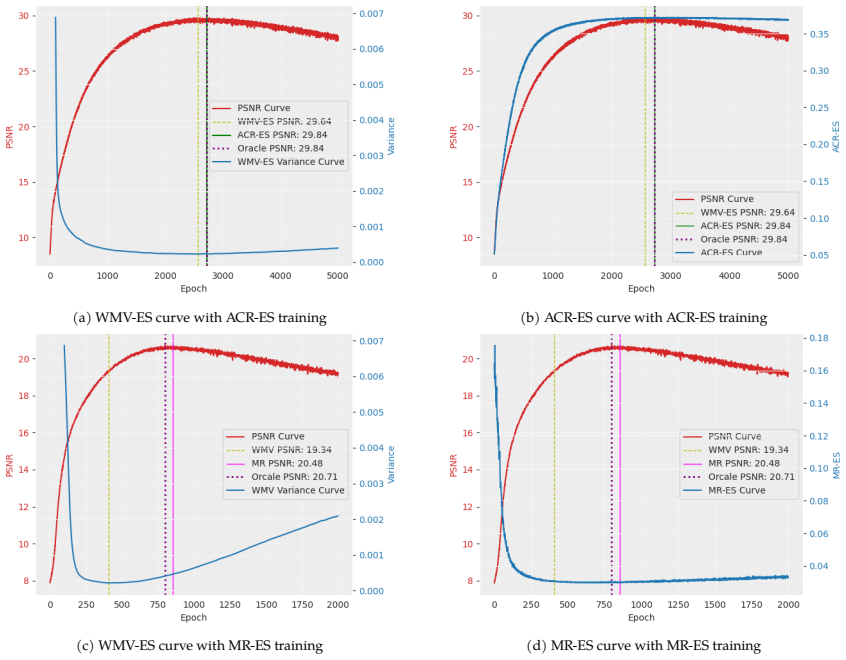
We show the noisy image, the reconstruction selected by WMV-ES, the reconstruction selected by MR-ES, and the oracle reconstruction. The corresponding WMV-ES and MR-ES curves are also given. The selected iteration of MR-ES is closer to the oracle iteration. Moreover, we also present the comparison of different training methods among the original DIP, the ...
work page 2026
This paper was first reviewed by grok-4.3 on June 30, 2026.
discussion (0)
Sign in with ORCID, Apple, or X to comment. Anyone can read and Pith papers without signing in.