Periodic orbits and gravitational waveforms around a Schwarzschild black hole with a cloud of strings embedded in perfect fluid dark matter
Pith reviewed 2026-06-29 20:47 UTC · model grok-4.3
The pith
A string cloud around a Schwarzschild black hole produces phase-delayed gravitational waveforms from periodic orbits that differ in duration and amplitude from pure Schwarzschild signals.
A machine-rendered reading of the paper's core claim, the machinery that carries it, and where it could break.
Core claim
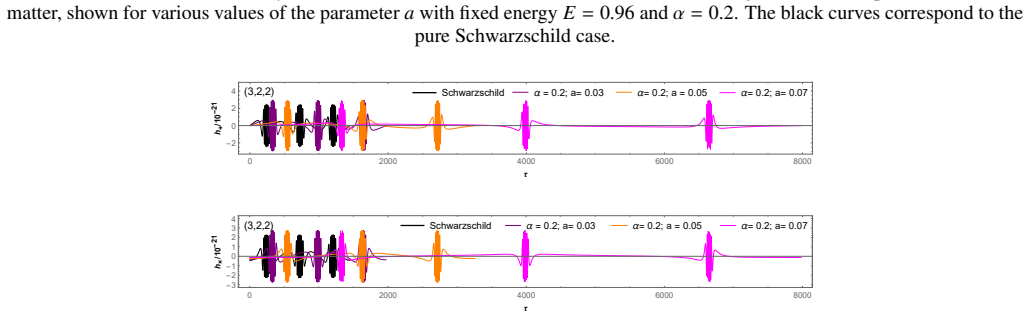
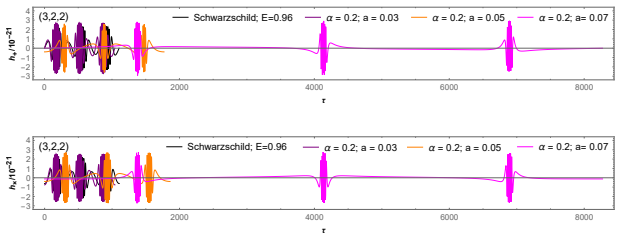
An increase in the string cloud parameter a induces a significant phase delay in the waveform; waveforms with lower values of a oscillate over shorter time intervals, whereas those with higher values extend to longer time scales, with noticeable differences in amplitude allowing clear distinction from pure Schwarzschild spacetime.
What carries the argument
The modified Schwarzschild metric that incorporates the string cloud parameter a and the dark matter parameter α, from which the orbital equations and quadrupole waveforms are derived.
If this is right
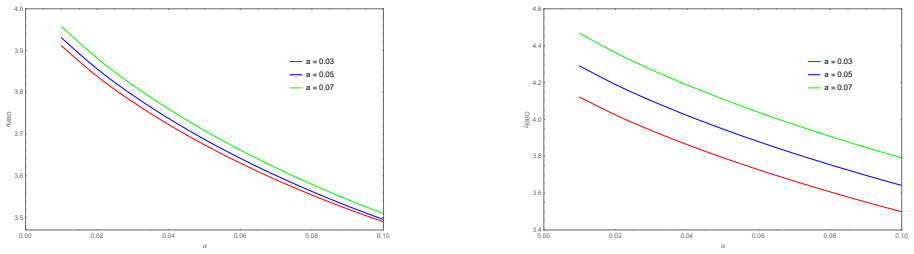
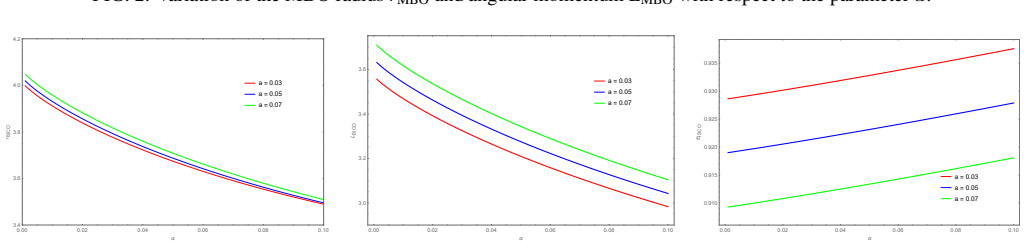
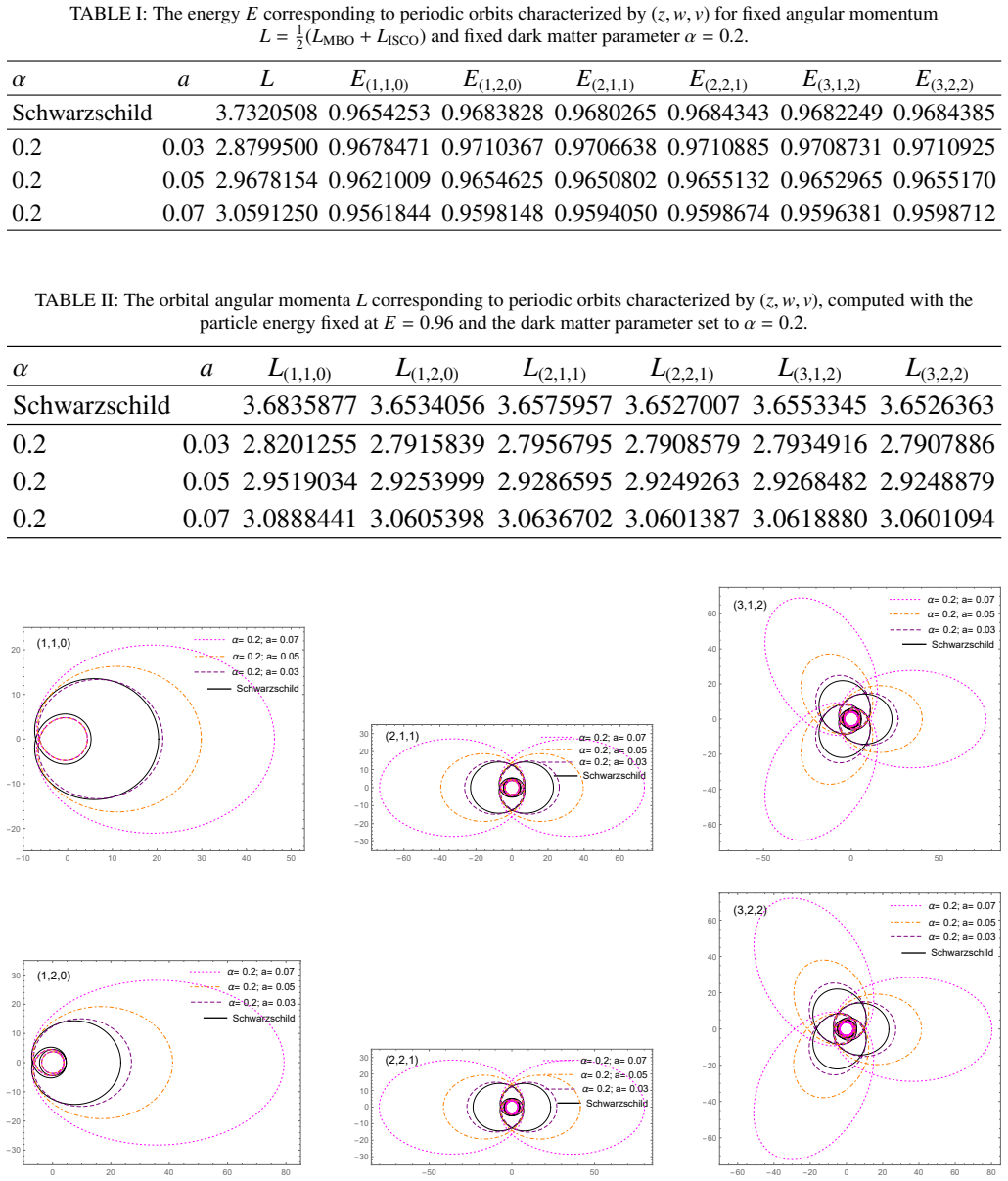
- Both the orbital radius and angular momentum at the marginally bound and innermost stable orbits increase with a and decrease with α.
- Orbital energy decreases as a grows and increases as α grows.
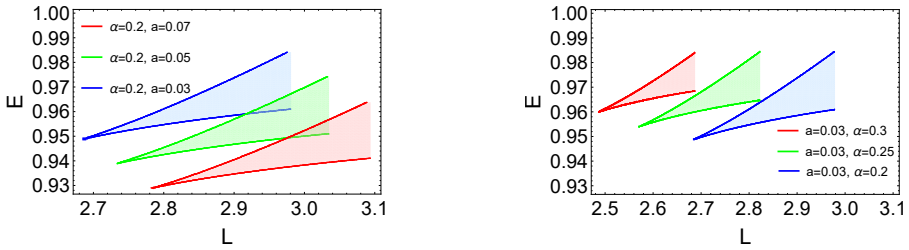
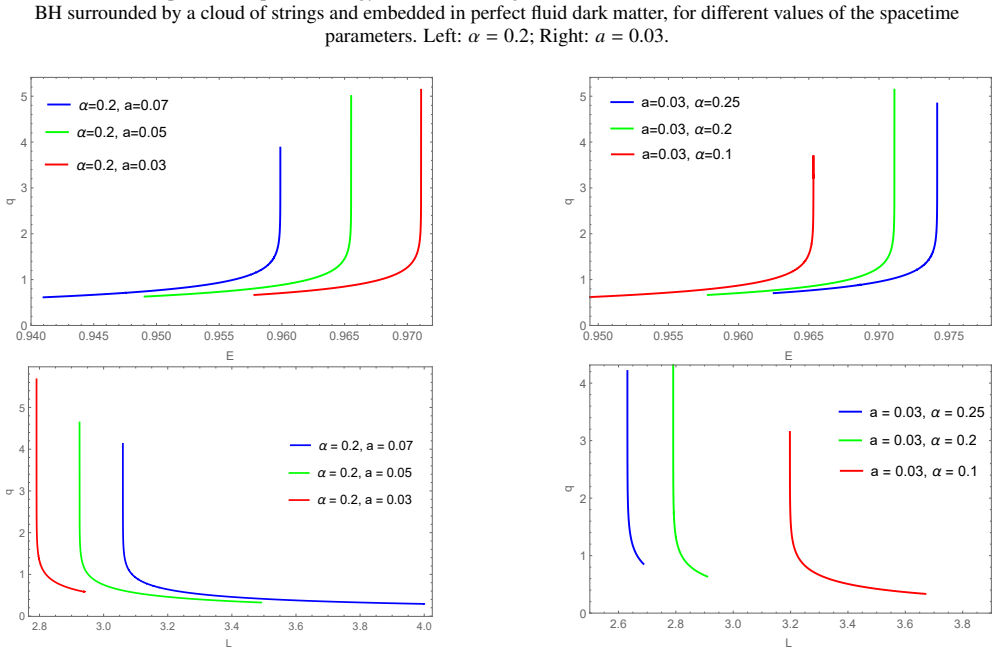
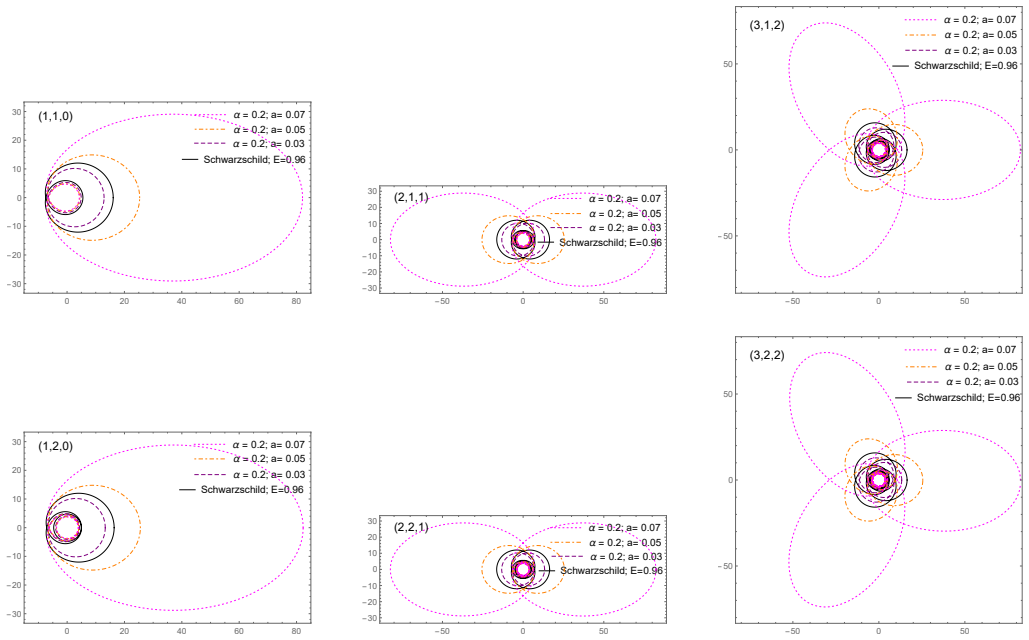
- Periodic orbits indexed by rational q produce waveforms whose phase, duration, and amplitude vary systematically with a.
- The resulting waveforms can be distinguished from those of a pure Schwarzschild black hole by their phase delay and extended oscillation times.
Where Pith is reading between the lines
- If such a string cloud exists, future gravitational-wave detectors could in principle measure a by fitting the phase and duration of signals from extreme-mass-ratio inspirals.
- The opposite trends with a and α suggest that combined observations of orbital radii and waveform timing might separate the two effects.
- The same metric could be used to recompute shadow sizes or quasinormal modes to check consistency with other observables.
Load-bearing premise
The spacetime is described by a specific functional form that adds the string cloud and dark matter contributions to the Schwarzschild geometry in the manner taken from earlier literature.
What would settle it
A direct comparison of numerical waveforms computed from the same periodic orbit in the modified metric versus the standard Schwarzschild metric shows no phase delay or amplitude difference when a is increased.
Figures

read the original abstract
In this study, we explore the dynamics of particle orbits and their corresponding gravitational wave signatures in the vicinity of a Schwarzschild black hole (BH) surrounded by a cloud of strings and embedded in a perfect fluid dark matter medium. The model is characterized by two parameters: $a$, associated with the string cloud, and $\alpha$, representing the dark matter distribution. We systematically analyze how the marginally bound orbit (MBO) and the innermost stable circular orbit (ISCO) depend on these parameters. Our findings reveal that while both the orbital radius and angular momentum increase with increasing $a$, they decrease as $\alpha$ increases; notably, the energy exhibits the opposite trend, decreasing with $a$ and increasing with $\alpha$. Furthermore, we examine periodic orbits indexed by rational numbers $q$ and the gravitational waveforms they generate. The results demonstrate that an increase in the string cloud parameter $a$ induces a significant phase delay in the waveform. Specifically, waveforms with lower values of $a$ oscillate over shorter time intervals, whereas those with higher values extend to longer time scales. These distinct features, including noticeable differences in amplitude, allow the waveforms to be clearly distinguished from those in a pure Schwarzschild spacetime.
Editorial analysis
A structured set of objections, weighed in public.
Referee Report
Summary. The paper claims that a Schwarzschild black hole surrounded by a string cloud (parameter a) and perfect fluid dark matter (parameter α) has MBO and ISCO radii and angular momentum that increase with a but decrease with α (with energy showing the opposite trend), and that periodic orbits labeled by rational q produce gravitational waveforms whose phase delay, oscillation timescale, and amplitude increase with a, allowing clear distinction from the pure Schwarzschild case.
Significance. If the adopted metric is shown to solve the Einstein equations for the combined sources, the work would supply concrete, parameter-dependent predictions for how string clouds and dark matter alter bound-orbit frequencies and waveform morphology, offering a potential observational handle on these matter distributions via gravitational waves.
major comments (1)
- [Background metric / spacetime geometry] The spacetime metric (introduced in the section describing the background geometry) is taken directly from earlier separate treatments of string clouds and perfect fluid dark matter. No explicit check is supplied that the resulting f(r) satisfies the Einstein equations when both stress-energy tensors are present simultaneously; because all geodesic frequencies, orbital periods, and waveform integrals rest on this f(r), the central claims about parameter trends and distinguishability remain conditional on an unverified assumption.
minor comments (2)
- [Abstract and waveform section] The abstract and results sections state qualitative trends in radius, energy, and waveform phase but do not report the numerical integrator, step-size control, or convergence tests used to generate the waveforms.
- [Periodic orbits section] Notation for the rational index q of periodic orbits and the precise definition of the waveform strain (e.g., which polarization or observer angle) should be stated explicitly when first introduced.
Simulated Author's Rebuttal
We thank the referee for the careful reading of our manuscript and the constructive comment on the background metric. We address the point below and will revise the manuscript to include the requested verification.
read point-by-point responses
-
Referee: [Background metric / spacetime geometry] The spacetime metric (introduced in the section describing the background geometry) is taken directly from earlier separate treatments of string clouds and perfect fluid dark matter. No explicit check is supplied that the resulting f(r) satisfies the Einstein equations when both stress-energy tensors are present simultaneously; because all geodesic frequencies, orbital periods, and waveform integrals rest on this f(r), the central claims about parameter trends and distinguishability remain conditional on an unverified assumption.
Authors: We acknowledge the validity of this observation: the manuscript does not contain an explicit verification that the combined metric satisfies the Einstein equations for the summed stress-energy tensors. The metric is assembled by adding the string-cloud and perfect-fluid-dark-matter contributions to the Schwarzschild lapse function, following the separate constructions in the cited references. To resolve the concern we will add, in the revised background-geometry section, a direct computation of the Einstein tensor components for the full f(r) and show that G_{\mu\nu} = 8\pi (T_{\mu\nu}^{\rm strings} + T_{\mu\nu}^{\rm PFDM}). This explicit check will remove the conditional status of the subsequent orbital and waveform results. revision: yes
Circularity Check
No significant circularity; parameter study is independent of inputs
full rationale
The paper treats a and α as free parameters in an adopted metric, varies them over ranges, and directly computes resulting changes to MBO/ISCO radii, angular momentum, energy, periodic orbit periods, and waveform phase/amplitude. These trends are explicit functions of the input parameters with no reduction by construction, no fitted quantities renamed as predictions, and no load-bearing self-citations or ansatzes identified in the provided text. The derivation from metric to geodesics to waveforms follows standard GR methods and remains self-contained.
Axiom & Free-Parameter Ledger
free parameters (2)
- a
- α
axioms (3)
- domain assumption The spacetime geometry is given by a Schwarzschild metric modified by additive terms proportional to a (string cloud) and α (perfect fluid dark matter).
- standard math Test-particle motion follows timelike geodesics of the modified metric.
- standard math Gravitational waveforms are computed from the quadrupole formula applied to the periodic orbits.
invented entities (2)
-
cloud of strings
no independent evidence
-
perfect fluid dark matter
no independent evidence
Reference graph
Works this paper leans on
-
[1]
B. P. Abbottet al.[LIGO Scientific and Virgo], Observation of Gravitational Waves from a Binary Black Hole Merger, Phys. Rev. Lett.116, no.6, 061102 (2016), [arXiv:1602.03837 [gr- qc]]
work page internal anchor Pith review Pith/arXiv arXiv 2016
-
[2]
First M87 Event Horizon Telescope Results. I. The Shadow of the Supermassive Black Hole
K. Akiyamaet al.[Event Horizon Telescope], First M87 Event Horizon Telescope Results. I. The Shadow of the Su- permassive Black Hole, Astrophys. J. Lett.875, L1 (2019), [arXiv:1906.11238 [astro-ph.GA]]
work page internal anchor Pith review Pith/arXiv arXiv 2019
-
[3]
First M87 Event Horizon Telescope Results. II. Array and Instrumentation
K. Akiyamaet al.[Event Horizon Telescope], First M87 Event Horizon Telescope Results. II. Array and Instrumentation, As- trophys. J. Lett.875, no.1, L2 (2019), [arXiv:1906.11239 [astro-ph.IM]]
work page internal anchor Pith review Pith/arXiv arXiv 2019
-
[4]
First M87 Event Horizon Telescope Results. III. Data Processing and Calibration
K. Akiyamaet al.[Event Horizon Telescope], First M87 Event Horizon Telescope Results. III. Data Processing and Calibration, Astrophys. J. Lett.875, no.1, L3 (2019), [arXiv:1906.11240 [astro-ph.GA]]
work page internal anchor Pith review Pith/arXiv arXiv 2019
-
[5]
First M87 Event Horizon Telescope Results. IV. Imaging the Central Supermassive Black Hole
K. Akiyamaet al.[Event Horizon Telescope], First M87 Event Horizon Telescope Results. IV . Imaging the Central Supermas- sive Black Hole, Astrophys. J. Lett.875, no.1, L4 (2019), [arXiv:1906.11241 [astro-ph.GA]]
work page internal anchor Pith review Pith/arXiv arXiv 2019
-
[6]
First M87 Event Horizon Telescope Results. V. Physical Origin of the Asymmetric Ring
K. Akiyamaet al.[Event Horizon Telescope], First M87 Event Horizon Telescope Results. V . Physical Origin of the Asymmetric Ring, Astrophys. J. Lett.875, no.1, L5 (2019), [arXiv:1906.11242 [astro-ph.GA]]
work page internal anchor Pith review Pith/arXiv arXiv 2019
-
[7]
First M87 Event Horizon Telescope Results. VI. The Shadow and Mass of the Central Black Hole
K. Akiyamaet al.[Event Horizon Telescope], First M87 Event Horizon Telescope Results. VI. The Shadow and Mass of the Central Black Hole, Astrophys. J. Lett.875, no.1, L6 (2019), [arXiv:1906.11243 [astro-ph.GA]]
work page internal anchor Pith review Pith/arXiv arXiv 2019
-
[8]
K. Akiyamaet al.[Event Horizon Telescope], First Sagittarius A* Event Horizon Telescope Results. I. The Shadow of the Su- permassive Black Hole in the Center of the Milky Way, Astro- phys. J. Lett.930, no.2, L12 (2022), [arXiv:2311.08680 [astro- ph.HE]]
work page internal anchor Pith review Pith/arXiv arXiv 2022
-
[9]
Akiyamaet al.[Event Horizon Telescope], First Sagittarius A* Event Horizon Telescope Results
K. Akiyamaet al.[Event Horizon Telescope], First Sagittarius A* Event Horizon Telescope Results. II. EHT and Multiwave- length Observations, Data Processing, and Calibration, Astro- phys. J. Lett.930, no.2, L13 (2022), [arXiv:2311.08679 [astro- ph.HE]]
-
[10]
Akiyamaet al.[Event Horizon Telescope], First Sagittar- ius A* Event Horizon Telescope Results
K. Akiyamaet al.[Event Horizon Telescope], First Sagittar- ius A* Event Horizon Telescope Results. III. Imaging of the Galactic Center Supermassive Black Hole, Astrophys. J. Lett. 930, no.2, L14 (2022), [arXiv:2311.09479 [astro-ph.HE]]
-
[11]
Akiyamaet al.[Event Horizon Telescope], First Sagittarius A* Event Horizon Telescope Results
K. Akiyamaet al.[Event Horizon Telescope], First Sagittarius A* Event Horizon Telescope Results. IV . Variability, Morphol- ogy, and Black Hole Mass, Astrophys. J. Lett.930, no.2, L15 (2022), [arXiv:2311.08697 [astro-ph.HE]]
-
[12]
Akiyamaet al.[Event Horizon Telescope], First Sagittarius A* Event Horizon Telescope Results
K. Akiyamaet al.[Event Horizon Telescope], First Sagittarius A* Event Horizon Telescope Results. V . Testing Astrophysical Models of the Galactic Center Black Hole, Astrophys. J. Lett. 930, no.2, L16 (2022), [arXiv:2311.09478 [astro-ph.HE]]
-
[13]
Akiyamaet al.[Event Horizon Telescope], First Sagit- tarius A* Event Horizon Telescope Results
K. Akiyamaet al.[Event Horizon Telescope], First Sagit- tarius A* Event Horizon Telescope Results. VI. Testing the Black Hole Metric, Astrophys. J. Lett.930, no.2, L17 (2022), [arXiv:2311.09484 [astro-ph.HE]]
-
[14]
Akiyamaet al.[Event Horizon Telescope], First M87 Event Horizon Telescope Results
K. Akiyamaet al.[Event Horizon Telescope], First M87 Event Horizon Telescope Results. VII. Polarization of the Ring, As- trophys. J. Lett.910, no.1, L12 (2021), [arXiv:2105.01169 [astro-ph.HE]]
-
[15]
P. S. Letelier, CLOUDS OF STRINGS IN GENERAL RELA- TIVITY , Phys. Rev. D20, 1294–1302 (1979)
1979
-
[16]
J. M. Toledo and V . B. Bezerra, The Reissner–Nordstr¨om black hole surrounded by quintessence and a cloud of strings: Ther- modynamics and quasinormal modes, Int. J. Mod. Phys. D28, 1950023 (2018). 8
2018
- [17]
-
[18]
Mustafa and I
G. Mustafa and I. Hussain, Radial and circular motion of pho- tons and test particles in the Schwarzschild black hole with quintessence and string clouds, Eur. Phys. J. C81, 419 (2021)
2021
- [19]
-
[20]
Zahid, J
M. Zahid, J. Rayimbaev, F. Sarikulov, S. U. Khan and J. Ren, Shadow of rotating and twisting charged black holes with cloud of strings and quintessence, Eur. Phys. J. C83, 855 (2023)
2023
- [21]
- [22]
-
[23]
C.-K. Qiao and M. Zhou, Gravitational lensing of Schwarzschild and charged black holes immersed in perfect fluid dark matter halo, JCAP12, 005 (2023), [arXiv:2212.13311 [gr-qc]]
-
[24]
B. P. Abbottet al.[LIGO Scientific, Virgo], Properties of the Binary Black Hole Merger GW150914, Phys. Rev. Lett.116, 241102 (2016), [arXiv:1602.03840 [gr-qc]]
work page internal anchor Pith review Pith/arXiv arXiv 2016
-
[25]
Laser Interferometer Space Antenna
P. Amaro-Seoaneet al.[LISA], Laser Interferometer Space An- tenna, [arXiv:1702.00786 [astro-ph.IM]]
work page internal anchor Pith review Pith/arXiv arXiv
-
[26]
Hu and Y .-L
W.-R. Hu and Y .-L. Wu, The Taiji Program in Space for gravi- tational wave physics and the nature of gravity, Natl. Sci. Rev. 4, 685–686 (2017)
2017
-
[27]
S. A. Hughes, Gravitational waves from extreme mass ratio inspirals: Challenges in mapping the space-time of massive, compact objects, Class. Quant. Grav.18, 4067–4074 (2001), [arXiv:gr-qc/0008058]
work page internal anchor Pith review Pith/arXiv arXiv 2001
-
[28]
Relativistic Dynamics and Extreme Mass Ratio Inspirals
P. Amaro-Seoane, Relativistic dynamics and extreme mass ra- tio inspirals, Living Rev. Rel.21, 4 (2018), [arXiv:1205.5240 [astro-ph.CO]]
work page internal anchor Pith review Pith/arXiv arXiv 2018
-
[29]
Science with the space-based interferometer LISA. V: Extreme mass-ratio inspirals
S. Babak, J. Gair, A. Sesana, E. Barausse, C. F. Sopuerta, C. P. L. Berry, E. Berti, P. Amaro-Seoane, A. Petiteau and A. Klein, Science with the space-based interferometer LISA. V: Extreme mass-ratio inspirals, Phys. Rev. D95, 103012 (2017), [arXiv:1703.09722 [gr-qc]]
work page internal anchor Pith review Pith/arXiv arXiv 2017
-
[30]
R. Ghosh and K. Chakravarti, Parameterized non-circular devi- ation from the Kerr paradigm and its observational signatures: extreme mass ratio inspirals and Lense-Thirring effect, JCAP 04, 037 (2025), [arXiv:2406.02454 [gr-qc]]
- [31]
-
[32]
Dark matter: an efficient catalyst for intermediate-mass-ratio-inspiral events
X.-J. Yue, W.-B. Han and X. Chen, Dark matter: an efficient catalyst for intermediate-mass-ratio-inspiral events, Astrophys. J.874, 34 (2019), [arXiv:1802.03739 [gr-qc]]
work page internal anchor Pith review Pith/arXiv arXiv 2019
- [33]
- [34]
-
[35]
Analytical time-like geodesics
U. Kostic, Analytical time-like geodesics, Gen. Rel. Grav.44, 1057–1072 (2012), [arXiv:1201.5611 [gr-qc]]
work page internal anchor Pith review Pith/arXiv arXiv 2012
-
[36]
E. Hackmann, V . Kagramanova, J. Kunz and C. Lammerzahl, Analytic solutions of the geodesic equation in higher dimen- sional static spherically symmetric space-times, Phys. Rev. D 78, 124018 (2008), [arXiv:0812.2428 [gr-qc]]
work page internal anchor Pith review Pith/arXiv arXiv 2008
-
[37]
Analytical solutions of bound timelike geodesic orbits in Kerr spacetime
R. Fujita and W. Hikida, Analytical solutions of bound time- like geodesic orbits in Kerr spacetime, Class. Quant. Grav.26, 135002 (2009), [arXiv:0906.1420 [gr-qc]]
work page internal anchor Pith review Pith/arXiv arXiv 2009
-
[38]
K. Glampedakis and D. Kennefick, Zoom and whirl: Eccen- tric equatorial orbits around spinning black holes and their evo- lution under gravitational radiation reaction, Phys. Rev. D66, 044002 (2002), [arXiv:gr-qc/0203086]
work page internal anchor Pith review Pith/arXiv arXiv 2002
-
[39]
L. Barack and C. Cutler, LISA capture sources: Approxi- mate waveforms, signal-to-noise ratios, and parameter esti- mation accuracy, Phys. Rev. D69, 082005 (2004), [arXiv:gr- qc/0310125]
-
[40]
R. Abuteret al.[GRA VITY], Detection of the Schwarzschild precession in the orbit of the star S2 near the Galactic cen- tre massive black hole, Astron. Astrophys.636, L5 (2020), [arXiv:2004.07187 [astro-ph.GA]]
-
[41]
K. Lake, Galactic potentials, Phys. Rev. Lett.92, 051101 (2004), [arXiv:gr-qc/0302067]
work page internal anchor Pith review Pith/arXiv arXiv 2004
-
[42]
A Periodic Table for Black Hole Orbits
J. Levin and G. Perez-Giz, A Periodic Table for Black Hole Orbits, Phys. Rev. D77, 103005 (2008), [arXiv:0802.0459 [gr- qc]]
work page internal anchor Pith review Pith/arXiv arXiv 2008
- [43]
-
[44]
C.-H. Wang, X.-C. Meng, Y .-P. Zhang, T. Zhu and S.-W. Wei, Equatorial periodic orbits and gravitational waveforms in a black hole free of Cauchy horizon, JCAP07, 021 (2025), [arXiv:2502.08994 [gr-qc]]
-
[45]
Huang and X.-M
L. Huang and X.-M. Deng, Can a particle’s motion distinguish scale-dependent Planck stars from renormalization group im- proved Schwarzschild black holes?, Phys. Rev. D109, 124005 (2024)
2024
- [46]
-
[47]
B. Hamil and B. C. L ¨utf¨uo˘glu, Schwarzschild black hole sur- rounded by a cloud of strings in the background of per- fect fluid dark matter*, Chin. Phys. C49, 025107 (2025), [arXiv:2410.09551 [gr-qc]]
-
[48]
A. Maselli, N. Franchini, L. Gualtieri, T. P. Sotiriou, S. Barsanti and P. Pani, Detecting fundamental fields with LISA observa- tions of gravitational waves from extreme mass-ratio inspirals, Nature Astron.6, 464–470 (2022), [arXiv:2106.11325 [gr-qc]]
- [49]
discussion (0)
Sign in with ORCID, Apple, or X to comment. Anyone can read and Pith papers without signing in.