Collective deformation of anisotropic particles with internal pulsation
Pith reviewed 2026-06-29 19:29 UTC · model grok-4.3
The pith
Periodic eccentricity drives on elliptical particles produce synchronized deformation waves that organize into collective patterns.
A machine-rendered reading of the paper's core claim, the machinery that carries it, and where it could break.
Core claim
Active anisotropic deformation, implemented as a periodic drive on particle eccentricity whose phase can be varied relative to the nematic field, yields waves that self-organize into various dynamical patterns; the coarse-grained hydrodynamic equations qualitatively capture the main collective states of the underlying particle dynamics.
What carries the argument
Coarse-graining procedure that produces a hydrodynamic description coupling nematic order to the synchronized periodic eccentricity drive.
If this is right
- Different relative phases between the eccentricity drive and local nematic orientation produce distinct synchronized collective states.
- The derived hydrodynamic equations reproduce the main microscopic patterns, allowing continuum-level prediction of wave emergence.
- Active anisotropic pulsation alone is sufficient to generate self-organized deformation waves in dense assemblies.
Where Pith is reading between the lines
- If the phase of the drive can be externally controlled, the model suggests a route to steer tissue-scale wave patterns in cardiac or other contractile assemblies.
- The hydrodynamic reduction may extend to other anisotropic active particles whose internal shape oscillates, offering a general route from microscopic pulsation to macroscopic waves.
Load-bearing premise
Eccentricity of each particle can be treated as an independent periodic drive whose phase relative to the nematic field is freely varied without constraints from particle interactions or volume conservation.
What would settle it
Run particle simulations that enforce area (or volume) conservation during eccentricity pulsation and check whether the predicted collective wave patterns and phase diagram survive or disappear.
Figures

read the original abstract
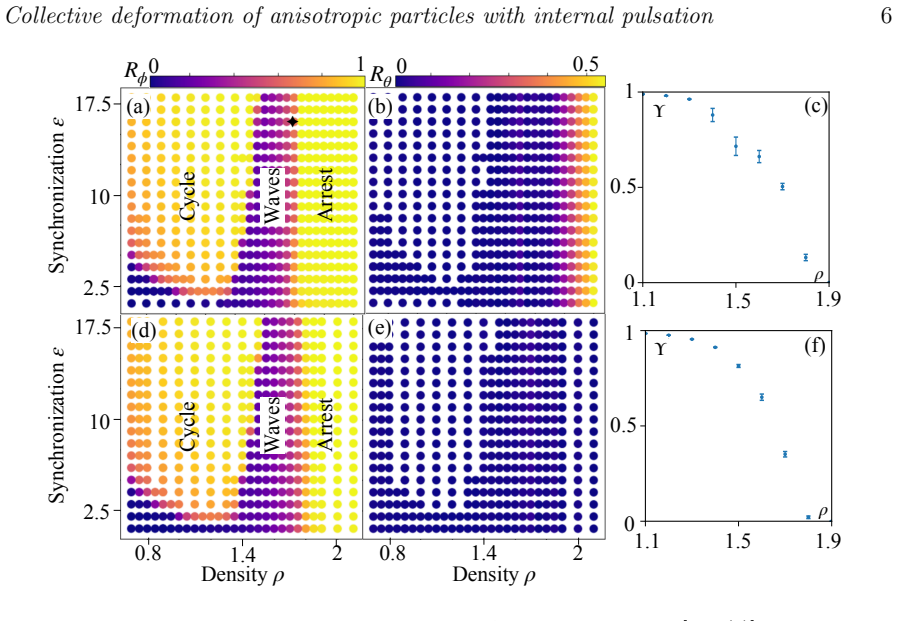
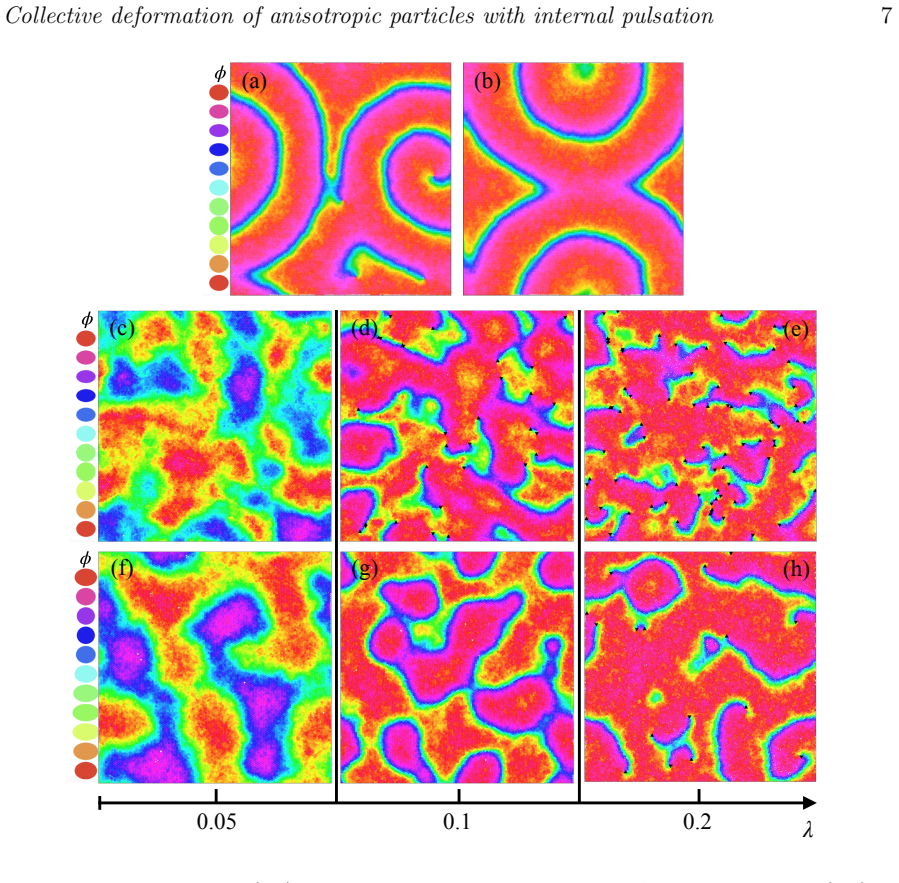
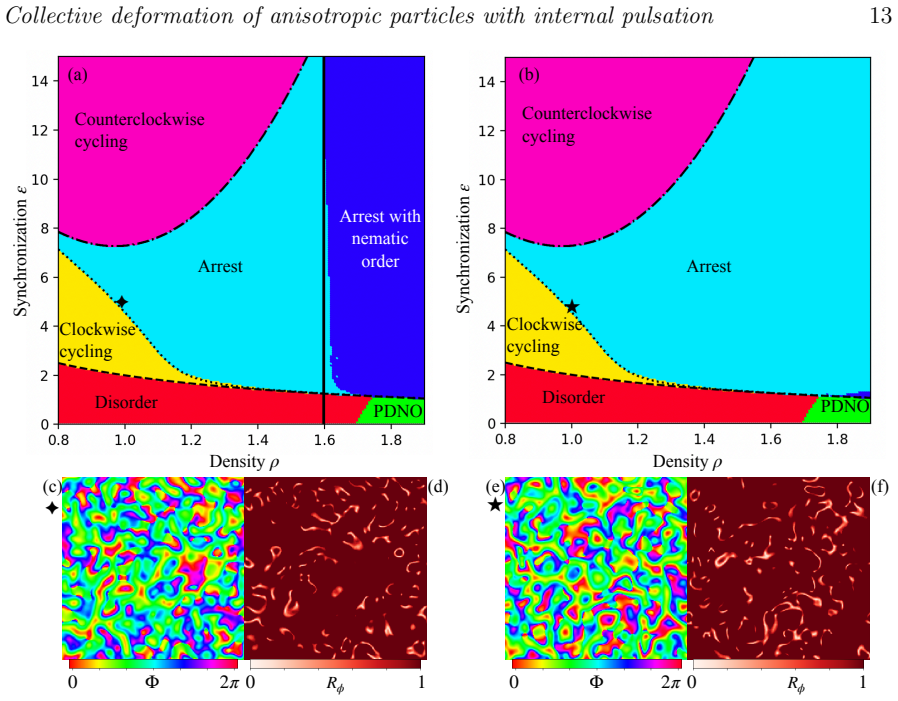
Capturing the emergence of deformation waves in contractile living tissues is a challenge that has recently been tackled with models of actively deformable particles. Inspired by the anisotropic deformation of cardiomyocytes in cardiac tissues, we examine how the pulsation of elliptical particles affects their collective properties in dense assemblies. We introduce two types of deformation where the eccentricity of each particle is subject to a periodic drive, and examine the interplay between nematic order and synchronized deformation via a systematic phase diagram. We derive a hydrodynamic description through a coarse-graining procedure, and show that it qualitatively captures the main collective states of the microscopic dynamics. Overall, our model provides key insights into how an active anisotropic deformation yields waves that self-organize into various dynamical patterns.
Editorial analysis
A structured set of objections, weighed in public.
Referee Report
Summary. The manuscript introduces a model of elliptical particles whose eccentricity undergoes periodic pulsation in two distinct deformation modes. It studies the resulting collective dynamics in dense assemblies, constructs a phase diagram for the interplay between nematic order and deformation synchronization, derives hydrodynamic equations from a coarse-graining procedure, and reports that the hydrodynamic description qualitatively reproduces the main collective states seen in the microscopic dynamics, with relevance to deformation waves in contractile tissues.
Significance. If the coarse-graining derivation is internally consistent and the hydrodynamic equations capture the microscopic states without circular parameter fitting, the work would supply a useful continuum framework for active anisotropic systems and could inform models of cardiac tissue mechanics. The systematic exploration of phase space is a constructive element, but the validity of the reported patterns rests on the independence of the prescribed deformation drive.
major comments (1)
- [Abstract and phase-diagram section] Abstract (paragraph describing the two types of deformation) and phase-diagram section: the central claim that the coarse-grained hydrodynamic equations qualitatively capture the microscopic collective states hinges on treating each particle's eccentricity as an externally prescribed periodic function whose phase can be varied independently relative to the nematic director. In a dense assembly this modeling choice decouples the drive from both area (volume) conservation per particle and from steric/hydrodynamic interactions that would correlate neighboring phases. If these couplings are present, the nematic-deformation coupling terms change and the reported phase diagram and wave patterns may not survive. The manuscript must either justify the independence assumption with explicit checks or incorporate the missing constraints into the microscopic model and re-derive the hydrodynamics.
minor comments (1)
- The abstract states that the hydrodynamic description 'qualitatively captures' the states but does not specify which observables (e.g., wave speed, synchronization order parameter, or defect density) were compared; a table or figure quantifying the level of agreement would strengthen the claim.
Simulated Author's Rebuttal
We thank the referee for their constructive comments. We address the major concern regarding the prescribed deformation drive below.
read point-by-point responses
-
Referee: [Abstract and phase-diagram section] Abstract (paragraph describing the two types of deformation) and phase-diagram section: the central claim that the coarse-grained hydrodynamic equations qualitatively capture the microscopic collective states hinges on treating each particle's eccentricity as an externally prescribed periodic function whose phase can be varied independently relative to the nematic director. In a dense assembly this modeling choice decouples the drive from both area (volume) conservation per particle and from steric/hydrodynamic interactions that would correlate neighboring phases. If these couplings are present, the nematic-deformation coupling terms change and the reported phase diagram and wave patterns may not survive. The manuscript must either justify the independence assumption with explicit checks or incorporate the missing constraints into the microscopic mode
Authors: The referee correctly notes that the eccentricity is an externally prescribed periodic function whose phase is set independently of particle interactions. This is an intentional modeling choice in our minimal phenomenological model, intended to capture the internally driven, active pulsation of anisotropic cells (e.g., cardiomyocytes regulated by biochemical signals) while isolating the effects of anisotropic deformation on collective dynamics. The synchronization of deformation phases and the resulting wave patterns emerge dynamically from the nematic ordering and interparticle forces in the simulations, even with fixed drive frequency. We agree that a fully coupled model including area conservation and interaction-induced phase correlations would alter the coupling terms; however, our approach enables a systematic phase diagram and a consistent coarse-graining procedure. In the revised manuscript we will expand the model description and add a dedicated paragraph justifying the independence assumption with references to biological literature on autonomous cell contraction cycles. We will also explicitly state the limitations of the prescribed-drive approximation and its implications for the hydrodynamic equations. revision: yes
Circularity Check
No circularity: hydrodynamic derivation is independent of microscopic data
full rationale
The paper performs a standard coarse-graining from an explicit microscopic model of pulsating elliptical particles to a hydrodynamic description, then compares the two. No equations or sections are quoted that reduce a claimed prediction to a fitted parameter, a self-definition, or a load-bearing self-citation. The central claim (qualitative capture of collective states) rests on the coarse-graining procedure itself rather than on any input that is redefined as output. The modeling choice of independent eccentricity drives is an assumption, not a circular step. This is the normal non-circular outcome for a derivation that remains self-contained against its own microscopic benchmark.
Axiom & Free-Parameter Ledger
Reference graph
Works this paper leans on
-
[1]
Marchetti M C, Joanny J F, Ramaswamy S, Liverpool T B, Prost J, Rao M and Simha R A 2013 Rev. Mod. Phys.851143
2013
-
[2]
Fodor E and Marchetti M C 2018Phys. A: Stat. Mech. Appl504106
-
[3]
Helbing D, Farkas I and Vicsek T 2000Nature407487
-
[4]
Gu F, Guiselin B, Bain N, Zuriguel I and Bartolo D 2025Nature638112–119
-
[5]
Leonardo R D, Angelani L, Dell’Arciprete D, Ruocco G, Iebba V, Schippa S, Conte M P, Mecarini F, Angelis F D and Fabrizio E D 2010Proc. Natl. Acad. Sci. U.S.A.1079541–9545
-
[6]
Commun.44190
Dell’Arciprete D, Blow M L and Brown A T 2018Nat. Commun.44190
-
[7]
Aranson I S 2022Rep. Prog. Phys.85076601
-
[8]
Bi D, X Yang M C M and Manning M L 2016Phys. Rev. X6021011
-
[9]
Phys.111074
Bi D, Lopez J H, Schwarz J M and Manning M L 2015Nat. Phys.111074
-
[10]
Czajkowski M, Bi D, Manning M L and Marchetti M C 2018Soft Matter145628–5642
-
[11]
Vicsek T, Czirok A, Ben-Jacop E, Cohen I and Shochet O 1995Phys. Rev. Lett.751226
-
[12]
Toner J and Tu Y 1995Phys. Rev. Lett.754326
-
[13]
Cates M E and Tailleur J 2015Annu. Rev. Condens. Matter Phys.6219
-
[14]
Heisenberg C P and Bella¨ ıche Y 2013Cell153948
-
[15]
Myers K M and Elad D 2017WIREs Syst. Biol. Med.91388
-
[16]
Karma A 2013Annu. Rev. Condens. Matter Phys.4313
-
[17]
Christoph J, Chebbok M, Richter C, Schr¨ oder-Schetelig J, Bittihn P, Stein S, Uzelac I, Fenton F H, Hasenfuß G, Jr R F G and Luther S 2018Nature555667
-
[18]
Gray R A and Jalife J 1996Int. J. Bifurcat. Chaos6415
-
[19]
Petrolli V, Goff M L, Tadrous M, Martens K, Allier C, Mandula O, Herv´ e L, Henkes S, Sknepnek R, Boudou T, Cappello G and Balland M 2019Phys. Rev. Lett.122168101
-
[20]
Blanchard G B, Murugesu S, Adams R J, Martinez-Arias A and Gorfinkiel N 2010Development 1372743
-
[21]
Kruse K and Riveline D 2011Curr. Top. Dev. Biol.9567
-
[22]
Tjhung E and Berthier L 2017Phys. Rev. E96050601 Collective deformation of anisotropic particles with internal pulsation17
-
[23]
Tjhung E and Kawasaki T 2017Soft Matter13111
-
[24]
Brito C, Lerner E and Wyart M 2018Phys. Rev. X8031050
-
[25]
Hadjifrangiskou I, Ruske L J and Yeomans J M 2023Soft Matter196664–6670
-
[26]
Nejad M R and Yeomans J M 2025Phys. Rev. Res.7043070
-
[27]
Hadjifrangiskou I, Thampi S P and Valani R N 2025Phys. Rev. Lett.135068101
-
[28]
Manning M L 2023Phys. Rev. Lett.130130002
-
[29]
Tjhung E and Berthier L 2017Phys. Rev. E96050601(R)
-
[30]
Lett.12840003
Koyano Y, Kitahata H and Mikhailov A S 2020Europhys. Lett.12840003
-
[31]
Togashi Y 2019J. Phys. Chem. B1231481
-
[32]
Rep.139455
Parisi D R, Wiebke L E, Mandl J N and Textor J 2023Sci. Rep.139455
-
[33]
Li Z Q, Lei Q L and Ma Y Q 2025Proc. Natl. Acad. Sci. U.S.A.122e2421518122
-
[34]
Zhang Y and Fodor E 2023Phys. Rev. Lett.131238302
-
[35]
Phys.26023017
hua Liu W, jing Zhu W and quan Ai B 2024New J. Phys.26023017
-
[36]
Pi˜ neros W D and Fodor E 2025Phys. Rev. Lett.134038301
- [37]
- [38]
-
[39]
Phys.865
G¨ oth N and Dzubiella J 2025Commun. Phys.865
-
[40]
Zhu W j, Jiang X k, Li J j and Ai B q 2025Phys. Rev. E111044123
-
[41]
Li X l and Zhu W j 2025Phys. Rev. E112064407
-
[42]
Chiou K K, Rocks J W, Chen C Y, Cho S, Merkus K E, Rajaratnam A, Robison P, Tewari M, Vogel K, Majkut S F, Prosser B L, Discher D E and Liu A J 2016Proc. Natl. Acad. Sci. USA 1138939–8944
-
[43]
Ishihara S, Marcq P and Sugimura K 2017Phys. Rev. E96022418
-
[44]
Oyama N, Kawasaki T, Mizuno H and Ikeda A 2019Phys. Rev. Res.1032038(R)
-
[45]
Biol.181–21
Staddon M F, Munro E M and Banerjee S 2022PLoS Comput. Biol.181–21
-
[46]
Boocock D, Hirashima T and Hannezo E 2023PRX Life1013001
-
[47]
Phys.7167
P´ erez-Verdugo F, Banks S and Banerjee S 2024Commun. Phys.7167
- [48]
- [49]
-
[50]
Phys.12472
I Nitsan S D, Lewis Y E, Cohen S and Tzlil S 2016Nat. Phys.12472
-
[51]
De Gennes P G and Prost J 1993The physics of liquid crystals(Oxford university press)
-
[52]
Commun.93246
Doostmohammadi A, Ign´ es-Mullol J, Yeomans J M and Sagu´ es F 2018Nat. Commun.93246
-
[53]
Gay J G and Berne B J 1981J. Chem. Phys.743316
-
[54]
Cleaver D J, Care C M, Allen M P and Neal M P 1996Phys. Rev. E54559
-
[55]
Manacorda A and Fodor E 2025Phys. Rev. E111L053401
-
[56]
Dean D S 1996J. Phys. A: Math. Gen.29
-
[57]
Bertin E, Droz M and Gr´ egoire G 2009J. Phys. A: Math. Theor.42445001
-
[58]
Horn R and Johnson C 1990Matrix Analysis(CUP)
-
[59]
Stewart G W and Sun J G 1990Matrix Perturbation Theory(AP)
discussion (0)
Sign in with ORCID, Apple, or X to comment. Anyone can read and Pith papers without signing in.